I’m continuing to dig up ancient MIDI compositions (now converted to glorious, lossless WAV files) from twenty years ago (give or take). This weekend I’m sharing some digital saxophone compositions with readers.
I probably intended these pieces to be played by an actual saxophone quartet/quintet/sextet at some point. I played in a saxophone quintet in high school (two altos, two tenors, one bari) and a saxophone sextet in college (I can’t recall the exact instrumentation, but I think it had soprano, two altos, two tenors, and one bari), so I did quite a bit of arranging and composing for those groups. I also arranged a ton for Brass to the Future, the brass quintet (with saxophone) that my brother and I played in for a number of years in the early 2010s.
Now they exist as ghostly digital instruments, honking and squawking through the musical musings of a plump young Portly with a head full of dreams and a belly full of Cheez-Its.
“Saxophonic Organ”
I’m not sure what the original title for this piece was meant to be, but I do remember wanting to emulate the sound and rhythms of a 1970s classic rock organ in the context of a saxophone ensemble. “Saxophonic Organ” is the result of that experimentation, and I rather like it.
Last week I submitted subscribers to Säx, a collection of saxophone quartet pieces I wrote and recorded way back in 2004 in a buddy’s attic studio. In digging around in the vast depths of my backup hard drive, I found quite a few compositions I believed were lost to time (and/or to a 32-bit operating system; my ancient version of Cakewalk 3.0 won’t run on modern, 64-bit operating systems).
Eventually, I’m going to re-release Säx and release these MIDI-based compositions on Bandcamp and on streaming platforms. I managed to convert the MIDI files to lossless WAVs, and I am doctoring some of them up using Audacity. Säx will be released in its original form—what paid subscribers could hear in full last week.
For now, I wanted to share some of the tracks from what will be the MIDI release, as well as a recording of one of the pieces I did on a tiny Yamaha keyboard my family has had since I was a small child (and I still have it—I think it works, too). Paid subs will have access to some other pieces over on SubscribeStar.
The first piece here is “Euroclydon,” named after the Mediterranean storm from the Book of Acts. I remember learning the name from a sermon at my parents’ church years ago, and I am guessing I composed the bulk of “Euroclydon” around 2012:
“Euroclydon”
The next piece is “Aachen Cathedral Chorale.” I used this chord progression and melody in a number of pieces, including my organ solo “Organic Evolution.” I’m sure it’s from some famous Baroque composer, but back in the day, it was one of my favorite themes to incorporate into music.
This version consists of three MIDI files I converted to WAVs and then aligned in Audacity. I also added some additional reverb and chorus effects. Essentially, I had the same theme composed for organ, strings, and saxophones, and then mashed them together into this glorious wall of sound:
“Aachen Cathedral Chorale”
This version of “Aachen” was played using the Yamaha keyboard and splicing/aligning all of the parts together. As I recall, I plugged the keyboard into my older brother’s ancient Crate amplifier, then dangled a primitive computer microphone in front of it and recorded either to Adobe Audition 1.5 or Windows Recorder (the latter would have been a nightmare to line up properly, so I’m thinking it’s the former). I am playing all of the parts on this one:
“Live at the Aachen Cathedral”
It’s wild to think that I wrote some of these pieces as early 2004 or so. I found stuff that I likely composed in high school, which would place the absolute earliest possible compositions at 1999. I was using Cakewalk 3.0 in the eighth grade, so I have some material that would date back to 1998—whoa!
One day I’ll finally figure out how to setup a Windows 95 virtual machine on my desktop so I can run Cakewalk 3.0 natively, but I’ve never had much success doing that.
Regardless, let’s see what else a young Portly cooked up back in the day.
I’m a tad late posting today because I was up quite late last night digging through some old computer files. I’ve been cleaning out my Drawer of Forgotten Technology, and stumbled upon my old SanDisk Sansa c250 MP3 player (which I am currently selling on eBay, if anyone wants it). The battery doesn’t hold a charge, but it will play when connected to power directly via its USB cable connected to any charging block that accepts USB. Even more intriguing is that it will interface with a PC when that same cable is connected to a USB port.
I uncovered a treasure-trove of music, basically the stuff I listened to in college and graduate school. Among the random bits of novelty music and 80s hair metal I found a track from long-forgotten musical project, Säx.
Säx was my first attempt at recording anything solo. I’d composed a number of saxophone quartet compositions specifically for me to record them. Each piece consisted of two alto sax and two tenor sax parts, and ran the gamut from blues to gospel to rock to circus music—pretty much anything I could think of to demonstrate my composing skills.
I recorded Säx in 2004 at a friend’s house. He was learning audio engineering at the time (and I believe he now does it for a living), so he was willing to record me and mix my tracks for free so he could get the experience. We were both 19 at the time, and home from our first year of college, and it was a period in my life when everything seemed possible.
To put things into perspective, this pre-dated YouTube, Spotify, Apple Music, etc. Getting music out there still pretty much meant burning CDs on your computer, then distributing those in jewel cases with homemade art to your friends and family. You could get them done professionally, but as possible as everything seemed at 19, yours portly didn’t have the money to make everything possible.
Säx was fun, though. I remember my buddy and I in his little attic space, which he had refurbished into a tiny recording studio, figuring out how to get the click tracks at the right tempo. There was one piece, an Irish jig in 6/8 time, that I just could not get down, so we axed it entirely (I love 6/8, but back then, I struggled with figuring out whether to set the metronome to duple or sextuple, something that seems laughably embarrassing to me now).
These recordings are not great, with the exception of “Middle Class White Kid Blues,” which actually came out pretty nicely:
The other recordings are a pretty good example of my composing chops at the time (which, I think, were not that bad; I can definitely hear my influences in these pieces, and composing elements I still use to this day, nearly twenty years later). My playing is often sloppy, with lots of intonation and pitching issues. Some of the examples are really bad—I end one of the pieces on what should be a beautiful chord, but it’s nasty thanks to bad tuning and intonation. But it’s still fun—albeit a bit cringe-inducing—to go back and listen to these pieces.
I’ll be re-releasing Säx at some point on Bandcamp and, ultimately, various streaming platforms, just for the completionists out there who want to hear everything I have ever recorded (I also uncovered some other synthesizer pieces I played and recorded in college under two project names, “Blasphemy’s Belt” and “Fat Guy in Boxer Shorts”; I’ll be releasing those pieces at a future date, too).
For now, my faithful paying subscribers are going to have access to all seven Säx tracks in existence—whether you like it or not! Enjoy this glimpse into some of my earliest recordings.
Tim Dillon’s favorite generation—the only generation to “grow older but not wiser“—seems permanent. The ubiquity of Boomerdom in all aspects of American life for over seventy years gives the demographic cohort the veneer of eternity, a massive, limitless generation that will never die—and never stop working.
Dr. Fiancée and I are both the children of Boomers, and our parents very much represent the good Boomer traits of hard work, diligence, self-restraint, etc. They possess some of the more benign aspects of Boomerism, like a love of buying random trinkets at Target, but they aren’t mired in the soulless consumerism that infested so much of their generation. In other words, “Not All Boomers Are Like That.”
But, goodness, a lot of them are like that: temperamental with service professionals (doctors, waiters, administrative assistants, airline attendants, and anyone else who provides some kind of service); pennywise-and-pound-foolish; extravagant in their self-indulgence, but miserly in the extreme; gluttonous for public services, without any regard to the social contract; and (I strongly suspect) fearful of death.
They also absolutely refuse to leave the workforce, while simultaneously refusing to adapt to new economic realities. I’ve read that Millennials (my generation, which is not exactly rose-scented, either) are aspiring Boomers, which is true: we’ve spent most of our disjointed careers trying to appease the vagaries of Boomer corporate leadership in the oft-vain attempt to build decent lives for ourselves. We grew up suckling at the teat of Boomer largesse, only to have the bottle stripped away in early adulthood; many of us (and I would partially include myself in this analysis) have been striving to get back to the relative ease and luxury of our childhoods ever since.
Granted, I know how the Boomers will respond, because I have written on this topic before. I get it; it’s not nice or even fair to have your entire generation called out (believe me, as a Millennial, I know: apparently, all of our problems stem from wanting to put avocado on our toast, not the fact that we started our careers during the Great Recession and have endured repeated economic downturns). But before you go post a rant on Facebook about how “entitled” my generation is (a bit rich, but the Boomers aren’t exactly known for their introspection), let me say something positive:
The funny thing is that my brother and I did not realize they were screening the film until we arrived at the venue; we thought it was just going to be music from the movie, not music with the movie. My brother was skeptical until we went to our seats, and saw a massive screen suspended above the orchestra:
The venue itself was pretty cool; it is an historic theatre located on Indianapolis’s famous Monument Circle:
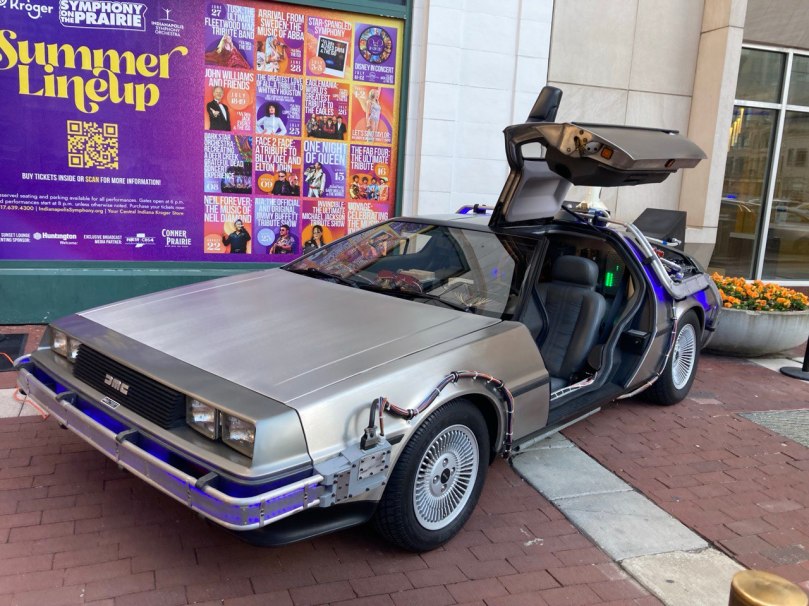
They also had a classic DeLorean parked out front:
I typically drive up to Indianapolis once a year to see my older brother, but this trip required me to fly up and back in the span of about thirty-six hours. I was really impressed with how smoothly American Airlines made the whole process.
I have not always had the best experiences flying, but this trip the airline did not seem to treat me like cattle to be abused and mistreated. It’s also amazing how easy it is to fly when you can just toss everything into a bookbag.
My students had their big Spring Concert back on Friday, 4 April 2025, at 6 PM EST. The Spring Concert is the major performance event of the Spring Semester, and represents the culminations of months of practice. Some of the songs on the programs the kids have worked on since August 2024. Some we added in the two or three weeks before the concert. Either way, it takes a tremendous amount of work and practice to get polished for the concert.
This year my school revived our annual Fine Arts Festival. Essentially, all that means is that we have the school musical and the Spring Concert in the same week, and the visual arts students display their artwork in the gym (which doubles as our auditorium). It makes sense from a marketing standpoint, but it does make my life a bit more difficult, as I have minimal time to turn around from the school play to get setup for the concert. As soon as the play wrapped that Thursday evening, I began resetting the stage for the concert.
Yours portly is still recuperating physically and mentally from the toll of the Fine Arts Festival, but I’ll be fine. What of the concert itself?
Well, it was, perhaps, the best in school history.
I’m frantically (actually, rather calmly) putting together what will become Leftovers IV, another short EP that I’ll release the Monday after Easter. I haven’t gotten much done, but the idea of the Leftovers releases is that they consist of random dribs and drabs of composing that never quite make it to a full release. That said, I sometimes compose pieces specifically for those releases.
That’s the case with one of the pieces featured today, “French Cuisine.” The other, “Seesaw,” is more typical of the kind of “I-don’t-know-where-to-put-this-piece” model for Leftovers releases.
Pickup my newest release: The Galactic Menagerie! Use promo code obesekangaroos to take an additional 20% off all purchases on Bandcamp! Code expires at 11:59 PM UTC on Friday, 4 April 2025.
Want to play the sax? Read my ultimate guide to getting started for under $350.
Wanna be utterly perplexed while laughing uproariously? Grab a copy of my first book, The One-Minute Mysteries of Inspector Gerard: The Ultimate Flatfoot (that’s an Amazon Affiliate link, so I’ll receive a portion of any purchase made through that link, at no additional cost to you—plus I’ll get the book royalties).
I’ve been engaged in quite a few cultural endeavors lately, and this week my students have their big Spring Concert. So I thought I’d look back at some culture posts from this past week:
Pickup my newest release: The Galactic Menagerie! Use promo code obesekangaroos to take an additional 20% off all purchases on Bandcamp! Code expires at 11:59 PM UTC on Friday, 4 April 2025.
Want to play the sax? Read my ultimate guide to getting started for under $350.
Last Saturday, 22 March 2025, I drove up to Hampstead, North Carolina to play a rare GigSalad booking. GigSalad is a website that connects performers of all types with those seeking their services, and GigSalad takes it’s cut (5% for free members, 2.5% for pro members). In the years that I have been using the service—admittedly, only intermittently—I’ve only booked two gigs through it. That’s not huge volume, but I look at it this way: those two gigs are money and experience I never would have had otherwise.
GigSalad users on the talent-buying end, in my experience, are not typically savvy to the unwritten rules and customs of booking talent. That’s not a problem—most people are not—and GigSalad is meant to smooth over that interaction, acting as a middleman to the exchange to protect both the talent and the buyer. But the service is rife with people looking for three-hour engagements with a budget of $100 or the like. In other words, the clientele tend to be a bit low-rent.
Yours portly isn’t exactly some high-class musician, but I know what my time and talent are worth, and I charge accordingly. My standard performance rate now is, depending on the client, $300 per performance hour. Note that, if someone books me to play one hour, there is about three hours of total commitment when factoring in travel, setup, teardown, etc. It’s more time if I have to travel a long distance. I also almost always play more than booked—I start playing before my official start time (if appropriate) and will often play beyond the official end time (again, if/when appropriate).
By “depending on the client,” I mean it depends on the type of client and the gig. Individuals are different than, say, large institutions. A large local hospital system in my area hires me for a couple of gigs a year; they have the budget to pay me $300 (and probably more) to play piano or noodle on the sax as background music for an hour. A local who needs sax for, say, background music for a small event might not get that same charge. But if it’s a wedding, the $300 rate applies.
That kind of conditional pricing my shock some buyers, but it’s just the way of things. Institutional buyers want to pay more (within reason), because if the price is too low, they begin to suspect the quality of the product. They’re also usually dealing with big entertainment budgets that need to be spent. Of course, we all know that anything related to weddings has a built-in markup.
But I digress. The issue is not the earnest local in need of some ambience or the large institution looking for the same. It’s usually the earnest local or out-of-towner who thinks it is reasonable to pay a musician $100 for providing hours of music.
Fortunately, that was not the situation last Saturday. I was booked to play sax for a small dinner party with a vaguely French theme. The talent buyer was extremely communicative and savvy, and after a few days of waiting for institutional approval (the event was attached to a large life insurance company), the deal was struck. Their upward budget was $300 for two hours of music, but I took it because a.) I needed the money and b.) I want to build up my reputation on GigSalad a bit. Also, c.) I missed playing out on the road.
I’m glad I took the slight price cut (again, these prices are not hard and fast); it was a very enjoyable evening, and that $300 booking will doubtlessly result in hundreds of more dollars going forward.
Pickup my newest release: The Galactic Menagerie! Use promo code obesekangaroos to take an additional 20% off all purchases on Bandcamp! Code expires at 11:59 PM UTC on Friday, 4 April 2025.
Want to play the sax? Read my ultimate guide to getting started for under $350.
With Saint Patrick’s Day earlier this week, I decided to compose a little piece to commemorate the holiday. Due to some pressing work, it took me a few days to finish it, but it’s a jaunty little piece.
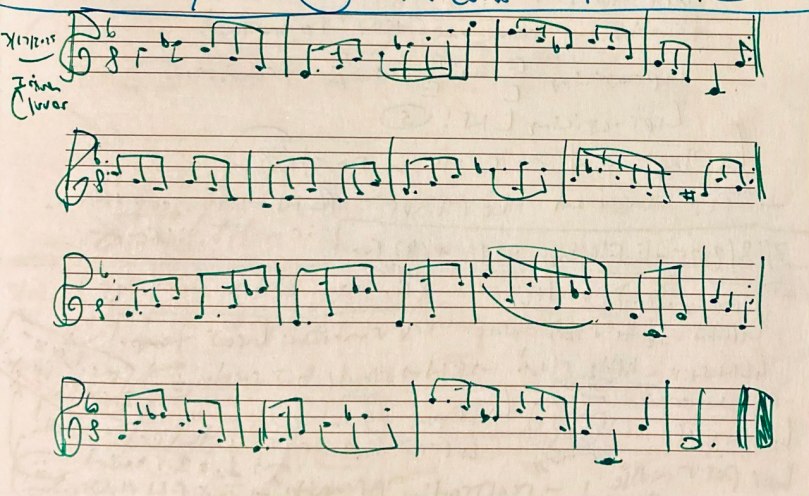
Here’s the manuscript of the piece, which I jotted down on Saint Patrick’s Day (17 March 2025):
“Irish Clover” is written for piccolo, flute, classical guitar, and harp. I have no idea if I composed the harp part correctly (in other words, if it is actually playable on a harp), but it sounds good! That’s the beauty of electronic music: you can do whatever you want!
That said, I always try to make the pieces realistically playable. I love the idea that someday, someone somewhere will put together a little ensemble and play some of my pieces.
Regardless, today I’m sharing the WAV recording of the piece, as well as a little video, for subscribers. Don’t worry, non-subs: you’ll get to hear the piece soon!












 The Portly Politico