

Yours portly has finally had some time to watch some movies again, and it really went from famine to feast. I’ve watched several solid flicks lately, including this week’s selection, the French-Canadian psychological thriller Red Rooms (2023).

Yours portly has finally had some time to watch some movies again, and it really went from famine to feast. I’ve watched several solid flicks lately, including this week’s selection, the French-Canadian psychological thriller Red Rooms (2023).

Today’s post is a SubscribeStar Saturday exclusive. To read the full post, subscribe to my SubscribeStar page for $1 a month or more. For a full rundown of everything your subscription gets, click here.
Amid a flurry of big news this week—which seems to be the norm now that Trump is back in office—one of the major stories was the president of Colombia backing down once Trump slapped some tariffs on his country for refusing to accept deportation flights from the United States. That the Colombian government didn’t even want their own people back tells you everything you need to know about the quality of these immigrants.
But I digress. Trump is wielding tariffs like a serious foreign policy weapon, which works exceptionally well when you’re the most powerful and productive economy on the Earth. Yes, the United States has struggled economically in recent years, but we’re still on top. Tariffs will only help with that goal, by bringing back manufacturing; ending America’s reliance on the financialization of everything as the driver of our economic growth; and forcing recalcitrant nations to play ball.
It is remarkable that we are returning, after the long fever trade of unbridled free trade—even at our own expense—to the age of William McKinley, a president that is often forgotten, but who has enjoyed renewed cache in recent years. President Trump explicitly mentioned McKinley in his Inaugural Address, and the former president’s legacy is experiencing a renaissance of sorts.
Today (Saturday, 1 February 2025), Canada, Mexico, and China will face new tariffs on their goods. Each of these nations have exploited America’s good will by flooding our nation with illegal fentanyl and immigrants. It is about dang time.
To read the rest of this post, subscribe to my SubscribeStar page for $1 a month or more.

America’s golden age has begun, and it’s already off to an amazing start: deportations, sanity on gender, firings—even snow in South Carolina! It’s an exciting, dynamic time to be alive.
Happy Sunday!
—TPP
Other Lazy Sunday Installments:

Today’s post is a SubscribeStar Saturday exclusive. To read the full post, subscribe to my SubscribeStar page for $1 a month or more. For a full rundown of everything your subscription gets, click here.
Americans are not accustomed to monarchy, nor should we be; we’re not a land built for hereditary rule the way Europe is. We might be the children of great monarchies, but we are republicans (with a lower-case “r”) at heart.
That said, it’s been extremely gratifying to see a Republican (with a capital “R”) flinging pens and issuing executive decrees with bold resoluteness. Donald Trump has accomplished more of the conservative agenda in a workweek than the vast conservative apparatus has achieved in fifty years.
Granted, executive orders are fragile, as they should be. They’re only as endurable for as long as the issuing president and/or his like-minded successors can maintain them, or get a recalcitrant Congress to pass an actual law (fat chance).
There are also limits to what they can do. Executive orders are not royal decrees—as much I’d like for them to be while my guy is in office—but they do have the force of law. Essentially, executive orders are instructions to the federal bureaucracy on how it is to enforce the laws Congress has passed.
The problem is that as Congress has delegated more authority to the executive branch’s bureaucracy, the more power those executive orders contain. Most presidents have largely left their bureaucracies to run themselves, in part because those bureaucracies are so elaborate, no single man can understand—or control—them. That lack of control became scarily apparent during the Obama years, and continued to hound President Trump during his first time.
President Obama wielded executive orders like a tyrant, due in part to his famously poor relationship with Congress—even when Democrats controlled it! Joe Biden—or, more likely, Joe Biden’s many handlers and puppeteers—used executive orders to weaponize the federal bureaucracy, entrenching all manner of Leftist pipe dreams into the functioning of the government and the execution of its laws.
President Trump has undone most of Biden’s legacy with the stroke of a pen. Even realizing that the real challenges of passing substantive legislation through Congress rests on the horizon, it is incredibly exciting and energizing to see President Trump fulfill one promise after the next, including enacting policies that are guaranteed to scare off huge chunks of the bloated, entitled, infantilized federal workforce, what I call the “professional useless people.”
To read the rest of this post, subscribe to my SubscribeStar page for $1 a month or more.

We’re just five days away from President/President-Elect Trump’s inauguration, and I’m as giddy as a schoolboy at the candy shop. There is much to be excited about in a second Trump administration, but lately I’ve been whooping like a silver-backed gorilla (at the candy shop, presumably) over the prospect of purchasing Greenland from Denmark—and taking back the Panama Canal.
The coverage of President-Elect Trump’s desire to take Greenland features a mix of bemusement and alarm, which is pretty on-brand for Trump’s pronouncements. There is a lot of chest-thumping from the European Union and the Danes, who both vow that the United States will never have Greenland. President Trump, for his part, seems to be having fun trolling the stuffed shirts in Europe and the hostile American press, especially with his talk of annexing Canada (which is trolling; I think Trump is just having fun at Justin Trudeau’s expense).
What I like about all this annexation talk is that it hearkens back to the presidency of James K. Polk. It was under Polk that the United States expanded to (mostly) its present borders, at least in the contiguous, lower forty-eight States. Polk similarly struck an aggressively expansionist tone, proclaiming “Fifty-Four Forty or Fight” in reference to the upper border of the Oregon Territory.
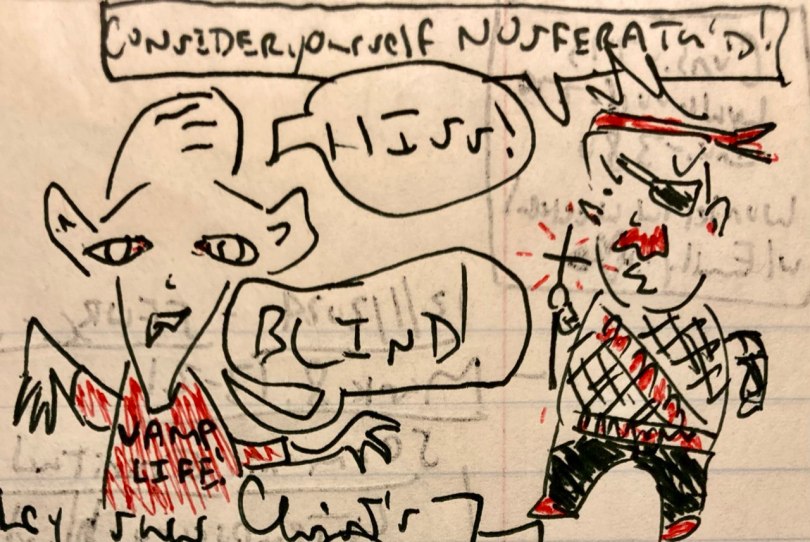
My older brother and I saw Nosferatu (2024) a couple of days after its release, which was on Christmas Day 2024. We attended a 12:30 PM EST showing on Friday, 27 December 2024, and even that early matinee had a very good crowd.
My brother and I had been anticipating the release of this film with an eagerness we rarely experience for movies anymore. I love movies, but there aren’t many films that get me excited to go see them.
Nosferatu promised “a symphony of horror,” according to its tagline (and the subtitle of the 1924 original), and it delivered—in spades.

It’s been several years now since I last taught the fun but short-lived Pre-AP Music Appreciation course that spawned some of these pieces highlighting classical and Romantic musical works, but I still love the musical selections dearly. Bedřich Smetana’s The Moldau still captures my imagination, and I still have not composed anything that comes remotely close to its beauty and genius.
Nevertheless, I routinely cite Smetana as an influence, especially when uploading my pieces to CD Baby for digital distribution. He almost always gets a mention in the “artists like” categories I fill out for each release. Hopefully he’s not spinning in his grave at the thought of that.
With that, here is 11 January 2024’s “TBT^2: The Joy of Romantic Music II: Bedřich Smetana’s ‘The Moldau'”:
Last year I wrote about the Puppet Master series, the brainchild of indie filmmaker Charles Band. Band’s Full Moon Entertainment for years produced schlocky, low-budget, but entertaining films that heavily featured miniatures and stop-motion animation. Like many small filmmakers, Band’s company kept budgets low by reusing models and footage in different films, often creating scripts (a la Roger Corman) to fit the props and sets already on-hand.
The guys over at RedLetterMedia did two long episodes on the Puppet Master franchise, and got into some of the details of Band’s approach to filmmaking in those videos:
They did a third video that continued to look at Band’s use of stop-motion techniques and puppetry:
If you’re not enticed at the thought of watching three lengthy videos to understand Band’s films, no worries; suffice it to say that Band was never one to let good (or bad) footage go to waste.
So come—at last!—to today’s film, the first review of 2025: The Primevals (2024).

Way back in 2019 I wrote a post entitled “Napoleonic Christmas“; it took off thanks to being featured on a conservative news aggregator that, at the time, was presenting itself as an alternative to The Drudge Report, which inexplicably but notably turned hard to the Left after the 2016 election, in which it played an important role in getting GEOTUS Donaldus Magnus elected.
Napoleon has always fascinated me. Indeed, I wrote an entire tone poem about the enigmatic figure:
I don’t think Napoleon was a good guy, but he was great, in the sense that he was—much like Trump—sui generis, a man unto himself, and a man for the historical moment in which he found himself.
At Christmas, however, the Greatest Man Is a little Baby in a manger. The Son of God Humbled Himself to become like us. No Napoleon or Trump (the latter of which I like very much, and who I believe has God’s Hand of Protection over him) could ever do that—or would.
With that, here is 28 December 2023’s “TBT: Napoleonic Christmas“:
Yours portly has had another busy weekend, one full of Christmas cheer. It was very nice to spend time with family and Dr. Girlfriend. Naturally, the blog and the Advent Calendar have fallen by the wayside a bit, but I’ll be getting caught up with both. It’s Exam Week this week, so I have the most free time I’ve had since summer break, so my hope is to work ahead on the blog enough that I don’t need to touch it much until 2025.
Last night Dr. Girlfriend I started watching the 1984 film adaptation of A Christmas Carol starring George C. Scott as Ebenezer Scrooge. We didn’t get to finish, but it’s remarkable to me how well done this version is. It brought to mind the 1951 version, which is an exquisite adaptation in its own right; indeed, it might be the definitive version.
So it is that I thought I’d cast a glance back to my own review of that version from 19 December 2022.
With that, here is “Monday Morning Movie Review: A Very Portly Christmas: A Christmas Carol (1951)“:
 The Portly Politico