TBT: Napoleonic Christmas

Somehow, I’d never reblogged this classic TPP post until this summer, when I did a retrospective look back at TPP’s Greatest Hits; “Napoleonic Christmas” came in as “Track III” on that list.  This post got picked up by a conservative news aggregator back in 2019, which caused its views to skyrocket.

I have always possessed a certain fascination with France and the French, and Napoleon is easily the most fascinating Frenchman of all.  That’s somewhat ironic considering he was a Corsican, from an island that belonged to an Italian city-state until said city-state needed to settle some debts with France and handed over the island in lieu of payment.  The Bonaparte family was from a line of minor Italian nobility, and were fiercely in favor of Corsican independence.

Funny how that works:  an Italian from a nationalistic Corsican family became the greatest political and military figure in modern French history.  We can never know what might become of a life.

As I’ve learned more about Napoleon, I disagree more with Andrew Roberts’s assessment of Napoleon in the linked video.  While Napoleon may have been responding to declarations of war by going on the offensive, he also had clear designs to stretch his influence all the way to India.  Indeed, he sought to emulate his hero, Alexander the Great.  The French also mercilessly plundered the cultural and artistic heritage of Italy in the process.

Regardless, Napoleon is a fascinating and complicated figure, and if he doesn’t earn our admiration, he certainly earned our grudging respect.

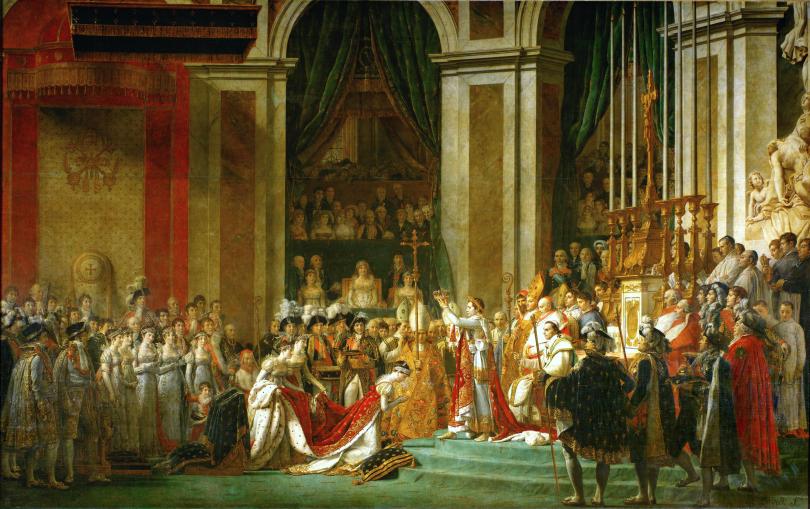
With that, here is 23 December 2019’s “Napoleonic Christmas“:

Read More »

Monday Morning Movie Review: Napoleon (2023)

Hollywood is in a weird place right now.  All of the major franchises and studios are bombing at the theaters.  The Marvel Cinematic Universe used to be a money-printing machine; now, it’s dropping like Iron Man in Avengers: Endgame (2019).  Disney is sinking faster than The Little Mermaid‘s hometown.  Star Wars is exploding as if a couple of proton torpedoes hit its reactor core.

At the same time, there have been some major prestige films that have done well with critics and audiences alike.  Oppenheimer (2023) became a cultural phenomenon due to its release alongside Barbie (2023).  Martin Scorsese’s Killers of the Flower Moon (2023) is earning accolades.

Now there’s another nearly-three-hour-long flick charging cinemas, and it’s quite good:  Ridley Scott’s Napoleon (2023).

Read More »

SubscribeStar Saturday: Acceptance

Today’s post is a SubscribeStar Saturday exclusive.  To read the full post, subscribe to my SubscribeStar page for $1 a month or more.  For a full rundown of everything your subscription gets, click here.

Readers are likely familiar with the Kübler-Ross model of the five stages of grief.  It’s one of those psychological models that has percolated into the popular culture.  As is often the case, The Simpsons illustrates it better than I can:

When it comes to the future of our nation, I’ve reached the “Acceptance” phase after many, many years in the other phases.

To read the rest of this post, subscribe to my SubscribeStar page for $1 a month or more.

Lazy Sunday CXXVI: Veterans Day Posts II

Yours portly has been run ragged lately.  It’s a bad sign when I’m unable to get Lazy Sunday posts written two weeks in a row.  We’re getting into the busy season for events at school, and setting up lighting and sound equipment with a broken ankle does not make it any easier (although I must note that I have had tons more help than usual with these tasks, and I have been blown away with the outpouring of charitable good cheer from my colleagues, administration, and fellow students).

I slept around twelve hours Friday night into Saturday morning, and apparently, it was exactly what I needed.  That doesn’t make for keeping up with a writing schedule, but it sure helped with my overall health.

But today’s post isn’t about yours portly.  It’s about remembering those who have served our nation in our armed forces.  Each year I reblog a Veterans Day post from 2018.  It might be one of the best public addresses I’ve ever given.

Here are all of the Veterans Day posts going back to 2018:

There you have it, folks.  Thanks to everyone who has served, and a huge thanks for those who have given their lives in the line of duty.  No mere blog post can do justice to the depth of your devotion.

Happy Sunday!

—TPP

Other Lazy Sunday Installments:

Solemn Saturday: Veterans’ Day 2018, Commemoration of the Great War, and Poppies

In lieu of SubscribeStar Saturday, I’m taking today to observe Veterans’ Day with the annual reposting of “Veterans’ Day 2018, Commemoration of the Great War, and Poppies.”  What follows is a transcript of remarks I gave to the county Republican Party to which I belonged at the time (I have since moved to another county, and am no longer active in any county Republican Party):

Read More »

Lazy Sunday CXVIII: Monarchy

I’ve been on a British monarchy kick the past month thanks to the excellent biographies over at The People Profiles.  So, as we enjoy the very American Labor Day weekend, let’s also look back at some recent posts about monarchy.

God Save the King—and Happy Sunday!

—TPP

Other Lazy Sunday Installments:

SubscribeStar Saturday: Behind Every Great Man

Today’s post is a SubscribeStar Saturday exclusive.  To read the full post, subscribe to my SubscribeStar page for $1 a month or more.  For a full rundown of everything your subscription gets, click here.

We’ve all heard the expression “behind every great man, there’s a great woman,” or some permutation of it (my personal favorite is Groucho Marx‘s:  “behind every successful man is a woman, behind her is his wife”).  It’s a familiar expression because it’s generally true, even if not quite as universal as the word “every” suggests.

Just as a bad woman can lead to a man’s swift downfall—or, worse yet, years of misery and then a swift downfall—a good woman can support a man through his trials, and even make him king.

Such was the case of Margaret Beaufort, who, through a combination of skill, diplomacy, wealth, and mother love, guided her son Henry through the complicated and dangerous War of the Roses to emerge as King Henry VII, the first monarch of the Tudor Dynasty.

Her bravery, tenacity, and sheer luck safeguarded her son through a lengthy exile, and ultimately to the height of power.  Her grandson, Henry VIII, would become the most powerful English monarch of his age, so much so that modern historians frequently regard him as a tyrant.

To read the rest of this post, subscribe to my SubscribeStar page for $1 a month or more.

In Defense of the British Monarchy

As a natural conservative, not merely a political one, I have always felt an affinity for the British monarchy, and never bought into the excessively utilitarian (and inherently radical) arguments that favor the abolition of the monarchy.  After weeks of listening to videos from The People Profiles about the monarchy, I am even more convinced in the necessity of the British monarchy as a cultural and political force.

To be clear, I do not advocate for monarchy of any form in the United States.  The reader might ask, “if it’s so beneficial to our British cousins, with whom we share quite a bit of history and culture, why isn’t it good for us?”  The answer is simple:  we’ve never had one!  Monarchy is something almost completely foreign to Americans, at least since 1776.  Our Founding was explicitly anti-monarchical, even if there were Americans willing to submit to a kingship under George Washington.

The British—and, more specifically, the English—however, have possessed a monarchy for over 1000 years, with the exception of that Cromwellian unpleasantness from 1648-1660, ending with the restoration of the Stuarts with Charles II.  That is a great deal of tradition, custom, and ceremony to toss out merely to save a few bucks on maintaining the Royal Family.

Read More »

SubscribeStar Saturday: The Folly of King Edward VIII

Today’s post is a SubscribeStar Saturday exclusive.  To read the full post, subscribe to my SubscribeStar page for $1 a month or more.  For a full rundown of everything your subscription gets, click here.

One of my favorite passages of Scripture is Proverbs 31:10-31, the famous passage about the qualities of a good woman.  As verse 10 reads, “Who can find a virtuous wife? For her worth is far above rubies.”  The implication is that a true “Proverbs 31 Woman” is a rare and precious thing.

Based on earlier chapters of Proverbs, which extensively detailed the dangers of a wanton floozy, it’s pretty clear that a bad woman can be quite destructive.  Proverbs 7:6-23 is an entire cautionary tale about a foolish young man who dies when a harlot stabs him after a night of passion!

Too many men (myself included) fall for the allure of a pretty face, which is probably why there are three or four chapters in Proverbs warning us off of them (and only one chapter about a good woman).

Such is the potentially corrosive effect of a loose woman that one nearly destroyed a monarchy.  The short-reigned King Edward VIII, who ruled in 1936 for barely eleven months.

The controversy over King Edward VIII’s decision to marry a twice-divorced woman (still married at the time of Edward’s abdication in December 1936), Wallis Simpson, threatened the House of Windsor, and nearly resulted in a constitutional crisis for the British Empire.

To read the rest of this post, subscribe to my SubscribeStar page for $1 a month or more.

SubscribeStar Saturday: Mostly Peaceful Politics

Today’s post is a SubscribeStar Saturday exclusive.  To read the full post, subscribe to my SubscribeStar page for $1 a month or more.  For a full rundown of everything your subscription gets, click here.

Lately I’ve been listening to a number of historical biographies from The People Profiles, an excellent YouTube channel that produces incredibly balanced, detailed biographies of historical figures.  The videos are always very well done, and the channel hosts a stable of exquisite narrators with British accents.

My absolute favorites are their biographies of English monarchs (at the time of this writing, they’ve just posted a video about King Charles II, which I am excited to listen to soon).  What strikes me about these monarchs is that, even as rulers, they dealt with constantly shifting political landscapes that would make our current politics look tame by comparison.

It wasn’t like these monarchs were sitting back and eating grapes (I mean, they probably did do that stuff); they constantly had to balance the needs of their people; their ornery nobility; and their expensive foreign policies (which typically meant “expensive foreign wars”).  Add to that rebellions, assassination attempts, succession crises, and all the rest, and it quickly makes one thankful for a relatively peaceful and predictable political order.

At the same time, there is something enviable about monarchical rule.  A bad king could cause a great deal of damage—and many bad kings did just that to England—but could also be identified easily as the source of a nation’s woes.  Dealing with a tyrannical monarch, in some ways, was far easier than dealing with a tyrannical bureaucracy.

To read the rest of this post, subscribe to my SubscribeStar page for $1 a month or more.