Monday Morning Movie Review: Mission: Impossible – Dead Reckoning Part One (2023)

In an era of declining box office receipts and regurgitated intellectual properties featuring race- and gender-swapped protagonists to appeal to “modern audiences,” it seems the only surefire way to make a smash hit is to attach Tom Cruise to the project.  Last summer’s smash blockbuster was Top Gun: Maverick (2022); one year later, it’s Mission: Impossible – Dead Reckoning Part One (2023).

Unwieldy title aside, Dead Reckoning Part One is an excellent film.  Cruise returns to portray super spy Ethan Hunt, the most resourceful asset of the mysterious Impossible Mission Force (IMF).  What makes the flick so compelling, and not just another rehash of past M:I films, is its antagonist:  a powerful Artificial Intelligence (AI) called “The Entity,” an enemy that is “everywhere… and nowhere.”

Read More »

Lazy Sunday CCXII: Ponty Week 2023

If the week of Independence Day was MAGAWeek2023, then last week was the unofficial Ponty Week 2023.  Regular contributor and right good bloke Pontiac Dream 39 (or 39 Pontiac Dream?)/Always a Kid for Today/Ponty sent in a trio of great pieces, and I decided to schedule them all for the same week.

So, in case you missed any of these excellent contributions from our favorite Englishman, here are Ponty’s posts:

That’s it for this ultra-British edition of Lazy Sunday.  Cheers!

—TPP

Other Lazy Sunday Installments:

Ponty’s Pen: The BBC’s Newfound Interest in the Gaming Industry

Video games used to be a bit of a niche—a large and popular niche, but a niche nonetheless.  Sure, our mom loved playing Dr. Mario on our old Nintendo, but that was about the extent of it.  Video games were largely for boys, who grew up into men.  Those men rebought the classics when they became available digitally, and continued to fuel the development of new games with their hard-earned dollars.

Of course, video game companies sensibly sought to expand their market share.  They developed more casual games to attract older gamers and more women.  The Nintendo Wii marked a major shift, as the kinetic style of the console made it popular among many demographics, most notably the elderly.  Nary a retirement home or assisted living facility lacked a Wii, with which geriatrics could play virtual tennis and bowling.

All of that is wonderful.  More gamers means more games, and it means broader acceptance of video games as a fun, harmless pastime (in spite of the ludicrous stories that insist on linking video games to violence—malarkey!).

Lately, however, video game developers have followed in the footsteps of film and television, making a mad push towards increasing “representation” in games.  This development is premised upon a number of false premises, such as “women are objectified damsels-in-distress in games,” which ignores Princess Peach, Princess Zelda/Sheikh, Lara Croft, and many other “strong female” protagonists or supporting characters in game.

That obsession is linked to another false premise:  that in order to enjoy a video game (or movie, or book, or other work), we must see carbon-copies of ourselves in them.  According to this reasoning, a black kid can’t enjoy a Mario game because Mario is an Italian-American plumber, not an African-American one.

As Ponty so eloquently points out, video games are frequently a form of escapism.  We don’t want to be ourselves; we want to be a burly barbarian, or a sneaky thief.  When I play roleplaying games, I don’t play a six-foot-one, two-hundred-fifty-plus pound nerd with bad eyesight; I typically play a short rogue or bard character, pilfering loot from NPCs’ homes.  I’d never burgle a home in real life, and the game doesn’t make me want to do so; rather, it gives the thrill of being a second-story man without any of the terrible consequences for either myself or the victim.

Regardless, gaming, too, has been a major front in the Culture Wars, going back to Gamergate in 2014.  Nearly ten years on, we’re still fighting similar battles.

With that, here is Ponty’s essay “The BBC’s Newfound Interest in the Gaming Industry”:

Read More »

TBT^4: Phone it in Friday XI: Coronavirus Conundrum, Part IV: Liberty in the Age of The Virus

Don’t be alarmed:  it’s Thursday.  I’ve “thrown back” to this classic edition of Phone it in Friday twice before, and even though The Age of The Virus is now over, it’s worth remembering the massive social and economic costs that came from the years of lockdowns.

The line from the Left now is, “oops, sorry, we overreacted, but we can let bygones be bygones, yeah?”  Forgiveness is important, but it’s also important to realize how self-righteous busybodies with an untrusting faith in “science” berated all of us into wearing diapers over our faces and putting kids in online classes for two years.

Masks don’t work.  If you can smell a tangy fart through an N95 mask, viruses can get through.  About the only sensible advice anyone received during The Age of The Virus was to wash our hands regularly.

Yet we turned our civil and medical liberties over to a handful of unelected “public health” bureaucrats based on the flimsiest of information.  Granted, those first “two weeks to flatten the curve” were scary, because we knew so little, but in hindsight, it looks like an attempt to see how much the American people would put up with before we revolted.  The answer, sadly, was quite a lot.

One other note:  I appreciate doctors for their training, though my faith in them has always been equivocal at best.  But the real problem seems to be nurses and public health officials.  The former is a profession that seems to attract its fair share of self-important nut jobs, and who hasn’t known a nurse who insists she knows better than the doctor?

The latter are people who couldn’t hack it as either a doctor or a nurse, so they got a relatively new degree (I first heard of people majoring in public health only about fifteen years ago) that somehow grants them enormous power to curtail individual liberties in the name of “public” health.

That’s a scary Pandora’s Box:  where do we draw the line?  I imagine there are all sorts of personally harmful but socially benign health choices that deviously creative public health officials could spin into activity that must be stopped in the name of “public health.”  Even when we knew that masks did nothing—I remember folks saying, “Well, the mask doesn’t protect you, but it protects other people,” which makes no sense at all—it was always couched in terms of helping other people.  It was the same way with The Vaccine—“if you don’t get this shot, you’re endangering others!”  Malarkey.

With that, here is “TBT^2: Phone it in Friday XI: Coronavirus Conundrum, Part IV: Liberty in the Age of The Virus“:

Read More »

Guest Post: The Year Before the Year After Next Year

This week is unofficially “Ponty Week 2023,” as good old Ponty/Always a Kid for Today sent me three excellent pieces over the long July Fourth week (his third will pop this Friday).  It’s great to see one of our most steadfast and lively contributors back on the blog.

It’s interesting to think that The Age of The Virus, which so dominated our lives and thoughts for nearly two years, now seems like a distant memory, a bad dream best forgotten when one wakes up, returning to one’s senses.  That is certainly how the worst of the self-proclaimed public health czars and czarinas hope we will regard it:  a well-intentioned nightmare that we needn’t talk about any further.  They know they eroded civil liberties, wrecked the economy, and made anyone without a diaper on their face feel like crap, all over a highly survivable virus.  Better to sweep all that under the rug and let bygones be bygones.  Forgive and forget, right?

We can forgive individuals—we all had family members who hysterically insisted that flimsy paper masks would save us from ourselves—but we should never forget the heavy toll of our public health tyranny.  As Ponty points out, they’re going to try it again, and it’s going to be worse next time.

It is perhaps a bit conspiratorial (and even hysterical on my part), but I sincerely believe The Age of The Virus was a test-run for the End Times Beast system.  Just as people willingly lined up for The Vaccine, which was promised to be the ticket to a normal life, people will line up to take the Antichrist’s Mark so they can continue shopping at Niemann Marcus.  What is one’s eternal soul when there is a sale on capris?

Even if I am wrong about that particular claim, The Age of The Virus was certainly a trial run to see how obedient we’d all be.  The answer, sadly, was, “very.”  Sure, we had some ructions after the first month or so of the “two weeks to flatten the curve,” but most Americans went along sheepishly with the dictates.  Yours portly wore his mask as little as possible, but even I took two shots of The Vaccine (not because I wanted to be “normal” again, but because I didn’t know any better at the time—and I should have!).

Ponty argues that inquiries into The Age of The Virus in Britain serve no purpose other than to strengthen the regime the next time around.  I think he is only missing one point:  these inquiries remind us, the sane, about what they did to us.  We should never let them get away with it again.

With that, here is Ponty’s “The Year Before the Year After Next Year”:

Read More »

SubscribeStar Saturday: Chicago

Today’s post is a SubscribeStar Saturday exclusive.  To read the full post, subscribe to my SubscribeStar page for $1 a month or more.  For a full rundown of everything your subscription gets, click here.

Here at The Portly Politico, I like to roleplay as some kind of Jeffersonian country squire, overseeing my little homestead while contemplating the grape harvest.  As much as I love living in a small, country town, yours portly is not immune to the allure of the big city.

Naturally, I have little desire to live in one, and most certainly not the one that is the topic of today’s post.  However, there is a vibrancy and energy to large cities that is intoxicating, especially for those of an artistic bent.  Cities can be cesspools of crime, homelessness, and progressive politics, but they also pulse with an electric creativity and a sense of hustle—everyone is working hard to survive and create in a sea of humanity.

Granted, I don’t want to live in an overpriced shoebox, isolated by the sheer size of that very sea.  Some people thrive in that environment, while others should probably live on forty acres in the woods somewhere.  The rest of us are somewhere in the middle.  Most Americans don’t want to live like lab rats in an urban playground.

All that aside, cities are cool—the seats of civilization, as Milo once argued.  Despite its crime-ridden reputation, I think Chicago, Illinois makes for a good illustration of cities as the centers of art and architecture—of civilization.  After all, what is a civilization but the expression of its cultural achievements?  Few cities exemplify achievements in architecture more than that great epicenter of nineteenth-century America, Chicago.

To read the rest of this post, subscribe to my SubscribeStar page for $1 a month or more.

TPP’s Greatest Hits, Track II: Thalassocracy

After MAGAWeek2023 and my extended time out of town, I’ve decided to take this week to rerun some classic hits from the extensive TPP back catalog.  Most of the posts are those with very high view counts, though I am presenting them in no particular order.  TBT will proceed as usual, and regular posts will resume Saturday, 15 July 2023.

With that, here is 18 May 2020’s “Thalassocracy“:

Read More »

SubscribeStar Saturday: Reject a Dictator’s Peace

Today’s post is a SubscribeStar Saturday exclusive.  To read the full post, subscribe to my SubscribeStar page for $1 a month or more.  For a full rundown of everything your subscription gets, click here.

Franklin Delano Roosevelt’s State of the Union Address for 1941 has come down to us as “The Four Freedoms” speech.  In it, Roosevelt envisioned a world in which all people would enjoy freedom of worship, freedom of speech, freedom from want, and freedom from fear.

In the context of the Second World War, which had already been raging in Europe for two years (and much longer in Asia), these freedoms may have seemed like a distant dream for anyone outside of the United States.  Indeed, many Americans took the attitude (one with which I am broadly sympathetic) that Europe’s problems were for Europeans to handle, not Americans.  After all, we’d gotten embroiled in the First World War—ostensibly because “the world must be made safe for democracy,” as President Woodrow Wilson put it in his address to Congress requesting war with Germany in 1917—only to see authoritarian regimes rise throughout Europe and Asia.  Why should we get involved in another mess on a continent an ocean away?

Even with Hitler and Stalin sweeping through Poland, and with the former on the cusp of invading France, Americans were reluctant to get involved in another of Europe’s conflicts.  Roosevelt knew that Americans had little appetite for war, but he made a compelling point in his speech:

No realistic American can expect from a dictator’s peace international generosity, or return of true independence, or world disarmament, or freedom of expression, or freedom of religion–or even good business.

Such a peace would bring no security for us or for our neighbors. “Those, who would give up essential liberty to purchase a little temporary safety, deserve neither liberty nor safety.”

As a nation, we may take pride in the fact that we are softhearted; but we cannot afford to be soft-headed.

We must always be wary of those who with sounding brass and a tinkling cymbal preach the “ism” of appeasement.

In other words, a Europe—not to mention Africa and Asia—in which Hitler reigned supreme would provide no real peace for Americans.  It would be “a dictator’s peace,” one in which Americans, while ostensibly independent, would constantly have to negotiate—and even bend the knee—to a powerful Old World hegemon.  Our own peace and liberties would be forever contingent on Hitler’s mercurial whims.

So it is that the United States today once again faces those who yearn for “a dictator’s peace.”  The enemy is not abroad—not North Korea, not Russia, not even China (although the Chinese are certainly a threat)—but at home.  Our national government, many of our State governments, our universities, our museums, our most important cultural and economic institutions:  all have been infiltrated and co-opted by an enemy within our gates, the enemy of Cultural Marxism, or “progressivism.”

A regular, albeit whispered, refrain in 2020 was, “maybe if Biden wins, we’ll finally have peace.”  These were words uttered by conservatives as much as progressives.  The relentless attacks on President Trump—easily the best President of the twenty-first century so far—were wearying.  Apparently, many of his supporters grew “tired of winning,” as candidate Trump cheekily predicted.  Even when people knew they were shams—like the two ludicrous impeachments—they secretly wished for some return to normalcy, which presented itself in the form of a geriatric octogenarian with a penchant for sniffing little girls’ hair.

Mind you, most of the people wanting “peace”—no more cities burned down by Antifa and BLM, they hoped—weren’t enduring even a fraction of what President Trump endured—still endures!—on a daily basis.  Mostly, their feathers were ruffled by a few cheeky Tweets and a great deal of hostile press coverage.  Oh, my, what a hardship—we have to hear Rachel Maddow squawk boyishly about how bad we Republicans are!  The terror!  Never mind that as their feathers ruffled, they feathered their retirement accounts with 20%-plus annual returns for their 401(k)s.

Now, here we are facing down 2024.  Markets are frothy at best.  Inflation is still through the roof, albeit it cooling slightly.  Grown men are increasingly emboldened—in no small part by our institutions and our own “President”—to espouse sexual relationships with minors.  Young people are mutilating themselves permanently in a vain quest for meaning.

Yet, the same voices yearning for “peace” are back at it, cooing over anyone but the one man who is equipped—and hardened—to take on the system.  Indeed, I was distraught to read this analysis from one of this site’s major contributors:

I don’t think I could vote for [Trump] were he to win the nomination. Another four years of the crap we endured in his first term? Count me out. “Sufficient unto the day is the evil thereof.” (Matt 6:34) 2025 will have its own evils and I want those evils to be faced with a singular determination and not as an item amongst many items that are causing charges to be brought against a sitting president. You know they’ll never stop – they will hound him to the grave and then put up a neon hate sign where a headstone should be.

It is precisely because “they’ll never stop” that we must support President Trump.  Anything else is a dictator’s peace, which we must reject.

To read the rest of this post, subscribe to my SubscribeStar page for $1 a month or more.

MAGAWeek2023: James Madison

This week is MAGAWeek2023, my celebration of the people and ideas that MADE AMERICA GREAT!  Starting Monday, 3 July 2023, this year’s MAGAWeek2023 posts will be SubscribeStar exclusives.  If you want to read the full posts, subscribe to my SubscribeStar page for as little as $1 a month.  You’ll also get access to exclusive content every Saturday.

Another shamefully neglected figure in the annals of MAGAWeek is that of James Madison, the fourth President of the United States and the so-called “Father of the Constitution.”  While Madison has graced the digital pages of this blog a number of times, he has yet to receive the biographical treatment—until today.

James Madison is one of the most fascinating of our Founding Fathers.  He was among the youngest of the major Founders—Washington, Adams, Jefferson, Hamilton, et. al.—but his contributions to political and constitutional theory were profound.  Indeed, his contributions to the Constitution were so significant, some political writers refer to our constitutional order as the “Madisonian order” or the “Madisonian system.”

It was Madison, for example, who argued that the sheer, physical size of the United States (which, at that time, extended to the Mississippi River) would preserve national unity, rather than undermine it.  That insight was completely contrary to all of the wisdom of the ancient and early modern worlds, both of which argued—with a great deal of evidence—that a republican form of government could only exist on a very small scale.  Eventually, the theory went, the rise of factions would rend a republic of any substantial size apart.

Madison argued the opposite:  because of the nation’s massive size, it would dilute factions, preventing regional parties from forming.  Through a system of federalism, in which each State would maintain significant local rights while enjoying representation in the national government, the States could make important, State-or-locality-specific decisions locally, while sharing the strength of a unified nation in foreign affairs and national defense.

Well, he was half right, anyway.  National parties did emerge, and they enjoyed broad support across all regions.  But regionalism set in regardless:  the High Federalists in New England during the War of 1812 (which they derisively called “Mr. Madison’s War”); the Democrats in the South from the 1850s until at least the 1970s; the rural-urban divide between the modern Republican and Democratic Parties today; etc.  That regionalism tended to be strongest, though, when the national government was overstepping its boundaries, or acting to the detriment of one region for the benefit of others (a key complaint of Southerners leading up to the American Civil War, for example, was that the Whig regime of extremely high tariffs was explicitly a national policy that benefited one region [New England and the Upper Midwest] at the expense of another [the South]).

But who was James Madison, this short (at 5′ 4″, Madison is our shortest president), shy nerd living in his parents’ home when he wrote the Virginia Plan for the Constitutional Convention?

To read the rest of today’s MAGAWeek2023 post, head to my SubscribeStar page and subscribe for $1 a month or more!

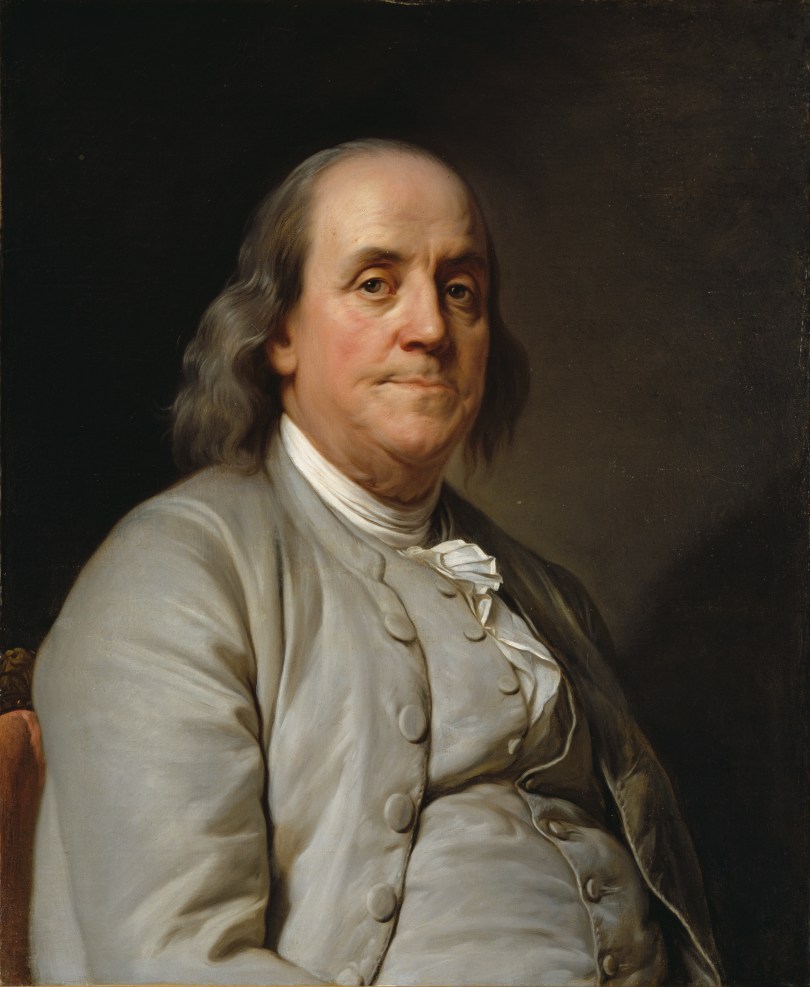
MAGAWeek2023: Benjamin Franklin

This week is MAGAWeek2023, my celebration of the people and ideas that MADE AMERICA GREAT!  Starting Monday, 3 July 2023, this year’s MAGAWeek2023 posts will be SubscribeStar exclusives.  If you want to read the full posts, subscribe to my SubscribeStar page for as little as $1 a month.  You’ll also get access to exclusive content every Saturday.

In looking through the extensive TPP archives, I’ve apparently only written the name “Benjamin Franklin” in a single post—9 May 2020’s SubscribeStar Saturday: Liberty and Safety.  Much like Franklin’s classic canard about trading liberty for safety and losing both, the lack of Franklin’s presence on this website is shameful.

That’s especially true considering that Benjamin Franklin is one of my personal heroes.  He was a skilled writer, editor, printer, inventor, politician, diplomat, wit, international playboy (seriously), statesman, and citizen.  He was the king of the nerds, at a time when nerds were celebrated not because of their weird Japanese body pillow fetishes, but because they were strong, smart, witty, and curious.

No single man’s life better exemplifies eighteenth-century colonial America.  Born in 1706 and passing in 1790, Franklin’s long life extended nearly the full breadth of that eventful century—eventful in large part because of him!

To read the rest of today’s MAGAWeek2023 post, head to my SubscribeStar page and subscribe for $1 a month or more!