SubscribeStar Saturday: Behind Every Great Man

Today’s post is a SubscribeStar Saturday exclusive.  To read the full post, subscribe to my SubscribeStar page for $1 a month or more.  For a full rundown of everything your subscription gets, click here.

We’ve all heard the expression “behind every great man, there’s a great woman,” or some permutation of it (my personal favorite is Groucho Marx‘s:  “behind every successful man is a woman, behind her is his wife”).  It’s a familiar expression because it’s generally true, even if not quite as universal as the word “every” suggests.

Just as a bad woman can lead to a man’s swift downfall—or, worse yet, years of misery and then a swift downfall—a good woman can support a man through his trials, and even make him king.

Such was the case of Margaret Beaufort, who, through a combination of skill, diplomacy, wealth, and mother love, guided her son Henry through the complicated and dangerous War of the Roses to emerge as King Henry VII, the first monarch of the Tudor Dynasty.

Her bravery, tenacity, and sheer luck safeguarded her son through a lengthy exile, and ultimately to the height of power.  Her grandson, Henry VIII, would become the most powerful English monarch of his age, so much so that modern historians frequently regard him as a tyrant.

To read the rest of this post, subscribe to my SubscribeStar page for $1 a month or more.

In Defense of the British Monarchy

As a natural conservative, not merely a political one, I have always felt an affinity for the British monarchy, and never bought into the excessively utilitarian (and inherently radical) arguments that favor the abolition of the monarchy.  After weeks of listening to videos from The People Profiles about the monarchy, I am even more convinced in the necessity of the British monarchy as a cultural and political force.

To be clear, I do not advocate for monarchy of any form in the United States.  The reader might ask, “if it’s so beneficial to our British cousins, with whom we share quite a bit of history and culture, why isn’t it good for us?”  The answer is simple:  we’ve never had one!  Monarchy is something almost completely foreign to Americans, at least since 1776.  Our Founding was explicitly anti-monarchical, even if there were Americans willing to submit to a kingship under George Washington.

The British—and, more specifically, the English—however, have possessed a monarchy for over 1000 years, with the exception of that Cromwellian unpleasantness from 1648-1660, ending with the restoration of the Stuarts with Charles II.  That is a great deal of tradition, custom, and ceremony to toss out merely to save a few bucks on maintaining the Royal Family.

Read More »

SubscribeStar Saturday: The Folly of King Edward VIII

Today’s post is a SubscribeStar Saturday exclusive.  To read the full post, subscribe to my SubscribeStar page for $1 a month or more.  For a full rundown of everything your subscription gets, click here.

One of my favorite passages of Scripture is Proverbs 31:10-31, the famous passage about the qualities of a good woman.  As verse 10 reads, “Who can find a virtuous wife? For her worth is far above rubies.”  The implication is that a true “Proverbs 31 Woman” is a rare and precious thing.

Based on earlier chapters of Proverbs, which extensively detailed the dangers of a wanton floozy, it’s pretty clear that a bad woman can be quite destructive.  Proverbs 7:6-23 is an entire cautionary tale about a foolish young man who dies when a harlot stabs him after a night of passion!

Too many men (myself included) fall for the allure of a pretty face, which is probably why there are three or four chapters in Proverbs warning us off of them (and only one chapter about a good woman).

Such is the potentially corrosive effect of a loose woman that one nearly destroyed a monarchy.  The short-reigned King Edward VIII, who ruled in 1936 for barely eleven months.

The controversy over King Edward VIII’s decision to marry a twice-divorced woman (still married at the time of Edward’s abdication in December 1936), Wallis Simpson, threatened the House of Windsor, and nearly resulted in a constitutional crisis for the British Empire.

To read the rest of this post, subscribe to my SubscribeStar page for $1 a month or more.

SubscribeStar Saturday: Mostly Peaceful Politics

Today’s post is a SubscribeStar Saturday exclusive.  To read the full post, subscribe to my SubscribeStar page for $1 a month or more.  For a full rundown of everything your subscription gets, click here.

Lately I’ve been listening to a number of historical biographies from The People Profiles, an excellent YouTube channel that produces incredibly balanced, detailed biographies of historical figures.  The videos are always very well done, and the channel hosts a stable of exquisite narrators with British accents.

My absolute favorites are their biographies of English monarchs (at the time of this writing, they’ve just posted a video about King Charles II, which I am excited to listen to soon).  What strikes me about these monarchs is that, even as rulers, they dealt with constantly shifting political landscapes that would make our current politics look tame by comparison.

It wasn’t like these monarchs were sitting back and eating grapes (I mean, they probably did do that stuff); they constantly had to balance the needs of their people; their ornery nobility; and their expensive foreign policies (which typically meant “expensive foreign wars”).  Add to that rebellions, assassination attempts, succession crises, and all the rest, and it quickly makes one thankful for a relatively peaceful and predictable political order.

At the same time, there is something enviable about monarchical rule.  A bad king could cause a great deal of damage—and many bad kings did just that to England—but could also be identified easily as the source of a nation’s woes.  Dealing with a tyrannical monarch, in some ways, was far easier than dealing with a tyrannical bureaucracy.

To read the rest of this post, subscribe to my SubscribeStar page for $1 a month or more.
Monday Morning Movie Review: Oppenheimer (2023)

If Sound of Freedom (2023) is the must-see film of the year due to sheer moral imperative, Oppenheimer (2023) is simply the must-see film of the year due to its technical and artistic brilliance.  If means and availability allow, see it in IMAX.  The visuals and the sound are a massive part of this film, and feeling the sound of the first successful test of the atomic bomb really drives home the impact—and the implications—of this terrible new weapon.

Read More »

Lazy Sunday CCXIV: D.C., Part II

I finally slapped together the concluding installments of my Washington, D.C. Trip series, which may or may not make it into a future collection of travel essays.  Based on sales of Arizonan Sojourn, South Carolinian Dreams: And Other Adventures, I’m not exactly hot to rush out another collection of such essays, but we’ll see after I have my book signing (rescheduled so I could deliver the baccalaureate sermon, but the date is still TBD), which should increase the book’s profile a smidge.  I do, however, have an idea for my third book, and it’s going to be something completely different from either of the first two.

Happy Sunday!

—TPP

Other Lazy Sunday Installments:

Lazy Sunday CCXIII: D.C., Part I

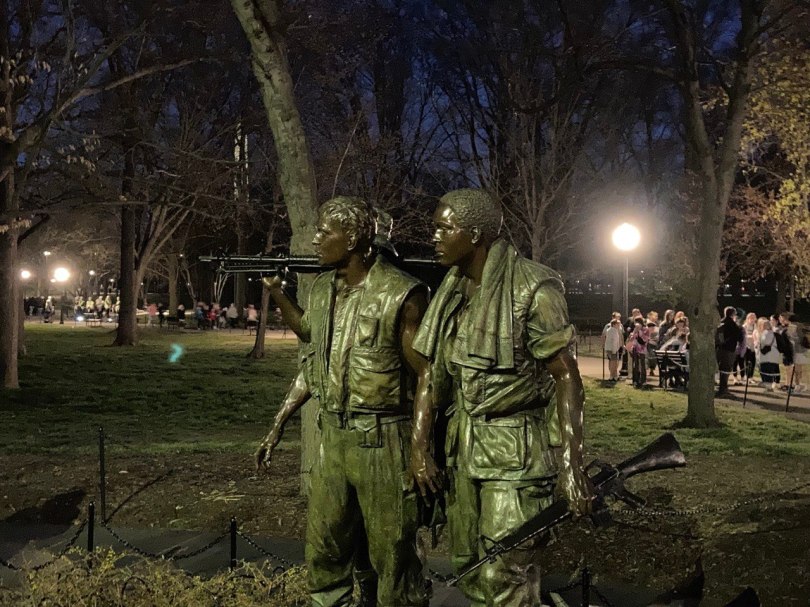
Back in March 2023 I chaperoned a particularly difficult group of students on a trip to Washington, D.C.  Some of the behavior and shenanigans I witnessed from other kids—and, sadly, even from my own students—was quite discouraging.  That aside, it was a good, albeit whirlwind, trip, and I’m in the process of finishing off the essays in this mini-saga.

With that said, here are the first three installments of the Washington, D.C. Trip series:

Happy Sunday!

—TPP

Other Lazy Sunday Installments:

SubscribeStar Saturday: Washington, D.C. Trip Part VI: Arlington, Holocaust Museum, Home

Today’s post is a SubscribeStar Saturday exclusive.  To read the full post, subscribe to my SubscribeStar page for $1 a month or more.  For a full rundown of everything your subscription gets, click here.

After a hairy night of elevator-related shenanigans, everyone was pretty ready to hit the road.  That said, we still had a long hike through Arlington National Cemetery, followed by a trip to the Holocaust Museum, before heading home to South Carolina.

Sadly, it appears I lost the photographs I took at Arlington National Cemetery, as well as the powerful World War II Memorial from the previous night.  It’s a shame, because it’s a humbling and breathtaking place.  The cemetery is massive, with graves everywhere; even so, it is running out of space.

We chanced upon the changing of the guard ceremony, where the guards stand vigil over the Tomb of the Unknown Soldier.  Our tour group was a bit late hiking up the hill to the Tomb, but our students managed to position themselves in such a way as to witness the guards perform the ceremony.

Even with our typically rambunctious group and dozens of other school groups, it was very quiet.  After two long days of trying to explain to them why these places were sacred, the awe and reverence of Arlington did more to quiet their ever-running mouths more than any of my self-righteous jeremiads ever could.

Following the quiet, contemplative morning at Arlington, we had a quick lunch at a mall food court, then headed to the Holocaust Museum—a sobering final coda to our trip.

To read the rest of this post, subscribe to my SubscribeStar page for $1 a month or more.

TBT^4: Phone it in Friday XI: Coronavirus Conundrum, Part IV: Liberty in the Age of The Virus

Don’t be alarmed:  it’s Thursday.  I’ve “thrown back” to this classic edition of Phone it in Friday twice before, and even though The Age of The Virus is now over, it’s worth remembering the massive social and economic costs that came from the years of lockdowns.

The line from the Left now is, “oops, sorry, we overreacted, but we can let bygones be bygones, yeah?”  Forgiveness is important, but it’s also important to realize how self-righteous busybodies with an untrusting faith in “science” berated all of us into wearing diapers over our faces and putting kids in online classes for two years.

Masks don’t work.  If you can smell a tangy fart through an N95 mask, viruses can get through.  About the only sensible advice anyone received during The Age of The Virus was to wash our hands regularly.

Yet we turned our civil and medical liberties over to a handful of unelected “public health” bureaucrats based on the flimsiest of information.  Granted, those first “two weeks to flatten the curve” were scary, because we knew so little, but in hindsight, it looks like an attempt to see how much the American people would put up with before we revolted.  The answer, sadly, was quite a lot.

One other note:  I appreciate doctors for their training, though my faith in them has always been equivocal at best.  But the real problem seems to be nurses and public health officials.  The former is a profession that seems to attract its fair share of self-important nut jobs, and who hasn’t known a nurse who insists she knows better than the doctor?

The latter are people who couldn’t hack it as either a doctor or a nurse, so they got a relatively new degree (I first heard of people majoring in public health only about fifteen years ago) that somehow grants them enormous power to curtail individual liberties in the name of “public” health.

That’s a scary Pandora’s Box:  where do we draw the line?  I imagine there are all sorts of personally harmful but socially benign health choices that deviously creative public health officials could spin into activity that must be stopped in the name of “public health.”  Even when we knew that masks did nothing—I remember folks saying, “Well, the mask doesn’t protect you, but it protects other people,” which makes no sense at all—it was always couched in terms of helping other people.  It was the same way with The Vaccine—“if you don’t get this shot, you’re endangering others!”  Malarkey.

With that, here is “TBT^2: Phone it in Friday XI: Coronavirus Conundrum, Part IV: Liberty in the Age of The Virus“:

Read More »

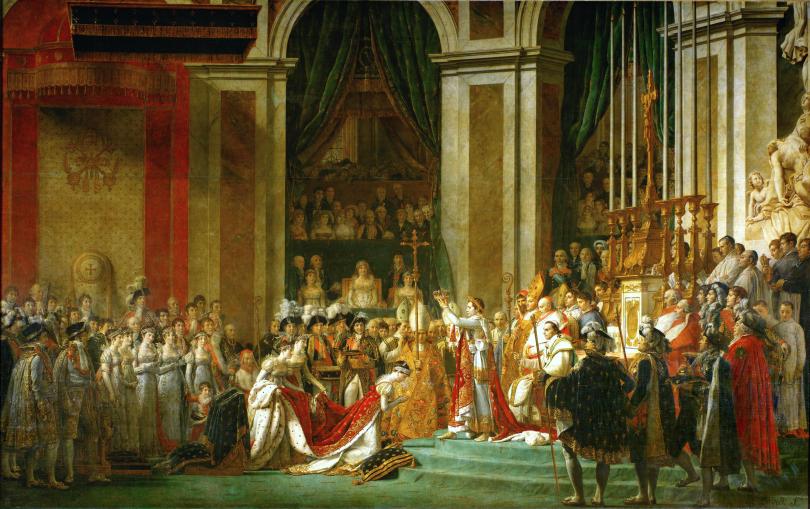
TPP’s Greatest Hits, Track III: Napoleonic Christmas

After MAGAWeek2023 and my extended time out of town, I’ve decided to take this week to rerun some classic hits from the extensive TPP back catalog.  Most of the posts are those with very high view counts, though I am presenting them in no particular order.  TBT will proceed as usual, and regular posts will resume Saturday, 15 July 2023.

With that, here is 23 December 2019’s “Napoleonic Christmas“:

Read More »