Retro Tuesday: Veterans’ Day 2018, Commemoration of the Great War, and Poppies

Today marks the 107th anniversary of Armistice Day, the day that the Great War (the First World War) ended.

The First World War has come back into vogue as an example of the absurd, murderous capacity of even seemingly enlightened humans to engage in massive, needless violence.  I think that’s true, but I also think the First World War is when the West lost confidence in itself.

Consider:  if the allegedly “enlightened” moderns of Western Civilization could lead their armies into senseless, ceaseless warfare for four years, how did that make us any better than the rest of the world?  Indeed, it seemed to make us and our advancements seem even worse.

That analysis misses some key points, however.  The war wasn’t just about nationalism-run-amok, or secret alliances swinging into a deadly, almost automatic catastrophe of geopolitics gone wrong.  It reflected the dehumanization of modernity itself, the turning of people into, first, mere cogs in vast industrial machines and, second, into fodder for a brutal meatgrinder.

The First World War may have caused the West to lose its “mojo,” as I’ve argued before, but the West was already losing its soul before that great, terrible conflict.  Fast forward 107 years, and Europe is a place so venal, so atheistic, so nihilistic, so devoid of meaning, that it’s gladly and eagerly invited its own replacement by foreign nationals and faiths.  The very same civilization that resisted Islamic domination for 1400 years has now given up without a fight.  As long as the endless welfare benefits keep coming, no one cares.

It’s truly tragic.  The World Wars cost millions of lives and wrought untold damage upon the world.  They also destroyed what little will the West had left to preserve itself, at least in Europe.  The West may very well have died 107 years ago.

I hope I am wrong.

With that, here is 13 November 2018’s “Veterans’ Day 2018, Commemoration of the Great War, and Poppies“:

Read More »

Lazy Sunday CLXXI: Veterans Day Posts

Way back in 2018—doesn’t that feel like a different world (and didn’t 2018 feel like a different world than even 2016)?—I gave a short talk to the Florence County (South Carolina) Republican Party about the Great War and Veterans Day, what was once called “Armistice Day.”  Not being one to let content go to waste, I published a transcript of the talk on 13 November 2018 to this blog, and I’ve reblogged it every year since on 11 November.

It’s probably a bit too “inside baseball,” but when I reblog these old posts, I’ll sometimes layer in the commentary from the past reblogged versions, too.  Readers will notice I do this with TBT posts, which over the years can become “TBT^2,” “TBT^4,” and so on.

For whatever reason, I only did this Talmudic commentary-on-commentary once with this post, back in 2020.  I suppose when Veterans Day falls on a Thursday again, I’ll reblog “TBT: Veterans’ Day 2018, Commemoration of the Great War, and Poppies” as a “TBT^2” post.

But I digress.  Here are all of the Veterans Day posts going back to 2018:

There you have it, folks.  Thanks to everyone who has served, and a huge thanks for those who have given their lives in the line of duty.  No mere blog post can do justice to the depth of your devotion.

Happy Sunday!

—TPP

Other Lazy Sunday Installments:

Flashback Friday: Veterans’ Day 2018, Commemoration of the Great War, and Poppies

It is Veterans Day here in the United States, what was once called Armistice Day, the day the cease-fire went into effect, effectively ending the First World War—the “Great War,” as it was then known.  The men that day never dreamed there’d be a Second World War, but in hindsight, it’s easy to see how the cease-fire and the subsequent Treaty of Versailles of 1919 were, indeed, mere stopgaps.  It was a cease-fire of twenty years, not a lasting peace, and the two great, terrible wars of the twentieth century are, perhaps, best understood as being one larger conflict, a la the Hundred Years’ War between France and England.

But I digress.  Every Veterans Day—which I stylized with a plural possessive apostrophe until finally looking it up this year and realizing my error—I repost this short talk I gave in 2018.  At the time, I was involved actively in the Florence County (South Carolina) Republican Party, and would give a brief Historical Moment talk at the start of each meeting.  This speech—from the 12 November 2018 meeting, one of my last with the organization—is the one of which I am most proud, and the one I feel most privileged to have given.

With that, here is “Veterans’ Day 2018, Commemoration of the Great War, and Poppies“:

Read More »

Wayback Wednesday: Memorable Monday: Veterans’ Day 2018, Commemoration of the Great War, and Poppies

While preparing a separate post on hymns (which I will likely post Friday), it occurred to me that today is Veterans’ Day in the United States, the observance formerly known as Armistice Day.  I’ve never thrown back to past posts on a Wednesday before, but it seemed fitting to recognize our fallen heroes on the day.

Last year I looked back at a Veterans’ Day post from 2018.  The post itself was originally delivered as remarks to the Florence County (SC) Republican Party, and was the most affecting of my old “Historical Moments” I’ve ever delivered.

It’s hard to believe that the centennial observance of the Great War has already passed, yet we’re still dealing with the fallout from that terrible war just over a century later.  The more I’m learning about the great Baroque, classical, and Romantic composers of Europe, the more the senseless loss and nihilistic destruction of that conflict weighs on me—and that the shimmering, confident civilization that fostered those composers also destroyed itself.

Read More »

TBT: The Influence of Christianity on America’s Founding

My high school American history classes are getting into the American Civil War—or the War of Northern Aggression, or the War for Southern Independence, or whatever you’d like to call it—this week, so we’ve been talking about beginnings a good bit.  The Civil War had deep roots that go back not just to the 1840s or 1850s, and not even to the Constitutional Convention in 1787.

Indeed, the fundamental division dates back to the English Civil War in the 1648, when the Puritan Roundheads under Oliver Cromwell ousted and beheaded Charles I, and established the English Republic (which—the English having little taste for radicalism or dictatorships, fortunately collapses in 1660 with the restoration of the Stuart monarchs).  Loyalists to the king and the monarchical order were the aristocratic Cavaliers.  Those same Puritans of East Anglia settled heavily in Massachusetts following the Pilgrims’ famous landing at Plymouth Rock, and the Cavaliers—in body and spirit—dominated the tidewater plantations of the South.

Read More »

Memorable Monday: Veterans’ Day 2018, Commemoration of the Great War, and Poppies

Today is Veterans’ Day in the United States.  Veterans’ Day began as Armistice Day, which ended the First World War in 1918.

The past century was not great for Western civilization.  Most of the horror of the long twentieth century stemmed from the Great War and its mostly senseless destruction.  The sense of nihilism that engulfed the West—a civilization that was bestrode the world with confidence and panache—metastasized into the identity crisis of its nations today.

The piece below is adapted from a talk I gave to the Florence County, South Carolina GOP last year at its November 2018 monthly meeting.  I still think it’s one of the best Historical Moment talks I ever gave, but that’s mostly due to John McCrae’s powerful poem “In Flanders Fields“; the poem is reproduced in full below.

Thank you to all of our veterans for their service.

—TPP

Yesterday Americans, Europeans, and the world commemorated the 100th anniversary of the end of the Great War, what we call the First World War.  The Armistice that silenced the guns of one of the most brutal conflicts in human history was signed in the wee hours of 11 November 1918, but did not take effect until 11 AM—the eleventh hour of the eleventh day of the eleventh month.  That bit of numerical symmetry, while memorable, cost an additional 2738 lives, with 10,944 casualties—a pointless denouement to a destructive war.

Peace would ultimately come to Europe—after three prolongations of the Armistice—in 1920 with the ratification of the Treaty of Versailles (the United States, refusing to join the League of Nations, negotiated a separate treaty with Germany, the Treaty of Berlin, in 1921).  That treaty, which the Germans called the Diktat because of its severity, and because it pinned the war solely on the German Empire, was a reflection of the Armistice signed three years earlier.

In preparing tonight’s remarks, I came across an article that describes the first meeting between Marshall Foch, the commander-in-chief of the Allied forces, and Matthias Erzberger, a middle-aged German politician who had come to sue for peace.  The Frenchman looked stonily at the German peace delegation, and said, “Tell these gentlemen I have no proposals to make.”  Rather, Marshal Foch had a number of demands to issue, thirty-four in total, including Germany’s agreement to pay heavy reparations.

In hindsight, we know the folly of trying to squeeze blood and treasure from the turnip that was a starving, reduced Germany—and the radicalism it, in part, inspired.  But we have to understand, as best we can, the bitterness and weariness the Great War wrought.  Millions of men in Europe had lost their lives, or were maimed for life, fighting in the war.  The republican governments of France and Britain were not willing to accept peace without something to show for it; their people (and voters) would not have accepted it.  Indeed, Marshall Foch told his staff he intended “to pursue the Feldgrauen [field grays, or German soldiers] with a sword at their backs” until the moment the Armistice went into effect.  One cannot help but wonder that the fighting in this final hours was motivated, in part, by a mutual bloodlust, and an opportunity to settle scores one last time before the clock struck eleven.

From the grime and death of the Great War, however, grew new hope—a hope for peace, yes, but also a hope that humanity could avoid such a devastating conflict again.  That hope—and the enduring hope for a world built on peace and understanding—is poignantly symbolized in the flowering of the churned up “No Man’s Land,” the pock-marked area between Allied and German trenches.  Immortalized in Canadian Lieutenant-Colonel John McCrae’s “In Flanders Fields,” poppies were first flowers to bloom in that graveyard of Western civilization.  To this day, the crimson of the poppies serves as a reminder of the men who made the ultimate sacrifice for their countries, and that even in death, life endures.

I will close this somewhat grim Historical Moment with a brief reading of that poem; it can commemorate the men there far better than I:

In Flanders fields the poppies blow
Between the crosses, row on row,
That mark our place; and in the sky
The larks, still bravely singing, fly
Scarce heard amid the guns below.

We are the Dead. Short days ago
We lived, felt dawn, saw sunset glow,
Loved and were loved, and now we lie
In Flanders fields.

Take up our quarrel with the foe:
To you from failing hands we throw
The torch; be yours to hold it high.
If ye break faith with us who die
We shall not sleep, though poppies grow
In Flanders fields.

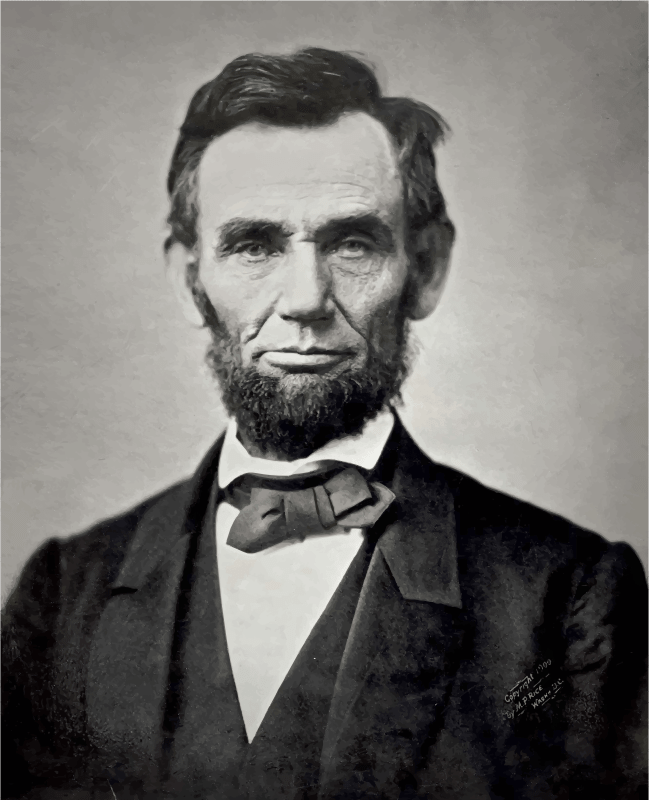
TBT: Lincoln on Education

This week’s TBT feature was also in last Sunday’s “Lazy Sunday XXIV – Education.”  With the school year in full swing, it’s always enjoyable to look back at the benefits of education—a reminder of why getting education right is so important.

Abraham Lincoln was largely self-educated, and he was motivated, it seems, by both a desire to improve his condition in life, and by a genuine love of learning.  As an avid reader myself, I can related to the anecdote (relayed below) of young Abe walking around with “a book in his hand or in his pocket.”

This little piece was an “Historical Moment,” a monthly feature for the Florence County (SC) GOP’s public events.  If I recall correctly, the FCGOP Chairman skipped over my segment in the program (presumably by mistake, but perhaps to save time), so while I wrote this brief talk for the September 2018 meeting, I did not deliver it publicly until the October meeting (it was published on this blog in September).

I hope you’ll find this adaptation of my talk enjoyable.  Here is “Lincoln on Education“:

We’re gathered here tonight to hear from members of and candidates for School Board; in that spirit, I’d like to speak briefly about education, particularly the education of the first Republican President, Abraham Lincoln.

From what I’ve read, Lincoln’s entire formal education consisted of around a year of schooling.  He would have a week or two here and there throughout his childhood in Kentucky and Indiana, and then return to working on the family’s farm.

Despite little formal education, Lincoln taught himself throughout his life.  He loved to read, and would read deeply on a variety of subjects, obtaining books whenever and wherever he could.  One of his contemporaries commented that “I never saw Abe after he was twelve that he didn’t have a book in his hand or in his pocket. It didn’t seem natural to see a feller read like that.”  When he sat for the bar exam, he’d read law books on his own time to prepare.

Lincoln also believed in education as a source of patriotism, morality, and self-improvement—what we might call “upward mobility.”  He was not a man who wanted to stay on the farm, and his self-education was a means to escape poverty.

If you’ll indulge me, I’d like to quote Lincoln at length from his 1832 speech “To the People of Sangamo County”:

“Upon the subject of education, not presuming to dictate any plan or system respecting it, I can only say that I view it as the most important subject which we as a people can be engaged in. That every man may receive at least, a moderate education, and thereby be enabled to read the histories of his own and other countries, by which he may duly appreciate the value of our free institutions, appears to be an object of vital importance, even on this account alone, to say nothing of the advantages and satisfaction to be derived from all being able to read the scriptures and other works, both of a religious and moral nature, for themselves. For my part, I desire to see the time when education, and by its means, morality, sobriety, enterprise and industry, shall become much more general than at present, and should be gratified to have it in my power to contribute something to the advancement of any measure which might have a tendency to accelerate the happy period.”

Here we can see Lincoln’s belief that education lays the foundation for patriotism—we understand our freedoms better when we understood what they cost, and that others lack them.  We see, too, the power of education to teach us the virtuous and the good.  From that morality flows, as Lincoln said, “sobriety, enterprise, and industry,” the tripartite tools to improve our material conditions.

Patriotism, morality, and industry—these were the three benefits of education Lincoln espoused.  Coming from the man who wrote the Gettysburg Address, I think we should take Lincoln’s views on education seriously.

Belated SubscribeStar Saturday: A Little American History – And Some Reflections on Teaching It

This past weekend’s SubscribeStar Saturday post was delayed until Sunday evening.  The end of the first week of school, followed by a very late night/early morning drive, with that followed up by a long day of family events, meant that my perfect attendance record for Saturday posts had to suffer.

But you can read that post—which went up last night—with a subscription to my SubscribeStar page!

Here’s a sneak peek:

Robert Kennedy was a strong contender for the Democratic Party primary in 1968, especially among the progressive wing, before Sirhan Sirhan, a Palestinian terrorist, shot him. His death left Vice President Hubert Humphrey as the only viable candidate. Remember, LBJ declined to run for reelection in 1968 because the Vietnam War was so deeply unpopular among antiwar Democrats, many of whom were radicals who were exerting greater control over their party (sound familiar?).

The Democratic National Convention devolved into riots and chaos, with Humphrey nearly succumbing to tear gas in his Chicago hotel room. Humphrey managed to close the gap with Nixon, but it was a three-way race (with segregationist George Wallace, Governor of Alabama, running as a third party candidate), and Nixon won on a law and order platform.

To read the rest of this post, subscribe to my SubscribeStar page for $1 a month or more.

Lazy Sunday XXIV: Education

The school year is back in full swing, and I am already beat.  It looks like it’s going to be a good year, and I have some very bright students, but my teaching load is substantially busier than last year, and my private lesson empire continues to grow.  Those are all blessings, but it means a lot more work for yours portly.

That’s all to say that I thought this Sunday’s edition of Lazy Sunday would be perfect for looking back at my education-related posts:

  • Lincoln on Education” – a little post consisting of remarks I made to the Florence County (SC) Republican Party back in September 2018 (actually, it may have been October—one of my “Historical Moments” was skipped in the program accidentally, so I reused it the following month).  I looked at the education—and the views thereon—of President Abraham Lincoln.  He was an avid learner, and saw education as the means by which he could improve himself.  Apparently, it worked!
  • Teachers Quitting in Record Numbers – Reflections on Education” – this lengthy post outlines my own observations about why teachers quit the profession—and some of its major problems.  My main idea was “flexibility”:  in pay, in lesson plans, and in certification.  Public education is a great deal for bad teachers—they coast along, cashing a paycheck no matter how well they do—but a poor one for good teachers.  Private education is great, but it can’t compete, at least in the rural South, with public education in terms of teacher pay and benefits.

    But the biggest concern is what I elegantly dubbed “administrative bullcrap.”  Teachers get loaded down with all of these duties that are only distantly related to their alleged jobs:  molding young minds.

  • The State of Education” – this post details the travails of a New York City French teacher, a good teacher whose experiences in multiple schools illustrate how public education is a bad gig for good teachers.  The stories are jaw-dropping, but hardly surprising now:  zero administrative support for discipline, a “talent show” that nearly devolves into a sweaty orgy, violent outbursts from animalistic students, etc.  Terrifying stuff.
  • Sailer and Spotted Toad on Education” – this post was a bit “meta”—it’s an overview of a review of a book.  That makes my post tertiary commentary at best.  The post looks at demographer Steve Sailer’s review of blogger Spotted Toad’s book 13 Ways of Going on a Field Trip: Stories about Teaching and Learning a narrative memoir detailing Toad’s decade teaching in public schools in the Bronx.  I’ve picked up the book but still haven’t read it (I’m working through Milo’s Middle Rages: Why the Battle for Medieval Studies Matters to America; review coming soon), but it looks to be an interesting read.
  • SubscribeStar Saturday:  The State of Education Update” – this post is an update of “The State of Education,” written nearly on the eve of my return to this present school year.  As SubscribeStar Saturday exclusive, you’ll have to subscribe to my SubscribeStar page for $1 a month or more to read it.  Tantalizing, no?

So, there you have it.  Now to fulfill my obligation to my wonderful SubscribeStar subscribers and get their delayed post done.

Happy School Year!

–TPP

Other Lazy Sunday Installments:

Lazy Sunday III: Historical Moments

My Internet is out at the house, and the technician won’t be out until Friday, so posting this week may be a bit dicey and inconsistent.  As a result, I’m phoning it once again this Sunday—the perfect way to start (or end, depending on your perspective) the week.

Brace yourself for “Lazy Sunday III:  Historical Moments” (read “Lazy Sunday” and “Lazy Sunday II“).  These posts are derived from a series of short talks I gave to the Florence County (SC) GOP in 2018.  They are presented in chronological order.

1.) “The Formation of the Republican Party” – this post was featured in “Lazy Sunday II:  Lincoln Posts,” as is the second piece in this list (sorry for the redundant recycling).  It’s a quick overview of the origins of the Republican Party in the 1850s.

2.) “Lincoln and Education” – another post from “Lazy Sunday II,” this Historical Moment explores Lincoln’s education, as well as his views on the subject.

3.) “Veterans’ Day 2018, Commemoration of the Great War, and Poppies” – like President George W. Bush, I am not one of the great orators of our time, but when I delivered this Historical Moment, it was probably the most powerful oratorical presentations I’ve ever given.  That is not due in any way to my own speaking abilities (although I do possess a rich, chocolate-y baritone when speaking), but to the emotional power of John McCrae’s “In Flanders Field.”  It was an arresting moment when I delivered the lines of that simple, sweet poem.

4.) “The Influence of Christianity on America’s Founding” – this talk was a longer-form version the usual Historical Moments, which are usually about five minutes long.  I was asked to give a slightly longer speech about the influence of Christianity on the founding of our nation at a joint FCGOP-Darling County GOP Christmas dinner.  It’s a complex topic, but, yes, Christianity was and is key to the American experiment in self-government.

So there you have it—more TPP greatest hits.  Enjoy, and have a restful Sunday!