As I’ve surely mentioned elsewhere, one of the joys of blogging is the opportunity to discover the work of other bloggers. There are a lot of blogs out there, and in the few years I’ve been writing daily, I’ve been fortunate to stumble upon some real gems.
One of the many benefits of teaching music is (re)discovering beloved favorite works. During last week’s round of distance learning, I had to pull out some of the classics. If we’re going to sit on a Google Meet call, let’s listen to some music, not just talk about it.
I really love programmatic music—instrumental music that tells a story, often accompanied by program notes explaining (usually very briefly) what the listener is supposed to hear in the musical “story.” Students often like to imagine their own stories when listening to instrumental music, which is great, but I find that programmatic works give students (and myself!) some guideposts to follow.
Fortunately, Ludwig von Beethoven provided some handy ones for us in his Sixth Symphony, quite possibly my favorite symphony, and certainly my favorite of Beethoven’s. It’s the so-called “Pastoral” symphony, as it depicts a pleasant trip to the country (besides the roiling thunderstorm in the fourth movement).
It’s also unusual in two respects: instead of the standard four movements of the classical symphony (a fast opening movement, a slow second movement, a dancelike third movement, and a fast fourth movement), Beethoven includes five; and the third, fourth, and fifth movements all flow seamlessly into one another, without the customary pause between each.
It is also long, especially by the standards of the classical symphony (the Romantics, however, would have easily matched Beethoven for runtime), clocking in at nearly forty-five minutes (the typical classical symphony averages around twenty-five-to-thirty minutes, but forty-five would have been the upper limit for the time). But that length is in service to Beethoven’s vision, and he fully explores every theme in this symphony.
Here is a particularly excellent performance—the one I showed, in part, to my classes last week—by the Berlin Philharmonic, under the direction of Bernard Haitnik:
Since the first installment of Midweek Mad Scientist Movie Madness two weeks ago, I’ve watched several more films from Mad Scientist Theatre, a collection of mostly bad, mostly public domain films. As with any such collection, the appeal is in the handful of renowned classics, and some of the hidden gems.
The first three flicks on the very first disc are all silent movie classics. I’ve already reviewed Dr. Jekyll and Mr. Hyde and The Cabinet of Dr. Caligari, which both debuted in 1920. I appreciated and enjoyed both films for different reasons, and both were very well done, although quite different, films.
The third film is 1927’s Metropolis, perhaps the greatest silent film of all time. I took a modern German history course in college, and we were supposed to attend a screening of Metropolis for class. For some reason, I did not attend, which was very out of character for me (I only missed class twice in college: a session of Human Geography because my saxophone sextet had its recital that morning, and a rehearsal of the University Band so I could play The Elder Scrolls: Oblivion the night it was released). I guess we were never tested on it, but when I found out there was a robot woman, I was kicking myself for missing the flick.
Now, some twenty years later, I’ve finally watched this classic of Weimar Germany’s wild cinematic scene. I wish I’d gone to see it in college!
As you can see, it is a long film—depending on which cut you see. Apparently, there are dozens of different cuts and restorations, and no one knows for certain which is the “definitive” version. One of my readers asked me which cut I saw, and I have no earthly idea (sorry, cinephiles). It’s whatever version Mill Creek Entertainment decided to put on this collection. I do know the film felt long in parts—although I was glued to the screen for most of it—but it didn’t feel like it was two-and-a-half hours long.
What I can say is that Metropolis is worth seeing, not only because it is an important film in the history of cinema (and the height of German Expressionism), but because it is a good movie with an important message: the head and the hands must work together through the heart.
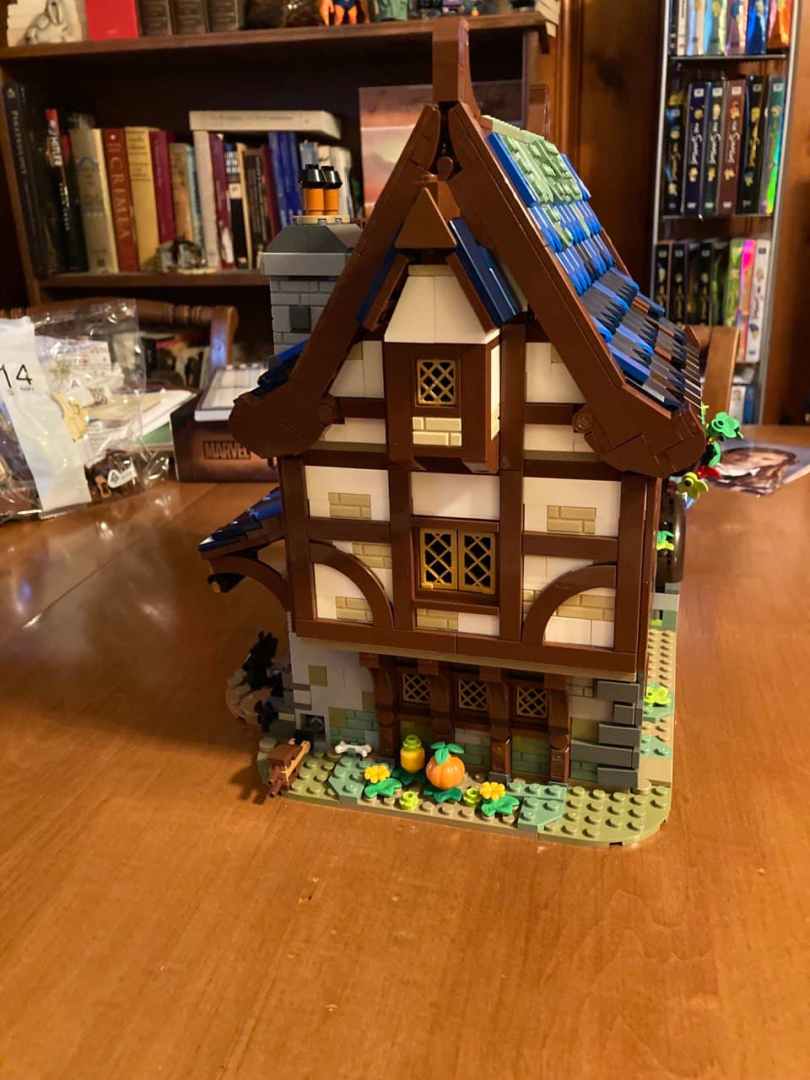
This weekend I embarked on the ultimate in childlike self-indulgence and built the largest, most detailed LEGO set I’ve ever encountered: The Medieval Blacksmith (#21325) set. This bad boy is part of the LEGO Ideas series, which allows LEGO fans to submit ideas for sets. If the set gets 10,000 votes, LEGO reviews the build and, if they like it, they turn it into an official LEGO set.
These are premiere sets, and are often quite expensive. I managed to pick it up on sale at Target and had a gift card, so against my better judgment, I treated myself to Medieval Blacksmith for the princely sum of roughly $145.
Readers must understand: that kind of splurge is very out of character for me. But sometimes a deal is too good to pass up, and I’ve been drooling over this set ever since it was announced some months ago on LEGO’s website.
I’d say I got my money’s worth with this one. Around 2 PM Saturday I set to work on the behemoth, taking breaks of varying lengths for meals and to walk Murphy. I stopped building around 12:15 AM Sunday morning, just before the first bits of icy sleet began to fall from the winter storm (which I dubbed “Winter Storm Randy”). I resumed building Sunday morning around 10 AM and wrapped up before noon.
In total, I’d say I spent a solid eight hours of actual construction time (that includes probably half-an-hour looking for a single missing piece on my hands and knees, which at the time of writing I still have not found). Normally I’d never have the time for such an endeavor, especially in one stretch, but with a gloriously open weekend and the Korean series Squid Game, I set about building the blacksmith’s shop and home—all 2164 pieces of it.
In lieu of the usual movie review this week, I’m taking advantage of the Martin Luther King, Jr. Day to lighten my blogging load slightly. I’ll have another Midweek Mad Scientist Movie Madness post for $3 and up subscribers on Wednesday, so if you want your weekly fix of filmic schlock, check back then. An aunt of mine has requested a movie review, and as soon as I figure out how to watch the flick, I’ll be reviewing it one Monday (I’m looking out for you, Aunt Marilyn).
After a week of virtual learning and lots of time alone (well, with Murphy, at least), I’m eager to get out of the house, but I will likely spend today prepping for the abbreviated school week and getting the house in order. I’m thankful for the day off, but I’d probably appreciate it more—as I did in January 2020—if I were utterly exhausted—as I was in January 2020. I think slightly less appreciation is a worthwhile trade-off, though!
This post from 2020 delves into some of the complexity of the Reverend Dr. King’s legacy, and warns against excessive idolization of historical figures—even martyrs. Much of the inspiration from the stories of Christian Saints, for example, derives from their human frailty. Even the great Saint Augustine, when praying to God for control over his lustful nature, prayed, “Grant me chastity and self-control, but please not yet.”
From the evidence, it appears that King participated in some really debauched, even evil, sexual practices. The FBI’s suspicions that he may have been are Marxist were probably justified to some extent, even if the FBI treated him shabbily and is a despicable tool of oppression. If King were alive today, I’d wager he’d be knee-deep in the CRT foolishness that his famous “I Have a Dream” speech explicitly rejects.
Yet from this extremely imperfect vessel came ringing declarations of spiritual equality. Regardless of our race, we are endowed by our Creator with certain inalienable rights. That is the part of King’s legacy we should celebrate, while remembering he was a deeply flawed individual.
In other words, let us put our faith and trust in Christ, not in men.
I thought I’d take a bit of a break from the retrospectives of movie reviews and look back at some of Son of Sonnet‘s entries in the ongoing The Gemini Sonnets series. Typically I feature three posts on Lazy Sunday, but Son always submits these in groups of two. Maybe that’s because I publish two a month, but perhaps there is some deeper, literary reason.
As such, here are posts about first two Gemini Sonnets. If you missed them when they were first published in November 2021, now’s your chance to catch up:
Every artist as dedicated to his craft as Son deserves both recognition and support. I would encourage you to consider a subscription to Son of Sonnet’s SubscribeStar page as a way to encourage the growth and development of an eloquent voice on our side of this long culture war. Conservatives often complain about not holding any ground culturally; now is the time to support the culture that is being created.
This weekend I’m continuing the six-part Behind the Songs miniseries for SubscribeStar Saturday. In this series, I’m going to reveal the stories behind each of the six songs on my debut EP, Contest Winner EP. I’ll go track-by-track, in order, detailing the inspirations behind these songs.
Regular readers know I love short stories, and dedicate an entire week in April to reviewing them. I love them even more when my friends write them—and receive rewards for doing so!
My former colleague and current friend Helen Liptak has done just that, taking runner-up in a recent short story contest for Funny Pearls, a British humo(u)r website dedicated to publishing women writers. She won the prize (and, as she told me, some pounds) for her story “Just Another Slow Day at the Diner.”
Today I am pleased to announce the fifth entry in The Gemini Sonnets, an original sonnet cycle by Son of Sonnet. I’m particularly pleased because SoS announced he was taking a hiatus from writing, so this sonnet is quite special.
Your generous subscriptions to my SubscribeStar page have made it possible to patronize Son’s work. As a community of artists, readers, and pundits, we should work together as much as possible to cultivate and support one another’s talents. I can’t pay Son much—yet—but I’m able to offer him something for his talents because of your generosity.
Every artist as dedicated to his craft as Son deserves both recognition and support. I would encourage you to consider a subscription to Son of Sonnet’s SubscribeStar page as a way to encourage the growth and development of an eloquent voice on our side of this long culture war. Conservatives often complain about not holding any ground culturally; now is the time to support the culture that is being created.







 The Portly Politico