Day Off

Yours portly is taking the day off from blogging.  I’m enjoying time with my girl (the human one, not Murphy; Murphy is enjoying time with my neighbors).

I was hoping to run Ponty’s response to my masterpiece review of Donnie Darko (2001) today.  You’ll hear from Ponty on a different topic later this week, but I can only assume his extended tardiness in sending along a detailed critique is a tacit indication that he has come around to my viewpoint.  Indeed, readers will readily agree that the only reasonable reason he hasn’t sent his review—surely it’s not due to busyness, or illness, or spending time with Tina—is that dear Ponty has realized I was right all along, and there’s no point in challenging me further on the issue.

So with that note of brotherly reconciliation and rhetorical dominance, I bid everyone a wonderful Monday.  I’ll be enjoying a relaxing day with my girl, basking in the knowledge that I’ve once again swayed public opinion about twenty-plus-year-old movies in a positive direction.

Cheers!

—TPP

TBT^2: Alone

It’s funny how time heals all wounds (except the conflicts between Israelis and Arabs; Sunnis and Shiites; Russians and Ukrainians; English and Irish; humans and robots; dogs and cats; etc., etc.).  What’s more notable is that dating someone who respects you and treats you well really puts a new perspective on life and love and relationships—all that mushy stuff we love to emote about around Valentine’s Day.

Yours portly has pretty much seen it all in the admittedly limited realm of heterosexual monogamous dating, the kind without any weird perversions or lurid peccadilloes attached.  It’s a tough playing field out there for men.  As you get to my age (I’m a supple thirty-nine now), it gets a bit more challenging.

One thing I’ve learned is that single Christian women over thirty are nuts.  There’s more pressure on them—mostly soft and, I suspect, self-inflicted pressure, but pressure nonetheless—than worldly floozies to get a husband.  Since most of their peers did so between the ages of eighteen and twenty-five, they can’t help but think something is wrong with themselves.  Women being particularly prone to solipsistic rationalization, they invent various reasons to cover up this gnawing sensation:  “I’m dedicated to my career”; “The Lord Has me in a season of singleness”; etc.  The Truth is probably too hard to confront.

Lest readers think I am dumping on the ladies, I acknowledge that these critiques apply partially to me, too.  The difference, I think, is that it is historically- and economically-established that men often don’t marry until later in life, as we take a bit longer to mature.  We also have the deeply instinctual provider role, and while the world insists we don’t have to do that and that women don’t want it, that impulse is still very real.  No woman wants to date a deadbeat, and we’re pretty much all deadbeats in our early twenties.  It takes us awhile to build up an empire.

Of course, that’s probably the key difference between men and women economically:  most women have the luxury of dropping out of the workforce when a suitably stable and secure man comes along, if they’re willing to make mild sacrifices.  It’s well-documented that men risk far more in relationships than women, and bear far greater search and support costs.

But I digress.  My experience has been that single Christian women past thirty are former party girls who have reconnected with their faith (good if true), or perpetual daddy’s girls who never left home.  Either way, they suddenly have ludicrously high standards that apply to the “good guys”—standards they once (and likely still would) throw out the window for the right bad boy.  Alternatively, they’re so starved for male affection, they’ll throw all standards out the window (missionaries, I’ve noticed, are the worst when it comes to this tendency).  Whatever the case, they’re not exactly strong “living witnesses” for the Lord.

Fear not, dear readers:  despite the previous diatribe, I am not bitter (the likely reaction to reading a veritable carpet bombing of taboo Truth Bombs).  I am dating a wonderful woman.  She is over thirty.  She is a Christian, albeit not in an intensely devout way.  Indeed, she kind of defaults to the mild progressivism of most twenty-first-century American women.  I don’t think she thinks about politics or social issues much beyond whatever comes up on in the mainstream.

And she’s the kindest, most well-adjusted woman I’ve ever dated.  She’s so kind and supportive, it’s made me chill out—and I’m probably as batty as some of the women I’ve described here.  For probably the first time in my lengthy dating career, I’m not worried about a relationship.  I don’t have the gnawing sense that she doesn’t like me for some unknown reason.

It’s pretty liberating.

Also, she brings me Biscoff cookies.  That’s love.

With that, here is 9 February 2023’s “TBT: Alone“:

Read More »

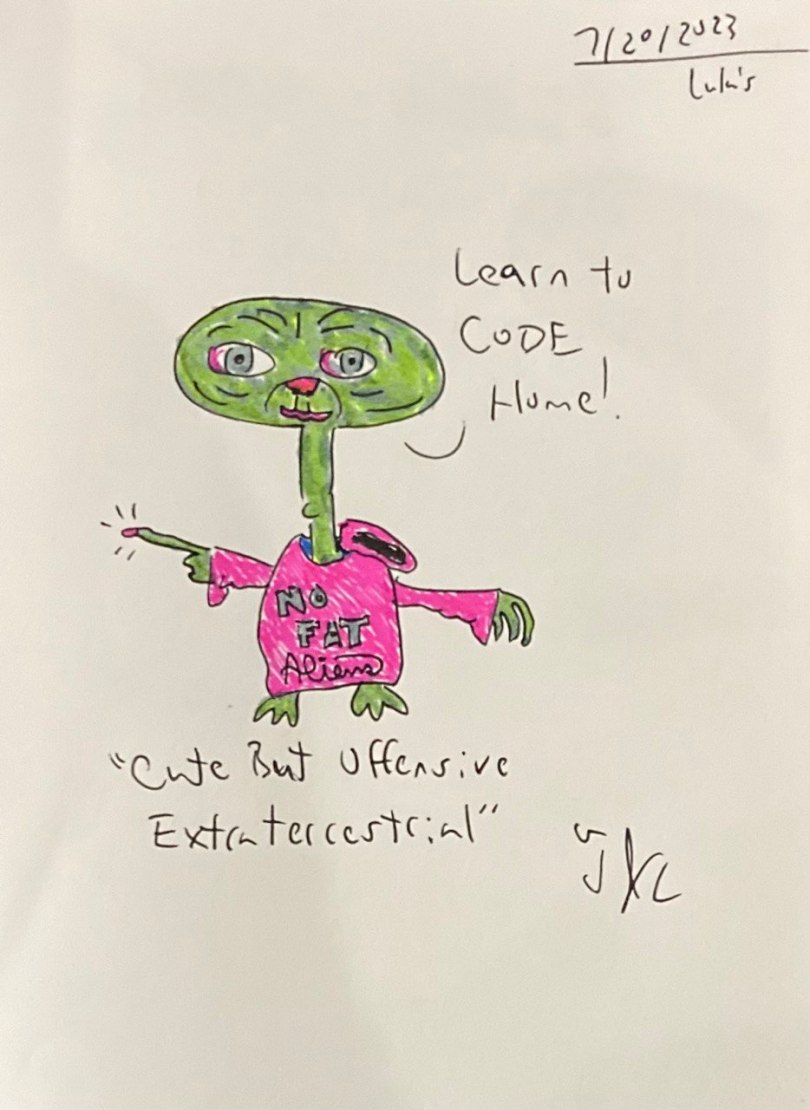
Offensive Poems: With Pictures Preview: “Cute But Offensive Extraterrestrial” & “Space Frog”

The following is a re-posting of this past Sunday’s edition of Sunday Doodles (Sunday Doodles CXCV), which is normally a perk for $5 and up subscribers to my SubscribeStar Page.  The post serves as a preview, of sorts, to the kind of content that will make up (I hope!) my third book, tentatively entitled Offensive Poems: With Pictures.  I thought I’d bring it to the masses—you, my beloved free subscribers and daily readers—to get feedback—and to let you in on this new project.  —TPP

Typically, Sunday Doodles is reserved for the classy $5 and up subscribers, while $3 a month gets the first Sunday of the month to gawk at doodles.  However, I’m opening this post up to all subscribers.

That’s because this weekend’s edition of Sunday Doodles features a preview of my current book project, Offensive Poems: With Pictures.  This project started almost by accident—I was doodling at an open mic night on Tuesday, 18 July 2023, and started sketching people around me.  Two nights later—Thursday, 20 July 2023—at another open mic, I drew “Cute But Offensive Extraterrestrial”; he prompted me to write the haiku “Learn to Code.”

That got me thinking:  what if I wrote a red-pilled haiku for every doodle?  I was already toying with the idea of writing poems to accompany each doodle, but I wasn’t thinking of making them a satirical commentary on the strange times in which we find ourselves.  Now, I can’t stop coming up with pithy verses about the various sacred cows and empty bromides of our time.  It’s remarkable how many Leftist slogans are seven-syllables, which works great for that second line of each haiku.

Why haiku?  I like the challenge of stating a complex sets of ideas in seventeen syllables.  The structure of a haiku—five syllables in the first and third lines, seven syllables in the second/middle line—means I have to be extremely efficient with words.

And, to be totally honest, I just find haiku easier to work with than other poetic forms.  It offers enough flexibility in terms of rhythm, meter, etc., for a hedge-poet like myself to play around with.  Once I have to worry about iambic pentameter, for example, and stressed and unstressed syllables, it’s a bit too much for yours portly.

That said, I wanted some form, as I find most free verse to be too loose.  There is something to be said for structure, as it forces me to think intentionally about every word.  Also, I find that much free verse quickly becomes indistinguishable from prose.  Much of it seems like prose writing with random or mildly clever line breaks.

So!  Enough rambling.  Let’s get to the doodles!

Read More »

Monday Morning Movie Review: Bloody Oranges (2021)

I’m not typically one for “trigger warnings,” but this week’s film is hard to watch.  I’ve seen some pretty foul stuff in all the crappy B-grade horror flicks I consume, and I have, perhaps sadly, become immune to most shocking material.  Just writing that sentence made me feel convicted… dang.

But my crushing Pentecostal guilt can wait until after this film review.  This flick, the 2021 French black comedy Bloody Oranges (or Oranges sanguines in French) possesses some truly difficult scenes to endure.  I found myself watching through my fingers at a couple of points in the film.

It’s an incredible movie, a movie I will heavily discourage most readers from watching.  My parents, my aunts, Audredon’t watch itRead some reviews if your curiosity is piqued, but don’t watch itPonty, you could probably handle it, even though I know how much you hate the frogs.

Read More »

Lazy Sunday CXL: More Movies, Part XI: Movie Reviews, Part XI

This Sunday’s collection of film retrospectives features a trio of darker and weirder fare, especially She’s Allergic to Cats (2016).  Perhaps the long Thanksgiving Break will give you an opportunity to watch a movie about a guy whose “true passion is making weird video art that nobody understands.”  ‘Tis the season… right?

With that, here are another three reviews for your delectation:

  • Monday Morning Movie Review: She’s Allergic to Cats (2016)” – This flick is described on Shudder.com thusly (and the description says it all):

    A lonely dog groomer in Hollywood searches for love, but his true passion is making weird video art that nobody understands. His menial routine spirals out of control when he meets the girl of his dreams, crossing boundaries between reality and fantasy as he dives deeper into his video experiments.

  • Monday Morning Movie Review: Near Dark (1987)” – What an excellent vampire movie!  Near Dark focuses on a relationship between a farm boy named Caleb and a strange girl called Mae.  Mae, of course, turns out to be a vampire, and ends up biting Caleb in his truck amid a frenzied, pre-dawn make-out session.  This bite transforms Caleb into a creature of the night, and as he runs—his body smoking in the harsh daylight—Mae’s cabal of white trash vampires snag Caleb, driving off with him.
  • Monday Morning Movie Review: Heathers (1989)” – Heathers was the writing debut of Daniel Walters, who (according to The Last Drive-in with Joe Bob Briggs) wanted to write a script that felt like a John Hughes film that Stanley Kubrick directed (Kubrick did not direct HeathersMichael Lehmann directed in his film debut).  Well, Walters achieved his goal—this is a very black satire on popularity, mass media, and high school power struggles.

Happy Sunday!

—TPP

Other Lazy Sunday Installments:

Monday Morning Movie Review: The Stuff (1985)

Shudder continues to deliver up the bizarre and unusual, proving it’s well worth the price of admission for the streaming service.  This last week saw the service bring the 1985 film The Stuff to the service.

It’s an unusual horror flick that combines elements of consumer protection advocacy, mass media advertising, consumerism, ruthless business tactics, and addiction into a blob of creamy terror.

Indeed, the film is something like The Blob (1958) and Halloween III: Season of the Witch (1982) rolled into one:  a greedy corporation knowingly sells a dangerous product, which turns out to be a goopy white organism that entire consumes the very people consuming it.

So, essentially, the entire flick is a metaphor for consumerism and corporate greed run amok.

Read More »

Monday Morning Movie Review: Heathers (1989)

Today marks the end of summertime fun and the beginning of work.  Classes for the school year won’t start for another nine days, but I’ll be filling out various bits of legalese paperwork and taking the same bloodborne pathogens quiz I’ve taken every August for the paste decade.

In the spirit of beginning another year of academic rigmarole and inspirational mind-molding, I decided to review the 1989 dark comedy Heathers, starring Wynona Rider and Christian Slater as two oddball teens who declare war against the titular popular clique that rules the school.

I first watched Heathers on Hulu back in 2019 with the girl I was dating at the time.  I remember it being far darker than I anticipated, and found the second half of the film unpleasant.  I usually enjoy unsettling movies, but tonally it seemed “off.”

I re-watched the film a couple of weekends ago on The Last Drive-in with Joe Bob Briggs, and must substantially revise my original assessment of the film.

Read More »

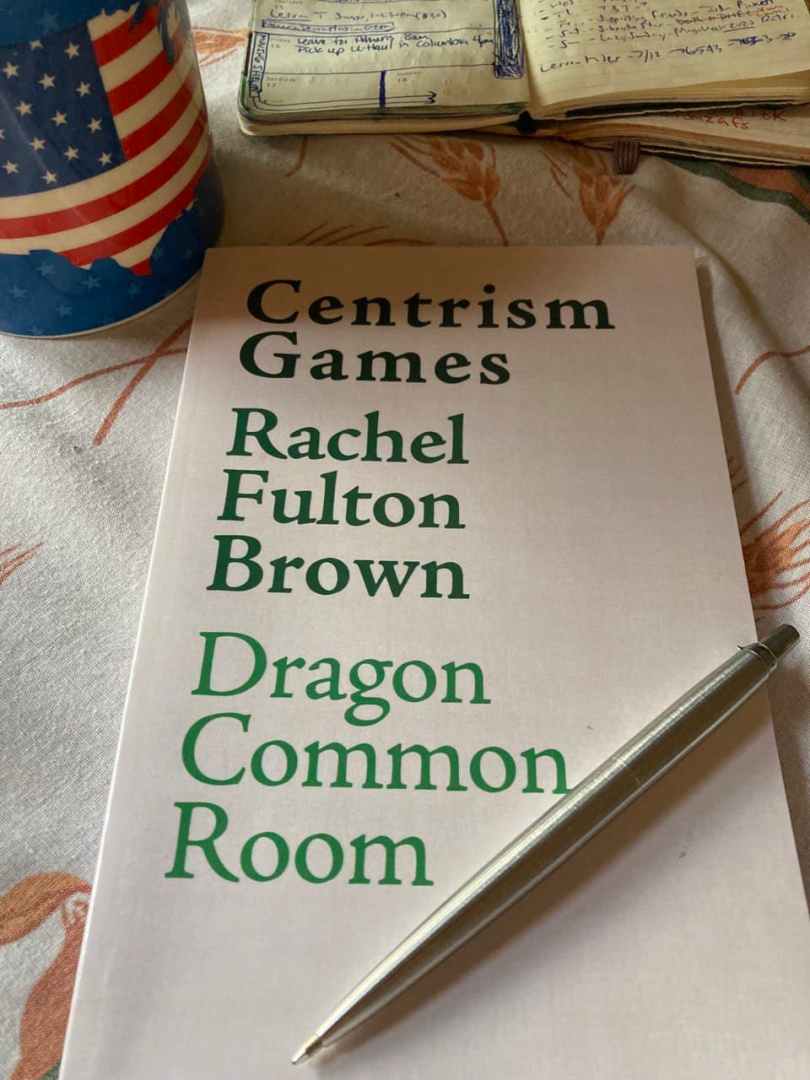
Supporting Friends Friday: Review of Rachel Fulton Brown and Dragon Common Room’s Centrism Games

After sitting with the copy on my nightstand since the book’s debut, I finally sat down and read Rachel Fulton Brown and Dragon Common Room‘s Centrism Games: A Modern Dunciad.  Having read it, my only regret is that I did not do so sooner.

A bit of background is in order:  Dr. Rachel Fulton Brown is a medievalist at the University of Chicago, and is known in our circles as a traditional Christian professor fighting against social justice indoctrination and infiltration of the humanities.

One wouldn’t think the more esoteric realm of medieval history would be a major battleground for the ultra-woke, but it makes sense:  the modern West is profoundly a product of the Middle Ages.  With that in mind, it becomes clear why the progressive revisionists wish to dominate the field:  in rewriting medieval history to fit their woke narrative, it makes the rest of their revisionist project—of casting all white, male, Christian endeavors as inherently wicked—that much easier.

Milo Yiannopoulos’s short book Medieval Rages: Why The Battle for Medieval Studies Matters to America, details that struggle in more detail.  I highly recommend picking it up, as it highlights the length to which the wokesters have gone to silence Dr. Brown.  Correspondingly, it demonstrates Dr. Brown’s incredible courage and fortitude—as well as her cleverly elfish responses to her critics.

Dr. Brown founded a Telegram chatroom, Dragon Common Room, to be a “a place for training in the arts of virtue and poetry. And mischief making for God. We fight the demons with laughter and wit.”  I participate infrequently in chat, but it has become one of my favorites on the platform.  In addition to fighting “demons with laughter and wit,” Dr. Brown and her merry band of righteous mischief-makers wrote, workshopped, edited, and compiled Centrism Games, releasing it as a handsome little volume consisting of seven poems of thirty stanzas each.

The seven poems constitute a mock-epic narrative, modeled after Alexander Pope’s satirical epic The Dunciad.  Whereas Pope’s Dunciad mocked the goddess “Dulness” and her agents, Centrism Games lampoons the goddess Fama—Fame—and her o’er eager knights

Read More »