

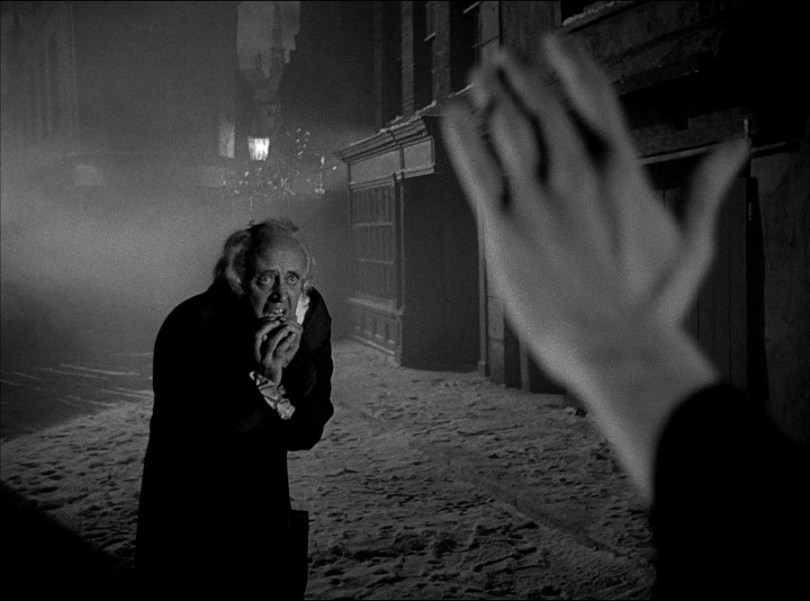
Back in 2022 a couple of my regular contributors and I each took turns reviewing the 1951 film adaptation of Charles Dickens’s A Christmas Carol (for links to all three reviews, click here). The film has since became almost annual viewing for yours portly, a tradition I hope to continue with Dr. Wife.
With all the busyness of the wedding and last week’s school play (as well as this week’s school concert), I decided to take this morning to look back at my review from three years ago.
The film is a poignant reminder to keep the joy of Christmas alive in our hearts, something that is often difficult as the trials of adulthood responsibility exact their toll. But Christmas is the time of year to celebrate the Birth of Jesus, and to recapture—to the extent possible—the simple magic of childhood.
With that, here is 19 December 2022’s “Monday Morning Movie Review: A Very Portly Christmas: A Christmas Carol (1951)“:
Now it’s yours portly’s turn to step up to the plate and take a swing at review a timeless Christmas classic, the 1951 adaptation of A Christmas Carol. Ponty did the film a great service, and I must confess I read his review before viewing the film, which somehow—shamefully!—had slipped through my viewing until this point in my life.
Such is the peril of editing guest contributions: I have to read them in order to write a pithy introduction and to get them scheduled. As such, I’ve read Ponty’s review, which has already been published, and Audre‘s review, which will pop this Wednesday, 21 December 2022. I’ve tried my best to stick to my own thoughts on the film, but Ponty’s review in particular really enhanced my viewing of the film. He doesn’t spoil anything, but his analysis of some of the scenes is quite insightful.
A Christmas Carol has been on my mind a good bit lately. Over Thanksgiving I reconnected with a college classmate from a Fiction Workshop class I took my senior year, herself a self-published author. She has been brainstorming ideas with me about an alternate telling of A Christmas Carol involving Scrooge and restorative, romantic relationship—a God-centered romance that turns the acquisitive, miserly Scrooge into the generous, giddy soul we see at the end of the film. I won’t reveal more, but it’s a fun project, and in line with her approach to writing.
All digressions aside, I must echo the sentiments of my contributors: the 1951 version starring Alistair Sim as the sinister Scrooge is one of the most arresting bits of storytelling I’ve ever seen set to film.
One element that struck me is just how ruthless Scrooge is, to the point that it is shocking that he actually gives Bob Cratchit the day of Christmas off from work. We quickly learn, however, that it was not ever thus—when the Ghost of Christmas Past takes Scrooge back through his life, we learn that he was, at one time, a jolly, fun-loving sort, a man who worked hard and played harder, who possesses a rosy view of life despite some childhood hardships.
His father, for example, blamed Scrooge for Scrooge’s mother’s death, as she died in childbirth. Scrooge’s punishment was exile to a lonely boarding school, where his beloved sister comes to rescue him. Later, that same sister dies giving birth to Scrooge’s nephew, perpetuating a cycle of loneliness for the miser.
Charles Dickens had a certain obsession with the ill effects of the Industrial Revolution, which he could see plainly around him in mid-nineteenth-century London: the long hours, the grubby living conditions, the low pay. Shades of that come out in the film, as we see a young Scrooge, now in the employment of a man addicted to “progress” and new-fangled manufacturing methods, debating with his employer about the dehumanizing and destructive aspects of the machines. Scrooge slowly comes to see people as machines, too, mere tools by which he can gain further money.
Another interesting scene is the one in which Scrooge and Marley save their crooked employer from an embezzlement scandal (which would have sent him to prison and would have resulted in potential losses for other warehousing businesses in London) through an aggressive, opportunistic buyout, just as their employer had done to old Fezziwig, the jolly businessman of Scrooge’s early career. At this point, Scrooge is in full wickedness mode, worshipping “a golden idol” at the expense of all else.
That worship goes to the point that Scrooge delays going to Marley’s deathbed until work hours end at 7 PM, the dying, gasping Marley somehow managing to hold on for a few more hours to sigh his last words to Scrooge. There is a poignancy here, as Marley warns Scrooge not to waste his life on greed and avarice. Alistair Sim’s acting is superb, as we see a look of dread and remorse pass over his face for just an instant, before resuming his hardened scowl.
We all know the rest—Scrooge comes to realize that his miserliness and greed have made life unbearably hard for those around him, though they all joyfully celebrate Christmas while he sips hot soup alone. What’s remarkable is how Sim plays this transformation convincingly—everything Scrooge does seems genuine, whether it be for good or for ill.
The scene in which the Ghost of Christmas Yet-to-Come shows Scrooge is grave is incredibly well shot, and supports Ponty’s argument that this flick is best seen in black and white. I can’t find a good screenshot or video of this pivotal scene, unfortunately, but it’s powerful: the grave is wreathed in shadows, out of which falls a devastated Scrooge, clinging to his lonely, crumbling headstone. That’s the pivotal moment in which Scrooge thinks all is lost, before his joyous redemption comes.
This flick is also spooky, as it should be—it’s a ghost story, after all, and the Victorians did two things well, and always together: Christmas and ghost stories. Marley rattling his chains—which Scrooge amusingly writes off as some “undigested beef… a bit of cheese”—is a terrifying racket, and the Ghost of Christmas Yet-to-Come is always a scary sight.
I encourage to watch this film right away.
Merry Christmas!
—TPP
 The Portly Politico
Very nice review of a classic. I consider Sim’s Scrooge one of the two
essential portrayals on film.
LikeLiked by 1 person
Agreed! What would you consider the other essential film portrayal?
LikeLike
George C Scott in the 1984 version. Very enjoyable.
LikeLiked by 1 person
Yes! Love George C. Scott.
LikeLike