Lazy Sunday CXXII: MAGAWeek2020 Posts

In my enthusiasm to for the animal kingdom a couple of weeks ago, I neglected to kickoff MAGAWeek2021 with a Lazy Sunday retrospective of MAGAWeek2020 posts.

Well, better late than never.  Here’s all the goodness from MAGAWeek2020, which went pretty heavy on the first couple of decades of the twentieth century.  Even my post on a contemporary figure, Tucker Carlson, had some Progressive Era ties:  The Tuck is a big fan of Theodore Roosevelt, who enjoyed two separate posts last year.

Remember, these posts are available in full if subscribe to my SubscribeStar page for as little as $1 a month.  I’ve included links to the preview posts here on the blog, as well as the direct links to the full posts on my SubscribeStar page.

With that said, enjoy!

  • #MAGAWeek2020: Theodore Roosevelt, Part I” (post on SubscribeStar) – This first post on Theodore Roosevelt details his early life:  his childhood illness and his strenuous efforts to overcome it; the death of his mother and wife one the same day; his move to the Dakotas; and his command of the Rough Riders during the Spanish-American War.
  • #MAGAWeek2020: Theodore Roosevelt, Part II” (post on SubscribeStar) – This second post on TR examines his presidency in greater detail.  TR was a trailblazing president of the Progressive Era, and while some of his notions would rankle conservatives today (as they did at the time), he was, perhaps, the greatest populist president since Andrew Jackson.
  • #MAGAWeek2020: The Tuck” (post on SubscribeStar) – Speaking of populists, this profile celebrates the elitist who wants leaders to care about the people they govern.  Tucker Carlson is the only major voice in the mainstream media who advocates for an American First, pro-nationalist, pro-populist message.  He’s not the only such voice, but he’s the only one currently with the legitimacy of the mainstream press behind him—even as the National Security Agency is spying on him!  But, as I always say, you can’t cuck The Tuck!
  • #MAGAWeek2020: Calvin Coolidge” (post on SubscribeStar) – Calvin Coolidge has enjoyed a bit of a revival in recent years as a stand-in for the tax reform debate.  In many ways, he was the antithesis to Theodore Roosevelt’s gutsy, activist style of leadership.  Coolidge took the role of president seriously, chiefly the idea that he was merely presiding over the country, not lurching into towards reform.  His steady, quiet, hands-off leadership allowed the country to flourish, and he holds the distinction of being the only president to shrink the size of the federal budget by the time he left office.

Well, now you’re all caught up.  Lots of good stuff to read—and just for $1 a month!  You can’t beat that, eh?

Happy Sunday!

—TPP

Other Lazy Sunday Installments:

Tip The Portly Politico:  Support quality commentary on politics, education, culture, and the arts with your one-time donation.

***NOTEThis link is NOT a subscription to my SubscribeStar Page; it is for a one-time donation/tip via PayPal. To subscribe to my SubscribeStar page, use this URL:   https://subscribestar.com/the-portly-politico***
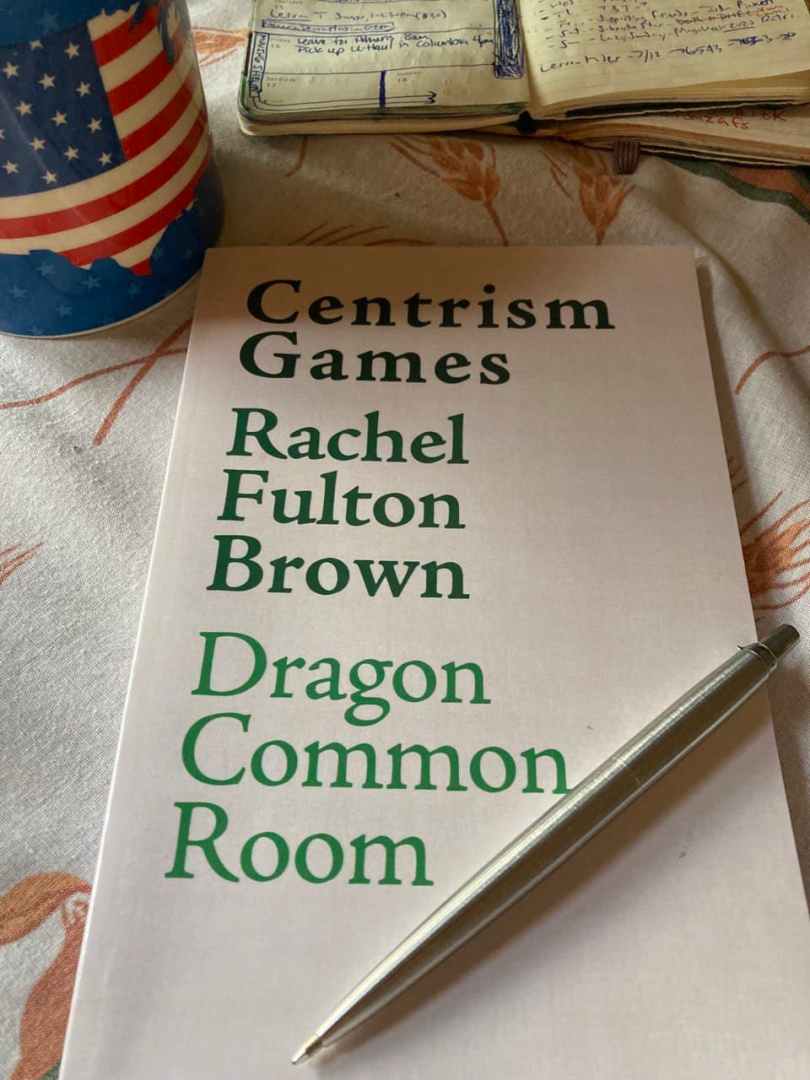
Supporting Friends Friday: Review of Rachel Fulton Brown and Dragon Common Room’s Centrism Games

After sitting with the copy on my nightstand since the book’s debut, I finally sat down and read Rachel Fulton Brown and Dragon Common Room‘s Centrism Games: A Modern Dunciad.  Having read it, my only regret is that I did not do so sooner.

A bit of background is in order:  Dr. Rachel Fulton Brown is a medievalist at the University of Chicago, and is known in our circles as a traditional Christian professor fighting against social justice indoctrination and infiltration of the humanities.

One wouldn’t think the more esoteric realm of medieval history would be a major battleground for the ultra-woke, but it makes sense:  the modern West is profoundly a product of the Middle Ages.  With that in mind, it becomes clear why the progressive revisionists wish to dominate the field:  in rewriting medieval history to fit their woke narrative, it makes the rest of their revisionist project—of casting all white, male, Christian endeavors as inherently wicked—that much easier.

Milo Yiannopoulos’s short book Medieval Rages: Why The Battle for Medieval Studies Matters to America, details that struggle in more detail.  I highly recommend picking it up, as it highlights the length to which the wokesters have gone to silence Dr. Brown.  Correspondingly, it demonstrates Dr. Brown’s incredible courage and fortitude—as well as her cleverly elfish responses to her critics.

Dr. Brown founded a Telegram chatroom, Dragon Common Room, to be a “a place for training in the arts of virtue and poetry. And mischief making for God. We fight the demons with laughter and wit.”  I participate infrequently in chat, but it has become one of my favorites on the platform.  In addition to fighting “demons with laughter and wit,” Dr. Brown and her merry band of righteous mischief-makers wrote, workshopped, edited, and compiled Centrism Games, releasing it as a handsome little volume consisting of seven poems of thirty stanzas each.

The seven poems constitute a mock-epic narrative, modeled after Alexander Pope’s satirical epic The Dunciad.  Whereas Pope’s Dunciad mocked the goddess “Dulness” and her agents, Centrism Games lampoons the goddess Fama—Fame—and her o’er eager knights

Read More »

Monday Morning Movie Review: Creepshow (1982)

I’ve been enjoying my Shudder membership immensely, and it’s pretty much become the main streaming service I watch when I’m viewing solo.  Needless to say, I’ve consumed a lot of movies on the service already, so brace yourselves for many horror movie reviews (as if I didn’t mostly write those already).

This week, I’m looking at the horror anthology Creepshow (1982).  Horror anthologies can vary in quality, with usually one very strong entry, and then some forgettable duds.  Creepshow, for the most part, beats the odds.

I don’t remember when I first saw Creepshow, but I was probably far too young.  What I do know is that some of its most iconic, comic-book-inspired images have stuck with me down to the present.  I didn’t even know they were from Creepshow until re-watching it all these years later, but they’ve been seared into my brain.

For example, the whole plot of “The Lonesome Death of Jordy Verrill“—which stars Stephen King in his first film role—has always stuck with me (indeed, I have an idea for a short story with a similar premise tentatively entitled “Yeast Man”):  the idiot farmer slowly succumbing to the weird alien plant.  Ted Danson’s submerged head in “Something to Tide You Over” is another memorable image, as is the flood of roaches entering the impossibly sanitized apartment in “They’re Creeping Up on You!

Read More »

Lazy Sunday CXXI: MAGAWeek2021 Posts

Last week was MAGAWeek2021, a week dedicated to the men, women, ideas, events, and things that, in their own way, MADE AMERICA GREATMAGAWeek2021 posts were SubscribeStar exclusives.  If you want to read the full posts, subscribe to my SubscribeStar page for as little as $1 a month.

In case you missed any of these posts, no worries!  You can catch up on them now with this edition of Lazy Sunday.  Here’s all the greatness in one convenient post:

So, with all that goodness, why haven’t you subscribed yet?  Hmmmmm?

Happy Sunday!

—TPP

Other Lazy Sunday Installments:

Tip The Portly Politico:  Support quality commentary on politics, education, culture, and the arts with your one-time donation.

***NOTEThis link is NOT a subscription to my SubscribeStar Page; it is for a one-time donation/tip via PayPal. To subscribe to my SubscribeStar page, use this URL:   https://subscribestar.com/the-portly-politico***

TBT^16: Happy Birthday, America!

Since 2018, I’ve been reblogging my original “Happy Birthday, America!” post, which dates back to 2016 and the old Blogger site.  Each year I add another layer of commentary to to the original post, which essentially analyzed and discussed very briefly Lincoln’s Gettysburg Address.

My view on Lincoln’s role in American history has shifted somewhat in five years, but it’s undeniable that the Gettysburg Address is a powerful, succinct speech.  The Address, unlike my windy blog posts, is the quintessential illustration of the principle that “less is more.”

Like last year, this year’s post is a bit delayed due to the way the Fourth fell this year (on a Sunday).  It was a very quiet Independence Day:  my younger brother had my girlfriend, myself, and another friend over to have hot dogs and burgers, as his wife and kids were away visiting family.  I manned the grill, turning the dogs like a human-operated convenience store hot dog roller.  The thin, diner-style smash burgers my brother made were delicious, especially with American cheese.

This year was the first in awhile that didn’t really feel like the Fourth of July, even though last year’s celebration was during the supremely unfree Age of The Virus.  I suppose the holiday snuck up on me, and with the nation in the state it is, perhaps I just wasn’t feeling all that patriotic.

Nevertheless, I reminded myself that America has been on the ropes before, and we’re not going to let some bug-eating, gender-confused CommieNazis destroy our hope.

With that, here are several posts commemorating July Fourths past:

Read More »

SubscribeStar Saturday: The Portly Politico Summer Reading List

Today’s post is a SubscribeStar Saturday exclusive.  To read the full post, subscribe to my SubscribeStar page for $1 a month or more.  For a full rundown of everything your subscription gets, click here.

It’s that time of year again:  summer!  That means we’re due for The Portly Politico Summer Reading List 2021!

After publishing the list a bit later than usual last year, I’ve decided that the list should be a midsummer event—just in time for Independence Day.

But, like Sunday Doodles—a perk for $5 a month subscribers—my philosophy is “better late than never!”  And with the Independence Day holiday approaching, it’s a great time to do some reading.

For new readers, my criteria is pretty straightforward.  To quote myself from the 2016 list:

The books listed here are among some of my favorites.  I’m not necessarily reading them at the moment, but that doesn’t mean you shouldn’t!

Pretty vague, I know.  Additionally, I usually feature three books, plus an “Honorable Mention” that’s usually worth a read, too.

For those interested, here are the prior two installments:

With that, here’s The Portly Politico Summer Reading List 2021:

1.) Thomas Harris, Hannibal (1999) – I recently wrote a review of the novel Silence of the Lambs, the second book in a series containing the charismatic, devilish cannibal, Dr. Hannibal Lecter.  I very much enjoyed the novel, but having seen the film, I already knew many of the plot points.  That did not diminish the quality of the novel—Thomas Harris is an exquisitely descriptive writer—but it did take away some of the thrill.  The point of a good thriller is to be constantly in a state of suspense; when one already knows the major plot points, that sense of suspenseful uncertainty is diminished.

As such, I was quite excited to read Hannibal, the third installment in what might be called Harris’s “Hannibal Cycle.”  I did not know any of this story going in, beyond some whispers about the outcome of the magnet relationship between Dr. Lecter and FBI agent Clarice Starling.  The book takes place seven years after the events of Silence of the Lambs, with Dr. Lecter on the loose and living secretly as an academic in Florence, Italy.

Meanwhile, one of Dr. Lecter’s former victims, pig tycoon and sadist Mason Verger, has put a hefty bounty on Dr. Lecter’s head, and employs a ruthless team of Sardinian kidnappers—and a corrupt, disgraced Italian cop—to hunt down the fugitive.

Tossed into the mix is Clarice Starling, who finds herself increasingly disillusioned with the bureaucracy and careerism present in the upper echelons of the FBI and the Department of Justice.  Her mentor, Jack Crawford, is creeping towards retirement, and is no longer the robust agent he once was.  Meanwhile, a lecherous deputy attorney general—working hand-in-glove with Verger—sets about destroying Starling’s reputation at the Bureau, both to undermine her search for Dr. Lecter, and because she rebuffed his sexual advances.

Whereas Silence of the Lambs portrayed the FBI glowingly as a competent, professional organization with the means and tenacity to track down the slipperiest serial killers, Hannibal resonates much more with the modern reality of the FBI—a venal, corrupt organization that, rather than solving actual crimes, uses its power to oppress and harass law-abiding citizens.  The corruption on display, with highly-placed government officials attempting to advance their professional and political careers by working with wealthy scumbags, rings true.  In the eleven years between writing Silence and Hannibal, it appears Harris had a real change of heart.

Overall, I can highly recommend Hannibal.  Be warned that it is a long read, with 103 chapters and around 560 pages, but it’s rarely a slog and always a chilling pleasure.

To read the rest of this post, subscribe to my SubscribeStar page for $1 a month or more.

TBT: Albino Giraffes Poached

I’ve had animals on the brain lately, especially dogs.  Perhaps it’s my girlfriend’s sweet German shepherd puppy, or my parents’ photogenic rat terrier; regardless, I realize I am becoming a softy for critters.

Not just the furry, charismatic ones, either:  I’m considering adding a small frog garden to my existing flower beds, as I have a number of toads and frogs that take up residence in my beds and planters already.  Giving them a murky little pond to splash about in would be fun, and might help cut down on some bugs in the yard.

So it is that I’m looking back to this horrible story from March 2020, about the poaching of two rare albino giraffes in Kenya.  In the original piece, I make quite a few wild speculations about the nature of the poachers, even implicating the 50,000 Chinese immigrants to the country.

Given that The Virus originated, most likely, in a Wuhan virology lab—suggesting the Chinese were working on some kind of horrible biological weapon—I’d say mistrust in China’s motives is justified.  It’s also a very weird culture, as the wet markets proved.  The Chinese long believed rhinoceros horn to be an aphrodisiac; how far-fetched would it be to think they would believe something similar about the flesh of an albino giraffe?

For that matter, Africa is still a land filled with many folk beliefs and superstitions.  Albino humans in Tanzania, for example, are the targets of witch doctors, who harvest albinos’ body parts for use in their dark magicGavin McInnes frequently mentions the belief among some African tribes that bald men’s heads are filled with gold.  And there is the horrific practice of AIDS sufferers raping virgins—especially very young children—in the belief that doing so will cure their affliction.

These are terrible things—far more wicked and evil than the murder of two albino giraffes.  But how we treat God’s Creation, even in its lower orders, is a reflection of how we treat one another.  Animal mutilation and murder is a key sign of a future serial killer or sociopath.

With that depressing preamble, here is 24 March 2020’s “Albino Giraffes Poached“:

Read More »

Make-A-Death-Wish

UPDATE:  In case anyone missed it, The Make-A-Wish Foundation REVERSED their decision to require terminally ill children and their families to be fully vaccinated in order to receive their wishes: https://theportlypolitico.com/2021/06/29/decency-prevails-make-a-wish-foundation-rescinds-mask-requirement-for-children/

Read The Foundation’s statement here: https://wish.org/news-releases/reemergence

* * *

The Make-A-Wish Foundation, which grants children with terminal medical conditions a “wish,” has announced it will require all wish recipients and their family members to be fully vaccinated against The Virus.

No vaccination, no wish fulfillment.

Naturally, this requirement is absurd, and represents a new low in the race to virtue-signal in The Age of The Virus.  At this risk of sounding macabre and insensitive, The Make-A-Wish Foundation is requiring children who are already dying to take a vaccine against an illness with a 99.5%+ survivability rate.

It’s a purely symbolic action that achieves nothing beyond making it more difficult for dying children to enjoy one last bit of whimsy before they cross over into the arms of Jesus.

Read More »

Supporting Friends Friday: The Cinematic Compositions of Mason Sandifer

The first two editions of Supporting Friends Friday (highlighting the poetry of Jeremy Miles and the music of Frederick Ingram) have been well-received, particularly by the friends being supported, and it gives me a great deal of joy to showcase their works, albeit from the humble platform of this blog (read by dozens a day!).  As I have written many, manymany times over the last year, making a living through creative work, like writing books and playing music, is difficult, especially in The Age of The VirusBuilding up a community of artists who celebrate one another’s works is an important part of the indie music and publishing business.

It’s also just fun, much like the music of Robert Mason Sandifer, the young composer I’m highlighting today.  Mason, as I call him, is a private student of mine, so this post is perhaps tad self-serving, but even if he weren’t my student, I would adore his music.

Read More »

Hard to Swallow

A big H/T to Neo at Nebraska Energy Observer for the inspiration for today’s post:  in his latest edition of Sunday Funnies (“Sunday Funnies:  Juneteenth & Other Things“), Neo includes a tabloid-style headline that reads, “I Was Nearly Krilled!: Lobster diver says he was swallowed by humpback whale.”  The pun “krilled’ is circled in orange.

I looked it up, and it’s a real story:  Michael Packard, a fifty-six-year old lobster diver from Massachusetts, was briefly trapped in the mouth of a massive humpback whale.  According to Packard, he was in the mouth of the great beast for about thirty seconds, before the creature surfaced, shook its head back and forth, and spit Packard into the air.

Here is the relevant excerpt of Packard’s account, as quoted at NPR.org:

Packard told WBZ-TV that he was about 45 feet down in the water when he suddenly felt “this huge bump and everything went dark.” He initially feared he had been attacked by a shark.

“Then I felt around, and I realized there was no teeth and I had felt, really, no great pain,” he said. “And then I realized, ‘Oh my God, I’m in a whale’s mouth. I’m in a whale’s mouth, and he’s trying to swallow me.’ “

Packard was still wearing his scuba gear and breathing apparatus inside the whale’s mouth, which he said was completely dark. Fearing he wouldn’t make it out alive, he thought about his wife and sons.

After about half a minute, the whale rose to the water’s surface and began shaking its head from side to side.

“I just got thrown in the air and landed in the water,” Packard recalled. “And I was free, and I just floated there … I couldn’t believe it. I couldn’t believe I got out of that.”

The story sounds incredible—and, according to whale experts, the odds of it happening are extremely rare—but it is within the realm of possibility.  Humpback whales lack teeth, and instead filter feed through baleen, long, hair-like “teeth” that filter out sea water and trap small prey, like shrimp and krill, inside.  Humpback whales often feed using lunge feeding, during which the whales “open their mouths, accelerate and ‘take in 10 SUVs worth of water and fish and then everything else,'” according to Iain Kerr, quoted in the same NPR piece.

Apparently, Packard just happened to be swimming in the wrong place at the wrong time, and the great whale accidentally sucked him up with tiny sea critters.

Read More »