

We have a new contributor here at The Portly Politico, a chap from jolly old England, Brian Meredith. He’s a graphic designer by trade and is Internet friends with our own senior correspondent, Audre Myers.
In this piece, “There’s No Such Thing as Bad Art,” Brian makes an essentially semantic argument: if we glorify pieces we like or appreciate as “art,” we conversely consider “bad” pieces as “not art.” Ergo, we cannot have “bad art” if art is definitionally whatever we define as “good.”
As Brian noted in an e-mail to me: “I would like to make it clear that my intention was to write something about the use of language rather [than] about art itself and in particular the commonly-accepted assumption that the very idea of art confers status.”
It’s an interesting argument, and one that I think has its merits. I disagree with the underlying premise, in that we can create things broadly termed “art” that are, indeed, quite poor in quality, either because of aesthetic choices or merely a lack of craftsmanship on the part of the artist. There can be “art” of varying qualities.
But I think Brian is correct when we look at “art” as a term of social categorization—as a form of judgment. In that regard, anything that we think is worthy of praise—even if from an objective or technical standpoint it is not very good—could be elevated to the status of “art,” as his argument is that society uses the term “art” almost exclusively as a term of praise. As such, if enough rubes agree that, say, an ashtray is a work of art, it is merely laudatory “art,” and not “bad art,” which—again—cannot exist in this usage of the word.
That explains why there are plenty of poor craftspeople whose work is lauded as “art” because they are well-connected (as I have written about before on this blog).
Ultimately, this subjective, linguistic/definitional argument results in the kind of postmodern garbage we see coming out of art studios today. I do not think Brian would agree with the sentiment he points out—he seems to be a diagnostician, not a physician, of this problem—but its existence is certainly real. As such, because lay persons exclusively use the term “art” in a laudatory context, the result is that we do end up with a great deal of bad art, even if definitionally that’s impossible.
It’s an intriguing semantic argument, but like most semantic arguments, it seems like it too easily devolves into postmodern nonsense. Again, I don’t think Brian is advocating for that, but is merely diagnosing the problem.
With that, here is Brian Meredith’s “There’s No Such Thing as Bad Art”:
There’s no such thing as Bad Art.
The term ‘art’ is one of those words which means so many things to so many people. Not even the dictionaries can agree.
The online dictionary Vocabulary keeps the definition fairly objective and defines it as: “Art is the expression of ideas and emotions through a physical medium, like painting, sculpture, film, dance, writing, photography, or theatre.”
Whereas, over at Collins, they prefer to insist that there must be specific purpose to art and so their definition runs along these lines: “Art consists of paintings, sculpture, and other pictures or objects which are created for people to look at and admire or think deeply about.”
There are many more variations on these themes, but I don’t want to dwell on dictionary definitions. The reality about language out here in the real world, is that words come to mean what people mean by them when they employ them, combined with what people understand them to mean when they hear them used, whether dictionary types like it or not.
And for most people the word ‘art’ is not merely an objective term to describe a range of activities or objects. In common usage it is quite clearly employed as a means of conferring approval, in much the same manner as awarding a certificate or a medal. Anything which is the product of a creative process therefore has to earn the right to be regarded as a work of art.
And it can be an object far from the minds of dictionary editors. When Aunt Edith unveils the birthday cake she has spent many long hours icing for her twin nieces, everyone agrees it is so good, it’s ‘a work of art’. And this accolade is not confined solely to the product of long and skilful labour. The face of a beautiful woman is just as likely to be referred to at some time or other as being a work of art. Not merely resembling a work of art, but actually ‘being’ one.
So, if the term ‘art’ is reserved for those things we wish to praise, what about paintings, sculptures and other products of artistic endeavour which do not meet with our approval? Are these things bad art? No, they are more likely to be dismissed as ‘not art’ rather than bad art.
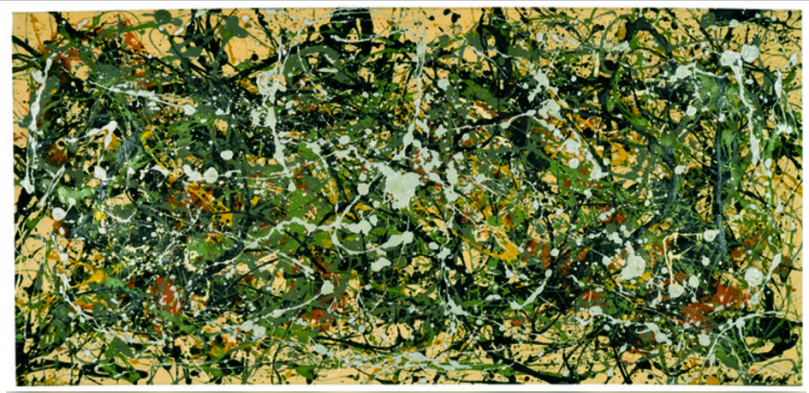
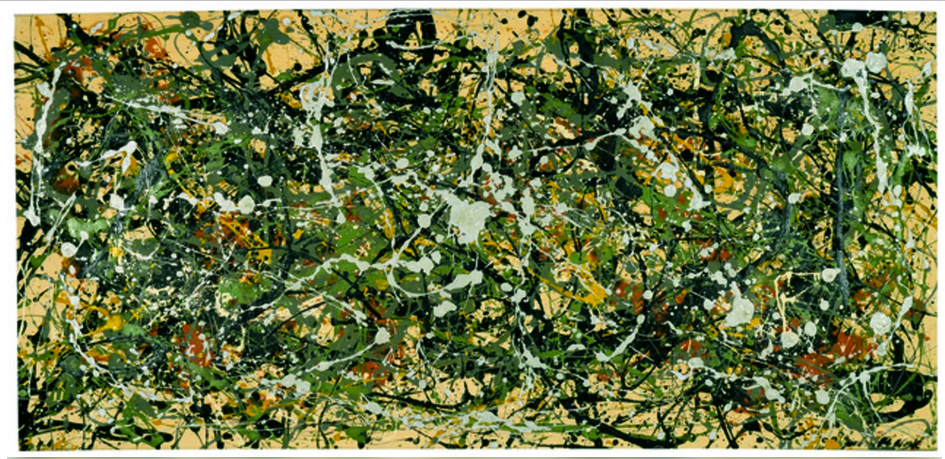
I well remember hearing my mother’s unequivocal condemnation of an exhibition of Jackson Pollock’s splish-splash paintings, which consist of enormous canvases covered in paint of all colours. Jackson’s method is to stretch the canvas out on the floor and to walk around and across the picture area, dripping the paint down onto the canvas, or sometimes throwing the paint into the air for it to land as it may. Other, more deliberate marks are made by dripping the paint from the end of a stick. At no point does he touch the surface as one would with a brush, whilst the height from which the paint is launched, determines the ‘splash factor’.
Seeing a clip of this so called ’action painting’ on the TV news, on the eve of a show in New York after the 44 year-old artist’s untimely death in 1956, after crashing his car while drunk, my mother must have spoken for many millions of disapprovers when she dismissed this activity completely, as ‘not art’.
So if we are to condemn all art of which we disapprove as ‘not art’ then logically, there can be no such thing as bad art.
 The Portly Politico
I can agree with Brian. Art is art and it’s very subjective to what we feel about it. Personally I feel like landscapes and portraits are pretty boring, but abstract art can be pretty cool. As long as we have art, and artists that create it, we should appreciate their work and the art itself.
LikeLiked by 3 people
My better half is an artist – predominantly sculptor but she’s pretty handy with a brush too – and though surrealism is her favourite form, the only work of hers we have in the house is an abstract which, incidentally, she hates and I love. Every day I look at it and can see different things.
When she’s world famous, that abstract will be worth a fortune but I wouldn’t part with it, not for all the gold in Midas’s palace.
LikeLiked by 3 people
That was one of things I wanted to do after I retired, learn how to sculpt. Sigh. It never happened. Frowny face. Tell her I’m jealous.
LikeLiked by 2 people
If you lived in the same country as us, she’d teach you. Alas, God knew that the States needed its own angel. 😉
LikeLiked by 2 people
Bless your dear, kind heart. Humbled.
LikeLiked by 2 people
It’s never too late to grab some modeling clay and go to town!
LikeLiked by 2 people
I totally understand that, 39 Pontiac Dream.
LikeLiked by 3 people
I’d love to see a picture of that abstract someday—and Tina’s other work!
LikeLiked by 2 people
Welcome, Brian! You’ll be happy here; Port is a good guy and he has some interesting readers. Loved the article – well done you!
LikeLiked by 2 people
Thanks for sending him my way, Audre!
LikeLiked by 2 people
👍😄
I’m so glad to see you here, Brian. I’ve been trying to send people here from TCW for quite a while but as it turned out, it took our sweet, dear Audre to bend your ear and get you over! 😂
And I agree – Tracy Emin’s Unmade Bed isn’t bad art; it’s not art! 😂
LikeLiked by 3 people
Whilst I agree with you on Tracy’s bed, I should stress that this ‘essay’ is not about my tastes in art, but about the way the term ‘art’ is used to express approval and so, in popular usage it’s not the objective descriptive term that people believe it to be.
Just by way of detail, I like Jackson Pollock’s work. When I was in New York, one of my ‘must-go’ places, after The Statue and the Empire State Building naturally, was the Guggenheim Museum where they have a good permanent collection of Pollock’s work from all periods. I guess final proof comes from the fact that I have a large framed print of ‘Convergence’ on my living room wall!
LikeLiked by 2 people
Fun fact: Jackson Pollock is from Sumter, South Carolina, which is about thirty minutes down the road from me.
LikeLiked by 1 person
I take that back; apparently, he was not from Sumter: https://en.wikipedia.org/wiki/Jackson_Pollock#Early_life_(1912%E2%80%931936)
I must be confusing him with another artist of the same time. D’oh!
LikeLiked by 1 person
I got that. I was referring more to your bad art, not art comment. 👍
LikeLiked by 1 person
My concern about the word ‘art’ and its common usage it that it is usually confined to things that have no utilitarian value, things that can only be looked at, but not used. While I have no objection to traditional art like paintings and sculpture (I regard most modern art as a con) and appreciate their intrinsic beauty, I can also see that beauty in a well-designed bridge, an old sailing ship or steam locomotive, even some cars. Maybe that’s because I’m an engineer.
LikeLiked by 2 people
Great point, Decaffeinated82aa0a0d53 (Tom). On my recent trip to Chicago, I was struck by how much art went into otherwise utilitarian things, like buildings. I think art can serve a practical, as well as an aesthetic, function.
LikeLiked by 2 people
I agree, I’m also a huge fan of architecture and civil engineering, with a particular interest in bridges.
A couple of years ago, I wrote a piece for The Conservative Woman examining how the design of a couple of these supposedly prosaic objects which fill our daily lives, do seem to represent the society which created them.
If you’d be interested to read it, the title of the piece was,
‘A brief history of modern Britain in two bridges”
LikeLiked by 2 people
Looking forward to reading it.
Here’s a link for interested readers: https://www.conservativewoman.co.uk/a-brief-history-of-modern-britain-in-two-bridges/
LikeLiked by 1 person
Brian
I run a free magazine called Free Speech (Free Speech Backlash | Free Speech Backlash). If you ever want to do a piece along those lines for us I’ll be very grateful.
Tom Armstrong
LikeLiked by 2 people
It’s a great site!
LikeLike
PS: I have no idea how to change that absurd moniker the comment site gave me.
Tom Armstrong.
LikeLiked by 2 people
Don’t worry, Tom “Decaffeinated82aa0a0d53” Armstrong. Your WordPress-assigned moniker is your true identity now.
LikeLiked by 1 person
You can change it in your WordPress profile. 👍
LikeLiked by 2 people
That’s why 39 Pontiac Dream will soon be 39aa0a0d39 Pontiac decaffeinated Dream 39 soon enough.
LikeLike