Romney Gets One Right

Okay, okay—before you start pelting me with the citrus fruit of your choice, let me make it clear:  I have no love for Mitt Romney.  I think he’s a traitorous, chimerical liar whose positions bend and twist with the ever-changing fashions of the Left.  He strikes me as a coward and opportunist, who will gladly slit his own party’s throat for a farthing of accolades from Democrats and the progressive press.

All that said, I’m intellectually honest enough to give credit where it is due, and even a stopped Mormon is right twice a day.  Mitt Romney has proposed a bill (forgive me for linking to the Never Trumpers at The Dispatch) that he argues is intended to alleviate childhood poverty, but is really a pro-natalist plan:  direct payments of $350 for children five and under, and $250 a month for children six through seventeen, with a maximum annual benefit of $15,000 annually, and payments beginning four months before a child’s birth.

Read More »

Monday Morning Movie Review: Witness (1985)

Just to prove that I don’t just watch cheesy horror movies (and that Hulu actually has more to offer than such films), this Monday I’m reviewing something a bit different:  the 1985 neo-noir Amish thriller Witness, starring Harrison Ford as Detective John Book, a clean cop hiding from his dirty colleagues in Pennsylvania’s Amish Country.

The movie is unique in that it contrasts the grittiness of the city with the tranquility and traditions of Amish country life.  There seemed to be a vague cultural fascination with the Amish that lasted from the 1980s up to around the turn of the century (take, for example, 1996’s Kingpin or Weird Al’s hit “Amish Paradise” from the same year).  The Amish are, indeed, interesting, but I’m not sure what accounts for this brief, generational curiosity in the rural pacifists.

Read More »

The Last Day of Freedom?

Here we are, 19 January 2021—the last day of basking in liberty before Biden the Usurper assumes the throne.  For all his personal foibles and occasional missed opportunities (while acknowledging, of course, his many achievements), President Trump at least fought to ensure that Americans could enjoy freedom and opportunity.  Under progressive rule, no such guarantees exist.

But rather than look about gloomily at what is to come, I’d like to offer some words of exhortation.  Times will not be easy for conservatives and Christians over the next four years, but I’m trying to embrace this new progressive era with some cautious, small-scale optimism.

For one, I think the whole sordid election fraud, as well as the bipartisan effort to impeach President Trump for—if we’re honest about it—discouraging violence and encouraging peaceful protest—has confirmed for many of us that the elites of both parties are against us.  As such, effecting change at the national level seems increasingly futile.

That might sound discouraging, but consider it from another angle:  if we can’t make much of a dent at the national level, then why waste the energy?  Instead, let’s focus our efforts locally.

Read More »

Mississippi Meanderings

At the tail end of 2020—and into the New Year—I visited the small town of Lucedale, Mississippi, to meet my girlfriend’s family.  I flew in last Wednesday and we drove back Saturday.

I’ve driven through Mississippi before, and was in Jackson a couple of years ago for a friend’s wedding.  This time I was much further south, as Lucedale—located in George County—is very close to the Gulf Coast, and about fifty minutes from Mobile, Alabama.  It reminded me a great deal of my dear South Carolina—pine trees and deciduous forests; ample farmland; small, rural communities flung across open land between larger municipalities.  In many ways, it felt like my home, just with small regional variations.

For example, my girlfriend’s family eats black-eyed peas on New Year’s Day, like any good Southerner does (for them, the black-eyed peas represent good luck; for us, they represent pennies and wealth), but instead of collard greens (also for wealth—they’re the dollars), they ate coleslaw.  I suspect that’s because none of her family liked collard greens, but the difference goes further:  my girlfriend’s father had never heard of Hoppin’ John.  For my Yankee readers, Hoppin’ John is a mixture usually consisting of black-eyed peas, tomatoes, and okra, and served over white rice.  It’s good.

Other than a world without Hoppin’ John, Mississippi also had some local chains I’d never heard of before.  My girlfriend’s mother kept raving about Dirt Cheap, which I think is like a Lowe’s-meets-Ollie’s that sells mostly “dirt cheap” home improvement supplies.  There’s also a regional chain called Foosackly’s, which is essentially a smaller-scale Zaxby’s with clever advertising and a hilariously bizarre name.  My girlfriend quickly became annoyed with my fascination with this obscure chicken joint.

One highlight of the trip was building a fire with my girlfriend’s dad.  He is a man of few words, clad in suspenders, and incredibly resourceful—he maintains much of their land himself, and has built several sheds and garages.  He also has added to their home, which has been in the family at least two generations, and will stay there (his mantra:  “never sell land”).

Read More »

Lazy Sunday XCIV: My Favorite Things

Today is the 99th edition of Lazy Sunday; it is also my birthday.  I’m getting to that age where my birthday is still enjoyable, but also serves as a reminder that I’m on the wrong side of my thirties, slipping towards forty ever-faster.

It’s also that point in my life that I’m becoming more aware of my own mortality.  Youthfulness compensated for poor dietary choices and succulent overeating in fifteen years ago; now, I’m feeling more and more the ravages of delicious indiscretions.  I also find I don’t sleep as well (usually) as I once did, and I will ache in places that never bothered me before.

That said, I’m still fairly spry, and while my on-stage antics might not be nearly as acrobatic as they were in my twenties, I still manage to huff and puff my way around a stage—and onto coffee tables, if need be.  Anything to entertain the crowd.

With that, I thought I’d celebrate Lazy Sunday and my birthday with some of my personal favorite posts:

That’s it for this birthday Sunday.  If you’d like to celebrate with me, considering giving yourself the gift of subscribing to my SubscribeStar page for $1 a month or more.

Regardless, Happy Sunday!

—TPP

Other Lazy Sunday Installments:

Tip The Portly Politico

Support quality commentary on politics, education, culture, and the arts with your one-time donation.

$1.00

TBT: The Invasion and Alienation of the South

Sheldon_Church_2

Tip The Portly Politico

Support quality commentary on politics, education, culture, and the arts with your one-time donation.

1.00 $

With the election still in the balance—it may be decided by the time you read this post—and two formerly conservative Southern States up for grabs, I thought it would be timely to revisit this piece, “The Invasion and Alienation of the South,” which looks at Leslie Alexander’s post “Stranger in a Strange Land.”  In that piece, Alexander writes about the hollow, joyless cosmopolitanism of living in Dallas—a stark contrast to the tight-knit cordiality and tradition of her native Louisiana.

While watching the election returns, it occurred to me that Georgia and North Carolina should not be risky toss-ups, and Virginia never should have been lost to hordes of Swamp People.  It’s an irony of history that Washington, D.C., was placed next to Virginia so the ornery planters, suspicious of federal power, could keep a closer eye on the national government.  Now, that bloated national government dominates politics in Virginia through its largess.

Meanwhile, transplants from up North have infested previously conservative States.  Charlotte, North Carolina has become a wretched hive of globalist scum and villainy.  During my online dating days, I would routinely get matched with babes from Charlotte; invariably, they were always from Ohio, or New York, or California—never actually true North Carolinians.

It’s one thing when local blacks vote Democratic.  Fine—we’re at least part of the same(-ish) Southern culture, and we’ll help each other out.  But then gentry white liberals start coming down here, ruining our politics and our cities.

Now, we live in a world in which Joe Biden might win Georgia, and North Carolina—NORTH CAROLINA—has become a nail-biter every four years.

Such is the price of our addiction to economic growth and convenience.  What we’ve gained in luxuries we have lost in heart.  We have paid for them with our souls.

Here is November 2019’s “The Invasion and Alienation of the South“:

Read More »

The Land and Heritage

A major theme of this blog has been the restoration of rural America, and the promotion of the idea that the future of the United States rests in its rural areas and small towns.  I have often touted the affordability and the decency of the country as major selling points to those looking for a change of scenery.

So this piece at The Abbeville Insitute—Travis Holt’s “Thirty Pieces of Silver“—grabbed my attention.  Holt is a native son of the Ozarks in Arkansas, and he writes movingly about how his ancestors carved a livelihood out of the rough mountains of a challenging wilderness.  He details the sweat and toil that went into improving the land, and of gradually expanding small family plots.

Holt also describes a process all-too-familiar in the New South:  the commercialization of those hard-won family plots.  Holt does not denounce the sale of family lands in general, as he recognizes the economic hardships and the lure of better lives, but he does lament the sacrifice of heritage, history, and family to the whims of the market.  His essay grapples with the complexity of that loss, and his own determination to keep his familial lands.

Read More »

More Mountain Musings

I made it back from my weekend trip to the mountains near Burnsville, North Carolina.  I slammed that SubscribeStar Saturday post out after being up since 5:30 AM, two hundred miles of driving, and a full day of family fun in Asheville, so I skimped on some details, even if I hit the main points I wanted to address.

It was a very rushed trip, with my girlfriend and I departing around 11 AM Sunday to take in some sights before rushing back to prepare for our busy workweeks.  We managed to spend a little time in Burnsville, which is named for Captain Otway Burns, a sailor and hero of the War of 1812.  A statue of Captain Burns, erected in 1909, stands in the town square, with an inscription that reads, “He Guarded Well Our Seas, Let Our Mountains Honor Him.”

From there, we headed into the mountains, eventually reaching the Blue Ridge Parkway.  Our destination was Mount Mitchell State Park, which provides easy access to the summit of Mount Mitchell.  Mount Mitchell is the highest peak in the Appalachian Mountains, and the highest in the eastern continental United States.

Read More »

What is Civilization?

This morning while getting ready for work I listened to a fascinating discussion between Milo Yiannopoulos and “groypers” Steven Franssen and Vincent James.  I don’t know much about Franssen and James, other than that they are fairly prominent figures on the Dissident Right, but the discussion (which is available at Censored.TV to subscribers—I highly recommend forking over the $10 a month for a subscription) covered a broad range of topics, from 9/11 to the future of America and traditionalism.

Out of that far-ranging discussion came a brief debate between Milo and his guests near the end of the exchange.  The gist of it boiled down to the question “what is civilization?”  Milo’s contention—an interesting one—is that by abandoning our cities, we are, essentially, abandoning our greatest cultural products:  our art, our architecture, our institutions.  These cultural artifacts took the blood, sweat, toil, and ingenuity of the American people to build, so we’re capitulating to the Leftist mobs when we flee our cities instead of fighting for them.

In true Milo fashion, it’s a compellingly contrarian argument:  why surrender what we fought so hard to build?  I am a big advocate of normal, decent folks abandoning the cities in search of a better life in the country (to the point I think we should consider subsidizing families in rural areas), but makes a strong case.  If we want to preserve our heritage, we shouldn’t hand it over to looters.

Read More »

TBT: High-Tech Agrarianism

Lately I’ve been heavily focused on yard work, as my lawn and flower beds were resembling an abandoned lot more than a well-maintained lawn.  As such, I’ve had small-scale farming on the brain more lately, even though the only edibles I planted were one forlorn banana pepper plant and some oregano (although the celosia leaves are edible before the plants flower).

Naturally, my mind returned to this March 2020 essay, “High-Tech Agrarianism.”  It’s perhaps a testament to how much we have adjusted to The Age of The Virus that I did not go out and till my half-acre, instead letting it loose to its recent weedy state.

Reading over this essay, which I wrote in the week after South Carolina schools shut down, it’s interesting how much I’ve mellowed on The Virus.  I was skeptical of it beforehand, but when schools were shuttered for the last two months of the academic year, the sense that something big was wrong only grew.  The most remarkable aspect of The Virus is that, even with shutdowns, the economy kept going, and there’s not the same sense of depressing listlessness that reigned during the Great Recession.

Of course, the economic fallout may very well be delayed, and I’m in a much better position financially and professionally this time around than I was in 2009.  The government distributing $1200 checks and propping up businesses probably smoothed out the economic disruption a bit, too.

It’s also interesting that other than wearing masks and sanitizing ourselves and our things constantly, life seems to be marching on more normally.  The True Believers in The Virus scold large gatherings, but people want to be together.  We can limit crowds only so much—people are going to congregate.

The Age of The Virus aside, the idea of tilling suburban and small town acreage is a prudent, if difficult, job.  I still maintain it’s a better use of land than a lawn.  Instead of mowing and edging, put that effort towards watering, weeding, and fertilizing.  Crops look good—and taste good, too.

That last paragraph probably highlights my ignorance about agriculture—something I’m working on as I flirt more and more with the idea of converting my yard into arable square feet.  We’ll see where I am in another six months.

Here’s “High-Tech Agrarianism“:

The coronavirus situation—which I am convinced is both quite serious, but also inspiring some huge overreactions—has created a world that feels almost entirely different than it did even a few days ago.  This time last week, I was convinced that the whole thing was way overblown, and that life would largely continue apace, minus some school closures here and there.

By Friday evening I was growing more concerned, as everything began to get closed or cancelled.  I proctored the SAT Saturday morning and even went out of town that evening.  At that point, I thought the risk of my school closing was greater than it had been even two or three days before, but I still figured it was a relatively remote possibility.

Then Governor McMaster announced the closure of all South Carolina public schools (I teach at a private school, but we always follow gubernatorial closures)—and a bunch of other stuff shut down.  I picked up dinner at a Hardee’s in Florence, South Carolina Monday evening after a guitar lesson, and it was surreal—everything was gone from the front, and the cashier had to give me a lid and straw according to their new cleanliness guidelines.

(Let’s take a moment to thank all those service industry folks and long-distance truckers who are continuing to work and risking exposure; they are unsung heroes.  Also, spare a thought to people in those industries that are out-of-work at the moment.  They need our love and charity now more than ever.)

That’s all to say that, in a remarkably short period of time, the United States has undergone a major paradigm shift.  The world of Saturday, 14 March 2020 at 2 PM—when I emerged from the cocoon of extended time SAT testing—was a different than the world of Wednesday, 18 March 2020 at 9 PM (when I’m writing this very belated blog post).

One trend—that I think will be positive if it endures—is the implicit rejection of globalism.  People are suddenly awakening, dramatically, to the manifold downsides of open borders and excessive global economic integration.  Suddenly, localism is back in vogue.

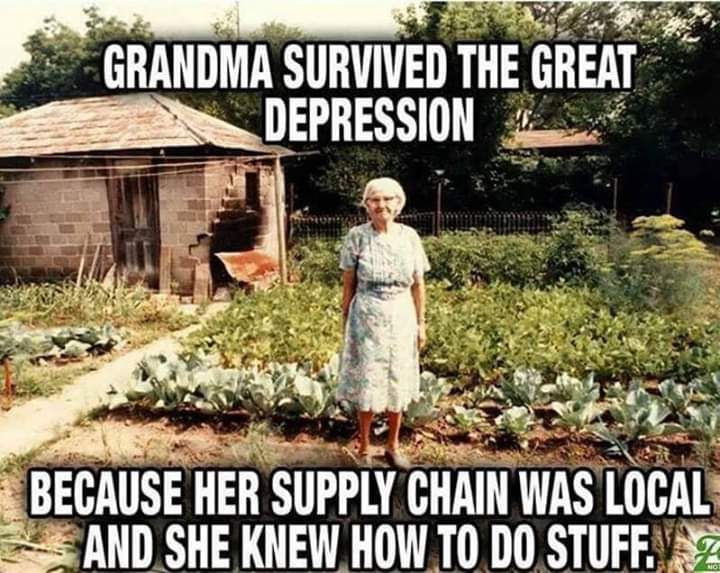
One of my musician friends, a bit of a Sandersnista hippie-dippie type (but attractive enough to get away with it) has been posting Left-leaning memes consistently throughout this crisis.  But one meme caught my eye:
Grandma - Local Supply Chain

Here’s good ol’ Granny tending her garden.  The meme is right:  I know from family lore that my Mamaw and Papaw fed themselves, their children, and a lot of other folks in the mountains of southwestern Virginia during the Depression with chickens and crops they raised themselves.

That got me thinking:  could America see the return of widespread of homesteading, or some modern-day version of Jeffersonian agrarianism?

I was pondering this question on my way to church tonight (yes, yes, social distancing, etc., but it’s a small church, and we had a very small turnout, so I’m sure it was fine to attend), driving through the fields on the outskirts of Lamar.  I began pondering the notion of a society with our level of information technology, but that saw most Americans farming or gardening for at least a small bit of their sustenance.

Such a system would be “high-tech agrarianism”—it would combine modern technology, especially information technology like the Internet, with millions of freehold agriculturalists.  Yes, we’d still have the huge mega-farms, we’d have people working in offices, etc.  But people would be making good use of their land, too, growing crops instead of grass.

Of course, I then began to ponder if such a society could have ever developed organically.  My instinct is no—it required the massive integration of local, regional, and national economies to raise production efficiency to the point that we can have widespread, niche-y specialization in tens of thousands of fields.  Greater efficiency fed into greater technological advancement, which in turn led to greater efficiency—and on and on and on, in a revving upward cycle.

But now we’re staring down this virus, which is leading governments all over the world to close stores, cancel events, lay off workers, turn away elderly patients, and on and on.  Those long, efficient supply chains are massively disrupted.  People are hoarding toilet paper and bread in the hopes of riding out likely (and, in some places, actual) quarantines.

I’m assuming life will return to normal… eventually.  But when?  So far, many of my assumptions about the pandemic have been incorrect (it turns out this time, the media wasn’t just crying wolf—well, not entirely, anyway; it still seems that some of this panicked response is driven by ridiculous media spin and speculation).  If we continue down this road of greater and greater decentralized isolation, people are either going to riot, or figure out how to provide for themselves.

In such a world, maybe high technology and small-scale farming could work keyboard-in-glove.  I’ve long advocated for some return to a simpler, more agrarian, more localized life.

Of course, I’m romanticizing America’s Jeffersonian past.  Farming is hard—and risky (of course, that hardness made our nation great).  I certainly don’t know anything about it—another truth to the meme above.  Also, if we’d continued as a mostly farming nation, we wouldn’t have the means to fight this virus, or to figure out how to fight it.

That said, converting your half-acre lawn into a garden full of corn, squash, peppers, lettuce, cabbage, beans, berry bushes, etc., seems like a far more productive use of your little plot of land, and one that could save your life and the lives of others in a pinch.  That seems sensible.

We could also do with some can-do gumption, like Granny had.

Home Depot is operating on shortened hours, but they’re remaining open.  Maybe now is the time to buy a roto-tiller.

Donate to The Portly Politico

Support quality commentary on politics, education, culture, and the arts with your one-time donation.

$5.00