The school year is back in full swing, and with the brief respite of Labor Day behind me, it’s a long stretch of mind-molding from here until Thanksgiving.
Fortunately, the school year means music lessons, and music lessons—as one former colleague, now retired, frequently reminds me—mean money.
I don’t lovemoney, but I certainly need it. And I love teaching music lessons, so it’s a happy way to bring in some extra bacon while also teaching kids (and adults!) to make music. There are few things I enjoy more than nurturing a love of music; if I make a few quid in the process, well, all the better!
The Lord has blessed me with an abundance—perhaps an over-abundance—of lessons. At the time of this writing, I am sitting at twenty-six lessons a week across twenty-four students. Scheduling has been a bit of a nightmare, but I think I have it largely figured out (of course, whenever I think that, some conflict arises and I have to play scheduling roulette—ha!).
After releasing Péchés d’âge moyen, my short collection of twelve original piano miniatures, I took a short break from composing to take care of some other items. Now that my insane two-or-three weeks of work have subsided into what is (hopefully) a quieter week—the eye of the storm—I’ve jumped back into composing by hand.
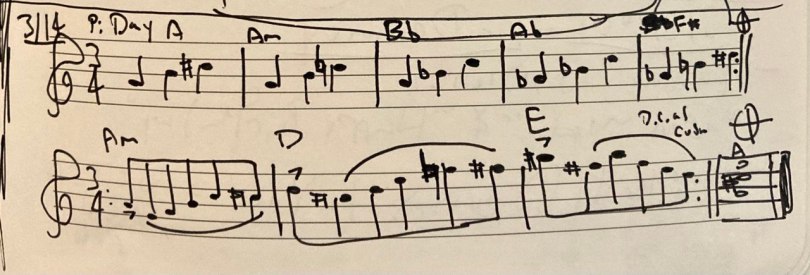
At the time of writing, I’ve composed six more short miniatures 11-14 March 2022. In order of composition they are as follows: “Diminished Minuet,” “Another L’il Divertimento in G major,” Three Rhapsodies in G major and Bb minor (consisting of “Largo in G minor,” “Poco allegretto in Bb major,” and “Adagio for a Rainy Day”), and “Pi Day.” To match Péchés d’âge moyen, I’ll compose at least six more pieces, with a goal of releasing more lo-fi recordings by the next Bandcamp Friday (1 April 2022—a fitting date, indeed!).
I’d hoped that in the few weeks I had between announcing the project and releasing it I’d be able to set up a more sophisticated recording rig. Instead, I recorded the twelve tracks in a white heat, using my iPhone SE’s voice memo app, and placing the phone on the old Baldwin Acrosonic piano in my school’s Music Room.
These made for less-than-ideal recording conditions, but in listening back to the album, it worked better than I thought.
The total recording clocks in at just six minutes and thirty-five seconds, but I’ve jam-packed this release with bonus features: videos, original manuscripts of each piece, and a PDF booklet detailing the origins of the project. It’s not bad for $5 (although that comes out to approximately $1.43 per minute if you just listen to the album once).
I also had a blast putting this recording together. The feel of putting pen to paper is just so satisfying, and each little bit of written music is like its own little work of art. One reason I included the manuscripts with the recording is because they’re beautiful to look at—even with my poor penmanship.
During the last eleven years of his life, the great composer of Italian opera Gioachino Rossini, enjoying a sumptuous retirement after a successful career, composed a collection of 150 pieces. He dubbed these pieces—intended for intimate and private performances in his home—Péchés de vieillesse, or “Sins of Old Age” (that title is actually affixed to only two of the fourteen albums, but later was applied to the entire collection). The pieces are a mix of chamber, vocal, and piano music, all meant to be played in Rossini’s home.
Most readers will recognize Rossini from his memorable overtures—often written mere hours before the opening nights of his operas, much to the chagrin of theatre managers—which are probably better known to mass audiences than his operas. Here’s the most famous of them:
Rossini was so successful as a composer, he basically spent forty years in retirement. While music historians disagree on exactly why he stopped composing operas so young, I suspect it had to do with the fact that made so much money from them, he didn’t need to work anymore, and enjoyed a fun retirement (ill-health was likely a contributing factor, too). He also exited gracefully at the top of his game, avoiding the common pitfall of overstaying one’s artistic welcome amid changing times and tastes.
As such, the Péchés de vieillesse are real gems, coming as they did from a great composer who had long retired from the craft. Here’s just one example (of 150!), his “Prelude inoffensif” from Volume VII of the collection:
As readers know, I’ve been getting back into composing, and have been exploring composing by hand. It is extremely satisfying to write pieces by hand (as opposed to a computer, which is certainly more convenient, but lacking in the same tactile satisfaction). I’ve written a few short piano miniatures—some good, some desperately in need of revision—and Rossini’s “Sins” have inspired some of my own: a small project I’m dubbing Péchés d’âge moyen.
Today’s post will be a bit of an acquired taste, as I’m essentially spinning a cheesy inside joke from the Internet into a post for general consumption.
At best, I’m hopeful it will give some insight into the often arbitrary and absurd sources for inspiration. I will note here that the short compositions here do not sound good (except for the second of the Ethiopian Rhapsodies I dashed off, which is actually pretty fun).
It’s also just fun, much like the music of Robert Mason Sandifer, the young composer I’m highlighting today. Mason, as I call him, is a private student of mine, so this post is perhaps a tad self-serving, but even if he weren’t my student, I would adore his music.





 The Portly Politico