

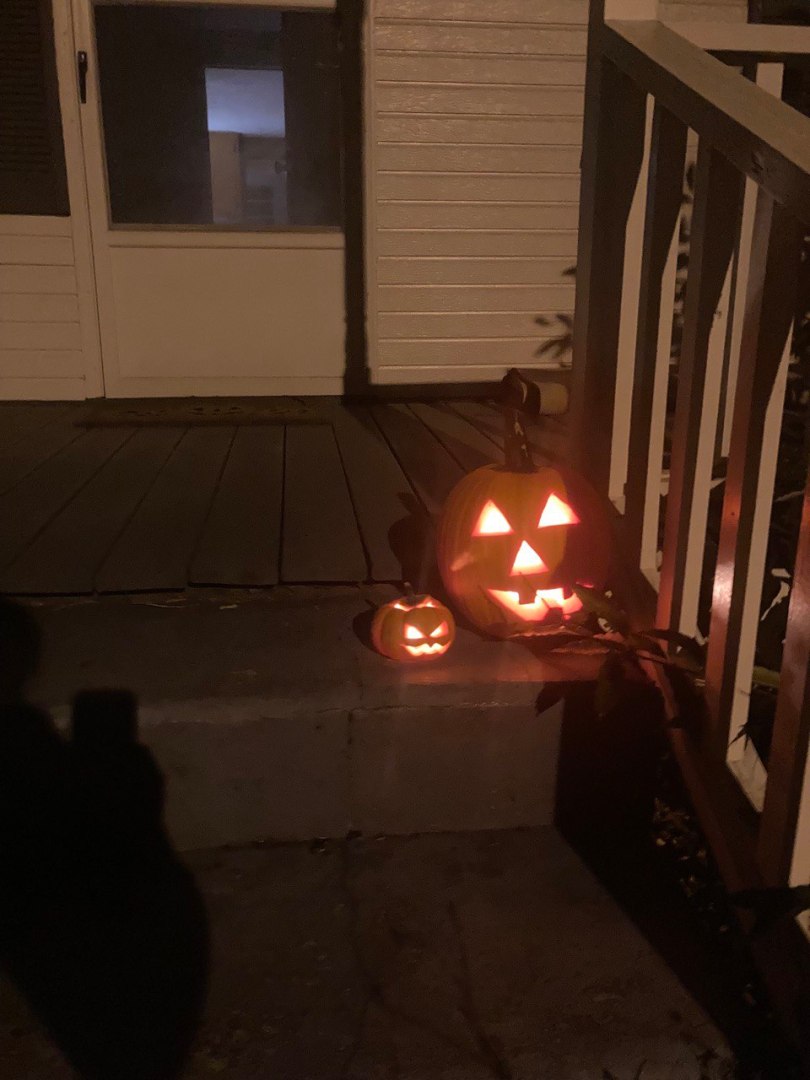
‘Tis the season, my friends—the spooky season! And it’s a time for reading some good ghost stories.
I have been reading William Peter Blatty’s The Exorcist—talk about a spooky read (the link to the book is an Amazon Affiliate link; if you make a purchase through that link, I receive a portion of the proceeds, at no additional cost to you)! By the time this post goes live, I should also be diving into some classic Victorian ghost stories.
I don’t have much to add to this year’s commentary about my favorite short story genre. The world provides plenty of spooks of its own, so it seems appropriate to enjoy some escapism with stories of haunts of a more metaphysical nature.
Of course, most of our problems are, ultimately, spiritual in nature, so perhaps diving into some ghost stories might be preparation. Or they’re just fun to read—you decide!
With that, here is 19 October 2023’s “TBT^16: On Ghost Stories“:
Yours portly has been in the Halloween spirit big time: scary movies, the SC Bigfoot Festival, releasing two albums of autumnal tunes (here and here). What I haven’t gotten to—yet!—are ghost stories.
I don’t have much additional ghost story commentary this year, but I will say that they tend to work better in books than in films. That’s a bold, unsubstantiated claim, but I find that reading about ghosts is a lot scarier than seeing them on celluloid. Ghosts might be—appropriately—a cold medium creature, best on the page or told about around the campfire. Other monsters are probably hot medium/media critters, best for television or the radio.
Whatever the case, here is “TBT^4: On Ghost Stories“:
Ah, yes—ghost stories. They are perhaps my favorite variation on the short story form. I always find it fascinating that the Victorians liked their ghost stories at Christmastime, but it makes sense—what else are you going to do on those long, dark, cold nights? Best to huddle around the fire and spin some yuletide yarns.
Every culture has its ghosts, spooks, haunts, haints, devils, and the like. As I’m writing this post, I’m reading about the boo hags of the Gullah culture of the South Carolina Lowcountry. Apparently, homes in the Charleston still feature porch ceilings painted “haint blue” to ward off evil spirits.
Looks I’ll be heading to the hardware store for some Behr Premium Ultra Lowcountry Haint Blue.
With that, here is 14 October 2021’s “TBT^2: On Ghost Stories“:
It’s that time of year again—the so-called “spooky season,” when Halloween decorations go up, scary stories get told, and overwrought bloggers with delusions of grandeur stage over-the-top concerts from their front porches (well, maybe that last one is just me). As the weather turns cool and the leaves begin to fall, it’s almost impossible not to settle in with some hot coffee and a good collection of ghost stories.
So, for the second year in a row, I’m looking back this TBT to 2019’s “On Ghost Stories,” a post that now will hold the distinction of being a perennial favorite.
One might think that as scary as the real world is, we’d spend less time reading spooky fiction. It seems the opposite is the case. Perhaps the idea that malevolence is not necessarily the result of human frailty, but rather due to wicked supernatural influences, is oddly comforting. That evil is the result of our fallen nature—and, of course, the malignant supernatural influence up on it—is a bit easier to forget, perhaps, when reading about some ghostly figure wreaking havoc in the English countryside.
More likely, it’s just that we enjoy being scared—when we can easily flip off the television or close the book. Horror is fun when there are no real consequences attached to it. Then again, just watching horror movies probably isn’t healthy (I’ll report back if I suddenly get any macabre urges).
Well, whatever the reason, a good ghost story is hard to pass up. With that, here is “TBT: On Ghost Stories“:
Today marks the first day of October, perhaps my favorite month of the year. We’re already getting that first crisp coolness in the air here in South Carolina, and it’s feeling more and more like autumn every day.
So with Halloween just thirty days away, I thought it would be fun to look back at a post from last “All Hallowe’s Eve Eve,” as I wrote at the time: one all about ghost stories.
I finally finished slogging my way through The Penguin Book of Ghost Stories, thanks in no small part to quarantine. It’s an excellent collection, and I stand by my recommendation from last October, but there are a handful of stories that are way too long—or dense.
I’m now reading through a more accessible, far lighter read: the classic Tar Heel Ghosts by John Harden. It’s a collection of North Carolina-based ghost stories published in the 1950s, so it has that pleasing sense of implicit patriotism and love of place that is now so sadly missing from our cynical, cosmopolitan writing of today. Like The Story of Yankee Whaling, it possesses a refreshing innocence about and love for its subject: no hand-wringing over now-unfashionable ideas, no condemnation of a lack of diversity, no talk of “marginalized” groups being “unrepresented.”
I picked up the book sometime in my childhood on a family trip, but I don’t think I ever finished the collection. I’m rectifying that all these years later, and I’m thoroughly enjoying it. I also plan to reread Ray Bradbury’s The Halloween Tree, one of my favorites to pull out this time of year.
Here’s hoping you find some spooky tales of your own to curl up with on these cold, October nights. Here’s October 2019’s “On Ghost Stories“:
It’s Halloween! Well, at least it’s All Hallow’s Eve Eve, but that’s close enough for some ghoulishly delicious ghost stories.
I love a good ghost story. The Victorians did the genre best, but many writers since have honed it further, adding their own unique twists and scares. Even Russell Kirk, the great conservative philosopher, was a fan of ghost stories. Indeed, his bestselling book was a ghost story.
For the Victorians, ghost stories were told at Christmastime. This timing, while peculiar to modern readers, makes sense intuitively—Christmas is a time for remembering the past, in part (perhaps especially) our honored dead (just ask Washington Irving—if he comes by to haunt you). The “ghosts” of departed loved ones linger closely during those long, frosty nights. The inherent nostalgia of Christmas and the winter season—and bundling up next to a crackling fire—sets the perfect mood for ghostly tales.
Nevertheless, what other time of year can beat Halloween for a good tale of witches and werewolves; of monsters and mummies; of ghouls, goblins, and ghosts?
As such, I’d encourage readers to check out “Nocturne of All Hallow’s Eve,” a deliciously frightening, blood-soaked tale of the supernatural and the macabre from Irish-American author Greg Patrick. Alternative fiction website Terror House Magazine posted it back in September, and I’ve been saving it to share on the blog until now.
Patrick’s style conjures the dense verbiage of Edgar Allan Poe. Indeed, he overdoes it a bit (see his more recently published “The Familiar“). But his subject matter is pure Halloween—the tenuous space between the natural and the supernatural, the mysterious rituals, and on and on.
If you’re still in search of some ghostly reads, check out The Penguin Book of Ghost Stories. It’s the collection I’ve been reading since my trip to New Jersey this summer. It’s a truly spine-tingling collection that covers some of the great—and many of the undeservedly unsung—writers of the genre, the men and women who truly created and molded what makes a good ghost story.
So wherever you find yourself the next couple of nights, curl up with a good book, a warm fire, and a good ghost story (and maybe someone else, if you’re so inclined). You and the ghosts will be glad you did!
 The Portly Politico
I’ll let you in on something spooky.
Many years ago, I wrote a short ghost story called The Phone Box, in which a man learns of the horrors of his past. A couple of years later, an action film called Phone Booth was released detailing much of what I’d written in my own short.
Talk about Twilight Zone…🤔
LikeLiked by 2 people
Whoa! Weird, wild stuff.
LikeLiked by 2 people
Here’s something that may surprise you. You may be familiar with him as a conservative voice in the UK. I really don’t care for him at all in that instance, mainly because he never smiles and is desperately deadly serious but I found a whole other side to him – this one. I love this guy, lol. https://www.youtube.com/watch?v=jXGnpcX4wl8
LikeLiked by 3 people
I’ll check out the video this afternoon! I am moderating a quiz bowl tournament this morning.
LikeLiked by 1 person
Quiz bowl? Is that like guessing ten pin scores? You don’t have lawn bowling in the States, do you?
Quiz and bowl. Not two words you’d ordinarily see in a sentence.
LikeLiked by 2 people
Sorry for not getting back to you with an answer to this sooner.
Quiz Bowl—also called “Academic Team” and “Academic Challenge”—is basically a competitive game in which two teams answer a series of “toss-up” questions. Teams buzz in to answer; if they get it wrong, the other team has a chance to buzz in to answer. If a team member answers a toss-up question correctly, the team as a whole can confer to answer four bonus questions.
Each toss-up is worth ten points and each bonus is worth five points.
It’s very fun, and even though I am no longer coaching, I get very competitive about it—one of the few things I get competitive about. I am also a very tough-but-fair moderator. I don’t put up with any foolishness.
LikeLike
Considering what this country has been through in the last few years, Oliver has had little reason to smile. But he does, when he can.
Glad to see you posting again. 👍
LikeLiked by 2 people
Bless your heart. Thank you.
LikeLiked by 2 people