

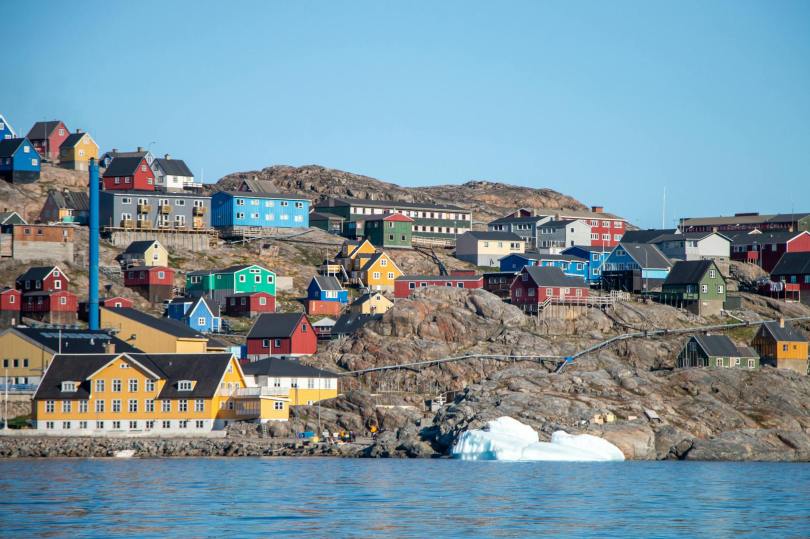
We’re just five days away from President/President-Elect Trump’s inauguration, and I’m as giddy as a schoolboy at the candy shop. There is much to be excited about in a second Trump administration, but lately I’ve been whooping like a silver-backed gorilla (at the candy shop, presumably) over the prospect of purchasing Greenland from Denmark—and taking back the Panama Canal.
The coverage of President-Elect Trump’s desire to take Greenland features a mix of bemusement and alarm, which is pretty on-brand for Trump’s pronouncements. There is a lot of chest-thumping from the European Union and the Danes, who both vow that the United States will never have Greenland. President Trump, for his part, seems to be having fun trolling the stuffed shirts in Europe and the hostile American press, especially with his talk of annexing Canada (which is trolling; I think Trump is just having fun at Justin Trudeau’s expense).
What I like about all this annexation talk is that it hearkens back to the presidency of James K. Polk. It was under Polk that the United States expanded to (mostly) its present borders, at least in the contiguous, lower forty-eight States. Polk similarly struck an aggressively expansionist tone, proclaiming “Fifty-Four Forty or Fight” in reference to the upper border of the Oregon Territory.
For context, the Oregon Territory consisted of modern-day Washington State, Oregon, and British Columbia, and the United States and Great Britain shared joint control of the territory. Polk was demanding all of the territory come under exclusive American control. Ultimately, the 49th-degree North parallel—the traditional border with Canada west of the Great Lakes—was extended to the Pacific Ocean, and Great Britain retained British Columbia as part of Canada.
However, Polk’s forcing of the issue—and his demand for the entire Oregon Territory—sparked negotiations with Great Britain that resulted in the United States getting what Polk (and Americans) really wanted: full control of the areas south of the 49th-degree parallel. He was engaging in something that President Trump does well: anchoring. In other words, Polk was making a wild demand—all of the territory—knowing that the Brits, out of desperation and consternation over what this reckless expansionist might do, would come to the negotiating table and meet Polk halfway—which is exactly what happened.
Similarly, Trump is playing the same game with Greenland. He knows that Greenland is likely a drain on Denmark (which spends billions in subsidies to the island’s largely indolent, welfare-addicted population each year), but represents an important strategic asset for the United States, as the Arctic Ocean becomes an increasingly important geopolitical region. Denmark is not likely to take advantage of Greenland’s strategic position in the Arctic Ocean, but it is very important to America’s national security.
Further, Greenland possesses potentially large reserves of rare earth metals and other mineral wealth, resources that the United States depends largely upon China to provide. Being able to mine our own rare earth metals for our electronic devices would be a major boon to the United States, and reduce our dependence on China—a key goal of the Trump administration.
Also, Greenland is in the Western Hemisphere. Since the days of the Monroe Doctrine, the United States has declared hegemony in this hemisphere. Existing European possessions can stick around, but there are to be no new European (or Chinese) colonies in this hemisphere. That said, the spirit of the Monroe Doctrine is to reduce any Old World colonial presence. Acquiring Greenland certainly fits with that goal.
Some will object that we have more pressing concerns here at home, and that purchasing Greenland—which Denmark so far has seem loathe to do—will be prohibitively expensive. We certainly have major problems to contend with here, but those problems do not preclude purchasing Greenland, which could benefit the United States in the long-term. As for the expense, well, our currency is largely theoretical at this point; while we’re burning money, we might as well obtain massive amounts of real estate in the process.
Besides, the United States has a rich tradition of acquiring cold, desolate lands on the cheap. Alaska turned out to be a major boon, with massive amounts of coal, oil, gold, and other precious minerals. And owning Greenland could provide many young men and women with an opportunity they desperately desire: the chance for adventure on the frontier.
As for the Panama Canal, I am fully onboard with taking it back from Panama as well. Chinese influence in Latin America—a blatant violation of the Monroe Doctrine—makes the Canal’s independence perilous. The Panamanian government has done an admirable job maintaining the Canal—so far. But, ultimately, the United States built it and paid for it. Panama as a nation would not exist had the United States not desired to build the Canal (President Theodore Roosevelt infamously recognized Panama’s independence from Colombia because he believed the Colombian Senate was gouging him for more money during negotiations for the Canal Zone).
And Canada? I’m not sure I want to take on the burdens of their ludicrously, cringe-inducingly multicultural society, but let’s face it—they’d be better off as States than as an independent nation electing incompetent pretty boys to run their socialist paradise.
At least we’d have poutine.
 The Portly Politico
Correct me if I’m wrong but Greenland has a population, albeit small (some 55k). At what point does taking Greenland mean invasion, colonisation?
LikeLiked by 1 person
I’m not advocating that we invade Greenland, but if we purchase the territory, the functional details of how Greenlanders live and govern themselves would not change. There’d just be American flags flying instead of Danish ones. Indeed, it would probably improve their lives. They’d have access to the continental United States without a passport, and would probably be granted US citizenship (like Puerto Rico).
Naturally, it would be great if the Greenlanders were onboard with it, but ultimately, it would be like the old days of empire: trading one master for another one, with no significant changes day-to-day. And as Greenlanders aren’t exactly paying into Danish coffers, it’s not like we’d be sucking them dry with our taxes; we’d end up sending more money to them. It’s not like, “different boss, same taxes,” but “different boss, same subsidies.”
Regardless, it’s worth it to have that strategic access to the Arctic on the Atlantic side.
LikeLiked by 1 person