

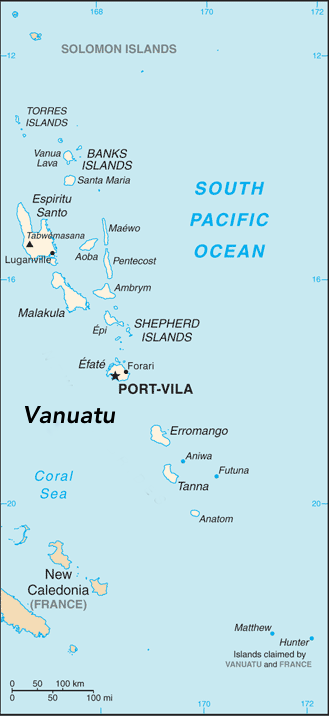
The FAIRtax folks, who advocate for replacing income and corporate taxes with a unified national sales tax, posted an interesting piece about the remote Pacific nation of Vanuatu (“FAIRtax in Vanuatu?“). It discusses how the archipelago boasts incredibly low taxes: a 15% value-added tax (“VAT”), and a business license fee of 5% (presumably, 5% of a business’s total annual revenue).
I’m personally agnostic on the adoption of a national sales tax in the United States. I do believe it would be much better than the income tax, which I absolutely loathe, and which requires a complex and oppressive bureaucracy to administer. I also resent sending the IRS all of my personal information every single year, including how many miles I drove and what sheet music I purchased (although those are great for those sweet, sweet tax write-offs). If it were practical, I’d much rather see a national sales tax, or even a return to old-school tariff regimes.
The problem is that, should we ever adopt a national sales tax, it will likely accompany the national income tax. A national sales tax also places a great deal of strain on States and localities. Good luck having a 10% national sales tax and a 6% State sales tax (as we do in South Carolina) and a plethora of local-option sales taxes (about 2% here in Darlington County; higher in neighboring Florence County). Tack on hospitality taxes, and it adds up fast.
For example, in neighboring Florence County, eating out automatically comes with a 10% sales tax: the 6% State sales tax, plus local sales and hospitality taxes, totally 10%. If we had a conservative 10% national sales tax on top, your $5 footlong (already gone—part of America’s mythological past) becomes $6 immediately. 20% sales tax means $1 of taxes for every $5 spent. A $500 item would cost $600.
I still think that’s preferable to the income tax, and instead of creating a disincentive to work, it would create a disincentive to spend.
But I digress. For a small nation like Vanuatu—population of around 300,000—a national sales tax makes sense. It’s a small enough area geographically and demographically that it the national sales tax is, essentially, akin to a State sales tax. As the article from FAIRtax.org notes, the island has something of a clean slate: no welfare, no government pensions, etc. Most people are subsistence farmers, and tourism is the major industry.
It sounds like paradise, doesn’t it? A balmy tropical climate with loads of seafood and farming and self-sufficiency. I’m sure the poverty is grinding, but the people don’t seem to mind, and it sounds like they are ruled with a light touch. The governing party recently won reelection in part on the promise to never institute corporate or income taxes. It doubtlessly helps that those subsistence farmers don’t have any income to tax, but it certainly creates an attractive business climate. With the growing trend of expat creatives and tech workers, Vanuatu might make for a logical base of operations.
The island republic is under intense pressure from Australia and other governments to adopt corporate and income taxes to bring it inline with the developed and developing nations of the region, but Vanuatu is standing firm in maintaining its current regime of light taxes and light regulation. That is an incredibly wise policy.
Another thought: not every nation needs to go through industrialization and postmodernity. Yes, I want the people of Vanuatu to have a high quality life: good roads, healthcare, education, etc. But those things all come with a steep price. If the people of the islands are happy, let them do their thing. If anything, their biggest concern now will be tons of hipsters flooding in and driving up rents and home prices once they realize they can chill out in a tropical country and work remotely (if the nation has the necessary Internet infrastructure, but that’s quickly becoming global).
It will be interesting to watch this little island nation develop. Let’s hope they’ve learned from the hard experiences of the West and avoid the pitfalls to which we’ve succumbed.
 The Portly Politico