TBT: The Invasion and Alienation of the South

Sheldon_Church_2

Tip The Portly Politico

Support quality commentary on politics, education, culture, and the arts with your one-time donation.

1.00 $

With the election still in the balance—it may be decided by the time you read this post—and two formerly conservative Southern States up for grabs, I thought it would be timely to revisit this piece, “The Invasion and Alienation of the South,” which looks at Leslie Alexander’s post “Stranger in a Strange Land.”  In that piece, Alexander writes about the hollow, joyless cosmopolitanism of living in Dallas—a stark contrast to the tight-knit cordiality and tradition of her native Louisiana.

While watching the election returns, it occurred to me that Georgia and North Carolina should not be risky toss-ups, and Virginia never should have been lost to hordes of Swamp People.  It’s an irony of history that Washington, D.C., was placed next to Virginia so the ornery planters, suspicious of federal power, could keep a closer eye on the national government.  Now, that bloated national government dominates politics in Virginia through its largess.

Meanwhile, transplants from up North have infested previously conservative States.  Charlotte, North Carolina has become a wretched hive of globalist scum and villainy.  During my online dating days, I would routinely get matched with babes from Charlotte; invariably, they were always from Ohio, or New York, or California—never actually true North Carolinians.

It’s one thing when local blacks vote Democratic.  Fine—we’re at least part of the same(-ish) Southern culture, and we’ll help each other out.  But then gentry white liberals start coming down here, ruining our politics and our cities.

Now, we live in a world in which Joe Biden might win Georgia, and North Carolina—NORTH CAROLINA—has become a nail-biter every four years.

Such is the price of our addiction to economic growth and convenience.  What we’ve gained in luxuries we have lost in heart.  We have paid for them with our souls.

Here is November 2019’s “The Invasion and Alienation of the South“:

Read More »

TBT: Happy Halloween!

Halloween is nearly here!  I love Halloween, so I had to dedicate this week’s TBT to last year’s Halloween post.  This Halloween is particularly fun, as I’m hosting my annual Spooktacular this Friday evening (information here).

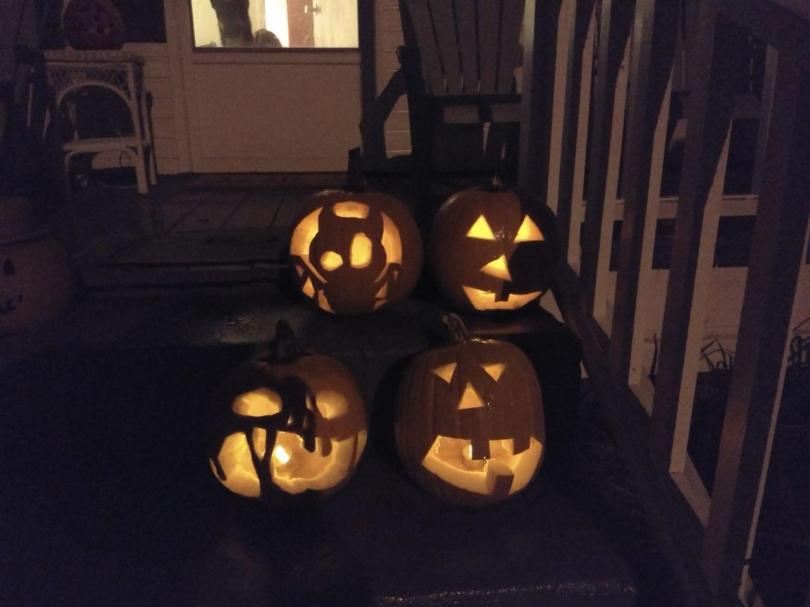
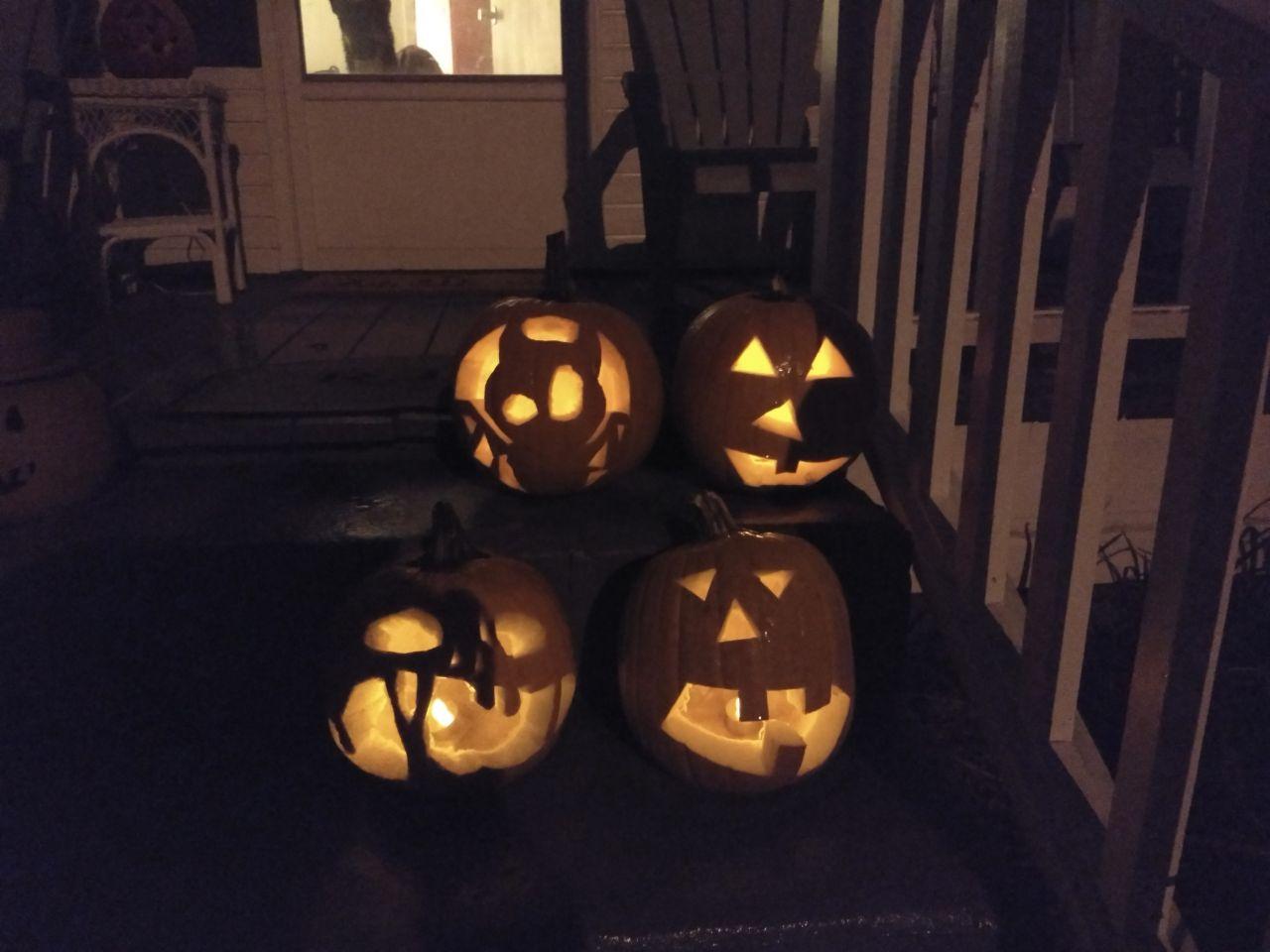
It’s been a good Halloween season.  My girlfriend and I carved pumpkins this weekend.  It was her first time, but she carved far more elaborate ones than I did.  See for yourself:

Pumpkins 2020

Her’s are the ones on the left—the bat and the drooling pumpkin.  Mine are on the right—the more traditional snaggle-toothed variety.  The one on the bottom right reminds me of King Kong.

We’ve also watched both Halloween and Halloween II, so we’ve pretty much checked off all the boxes.

With that, here’s 31 October 2019’s “Happy Halloween!“:

Read More »

TBT: Climate Hysteria Robs Us of Joy

In casting about for a good TBT this week, I stumbled upon this post—which really should have ended up in one of my “Forgotten Posts” editions of Lazy Sunday—about the foolishness of climate hysteria, and the arrogance of thinking we can really have a concrete impact on the environment at the macro-level.

Don’t get me wrong:  I enjoy God’s Creation, and I think stewardship of His Creation is incredibly important.  We shouldn’t go around adopting baby sea turtles.  But driving to work everyday isn’t going to affect the environment or the climate in any discernible way.

In fact, it’s funny—climate change doesn’t even seem like a serious issue anymore (who even remembers Greta Thunberg now?).  As soon as the elites went hard for The Virus hysteria, they immediately had us using disposable plastic crap and Styrofoam containers again.  Even the whole message of The Age of The Virus was “Consume”—stay home, eat takeout, watch trash TV.

That puts the lie to the climate change nonsense.  I’ll repeat my admonition from one year ago today:  “Eat, drink, and be merry—and have lots of babies.”

Here is 22 October 2019’s “Climate Hysteria Robs Us of Joy“:

Growing up, I received my fair share of public school climate indoctrination.  My generation cut its teeth on Captain Planet, the eco-propaganda cartoon that, among other things, scolded Americans for using too many resources and having too many babies.  Fast forward to today, and those arguments are mainstream.

In fact, I remember my dad telling me that Captain Planet was Ted Turner‘s ham-fisted attempt at indoctrinating kids—one of the first times I vividly remember learning that the elites were lying to us.  The finger-wagging, puritanical nagging of environmentalists further pushed me away from eco-hysteria.

Still, we were always taught that the oceans were dying, that fresh water was scarce, etc.  Well, thanks to Quora, some easy math shows us that God’s Creation is abundant enough.

Quora user posed the question (to paraphrase):  if everyone drank a glass of water from the ocean (let’s assume it’s been desalinated), how would it affect the sea level?

One poster’s answer goes through the math:  if everyone—including babies! (around 7.7 billion people)—took a twelve-ounce glass of water from the ocean simultaneously, “the water level would drop by 0.0000000075 meters, or about 7.5 nanometers. That’s about 1/1000 the size of a red blood cell.”  Another contributor, Vilmos Shepard, writes that this scenario “would lower the ocean by less than a wavelength of light.”

As the contributor writes in his response, “within a day or two, we’d all sweat, breathe and urinate that water back out, and it would eventually end up back in the oceans. The water cycle is a hard thing to beat.”  Indeed.

The more I learn about Creation, the more I appreciate that there’s not much we can do to affect or alter the macro-level environment.  We can make tweaks and marginal improvements—such as improving desalination of sea water, transporting water more efficiently, picking up trash, etc.—but it’s foolish to think we alone can break or fix the environment.  Creation is incredibly abundant and robust.

Barring massive nuclear warfare, our everyday actions are not going to destroy the planet.  I’m not saying we should casually throw our old tires into the river—we should be good stewards of Creation—but it’s wasted effort to agonize over our carbon footprint.  If the enviro-cultists and eco-hipsters really cared, they’d live in the country, instead of cramming themselves into energy-guzzling urban hellscapes.

Eat, drink, and be merry—and have lots of babies.  Don’t curtail your enjoyment of the bounty of God’s Creation just because Ted Turner and Greta Thunberg are insane and deluded.  Yes,  yes—dispose of your old electronics and used motor oil properly (we’re trying have a society here), but we shouldn’t lose sleep over eating a steak.

Tip The Portly Politico

Support quality commentary on politics, education, culture, and the arts with your one-time donation.

$1.00

TBT: The Joy of Hymnals

It being October, I tend to focus on the spookiness of the season.  I love Halloween, ghost stories, and scary movies, but it’s important not to get too bogged down in the chills.

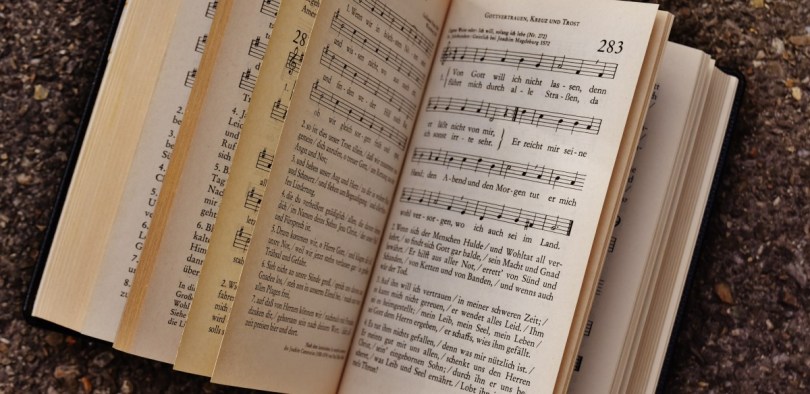
So as I was going through posts from October 2019, I stumbled upon one of my old favorites:  “The Joy of Hymnals.”  My small church roped me into playing piano for Sunday morning services maybe two years ago, and it quickly rekindled an old love of hymns and hymnals.

Hymnals are my favorite items to find in old second-hand shops and antique stores (the latter of which often selling them at an egregious markup).  It’s fun to see which hymns do—and, more importantly, don’t—show up in any given hymnal.  I particularly like slender volumes, the kind that were meant for carrying from service to service or camp meeting to camp meeting, and which tend to possess hymns from the canon, if such a thing exists, of hymnody.

I even recorded and released a very lo-fi EP, The Lo-Fi Hymnal, which consists of crude recordings of my Sunday morning playing.  That short collection also includes a PDF version of today’s TBT feature.

Here is “The Joy of Hymnals“:

Read More »

Phone it in Friday XVI: Week in Review (5-8 October 2020)

I’m out of town for a few days, so I’m resorting to something I rarely do:  a week in review post.  Some bloggers feature these weekly, such as my blogger buddy Mogadishu Matt.  I sort of did one back with “Lazy Sunday LVIII: Spring Break Short Story Recommendations Recap,” but that was more a review of a week-long series of posts, not a review, per se, of the week itself.

Ah, well.  That’s just nit-picking.  Here’s what I wrote about this past week:

That’s it for this edition of Phone it in Friday.  Here’s hoping I wrote some material good enough that you don’t mind reading it (and reading about it) again.

Happy Friday!

—TPP

Tip The Portly Politico

Support quality commentary on politics, education, culture, and the arts with your one-time donation.

1.00 $

TBT: Lazy Sunday LVIII: Spring Break Short Story Recommendations Recap

It’s getting into that spooky time of year, so for this week’s TBT I decided to look back at “Lazy Sunday LVIII: Spring Break Short Story Recommendations Recap.”  I spent most of my Spring Break this year reading horror short stories, writing reviews about and recommendations for some of the better stories I read.

I won’t do much more editorializing than that, as the original post is quite lengthy and detailed.  I will add that love short stories, and find the form chillingly effective for horror.  The brevity and concision of the form encourages horror writers to deliver chills and terror straightaway, and allows for frights to be the focus.

With that, here is “Lazy Sunday LVIII: Spring Break Short Story Recommendations Recap“:

Read More »

TBT: On Ghost Stories

Today marks the first day of October, perhaps my favorite month of the year.  We’re already getting that first crisp coolness in the air here in South Carolina, and it’s feeling more and more like autumn every day.

So with Halloween just thirty days away, I thought it would be fun to look back at a post from last “All Hallowe’s Eve Eve,” as I wrote at the time:  one all about ghost stories.

I finally finished slogging my way through The Penguin Book of Ghost Stories, thanks in no small part to quarantine.  It’s an excellent collection, and I stand by my recommendation from last October, but there are a handful of stories that are way too long—or dense.

I’m now reading through a more accessible, far lighter read:  the classic Tar Heel Ghosts by John Harden.  It’s a collection of North Carolina-based ghost stories published in the 1950s, so it has that pleasing sense of implicit patriotism and love of place that is now so sadly missing from our cynical, cosmopolitan writing of today.  Like The Story of Yankee Whaling, it possesses a refreshing innocence about and love for its subject:  no hand-wringing over now-unfashionable ideas, no condemnation of a lack of diversity, no talk of “marginalized” groups being “unrepresented.”

I picked up the book sometime in my childhood on a family trip, but I don’t think I ever finished the collection.  I’m rectifying that all these years later, and I’m thoroughly enjoying it.  I also plan to reread Ray Bradbury’s The Halloween Tree, one of my favorites to pull out this time of year.

Here’s hoping you find some spooky tales of your own to curl up with on these cold, October nights.  Here’s October 2019’s “On Ghost Stories“:

It’s Halloween!  Well, at least it’s All Hallow’s Eve Eve, but that’s close enough for some ghoulishly delicious ghost stories.

I love a good ghost story.  The Victorians did the genre best, but many writers since have honed it further, adding their own unique twists and scares.  Even Russell Kirk, the great conservative philosopher, was a fan of ghost stories.  Indeed, his bestselling book was a ghost story.

For the Victorians, ghost stories were told at Christmastime.  This timing, while peculiar to modern readers, makes sense intuitively—Christmas is a time for remembering the past, in part (perhaps especially) our honored dead (just ask Washington Irvingif he comes by to haunt you).  The “ghosts” of departed loved ones linger closely during those long, frosty nights.  The inherent nostalgia of Christmas and the winter season—and bundling up next to a crackling fire—sets the perfect mood for ghostly tales.

Nevertheless, what other time of year can beat Halloween for a good tale of witches and werewolves; of monsters and mummies; of ghouls, goblins, and ghosts?

As such, I’d encourage readers to check out “Nocturne of All Hallow’s Eve,” a deliciously frightening, blood-soaked tale of the supernatural and the macabre from Irish-American author Greg Patrick.  Alternative fiction website Terror House Magazine posted it back in September, and I’ve been saving it to share on the blog until now.

Patrick’s style conjures the dense verbiage of Edgar Allan Poe.  Indeed, he overdoes it a bit (see his more recently published “The Familiar“).  But his subject matter is pure Halloween—the tenuous space between the natural and the supernatural, the mysterious rituals, and on and on.

If you’re still in search of some ghostly reads, check out The Penguin Book of Ghost Stories.  It’s the collection I’ve been reading since my trip to New Jersey this summer.  It’s a truly spine-tingling collection that covers some of the great—and many of the undeservedly unsung—writers of the genre, the men and women who truly created and molded what makes a good ghost story.

So wherever you find yourself the next couple of nights, curl up with a good book, a warm fire, and a good ghost story (and maybe someone else, if you’re so inclined).  You and the ghosts will be glad you did!

Ghost

Donate to The Portly Politico

Support quality commentary on politics, education, culture, and the arts with your one-time donation.

5.00 $

TBT: Tarantulas and the Hygge

The weather in the mountains this past weekend was delightfully chilly, and it seems the cold up on Mount Mitchell has blown down into South Carolina.  In short, the weather is perfect—warm afternoons, and crisp, autumnal mornings.  I’ve been taking a cup of half-caff coffee in the afternoons after getting home from work and watering the garden, and it’s been glorious sitting on the porch and enjoying the coolness of the evening.

That first nip in the air is a sign that the hygge—the Danish concept of contented, warm coziness—is near.  It’s a time for bundling up and staying warm in old quilts with good books—and good company!  Food tastes better, coffee seems more satisfying, and my mind feels more alert and alive this time of year.

There’s also college football, which is nice, too—and Halloween!

So it seemed like a good time to look back to a post from March of this year, during South Carolina’s unusually cool—and longspring.  This post, “Tarantulas and the Hygge,” explored what I called “the weird side of the Internet,” traveling “down one of those byways of oddity.”

Read More »

TBT: [Censored.TV] Lineup Announced

Other than Roosh V, probably the greatest influence on my deeper red-pilling was Gavin McInnes.  McInnes’s commentary is funny, lively, and fresh.  I have consumed hundreds of hours of his popular podcast, Get Off My Lawn, so I’ve heard a lot of his thoughts on a broad range of topics.  Even when I disagree with his assessment of some event, his perspective is unique and interesting.

Milo is also a part of McInnes’s world, and his sharp, erudite, biting commentary—and excellent journalism—routinely inspire posts on this site, such as Monday’s piece “What is Civilization?

Back in Summer 2019, McInnes—who, like Laura Loomer, has been banned from multiple platforms—launched Censored.TV, which at the time was FreeSpeech.TV (thus the brackets in this post’s title, and in the original post below; the service changed its name after another company threatened a trademark suit against McInnes).  The service, which is just $10 a month or $100 for a year, features about a dozen different personalities and shows, ranging from “Gary’s Mailbag”—a homeless man who wanders around outside the studio and reads letters—to Milo’s raucous “Friday Night’s All Right.”

The main message of the original post was to encourage readers to support content they like (myself included!), especially conservatives.  Platforms like SubscribeStar help give conservatives and dissidents a voice, but those platforms are oases of freedom in a desert of techno-tyranny.

With that, here is 2019’s “FreeSpeech.TV Lineup Announced“:

Thanks to my brother for this nocturnal news update:  Gavin McInnes’s new subscription-based service, [Censored.TV], is ready to launch.  Listeners to the excellent, hilarious Get Off My Lawn podcast know that Gavin has been planning this platform for some time now, so it’s exciting to see the lineup.  The most exciting part of that schedule:  the twice-monthly sit-downs with Milo Yiannopoulos to talk about the news.  Talk about throwing gasoline onto a raging fire of awesomeness.

The service is $10 a month, or $100 a year, which is on par with Steven Crowder’s Mug Club or Ben Shapiro’s subscription.  I just don’t think it comes with a Leftist Tears Hot-or-Cold Tumbler, much less a far superior hand-etched mug.  But with McInnes’s crazy, controversial, humorous observations about life and culture, I can live without a drinking vessel tossed in (although it would be hysterical to drink coffee from a mug made to look like McInnes’s bearded mug).

Because of constant censorship from techno-elites and their ever-shifting “terms of services,” conservative and Dissident Right voices have fewer and fewer options to raise funds.  Some sites, like immigration patriot website VDare.com, can’t even use PayPal anymore.  As such, more and more content creators are turning to alternative or free-speech-friendly services, or undertaking the cost of creating their own infrastructure, so they can continue to get their work to fans.

I am definitely a small fry in this game of commentary, but that’s why I’ve setup a page with SubscribeStar.  My goal isn’t too live off of subscriptions, but just to supplement my income slightly to make blogging more on a daily basis more feasible (and to reinvest some of the funds into maintaining and improving the experience).

For guys like Gavin McInnes, who has been hounded from even supposed safe havens like his old employer, CRTV (now BlazeTV), reliable income streams aren’t a passing lark—they’re absolutely crucial.

In a better timeline, McInnes would be hosting Red Eye.  But he’s a fighter, and I have no doubt his new service will continue to deliver the laughs.

Free speech isn’t free.  Support creators like McInness, Crowder, Shapiro, and Milo to the best of your ability to keep their content alive.

If you’d like to support MY content, consider signing up for a subscription to my SubscribeStar page.  New, exclusive content every Saturday, starting at just $1 a month.

Donate to The Portly Politico

Support quality commentary on politics, education, culture, and the arts with your one-time donation.

$5.00

TBT: High-Tech Agrarianism

Lately I’ve been heavily focused on yard work, as my lawn and flower beds were resembling an abandoned lot more than a well-maintained lawn.  As such, I’ve had small-scale farming on the brain more lately, even though the only edibles I planted were one forlorn banana pepper plant and some oregano (although the celosia leaves are edible before the plants flower).

Naturally, my mind returned to this March 2020 essay, “High-Tech Agrarianism.”  It’s perhaps a testament to how much we have adjusted to The Age of The Virus that I did not go out and till my half-acre, instead letting it loose to its recent weedy state.

Reading over this essay, which I wrote in the week after South Carolina schools shut down, it’s interesting how much I’ve mellowed on The Virus.  I was skeptical of it beforehand, but when schools were shuttered for the last two months of the academic year, the sense that something big was wrong only grew.  The most remarkable aspect of The Virus is that, even with shutdowns, the economy kept going, and there’s not the same sense of depressing listlessness that reigned during the Great Recession.

Of course, the economic fallout may very well be delayed, and I’m in a much better position financially and professionally this time around than I was in 2009.  The government distributing $1200 checks and propping up businesses probably smoothed out the economic disruption a bit, too.

It’s also interesting that other than wearing masks and sanitizing ourselves and our things constantly, life seems to be marching on more normally.  The True Believers in The Virus scold large gatherings, but people want to be together.  We can limit crowds only so much—people are going to congregate.

The Age of The Virus aside, the idea of tilling suburban and small town acreage is a prudent, if difficult, job.  I still maintain it’s a better use of land than a lawn.  Instead of mowing and edging, put that effort towards watering, weeding, and fertilizing.  Crops look good—and taste good, too.

That last paragraph probably highlights my ignorance about agriculture—something I’m working on as I flirt more and more with the idea of converting my yard into arable square feet.  We’ll see where I am in another six months.

Here’s “High-Tech Agrarianism“:

The coronavirus situation—which I am convinced is both quite serious, but also inspiring some huge overreactions—has created a world that feels almost entirely different than it did even a few days ago.  This time last week, I was convinced that the whole thing was way overblown, and that life would largely continue apace, minus some school closures here and there.

By Friday evening I was growing more concerned, as everything began to get closed or cancelled.  I proctored the SAT Saturday morning and even went out of town that evening.  At that point, I thought the risk of my school closing was greater than it had been even two or three days before, but I still figured it was a relatively remote possibility.

Then Governor McMaster announced the closure of all South Carolina public schools (I teach at a private school, but we always follow gubernatorial closures)—and a bunch of other stuff shut down.  I picked up dinner at a Hardee’s in Florence, South Carolina Monday evening after a guitar lesson, and it was surreal—everything was gone from the front, and the cashier had to give me a lid and straw according to their new cleanliness guidelines.

(Let’s take a moment to thank all those service industry folks and long-distance truckers who are continuing to work and risking exposure; they are unsung heroes.  Also, spare a thought to people in those industries that are out-of-work at the moment.  They need our love and charity now more than ever.)

That’s all to say that, in a remarkably short period of time, the United States has undergone a major paradigm shift.  The world of Saturday, 14 March 2020 at 2 PM—when I emerged from the cocoon of extended time SAT testing—was a different than the world of Wednesday, 18 March 2020 at 9 PM (when I’m writing this very belated blog post).

One trend—that I think will be positive if it endures—is the implicit rejection of globalism.  People are suddenly awakening, dramatically, to the manifold downsides of open borders and excessive global economic integration.  Suddenly, localism is back in vogue.

One of my musician friends, a bit of a Sandersnista hippie-dippie type (but attractive enough to get away with it) has been posting Left-leaning memes consistently throughout this crisis.  But one meme caught my eye:
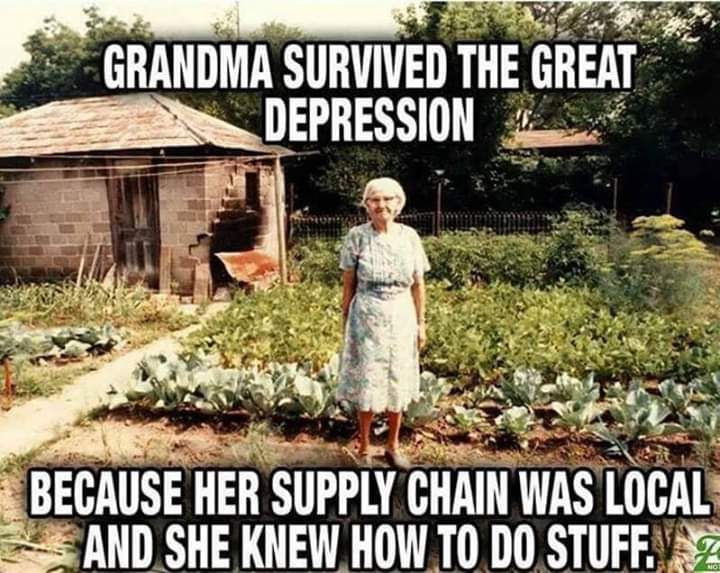
Grandma - Local Supply Chain

Here’s good ol’ Granny tending her garden.  The meme is right:  I know from family lore that my Mamaw and Papaw fed themselves, their children, and a lot of other folks in the mountains of southwestern Virginia during the Depression with chickens and crops they raised themselves.

That got me thinking:  could America see the return of widespread of homesteading, or some modern-day version of Jeffersonian agrarianism?

I was pondering this question on my way to church tonight (yes, yes, social distancing, etc., but it’s a small church, and we had a very small turnout, so I’m sure it was fine to attend), driving through the fields on the outskirts of Lamar.  I began pondering the notion of a society with our level of information technology, but that saw most Americans farming or gardening for at least a small bit of their sustenance.

Such a system would be “high-tech agrarianism”—it would combine modern technology, especially information technology like the Internet, with millions of freehold agriculturalists.  Yes, we’d still have the huge mega-farms, we’d have people working in offices, etc.  But people would be making good use of their land, too, growing crops instead of grass.

Of course, I then began to ponder if such a society could have ever developed organically.  My instinct is no—it required the massive integration of local, regional, and national economies to raise production efficiency to the point that we can have widespread, niche-y specialization in tens of thousands of fields.  Greater efficiency fed into greater technological advancement, which in turn led to greater efficiency—and on and on and on, in a revving upward cycle.

But now we’re staring down this virus, which is leading governments all over the world to close stores, cancel events, lay off workers, turn away elderly patients, and on and on.  Those long, efficient supply chains are massively disrupted.  People are hoarding toilet paper and bread in the hopes of riding out likely (and, in some places, actual) quarantines.

I’m assuming life will return to normal… eventually.  But when?  So far, many of my assumptions about the pandemic have been incorrect (it turns out this time, the media wasn’t just crying wolf—well, not entirely, anyway; it still seems that some of this panicked response is driven by ridiculous media spin and speculation).  If we continue down this road of greater and greater decentralized isolation, people are either going to riot, or figure out how to provide for themselves.

In such a world, maybe high technology and small-scale farming could work keyboard-in-glove.  I’ve long advocated for some return to a simpler, more agrarian, more localized life.

Of course, I’m romanticizing America’s Jeffersonian past.  Farming is hard—and risky (of course, that hardness made our nation great).  I certainly don’t know anything about it—another truth to the meme above.  Also, if we’d continued as a mostly farming nation, we wouldn’t have the means to fight this virus, or to figure out how to fight it.

That said, converting your half-acre lawn into a garden full of corn, squash, peppers, lettuce, cabbage, beans, berry bushes, etc., seems like a far more productive use of your little plot of land, and one that could save your life and the lives of others in a pinch.  That seems sensible.

We could also do with some can-do gumption, like Granny had.

Home Depot is operating on shortened hours, but they’re remaining open.  Maybe now is the time to buy a roto-tiller.

Donate to The Portly Politico

Support quality commentary on politics, education, culture, and the arts with your one-time donation.

$5.00