SubscribeStar Saturday: The Portly Politico Summer Reading List 2023

Today’s post is a SubscribeStar Saturday exclusive.  To read the full post, subscribe to my SubscribeStar page for $1 a month or more.  For a full rundown of everything your subscription gets, click here.

It’s that time of year again:  summer!  That means we’re due for The Portly Politico Summer Reading List 2023!

For new readers, my criteria is pretty straightforward.  To quote myself from the 2016 list:

The books listed here are among some of my favorites.  I’m not necessarily reading them at the moment, but that doesn’t mean you shouldn’t!

Pretty vague, I know.  Additionally, I usually feature three books, plus an “Honorable Mention” that’s usually worth a read, too.

For those interested, here are the prior installments:

With that, here’s The Portly Politico Summer Reading List 2023:

1.) “The Legend of Sleepy Hollow” and Other Stories from The Sketch Book, Washington Irving – There are dozens of compilations of Washington Irving’s The Sketch Book of Geoffrey Crayon, Gent.  The book has been in continuous print since its first publication in 1819-1820, which is remarkable:  at the time, American literature was in its infancy, struggling to differentiate itself from the flood of European novels, poetry, and short stories coming out of the Old World at the time.  Irving, along with his contemporary James Fenimore Cooper, launched American literature beyond our own hardscrabble frontiers into the wider world, and both authors became the first Americans whose works were read widely in Europe.

I picked up this Signet Classics edition (ISBN: 0-451-5301-8) approximately fifteen years ago, largely on the strength of its two most famous short stories:  “The Legend of Sleepy Hollow” and “Rip Van Winkle.”  These tales account for the vast popularity of the collection, but aside from a few other essays on American life, the vast majority of the collection takes place in England.

One of the most memorable essays from my first reading was “Westminster Abbey,” about the impressive abbey near London.  Here’s the first very first paragraph:

On one of those sober and rather melancholy days in the latter part of autumn when the shadows of morning and evening almost mingle together, and throw a gloom over the decline of the year, I passed several hours in rambling about Westminster Abbey. There was something congenial to the season in the mournful magnificence of the old pile, and as I passed its threshold it seemed like stepping back into the regions of antiquity and losing myself among the shades of former ages.

How’s that for setting the scene and the mood?  There is something mystical about that period in late autumn that is “rather melancholy,” and everything seems to have a certain shadowy gloominess cast over it.  I’ve always thought that the best time to learn about colonial American history—especially the history of New England—is in late autumn, when that damp crispness enters the air.  It feels like Plymouth Rock, or Salem Town, or the backwoods of New Hampshire.

This summer, I hope to reread this collection for the first time in fifteen years.  The essays on Christmas—“Christmas Eve,” “Christmas Day,” and “Christmas Dinner“—are instantly charming, and explain much of the more ancient English traditions of celebrating Christmas, including ghost stories around the fire (which became more popular in the Victorian era).

Needless to say, The Sketch Book has had an immense influence on my own writing, particular my travel writing.  I’m no Washington Irving (or Geoffrey Crayon), but my second book Arizonan Sojourn, South Carolinian Dreams: And Other Adventures clearly illustrates Irving’s influence upon my writing style.

To read the rest of this post, subscribe to my SubscribeStar page for $1 a month or more.
Bible Study Update II

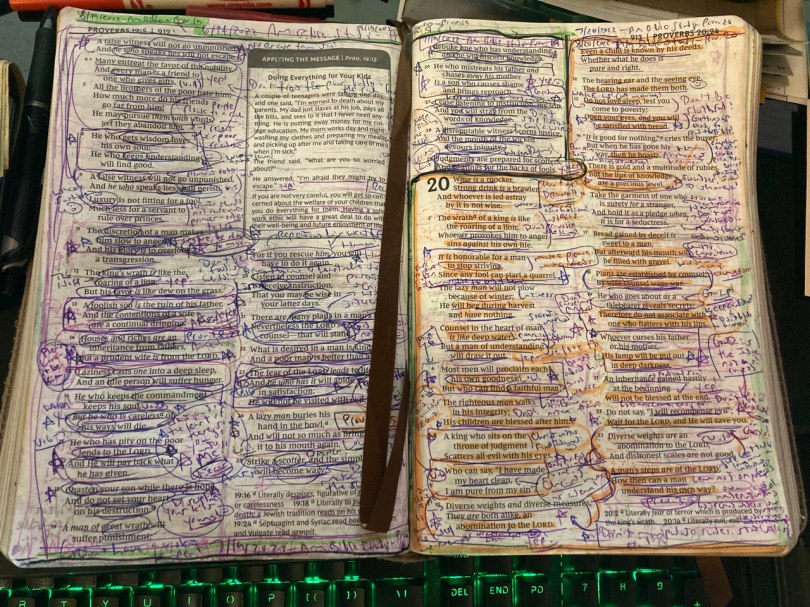
An eager commenter on my original “Bible Study” post prompted me to give a second brief update on my daily Bible reading (I wrote the first update back in July 2022).  Apparently, my humble daily regimen inspired the reader to establish a schedule of her own.  To that, all I can say is, “To God Be the Glory!”

That said, it’s satisfying to know that the words I scribble down on this self-indulgent blog do, indeed, reach people.  There are probably fewer things more pleasurable to a writer than to find that his words have made some impact on his readers, and the pleasure is enhanced when it’s a stranger.  We all understand that we influence those close to us, for good or for ill, because we can see the effects more clearly.  But the idea that a stranger might be reading our words is a small sign that we’re expanding beyond our immediate familial and social circles to wider audiences.  It feels good.

But I digress.  This post is about studying the Bible, not tooting my own saxophone; pride, after all, is a sin.

Read More »

Supporting Friends Friday: Andrea the Illustrator’s Children’s Book

I should probably not trumpet so triumphantly and assuredly the death or hiatus of any given thing, especially as it pertains to this blog.  I’d decided to give Support Friends Friday a rest for a bit—and I did, for two weeks!—because I was running out of friends to support.  At least, I was running low on new friend-generated content to champion.

Then good old Andrea the Illustrator went and published a book with a bunch of contributors.  It’s called Creative Gems, Volume I, and it’s out in paperback, hardcover, and Kindle editions now.

Read More »

Bible Study Update

For the past month (roughly) I’ve been dedicating my mornings to Bible study.  I became very negligent about spending time in God’s Word over the past school year—and, really, over the past few years—so I have been doing my part to mend my relationship with Him and to immerse myself in His Word.

I’m pleased to report that, so far, I have largely stuck with it, only rarely missing a day’s reading.  I started simply:  reading through Proverbs.  A very common Bible study tactic is to read one chapter of Proverbs a day; in thirty-one days, or one month, you’ll have read the entire book.  I adapted that slightly, sometimes reading a couple of chapters a day.  As June has only thirty days, and I started late, I managed to end the month with Proverbs 31.

After finishing Proverbs, I realized I needed to expand my reading further.  To that end, here is my current reading schedule each morning:

  • Three chapters of Psalms (with 150 chapters, it should take fifty days to get through Psalms, although Psalms 119 might be its own day)
  • One chapter of Proverbs, corresponding with the date (for example, this morning I will read Proverbs 12)
  • One chapter of Isaiah, also corresponding with the date until I get to Isaiah 32 on 1 August 2022, at which point I’ll keep reading one chapter a day until I have completed the book (again, this morning I’ll read Isaiah 12)
  • A New Testament passage from a little “read-the-New-Testament-in-one-year” Bible someone gave me years ago (today’s passage will be Romans 1:1-17)
  • Some days, I do a reading from a little devotional, Our Daily Bread

In total, it takes me anywhere from forty-five minutes to an hour to complete this reading, as I try to read slowly and take notes in the margins (I also start readings with thorough prayer time with God, praying prayers of thanksgivings to Him; praying specific prayer requests; and praying for His Hand in my life and my budding relationship) and if I see connections to other Scriptures—which is happening more and more frequently lately—I will take time to note the parallels and tie them back.

Read More »

SubscribeStar Saturday: The Portly Politico Summer Reading List 2022

Today’s post is a SubscribeStar Saturday exclusive.  To read the full post, subscribe to my SubscribeStar page for $1 a month or more.

It’s that time of year again:  summer!  That means we’re due for The Portly Politico Summer Reading List 2022!

For new readers, my criteria is pretty straightforward.  To quote myself from the 2016 list:

The books listed here are among some of my favorites.  I’m not necessarily reading them at the moment, but that doesn’t mean you shouldn’t!

Pretty vague, I know.  Additionally, I usually feature three books, plus an “Honorable Mention” that’s usually worth a read, too.

For those interested, here are the prior installments:

With that, here’s The Portly Politico Summer Reading List 2022:

1.) Quentin Tarantino, Once Upon a Time in Hollywood: A Novel (2021) – This novel—Tarantino’s first—is a novelization of his film Once Upon a Time in Hollywood (2019), a flick I really enjoyed, even though it appears I have not reviewed it on the site.  What makes it so fun is that it’s written like a pulp novel about the waning days of Hollywood’s golden age.  I’m only nine chapters (about 142 pages of 400) into the book, but as a fan of the film, I can heartily recommend it.  Like an novel (or, in this case, novelization) it can explore scenes and characters and backstories in more detail.  Considering the film is a daunting 161 minutes—nearly three hours—in length, it’s remarkable how much more can be explored in a book.

The novel shifts perspectives between different characters, but the main characters are washed-up cowboy actor Rick Dalton and his stunt double and personal driver, Cliff Booth.  Dalton’s career isn’t exactly dead, but his glory days are behind him, and he’s playing bit-parts as the “heavy” on Westerns.  Booth, a veteran of the Second World War with a fairly dark past, plays babysitter to the bipolar, alcoholic Dalton.  While it seems Dalton gets the better part of this arrangement, the pair form a mutually-beneficial bond—when Dalton works, Cliff does.

Dalton’s career is slowly starting to improve against the backdrop of the Manson Family, which begins its murderous spree in Los Angeles.  The film version presents an alternate version of the Sharon Tate murder, and I imagine the book is heading in the same direction.

For fans of Old Hollywood and Westerns—and, of course, the Zeitgeist of the late 1960s and early 1970s—it’s a must-read, and very fun, too.

To read the rest of this post, subscribe to my SubscribeStar page for $1 a month or more.
Bible Study

Now that summertime is here, I’m using the bit of extra, unstructured time to try to develop some good habits.  This past school year was pretty brutal, between a heavy load of classes and up to twenty lessons a week.  I was thankful for the income from lessons and for the security of work, but it really took its toll as the academic year wore on.

Unfortunately, one of the first things I let go was daily Bible study.  I’ll be the first to admit that I’ve always been spotty about reading the Bible daily.  I’m often more interested in listening to someone else’s commentary on God’s Word than reading it for myself, as if I’m a medieval Catholic.

But there’s no substitute for the real thing—daily Bible reading and study.  So I’ve established a routine now that summer is here, and it’s really helped me keep on track.

Read More »

SubscribeStar Saturday: The State of Education Update II

Today’s post is a SubscribeStar Saturday exclusive.  To read the full post, subscribe to my SubscribeStar page for $1 a month or more.

Spring Break is drawing to a close, with a four-week-ish slog to the relative freedom of summer vacation, when I go from being a stressed-out ball of blubber persisting on processed foods and frozen pizza to living like a chubby retiree.  As such, it seemed like an opportune time to look at the state of education in the United States.

As I wrote this morning, lately I’ve been listening to quite a bit of the ideas of “unschooling” advocate John Taylor Gatto.  Some of his views on adolescence (he says there really isn’t one, and that childhood essentially ends around the age seven) are pretty radical, though they aren’t without historical precedent, but for the most part, I find myself in agreement with assessment of the modern educational-industrial complex.

The first JTG video I watched/listened to

In essence, Gatto (should I call him “JTG”?) argues—and supports, with ample primary source research—that the modern system of “warehouse” schooling is not a proper education at all, but rather a massive system for indoctrinating students into compliance and mass conformity.  He argues that little real “education” takes place inside of schools, and that a genuine education comes from within the student himself.  In other words, all of the world is a “classroom” and everyone in it a “teacher” to the open learner.  An elite, private or boarding school education is available to anyone, Gatto contends, for free.

Gatto famously quit after a long, celebrated career in New York City public schools in a letter to The Wall Street Journal entitled “I Quit, I Think” (note that the title has two possible meanings:  the first, obvious one is the note of uncertainty the added “I Think” carries; the second one is the subtle implication that because “I Think,” I (Gatto) must quit).  In short, Gatto came to believe that what he had been doing for years was actually harming students, rather than improving their lives.

Talk about a heavy epiphany.

To read the rest of this post, subscribe to my SubscribeStar page for $1 a month or more.

Supporting Friends Friday: Mariella Hunt’s Serialized Novella

Readers my recall an edition of Supporting Friends Friday dedicated to Mariella Hunt, an Idaho-based author who also dabbles in cute water colors of birds.

Before she started painting birds, Mariella was a writer—a prolific one, at that.  I discovered her first through her paintings, through Andrea the Ilustrator’s blog, but have come to appreciate and enjoy her writing as well.

Mariella is a talented non-fiction writer, but her real passion is fiction.  She tells me that she is hoping to make a living as a freelance writer, and is currently publishing her novella The Sea Rose via Amazon’s Kindle Vella service.

Kindle Vella allows authors to release stories serially, in short little doses or chapters, much the way much of Charles Dickens’s work was published.

I’ve read the first chapter of The Sea Rose, and it’s good—really good.  I am eagerly awaiting the second chapter (which should be available by the time you read this post!).

Read More »

TBT^2: On Ghost Stories

It’s that time of year again—the so-called “spooky season,” when Halloween decorations go up, scary stories get told, and overwrought bloggers with delusions of grandeur stage over-the-top concerts from their front porches (well, maybe that last one is just me).  As the weather turns cool and the leaves begin to fall, it’s almost impossible not to settle in with some hot coffee and a good collection of ghost stories.

So, for the second year in a row, I’m looking back this TBT to 2019’s “On Ghost Stories,” a post that now will hold the distinction of being a perennial favorite.

One might think that as scary as the real world is, we’d spend less time reading spooky fiction.  It seems the opposite is the case.  Perhaps the idea that malevolence is not necessarily the result of human frailty, but rather due to wicked supernatural influences, is oddly comforting.  That evil is the result of our fallen nature—and, of course, the malignant supernatural influence up on it—is a bit easier to forget, perhaps, when reading about some ghostly figure wreaking havoc in the English countryside.

More likely, it’s just that we enjoy being scared—when we can easily flip off the television or close the book.  Horror is fun when there are no real consequences attached to it.  Then again, just watching horror movies probably isn’t healthy (I’ll report back if I suddenly get any macabre urges).

Well, whatever the reason, a good ghost story is hard to pass up.  With that, here is “TBT: On Ghost Stories“:

Read More »

Supporting Friends Friday: The Cinematic Compositions of Mason Sandifer

The first two editions of Supporting Friends Friday (highlighting the poetry of Jeremy Miles and the music of Frederick Ingram) have been well-received, particularly by the friends being supported, and it gives me a great deal of joy to showcase their works, albeit from the humble platform of this blog (read by dozens a day!).  As I have written many, manymany times over the last year, making a living through creative work, like writing books and playing music, is difficult, especially in The Age of The VirusBuilding up a community of artists who celebrate one another’s works is an important part of the indie music and publishing business.

It’s also just fun, much like the music of Robert Mason Sandifer, the young composer I’m highlighting today.  Mason, as I call him, is a private student of mine, so this post is perhaps tad self-serving, but even if he weren’t my student, I would adore his music.

Read More »