TBT: The Joy of Hymnals

It being October, I tend to focus on the spookiness of the season.  I love Halloween, ghost stories, and scary movies, but it’s important not to get too bogged down in the chills.

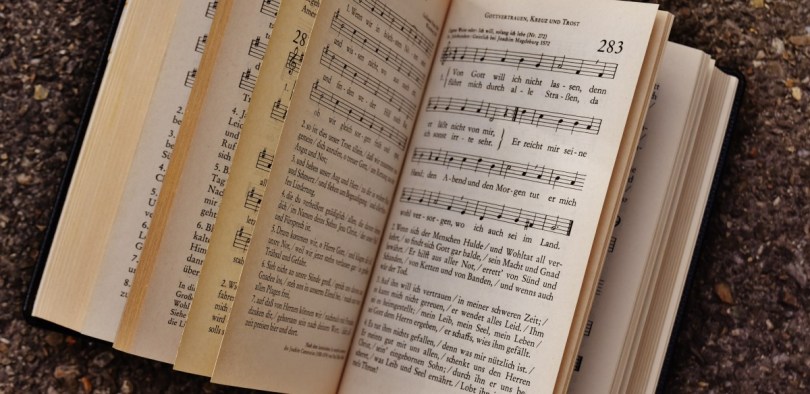
So as I was going through posts from October 2019, I stumbled upon one of my old favorites:  “The Joy of Hymnals.”  My small church roped me into playing piano for Sunday morning services maybe two years ago, and it quickly rekindled an old love of hymns and hymnals.

Hymnals are my favorite items to find in old second-hand shops and antique stores (the latter of which often selling them at an egregious markup).  It’s fun to see which hymns do—and, more importantly, don’t—show up in any given hymnal.  I particularly like slender volumes, the kind that were meant for carrying from service to service or camp meeting to camp meeting, and which tend to possess hymns from the canon, if such a thing exists, of hymnody.

I even recorded and released a very lo-fi EP, The Lo-Fi Hymnal, which consists of crude recordings of my Sunday morning playing.  That short collection also includes a PDF version of today’s TBT feature.

Here is “The Joy of Hymnals“:

Read More »

The Future of Cinema

Over the past year or so, I’ve become far more interested in film as an artistic medium.  I’ve always enjoyed going to the movies, but I’m beginning to seek out more interesting and unusual fare, particularly the classics.  One reason I’m watching more films from the 1960s-1990s is because so many flicks these days are full of social justice pandering and parroting of the Leftist bromides du jour.  It’s refreshing watching movies in which people act like people, and not drones from the HR or Diversity Departments.

In The Age of The Virus, we’ve been encouraged to stay home and watch TV—a commentary on our diluted sense of “sacrifice” in the twenty-first-century West.  But that’s had an interesting impact on the cinema, by which I mean movie theaters.  With endless content on streaming services and bigger, cheaper televisions, it seems that the old movie palaces and multiplexes are increasingly obsolete.

Regal Cinemas re-shuttered its theaters across the country after making a go at reopening.  When I went to see The Empire Strikes Back and The New Mutants, there were very few people there, even during prime weekend screening times.  The New Mutants was a full-freight flick, but Empire and other classics were just $5!  Even then there were loads of empty seats—and that wasn’t just because of social distancing requirements.  I asked a manager how he was doing and he said, “Well, at least we’ve got some people here tonight.”  It does not sound good for the future of theaters.

Read More »

Movie Review: The Little Girl Who Lives Down the Lane (1976)

After returning from Universal Studios yesterday, I decided to ease back into the week with a couple of flicks.  Hulu isn’t the best of streaming services in terms of content, but lately I’ve uncovered some good older films on the platform, and occasionally I’ll uncover some hidden gems.

To be sure, there’s a good bit of garbage, too, especially this time of year, when the budget horror flicks pop up like weeds.  I watched 1972’s The Last House on the Left last night before catching the subject of this review, and it was a lurid bit of early 70s exploitation.  It didn’t necessarily endorse the violence and depravity it depicted, but it certainly seemed to revel in it.  At its best, it was a morality tale about the dangers of the hippie movement and misguided youthful energy; at its worst, it was an excuse to torture pretty girls on screen.  I’d recommend giving it a pass.

The second film I watched, however, is one I will highly recommend:  1976’s The Little Girl Who Lives Down the Lane.  It stars a barely-thirteen-year old Jodie Foster in a command performance, along with a young Martin Sheen, who must have been about twenty-six at the time.

Read More »

Memorable Monday: Happy Columbus Day!

I’m back from my third trip to Universal Studios this year, and I’m worn out.  Having nonstop fun in the central Florida sun for three days straight really takes it out of me—that, and driving nearly fourteen hours round trip.  I’ll be posting a delayed SubscribeStar post about the trip for subscribers later this evening, after taking a much-needed nap.

Today is Columbus Day, and outside of banks and the postal service, I’m one of the few people who doesn’t have to work today.  I’m thankful for that, and to Columbus for making his historic voyages to the New World.

The attempts of cancel culture to rewrite history have only intensified since I wrote this post one year ago.  The trend is heading into extreme territory, in which we absurdly demand people living four hundred years ago to have had the foresight to think and believe the way we do in 2020.  We pillory them and destroy their statues if they failed to genuflect properly.

The world in 1492 was a brutal place, especially in the New World.  The myth of the “noble savage” was just that—a myth.  The Native Americans were a vastly diverse array of tribes and confederations, often intensely at war with one another.  That doesn’t excuse some of the abuse they did receive at the hands of Europeans and, later, Americans, but it should dispel this notion that white people cruelly destroyed peaceful Earth worshippers.

That it doesn’t is a testament to the strength of progressive indoctrination in our schools.  We don’t name football teams, towns, and military weaponry after Native Americans because they were pagan hippies; we do so because we fought them for hundreds of years and admire their tenacity and warrior-spirit.  It’s the hard-won respect one has for a worthy opponent, even a defeated one.

So, I’ll repeat my call to preserve Columbus Day.  Here is 2019’s “Happy Columbus Day!“:

Today is Columbus Day in the United States, the day that commemorates Columbus’s voyage to the Americas in 1492.  It’s one of the most significant events in human history—as I tell my American History students, “we wouldn’t be here if Columbus hadn’t made his voyages”—yet the social justice, Cultural Marxist revisionist scolds want to do away with the holiday entirely, replacing it instead with “Indigenous People’s Day.”

The thrust of the proposed (or, as is the way with SJWs, demanded) name change is that Columbus was a genocidal, white male meanie who defrauded and murdered peace-loving Native Americans (who had the gall to mislabel Indians!), so instead we should celebrate the contributions of Stone Age cannibals.

Two States—Vermont and Maine (of course they’re in New England, the epicenter of neo-puritanical scolds)—have passed laws renaming the federal holiday to the SJW-approved Indigenous People’s Day.  One Maine mayor, however, refuses to bend, and has declared that in Waterville, Maine, Columbus will be honored.

Mayor Nick Isgro has garnered national attention for his stand to protect Columbus Day from the faddish winds of outrage culture:  “‘The history of mankind is not necessarily a nice one,’ he said. ‘With every great accomplishment, we could probably line up negative consequences as well as positive consequences and that goes across all peoples, all continents, all countries.’”

That’s probably one of the best, brief summaries of a proper historical perspective I’ve read recently:  we can find all sorts of nasty bits about every culture, country, and personality.  But that doesn’t detract from the greatness of their accomplishments.

The revisionists are not incorrect about Columbus:  he did, in his own misguided way, commit what we would now consider atrocities against the Arawaks of the Caribbean.  But it’s foolish to believe that the Native Americans were peaceful, “noble” savages, living in a harmonious state of nature until the evil, exploitative Europeans showed up.  That version of history is a Leftist passion play, which casts history into shades of (literal and metaphorical) black and white—and any white person must possess a black soul.

The peoples of the late fifteenth-century Caribbean were no saints.  To quote from Samuel Eliot Morrison’s Admiral of the Ocean Sea (quotation c/o VDare.com):

The searching party found plentiful evidence of these unpleasant Carib habits which were responsible for a new word—cannibal—in the European languages. In the huts deserted by the warriors, who ungallantly fled, they found large cuts and joints of human flesh, shin bones set aside to make arrows of, caponized Arawak boy captives who were being fattened for the griddle, and girl captives who were mainly used to produce babies, which the Caribs regarded as a particularly toothsome morsel.

Clearly, the Arawaks weren’t polite simpletons (which is how they come across in progressive retellings) snookered by a wicked Italian.  They were fattening up little boys t be eaten, and impregnating young girls to eat their offspring!

I recently wrote about similar Native American atrocities regarding the Aztecs.  The Aztecs’ atrocities are far better understood—the massive, organized human sacrifices, for example—but there’s still this push among modern historians to cast the Spanish conquistadors as the villains.

Naturally, we have to understand these cultures and civilizations in their time and place—but we can do so without condoning their barbarism and cannibalism.  Similarly, if we’re willing to accord some historical wiggle room to baby-eaters, can’t we extend the same generosity to Columbus and the Spanish conquistadors?

Further, as I read the accounts of various Native American practices, I can see why Spanish and subsequent Europeans believed they were doing the Lord’s work to wipe out these practices:  some of them are downright demonic.  It’s fitting that the bloody temples of Tenochtitlan were dismantled and replaced with a Christian cathedral.  The Old Testament is rife with examples of pagan places of worship being destroyed and replaced with altars to Jehovah.

(Of course, if the Spanish were indeed part of God’s Divine judgment on the Aztecs, et. al., Americans should be very worried today, as we continue to participate in mass infanticide.  God is patient, but His patience does not endure forever.)

So, yes, let’s celebrate Columbus on Columbus Day.  I’m glad to be in the New World, and that we don’t line people up to be sacrificed to a sun god every day.

Columbus

Tip The Portly Politico

Support quality commentary on politics, education, culture, and the arts with your one-time donation.

1.00 $

Phone it in Friday XVI: Week in Review (5-8 October 2020)

I’m out of town for a few days, so I’m resorting to something I rarely do:  a week in review post.  Some bloggers feature these weekly, such as my blogger buddy Mogadishu Matt.  I sort of did one back with “Lazy Sunday LVIII: Spring Break Short Story Recommendations Recap,” but that was more a review of a week-long series of posts, not a review, per se, of the week itself.

Ah, well.  That’s just nit-picking.  Here’s what I wrote about this past week:

That’s it for this edition of Phone it in Friday.  Here’s hoping I wrote some material good enough that you don’t mind reading it (and reading about it) again.

Happy Friday!

—TPP

Tip The Portly Politico

Support quality commentary on politics, education, culture, and the arts with your one-time donation.
1.00 $

TBT: Lazy Sunday LVIII: Spring Break Short Story Recommendations Recap

It’s getting into that spooky time of year, so for this week’s TBT I decided to look back at “Lazy Sunday LVIII: Spring Break Short Story Recommendations Recap.”  I spent most of my Spring Break this year reading horror short stories, writing reviews about and recommendations for some of the better stories I read.

I won’t do much more editorializing than that, as the original post is quite lengthy and detailed.  I will add that love short stories, and find the form chillingly effective for horror.  The brevity and concision of the form encourages horror writers to deliver chills and terror straightaway, and allows for frights to be the focus.

With that, here is “Lazy Sunday LVIII: Spring Break Short Story Recommendations Recap“:

Read More »

Rock in Peace, Eddie Van Halen

It is with a heavy heart that we bid a fond farewell to the Mozart of our time, Eddie Van Halen.  Van Halen passed away after a lengthy struggle with lung cancer.  He is survived by his brother, drummer Alex Van Halen, and his son, Wolfgang Van Halen, who joined the band as its bassist in 2006.

Van Halen was truly one of the guitar greats of the twentieth century, the second half of which witnessed the rise of many guitar heroes to the pinnacles of superstardom, particularly in the 1970s and 1980s.

But Van Halen’s licks didn’t stop with memorable riffs.  He could play neoclassical passages with ease, weaving them into songs about partying and and lusting after one’s teacher.  Learning his signature solo, “Eruption,” became a rite of passage for budding guitarists in the 1980s and beyond.  Van Halen also dominated on the keyboards—much to the chagrin of perennial showman David Lee Roth—as is clear from the entire album 1984, one of the best albums of all time.  Who can resist jumping when hearing the opening strains of “Jump“?

Read More »

Morning Movie Review: Brazil (1985)

In continuing with last week’s review of The Empire Strikes Back—and this week’s unofficial theme of keeping posts light—I decided to jot off this quick review of a very good, very deep film, the dystopian dark comedy Brazil.

This film has been on my watch list for some time, and a timely RedBox 50% off on-demand streaming coupon made it a compelling rental for a Monday night.  It was well worth the $2.15; indeed, I may even watch it again tonight, just to catch details I likely missed the first time.

The basic premise of Brazil is to envision an excessively bureaucratic society, in which filing the proper paperwork and avoiding blame—the hallmarks of any bureaucracy—matter more than doing what’s right or decent.  Indeed, the highest good in the nameless society of Brazil is to keep the bureaucracy chugging along, and to wrap everything up in red tape.

Read More »

Lazy Sunday LXXXI: Education, Part II

The school year is roaring on, and we’re already coming up on the end of our first quarter (an unusually truncated first quarter, as we’ll only have been in school seven weeks by this Friday, plus two days).  I’ve been writing a bit more about education lately, as is common during the school year.  In The Age of The Virus, it makes for slightly more interesting writing than the usual complaints about overstuffed classrooms and understuffed paychecks.

I also haven’t featured education since “Lazy Sunday XXIV: Education,” so it seemed like a good time to revisit the topic that consumes most of my daily life.  Here are some recent posts on that all-consuming topic:

  • Progress Report: Teaching in The Age of The Virus” – I wrote this post just a few weeks ago, when interim/progress reports were coming out at my school.  It was a good opportunity, after nearly a month of teaching, to reflect on the additional challenges and burdens of teaching live to students face-to-face and online simultaneously, and of recording (often with buggy apps) for international students to watch later.  The workload has since taken on a more familiar pattern and rhythm, but those first few weeks consumed huge amounts of time and energy.
  • Teaching in The Age of The Virus: Live Remote Learning Rehearsal Day” – I wrote this post just two days ago, and it was a bit of an update on my “Progress Report.”  This post reviewed our “Live Remote Learning Rehearsal Day,” in which all students stayed home and livestreamed classes via Google Meet, while teachers taught from their respective classrooms.  I was surprised by how challenging it was to maintain the rapport of a classroom setting while having students sitting at home.  Very odd.
  • SubscribeStar Saturday: Making Music, Part II” – When I wrote this post yesterday, I had forgotten I’d written another SubscribeStar Saturday post of the same name in May!  That was bound to happen eventually, so I hastily added the “Part II” to this one.  Yesterday’s post was a bit of a counterpoint to the frustration and pessimism of Friday’s review of the live remote rehearsal day:  it was a celebration of music education, and the joy of watching student-musicians forming bands, writing lyrics, singing songs, and all that.  Indeed, it’s a reminder why teachers teach—and why music teachers have it the best, even if they work hard.

That’s it for another Lazy Sunday.  Here’s hoping you enjoyed a restful weekend.  It’s finally October, and the weather in South Carolina has been sublime:  warm enough to enjoy a walk in the afternoon, but cold enough to kill most of the bugs.

Happy Sunday!

—TPP

Other Lazy Sunday Installments:

Donate to The Portly Politico

Support quality commentary on politics, education, culture, and the arts with your one-time donation.

$5.00

TBT: On Ghost Stories

Today marks the first day of October, perhaps my favorite month of the year.  We’re already getting that first crisp coolness in the air here in South Carolina, and it’s feeling more and more like autumn every day.

So with Halloween just thirty days away, I thought it would be fun to look back at a post from last “All Hallowe’s Eve Eve,” as I wrote at the time:  one all about ghost stories.

I finally finished slogging my way through The Penguin Book of Ghost Stories, thanks in no small part to quarantine.  It’s an excellent collection, and I stand by my recommendation from last October, but there are a handful of stories that are way too long—or dense.

I’m now reading through a more accessible, far lighter read:  the classic Tar Heel Ghosts by John Harden.  It’s a collection of North Carolina-based ghost stories published in the 1950s, so it has that pleasing sense of implicit patriotism and love of place that is now so sadly missing from our cynical, cosmopolitan writing of today.  Like The Story of Yankee Whaling, it possesses a refreshing innocence about and love for its subject:  no hand-wringing over now-unfashionable ideas, no condemnation of a lack of diversity, no talk of “marginalized” groups being “unrepresented.”

I picked up the book sometime in my childhood on a family trip, but I don’t think I ever finished the collection.  I’m rectifying that all these years later, and I’m thoroughly enjoying it.  I also plan to reread Ray Bradbury’s The Halloween Tree, one of my favorites to pull out this time of year.

Here’s hoping you find some spooky tales of your own to curl up with on these cold, October nights.  Here’s October 2019’s “On Ghost Stories“:

It’s Halloween!  Well, at least it’s All Hallow’s Eve Eve, but that’s close enough for some ghoulishly delicious ghost stories.

I love a good ghost story.  The Victorians did the genre best, but many writers since have honed it further, adding their own unique twists and scares.  Even Russell Kirk, the great conservative philosopher, was a fan of ghost stories.  Indeed, his bestselling book was a ghost story.

For the Victorians, ghost stories were told at Christmastime.  This timing, while peculiar to modern readers, makes sense intuitively—Christmas is a time for remembering the past, in part (perhaps especially) our honored dead (just ask Washington Irvingif he comes by to haunt you).  The “ghosts” of departed loved ones linger closely during those long, frosty nights.  The inherent nostalgia of Christmas and the winter season—and bundling up next to a crackling fire—sets the perfect mood for ghostly tales.

Nevertheless, what other time of year can beat Halloween for a good tale of witches and werewolves; of monsters and mummies; of ghouls, goblins, and ghosts?

As such, I’d encourage readers to check out “Nocturne of All Hallow’s Eve,” a deliciously frightening, blood-soaked tale of the supernatural and the macabre from Irish-American author Greg Patrick.  Alternative fiction website Terror House Magazine posted it back in September, and I’ve been saving it to share on the blog until now.

Patrick’s style conjures the dense verbiage of Edgar Allan Poe.  Indeed, he overdoes it a bit (see his more recently published “The Familiar“).  But his subject matter is pure Halloween—the tenuous space between the natural and the supernatural, the mysterious rituals, and on and on.

If you’re still in search of some ghostly reads, check out The Penguin Book of Ghost Stories.  It’s the collection I’ve been reading since my trip to New Jersey this summer.  It’s a truly spine-tingling collection that covers some of the great—and many of the undeservedly unsung—writers of the genre, the men and women who truly created and molded what makes a good ghost story.

So wherever you find yourself the next couple of nights, curl up with a good book, a warm fire, and a good ghost story (and maybe someone else, if you’re so inclined).  You and the ghosts will be glad you did!

Ghost

Donate to The Portly Politico

Support quality commentary on politics, education, culture, and the arts with your one-time donation.

5.00 $