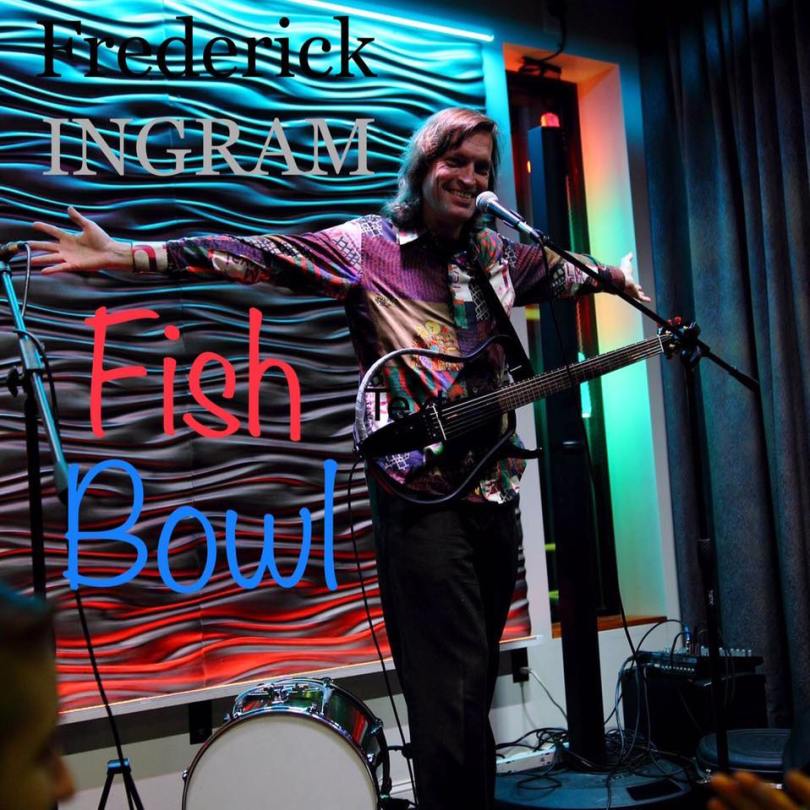
Supporting Friends Friday: The Music of Frederick Ingram

Last Friday’s very first Supporting Friends Friday, which featured the release of Jeremy Miles‘s (read his blog) latest book of poetryHindsight: Poetry in 2020, was quite fun, and at the very least brought delight to Jeremy, and at the most hopefully helped sell a couple of copies of his book.

In that spirit, I wanted to dedicate this second installment to the music of my musician buddy Frederick Ingram.  Frederick is a gifted and skilled guitarist, vocalist, and songwriter, and we have played together or on the same bill on a number of occasions.  Frederick also recently made a surprise appearance to the inaugural TJC Spring Jam, and treated us to a three-song set.

Recently, Frederick released the “Funky Margarita Mix” of his ode to open mic nights, “Fish Bowl.”  Frederik wrote “Fish Bowl” some years ago, inspired by a (I believe) now-defunct open mic night once hosted at a groovy little joint in Columbia, South Carolina.  The story, as I recall, is that the venue’s stage had an aquarium as a backdrop, which surely made for any intriguing performance experience.

Read More »

Fighting Back Against Critical Race Theory

In the waning years of the Obama Administration, a strident new form of race hustling emerged.  Combining elements of identity politics, Foucaultean power dynamics, Cultural Marxism, and Nineties-style corporate diversity training, Critical Race Theory (CRT) emerged as a powerful ideological bludgeon with which to batter anyone with the audacity to be white.

At its core, CRT proposes a simple thesis:  any person of color, in any material or spiritual condition, is automatically oppressed compared to white people, because white people benefit from inherent privilege due to their whiteness.  Alternatively, black and brown people face systemic racism—racism present in the very structure of the West’s various institutions—so even when not facing overt acts of racism, they are still suffering from racism nonetheless.  The source of white people’s “privilege” is that systemic racism benefits them at the expense of black people.

The problem is easy to spot:  any personal accountability is jettisoned in favor of group identities, so any personal setbacks for a darker-skinned individual are not the result of that individual’s agency, but rather the outcome of sinister, invisible forces at play within society’s institutions themselves.  Similarly, any success on the part of a lighter-skinned individual is due to the privilege that individual enjoys.

Read More »

Ending Neverending Benefits

According to Scott Rasmussen’s Number of the Day for Tuesday, 8 June 2021, 71% of voters favor ending supplemental insurance benefits.  Indeed, according to last Friday’s Number of the Day, twenty-five States have already ended or plan to end pandemic-related unemployment benefits.  South Carolina is among those twenty-five States, all of which have Republican governors (Vermont and Massachusetts are the the only two States with Republican governors who have not ended the benefits), thus demonstrating once again that the Republican Party, for all of its faults, is still the party of commonsense.

As I’ve written recently, excessive unemployment benefits account for the current labor shortage, which in turn has fueled inflation.  It seemed to hit the fast food industry first, as workers could make more money staying at home than returning to their reopening restaurants.  As I detailed in “Fast Food Premium,” restaurants began offering higher pay, signing bonuses, and even cash for submitting an application.  All of those costs get factored into the price of the final product, causing prices to increase.

Read More »

The Interstate

I made it back from my latest trip to Universal Studios after a long, tedious drive that took up the better part of Sunday.  I’d intended to hammer out a belated Lazy Sunday upon my return, but I was so wiped from the drive, I just watched television instead.

With all the driving on I-4, I-95, I-26, I-77, and I-20, I had ample time to think about the pros and cons of the Interstate Highway System.  I have a bit of a love-hate relationship with the Interstate.  On the love side of the equation, I appreciate the convenience of being able to drive vast distances in reasonable times.  The trip that took us around seven hours to complete yesterday (and that was with terrible traffic and inclement weather) would have taken, according to Google Maps, between nine and ten hours.  In reality, that would have been closer to eleven or twelve hours with stops, traffic, etc.

As an engine for economic growth, the Interstate is probably the best investment the federal government ever made.  It was pitched to Congress as a national security project—we needed broad, interstate boulevards for our tanks to deploy swiftly against a Soviet invasion—an approach that John C. Calhoun attempted as Secretary of War in 1817 (under the strict constructionist Democratic-Republican James Madison, Calhoun’s Bonus Bill faced a swift veto).  But the real benefit of the Interstate Highway System is its ability to move people and goods swiftly, cutting down on shipping and transportation costs, and making longer commutes feasible.

Granted, there were downsides:  the small towns and tourist traps alongside old federal highways and State roads.  Just as the old railroad towns withered up when the trains stopped running—or repurposed into some other form—many small towns died out when the Interstate diverted traffic away from them.  Of course, the converse is true:  many towns boomed when the Interstate weaved their way.

So, one could surmise I appreciate the Interstate for its convenience and beneficial qualities.  So, where is the hate?

Read More »

TBT: Gay Totalitarianism

Thanks to Lauren Witzke, yesterday’s post was spread far more widely than I anticipated.  It’s thanks to her that I even had the idea for the post, thus proving, once again, that beautiful and intelligent women continue to serve as a source of inspiration.

In keeping with the theme, I thought this week’s TBT should look back at a past post about the totalitarian nature of the LGBTQ+2Aetc. movement.  I wrote this piece way back in April 2019, which feels like it was an eternity go.

The problem I identified at the time—the excessive empowerment of fringe identities leading to perverse incentives to play victim—has only exacerbated since then.  Remember, 2019 was before the George Floyd debacle, which turned a man with numerous health problems overdosing on fentanyl into a martyr and a saint—and resulted in a summer of race riots.  Depending on one’s sexual orientation and/or skin color, one can practically commit crimes and get off scot-free.

I attributed this to the totalitarian Left’s lust for power.  Now, however, I’m not even so sure if that’s what is at root of it all.  At a certain point, rational explanations fail.  There is such a degree of irrationality at play, the presumption shifts from “these actions are conscious and intentional” to “these actions are the result of an insane mind.”  Perhaps we’re witnessing widespread insanity, which progressive politics caters to happily.

Whatever the reason, identity politics is destroying our fragile social fabric, rending it violently apart.

With that, here is 2 April 2019’s “Gay Totalitarianism“:

Read More »

SubscribeStar Saturday: Small-Scale Entrepreneurism

Today’s post is a SubscribeStar Saturday exclusive.  To read the full post, subscribe to my SubscribeStar page for $1 a month or more.  For a full rundown of everything your subscription gets, click here.

Last night was my first ever Spring Jam, and my second ever front porch concert.  The first such concert, my Halloween Spooktacular, was far more successful than I imagined.  At the time of this writing—which is actually before the concert (gasp!)—I don’t know how well the Spring Jam will go financially, but I’ll have detailed numbers, as well as an overall review of the event, next Saturday.

That said, in putting together this second front porch concert, I’ve run into a few more hiccups than last time.  Most of these have been relatively minor—and one of them quite major—but they’ve taught me some lessons for next time.

Most importantly, they’ve driven home the risks and opportunities inherent in putting on any endeavor.  Impresarios past and present know well the risks of producing any kind of stage or musical production.  Even at the very small scale at which I am working, some risks are present.

To that end, allow me to share with you some of the learning opportunities putting together this Spring Jam has afforded me, and how these lessons can be applied to future entrepreneurial ventures of any kind.

This post will be finished later; I was slammed with the Spring Jam and wasn’t able to finish the subscriber essay.  I’ll let y’all know when I have it done.  Apologies!  —TPP

To read the rest of this post, subscribe to my SubscribeStar page for $1 a month or more.

TBT: The Desperate Search for Meaning IV: Vanity

In the spirit of yesterday’s post, which also dealt with a passage from Ecclesiastes, I thought I’d dust off an old post from my The Desperate Search for Meaning Series, which I completed back in 2019.  A double-shot of Ecclesiastes, and the long-winded (but condensed here) wisdom of Pastor Monday is always a nice treat.

With that very brief introduction, here is October 2019’s “The Desperate Search for Meaning IV: Vanity“:

Read More »

The Passing Seasons of Life

My pastor delivered an interesting sermon this past Sunday (23 May 2021) entitled “Recognizing the Passing Seasons of Life.”  The sermon pulled from the famous passage from Ecclesiastes 3, explaining that “To everything there is a season” and there is “a time for every purpose under heaven.”

I’ve always loved Ecclesiastes and its central insight that without God, everything is meaningless.  The perpetual turning of the seasons—the cycle of birth, preparation, harvest, and death—is similarly meaningless—an endless cycle—without God.

Pastor Monday took a slightly different approach, one that is still very important:  we so often abuse, misuse, or waste the time we have.  The season of preparation—planning ahead, planting our seeds, tending to them, etc.—is frequently squandered; as a result, the harvest is lacking.  We all want the harvest without the preparation, but a harvest that lacks preparation is no harvest at all—or a harvest of dust.

Read More »

Disincentives to Work

A few weeks ago, I wrote a piece, “Fast Food Premium,” which argued that, as restaurants began offering higher wages and even signing bonuses to employees, those increased wages would get passed along to consumers, and would result in wider inflation (a big “thank you” to jonolan at Reflections from a Murky Pond for expanding upon the premise of my post with his own, excellent piece, “UBI —> UBM“).  My observations might be deemed “prophetic” if they weren’t so blindingly obvious:  higher input costs mean higher prices.  That’s basic economics.

Of course, the ongoing labor shortage is not due to a booming economy, per se, but due to excessively generous federal unemployment benefits, which have effectively increased the minimum wage for restaurant employees:  many such employees are paid more to stay at home, collecting unemployment, than they are to flip burgers, wait tables, etc.  Mogadishu Matt highlights this phenomenon in a reblog of a John Stossel piece:  the issue is not a labor shortage, but a problem of incentives.

Read More »

Monday Morning Movie Review: The Wailing (2016)

Lately I’ve been watching quite a few foreign-language flicks, some good, some disturbing.  The latest, the 2016 Korean film The Wailing, falls somewhere in the middle.

The plot of the film involves a mysterious illness or curse that enters a remote Korean mountain village when a Japanese tourist arrives to town.  The malady causes victims to develop glowing red eyes and dark skin, as well as odd contortions of their bodies.  Ultimately, sufferers kill their entire families.

It is near the beginning of this curse that Officer Gong-joo witnesses a naked, wild-eyed woman banging on the doors of his police substation during a thunderstorm.  Gong-joo and his partner hide behind their desks, debating about who will check on the naked woman, but the woman has fled by the time they muster the courage to investigate.  At a crime scene a short time later, they find the woman, along with her family, dead or raving violently at their burned out home.

It is established early on that Officer Gong-joo is a pitiful loser, but he loves his daughter, Hyo-jin, a predictably adorable little Korean girl.  Gong-joo cheats on his wife, shirks work responsibility, and is the laughingstock of his police precinct.  He is a coward and an utter failure, but he is—in spite of it all—a good father.

When his beloved daughter comes down with the strange curse, he has the opportunity to prove his courage.

Read More »