TBT^65,536: Happy Birthday, America!

On Tuesday, American celebrated its 247th birthday.  We’re now just three years away from the “Bisesquicentennial,” or whatever the word is for “250th.”  That’s going to be a big one, for sure.

Since last year’s Independence Day post, things seem about the same.  The culture war rages on, but everything feels like it’s in a weird sort of stasis.  Yes, Trump has been indicted on (pardon the expression) trumped up charges.  Yes, Tucker got the boot from Fox News.  But even those events—which are major turning points—don’t feel all that consequential.  I mean, they are, but in a world where we’re constantly passing through one looking glass after another, crossing one Rubicon after the other, even the momentous has become mundane.

It probably doesn’t help that we all know the Trump indictments are a political witch hunt and are utterly meaningless in any legal sense, and that we all knew Fox News was going to defenestrate The Tuck sooner or later.  That doesn’t diminish the importance of those events, but they’re not exactly shocking, either.  Persecution of popular and effective figures on the Right is now just part of the new normal.

Such is the danger of the banality of evil—we come to suffer them, while still sufferable, because the alternative could be worse.  Jefferson wrote as much in the Declaration of Independence (emphasis added):

Prudence, indeed, will dictate that Governments long established should not be changed for light and transient causes; and accordingly all experience hath shewn, that mankind are more disposed to suffer, while evils are sufferable, than to right themselves by abolishing the forms to which they are accustomed.

Of course, these evils are far less sufferable than the tyranny the American colonists faced in 1776—and which they were already fighting against, starting with Lexington and Concord in April 1775.  Indeed, the colonists were pushing back as early as 1765 and the Stamp Act Crisis; Lexington and Concord were just when Americans were shooting at the British (they started shooting at us in 1770 at the Boston Massacre).

Today, we have hundreds of Americans held indefinitely without trial because they moseyed through the Capitol Building with a police escort serving as tour guides.  Never mind that Leftists and myriad other groups have “stormed” the Capitol Building on multiple occasions, also disrupting the government’s business; they’re the beautiful people, right?

Perhaps it would do us well to reflect upon the Spirit of 1776.

With that, here is “TBT^256: Happy Birthday, America!“:

Read More »

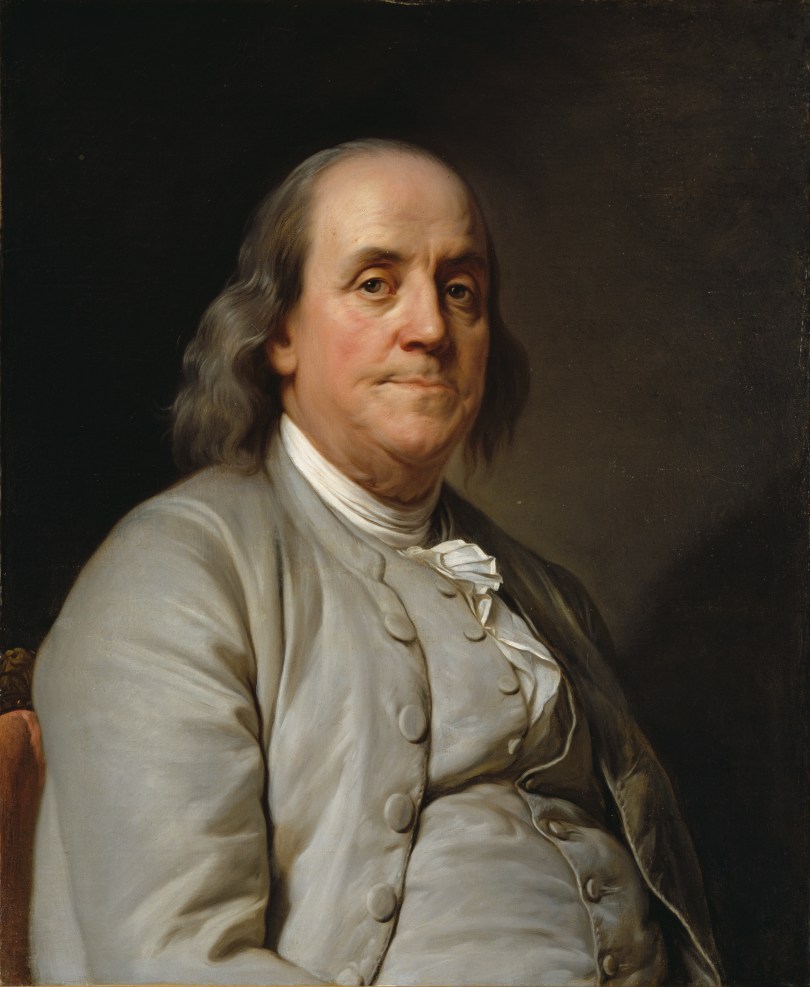
MAGAWeek2023: Benjamin Franklin

This week is MAGAWeek2023, my celebration of the people and ideas that MADE AMERICA GREAT!  Starting Monday, 3 July 2023, this year’s MAGAWeek2023 posts will be SubscribeStar exclusives.  If you want to read the full posts, subscribe to my SubscribeStar page for as little as $1 a month.  You’ll also get access to exclusive content every Saturday.

In looking through the extensive TPP archives, I’ve apparently only written the name “Benjamin Franklin” in a single post—9 May 2020’s SubscribeStar Saturday: Liberty and Safety.  Much like Franklin’s classic canard about trading liberty for safety and losing both, the lack of Franklin’s presence on this website is shameful.

That’s especially true considering that Benjamin Franklin is one of my personal heroes.  He was a skilled writer, editor, printer, inventor, politician, diplomat, wit, international playboy (seriously), statesman, and citizen.  He was the king of the nerds, at a time when nerds were celebrated not because of their weird Japanese body pillow fetishes, but because they were strong, smart, witty, and curious.

No single man’s life better exemplifies eighteenth-century colonial America.  Born in 1706 and passing in 1790, Franklin’s long life extended nearly the full breadth of that eventful century—eventful in large part because of him!

To read the rest of today’s MAGAWeek2023 post, head to my SubscribeStar page and subscribe for $1 a month or more!

MAGAWeek2023: John Taylor Gatto

This week is MAGAWeek2023, my celebration of the men, women, and ideas that MADE AMERICA GREAT!  Starting Monday, 3 July 2023, this year’s MAGAWeek2023 posts will be SubscribeStar exclusives.  If you want to read the full posts, subscribe to my SubscribeStar page for as little as $1 a month.  You’ll also get access to exclusive content every Saturday.

It’s no secret that education in the United States—at least, formalized, factory-style education—is broken, and quite badly.  No one, however, quite understands why.  State politicians, federal Department of Education bureaucrats, and local schoolboards all pass more and more regulations and requirements, few of which actually address the root causes of this brokenness.  Instead, they merely treat the symptoms, symptoms they themselves have created, and the treatments usually just breed more symptoms, to be treated once again with another dose of “education reform.”

Naturally, these “reforms” and “treatments” fall squarely on teachers to administer.  Politicians and school administrators are like aloof doctors who are so disconnected from their patient, and so motivated by their own agendas, they don’t really care about the patient’s health, so long as they can say, “we did something.”  Parents—forced into long working hours and with little free time—foist their students into a system that is supposed to work, but ultimately is just government-funded daycare.  How else is mom supposed to work sixty hours a week alongside dad?  That’s progress, after all!

So students and teachers are caught in the middle.  Teachers become nurses in this sick system.  Like real nurses, most of them think they know everything, and know better than the doctors.  Typically, teachers are correct in assuming they know more than the doctors; the problem, however, is that most of the most strident nurse-teachers go on to become the doctors, and then proceed to prescribe the same medicines, only this time they think they know better.

The other teachers labor on with some quiet grumbling, making the best of an increasingly impossible situation.  Caught between parents who are by turns indifferent and meddling and administrators and politicians who are inflexible and demanding, teachers administer whatever prescriptions they are forced to deliver, and try to do some actual teaching in the process.

The results are clear:  the worst become whiney thorns that are absorbed into the administrative ranks.  The best labor on, looking forward to summer.  The rest burnout quickly, leaving the profession early.

Students, meanwhile, are alternatively coddled and hyper-micromanaged.  They spew obscenities in the hallways and locker rooms with abandon; they vandalize bathroom stalls; they vape (the gayest form of nicotine consumption) between classes; they show up late every day.  At the same time, their every movement is tracked—by cameras, by sign-in and sign-out sheets, by teachers roaming the halls.  It’s a bizarre form of anarcho-tyranny in which all the poor behaviors are allowed to run rampant like kudzu, a weed the administration timidly trims from time to time while blaming the teachers for not realizing Johnny was at the vending machine instead of in the bathroom.

Is it any wonder we live in a world with rampant cheating and arbitrary rules, which are just arbitrarily waived the moment anyone offers up a sob story?  We’ve bred generations of students who are paradoxically rebellious and conformist—as long as Johnny takes his shot and is a good little office worker, he can indulge in whatever lame vices he wishes, so long as he shows up mostly on time the next day.  Did Johnny sleep with the secretary or steal money from the till?  Well, he must have had a good reason—he had a rough home life, you know.

None of these problems are particularly new or novel.  We’ve all come to accept them as the price for modern living:  send the kids off to indoctrination daycare, because God forbid both parents aren’t working.  After all, that’s feminism—women are liberated when they can slave for some strange man eight hours every day.  That’s way better than staying home with her kids and maintaining a good home for her husband and children… right?

Into this Orwellian nightmare stepped the great John Taylor Gatto.  Gatto taught in New York City public schools for thirty years, and was a renowned teacher, author, and public speaker.  He was one of the pioneers and major proponents of the “unschooling” movement, a variation on homeschooling that emphasizes activities chosen by the learner.  He was also a major critic of the kind of factory-style public education we have today (itself an innovation from socialist German intellectuals that, unfortunately, glommed its way onto the minds of American education “reformers” in the late nineteenth century).  Gatto argued forcefully that modern education is not only broken, but actively destroys real learning.  Instead, it merely creates conformist worker drones who are educated simpletons.

To read the rest of today’s MAGAWeek2023 post, head to my SubscribeStar page and subscribe for $1 a month or more!

The Importance of Science Fiction

Science fiction is amazing.  When it comes to fiction, it is probably my favorite genre, second to (but rivaling) only the ghost story.  Science fiction is a form of speculative fiction, which—as the name suggests—speculates about future events.

But the best science fiction doesn’t just look into the future—it tells us about ourselves, past, present, and future.  That so much of the great science fiction of the twentieth century has come true, to one extent or another, is indicative of the power of the genre to diagnose social developments, if not to predict them precisely.

The latest uproar over artificial intelligence—and the apparent willingness, blind or intentional, to develop it beyond all sensible precautions—is a prime example of the failure to take the warnings of science fiction seriously.

Science fiction is not Scripture—far from it!—but we ignore its warnings at our peril.

Read More »

SubscribeStar Saturday: Even More Graduation Day Wisdom

Today’s post is a SubscribeStar Saturday exclusive.  To read the full post, subscribe to my SubscribeStar page for $1 a month or more.  For a full rundown of everything your subscription gets, click here.

Another graduation ceremony is upon us, signaling the end of the school year and the beginning of another summer vacation.  The grand cycle of the academic calendar continues, coming to a stately close after a hectic few months.

I never anticipated being asked to speak at graduation, and I long doubted I ever would.  I still have not—lest the last sentence come across as misleading—but after delivering the baccalaureate sermon this past Sunday, I suspect the odds of being asked to speak at commencement at some future date has increased, even if only slightly.  What was hovering at around 1% might be up to 5% right now, but I possess no special insights into the vagaries of my administrations hive mind.

Regardless, if I did get to speak before our graduating seniors, I’d offer up some of my dubious wisdom, such as it is.  The first time I wrote on this topic I offered mostly financial advice; last year, after experiencing the effects of The Age of The Virus, I revised my wisdom to include more spiritual concerns.

This year, my advice is a grab-bag of plainspoken wisdom—take it or leave it.

To read the rest of this post, subscribe to my SubscribeStar page for $1 a month or more.

Robocalypse

I have long been a lover of robots (metaphorically, not literally, you perverts).  Star Wars probably did more to endear the public to quirky humanoid droids more than any PR stunt from NASA or Honda.  What chubby child didn’t dream of hanging out with their very own R2-D2?  Heck, nerds young and old can build their own (non-functioning) droids at Disney World.  R2-D2 was stubborn and obstinate, sure, but he’d be easier to maintain than my dog.

Of course, artificial intelligence (AI) doesn’t seem quite so lovable these days.  With ChatGPT and the weird Microsoft Bing! AI, it seems that no one read Isaac Asimov’s I, Robot.  Instead of programming in the Three Laws of Robotics, we’re programming in the laws of wokeness.

Even if our AI didn’t resemble the faculty at a UC-Berkeley cocktail mixer, it would be disconcerting for a number of reasons.  That we’ve politicized even our robots is just further cause for concern.

Read More »

TBT^2: Climate Hysteria Robs Us of Joy

Talk about a forgotten post:  I wrote this post way back in 2019, then reblogged it in 2020, and haven’t thought about it since.

When you’ve written and/or edited blog posts for going on 1430 consecutive days, it’s easy to forget some of the pieces you’ve written.  It’s one reason why it’s so foolish to crucify public intellectuals and other personalities for misguided tweets or ancient blog posts.  The nature of the medium is to produce, produce, produce—a constant churning of content.  That doesn’t mean we should be irresponsible with our words, but that it’s easy to forget old posts and arguments.

What brought this post to mind was a comment from the Quora contributor whose answer to a question inspired this post.  He commented over Thanksgiving and asked that I remove his name from the post, which I did.

Here was his comment in full:

I’m the one you’re quoting in this piece, and the connection you’re trying to make is utter nonsense. If you’d like me to explain the difference between trying to drink the ocean and altering the CO2 content of the atmosphere, I’d be happy to do so, but given the utter lack of scientific understanding displayed here, I’m guessing you wouldn’t care.

As a scientist, I’m offended that you’re peddling this kind of misinformation, and using my name to do it. As a Christian, I’m offended that you’re invoking the name of deity (and a diametrically wrong reading of scripture), to argue in favor of ignorance and lack of responsibility.

If you’re going to sell this kind of garbage, kindly leave my name out of it.

I respectfully disagree.  I think the poster missed the point of my piece.  Obviously, drinking from the ocean is not perfectly analogous to pumping carbon dioxide into the atrmosphere, but the two do seem related:  if we meaningfully affect sea levels by taking a collective drink from the ocean, it seems unlikely that we can meaningfully affect the ozone layer.

But the comment proves my point:  here’s a man so enslaved to the dogmatism of scientific materialism, he’s spending his Thanksgiving calling people stupid online.

I mean, I’m no scientist, and I probably am stupid about a lot of things, but I also didn’t shut down the global economy and civil society for two years and demand people trust my authority because I wear a lab coat.  My whole life I’ve heard that “science is our religion now” (probably true) and that “scientists are the new high priests of society.”

Well, they’re doing a pretty lousy job of it.  I wonder how many Westerners will freeze to death this winter because our priestly caste demands we bow obsequiously to Mother Gaia?  If questioning their dogmatic faith is “misinformation,” then I am proud spreader of the same.

With that, here is “TBT: Climate Hysteria Robs Us of Joy“:

Read More »

You’ll Get Everything and Not Like It

Being one of three brothers who came of age in the 1990s—the golden age of watching ribald, edited-for-television comedies on basic cable—I was constantly exposed to humorous quips and one-liners from hilarious movies.  One perennial favorite was the raunchy (again, edited for television) comedy classic Caddyshack (1980), about a bunch of blue-collar kids working at a tony country club’s golf course (and Bill Murray trying to blow up a gopher).

My brothers and I still reference one brief but oft-quoted scene:

Judge Smails irate handling of his ingrate nephew is a classic, and something I have probably said to a student.  My older brother loves saying it to my younger brother’s kids, who, while not rotten, and definitely spoiled (a good bit by their Uncle Portly).

My older nephew, is nearly six, likes to invert the phrase, shouting at his other uncle, “You’ll get everything and not like it.”  It’s one of his many (unintentionally?) Zen utterances.

I was contemplating this amusing bit of familial banter on the way to work yesterday.  My sweet little nephew is right—we Westerners do have everything—and we’re miserable!

Read More »

SubscribeStar Saturday: Malfunctioning Robots

Today’s post is a SubscribeStar Saturday exclusive.  To read the full post, subscribe to my SubscribeStar page for $1 a month or more.  For a full rundown of everything your subscription gets, click here.

After two years under the befuddlingly tyrannical rule of a mentally-impaired geezer, our electoral standards have slid to meet the lowered expectations of our time.  Now a mentally-impaired greaseball wants to be the United States Senator for Pennsylvania, and until a disastrous debate performance that was impossible to ignore, it seemed that Pennsylvanians were willing to vote for him.

To be clear, I take no pleasure in the profound illness of another person.  John Fetterman suffered a stroke—a terrible thing—but he is still pursuing public office.  As much as Henry Clay disliked Andrew Jackson in the 1824 presidential election, he wasn’t going to throw his support behind Secretary of Treasury William Crawford of Georgia (the election was thrown to the House of Representatives; Crawford was in third, but had suffered a major stroke and would pass away soon afterwards, with Clay giving his support to John Quincy Adams).

But we’ve grown accustomed to power-hungry wives and political parties propping up brain-dead puppets in public office.  Indeed, the historians of the distant future will no-doubt look back at our time and think of it as The Age of The Impaired.  We celebrate every manner of impairment—transgenderism, paralysis (both moral and physical), gluten intolerance, etc.—as some kind of special mark of holiness.

Of course, we should treat such people with compassion, but we shouldn’t be electing them to public office, no matter how good it makes us feel about ourselves to do so.  Public service is hard, even for the able-bodied and clear-minded.  Being a United States Senator is exceptionally difficult—and a position with incredible amounts of power and prestige.

What we saw with Fetterman—much like Marco Rubio’s glitching out in 2016—was an Establishment robot malfunctioning on live television.  I’m only being mildly hyperbolic—Fetterman can only process incoming sounds via a computer.  That’s a miraculous bit of technology, but do we want a cyborg serving as one of the 100 men and women of the US Senate?  Even if we did, would we want one that was constantly breaking down in stressful situations?

To read the rest of this post, subscribe to my SubscribeStar page for $1 a month or more.

SubscribeStar Saturday: The Great Coarsening

Today’s post is a SubscribeStar Saturday exclusive.  To read the full post, subscribe to my SubscribeStar page for $1 a month or more.  For a full rundown of everything your subscription gets, click here.

A perennial saw of the conservative pundit is the decline of public morality.  Indeed, it is so well-worn that the ignorant use it as evidence that, because people have always complained about “kids these days,” it must mean that we’re just fuddy-duddies who are painfully out of touch.  Why, elders have always complained about their kids!

Of course, that’s not true.  The idea of a “generation gap” is a relatively modern phenomenon.  For most of human history, children grew up to be very much like their parents (indeed, I would argue that is still the case, just with the addition of angsty, extended adolescence tossed into the mix).  Yes, humans have always recognized the folly of youth—Proverbs frequently refers to children and young people as “fools,” or taken with folly—but it wasn’t considered to be either virtuous or some massive, unbridgeable gap.

But in a world with no connection to the past, one which exists in an eternal Present, it is little wonder that we witness—even encourage!—such a separation from our ancestors.  The United States particularly suffers from the pedestalization of youth:  we have come to believe that youngsters possess all wisdom, being spared the corruption of Reality—of real life.

The opposite, of course, is true.  Yes, there is something admirable about the energy and certitude of youthful moral righteousness, but it is often a quite short-sighted self-righteousness.  That’s not the fault of young people—they are, after all, young and inexperienced—but the traditional expectation was that they would grow out of that sunny idealism as Reality and Truth taught their hard lessons.  We should remain optimistic and thankful in the midst of adversity, but true foolishness comes from ignoring these hard-taught lessons.

That’s all a very long preamble to get to the thrust of this piece:  we are witnessing The Great Coarsening of civil and social life, in every arena:  politics, culture, art, manners, customs, etc.  How often do we hear the F-word dropped casually in everyday conversation—the way Nineties Valley Girls used the word “like”?  As a schoolteacher, I overhear this word frequently, as students and adults treat it as, essentially, a sentence enhancer.

Here is where the charges of fuddy-duddiness are most frequently leveled: “Oh, come now, Port, who cares about some word?”  It’s not the word itself, per se—although that word is exceptionally foul—but what it represents.

Or, rather, what it’s ubiquity represents:  the aforementioned Great Coarsening.

To read the rest of this post, subscribe to my SubscribeStar page for $1 a month or more.