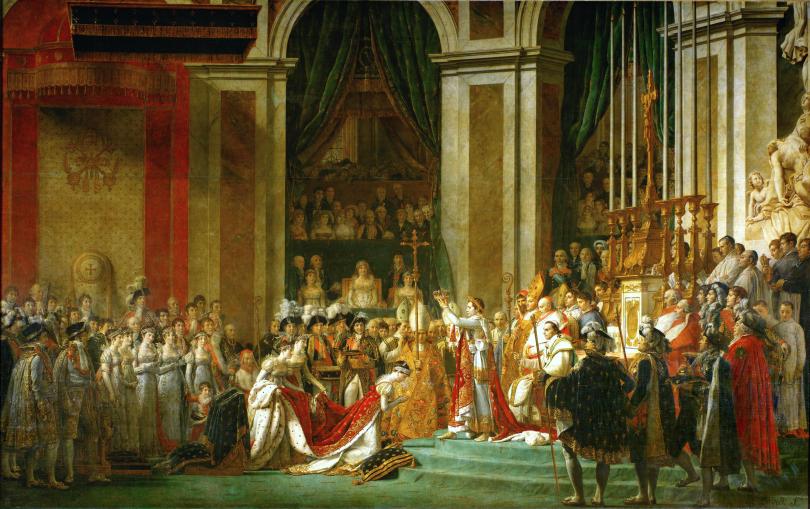
TBT: Remembering 1519

We’ve been back at school for one week now, and so far things seem to be going well, albeit very busy.  We’re slowly settling into a groove with our various safety protocols, and most of the schedule changes are solidified.  That should make for much smoother sailing going forward.

I’m mostly teaching music courses this year, but I still have a couple of sections of Honors US History.  That means it’s another year of telling the “grand narrative of American history.”  My main goal as a history teacher is to make sure students receive a balanced, analytical telling of our great nation’s history.  That means that while I point out the atrocities of, say, the Spanish conquistadors, I also discuss the wickedness of the Aztecs, who engaged in daily human sacrifices.  That the Spanish built a cathedral atop the old Aztec altar to their false gods is a fitting bit of divine judgment.

Of course, as an American I’m more interested in English colonization and settlement in British North America—what would become the United States—than I am in the vast empire of New Spain.  We should be getting into Roanoke, Jamestown, and Plymouth Rock today or tomorrow, and I’m quite excited about that.  For me, that’s when the story really starts cooking.  Naturally, the clash of Spanish conquistadors and Aztec and Inca warriors is cool, but those first saplings of a free country stir my heart.

All that said, this week’s TBT looks back at those cool conquistadors.  Here is 3 September 2019’s “Remembering 1519“:

Read More »

Cancelling Jesus

Yesterday, I wrote about the destruction of statues of American leaders—the destruction of American history.  My position is that tearing down virtually any statue—Confederate, Union, Theodore Roosevelt, etc.—is the untenable erasure of our nation’s history.  Further, the historic illiteracy of the woke SJWs has seen the defenestration of statues of abolitionists—an absurdity for groups that claim to be fighting against the legacy of slavery.

In that context, I made a big deal about the toppling of a statue of Abraham Lincoln.  Lincoln has assumed something of a demigod status in American history, one that glosses over some of the thorny issues of how to respond to the secession of the Southern States (a real question at the time was, having opted into the Constitution, could States later opt out; for a good biographical read on that issue, check out “A Voice of Reason” by John Marquardt at the Abbeville Institute).  Lincoln was certainly a man with many noble qualities, and a keen constitutional mind.  The toppling of his statues is the height of insanity—or nearly so.

In my haste, I neglected the even more egregious calls to destroy statues and stained glass windows depicting The most important Figure in world historyJesus Christ.

Read More »

Thalassocracy

The Internet is a funny thing.  Anyone that’s ever gone down a Wikipedia hole realizes that, pretty soon, that one thing you needed to look up can turn into a two-hour deep dive into barely-related topics.

It’s also weird.  There’s so much content—so much that we can’t really quantify it—you’re bound to stumble upon something interesting.  It is, perhaps, a sad commentary of the human condition that, given unlimited access to information and knowledge, we use the Internet primarily for mundane purposes, and frequent the same dozen websites everyday.

Of course, that’s also the problem of abundance.  People can’t handle that many choices, and there are only so many spare hours to cram in unorganized knowledge.

That’s how I came to stumble upon the topic of today’s post, thalassocracy, or “rule by the sea.”  I recently purchased a very nerdy space exploration strategy game called Stellaris (itself a recommendation from a member of Milo’s Telegram chat).  Stellaris has a steep learning curve, so it’s a game that basically requires the player to do homework to figure out what they’re doing (my race of peaceful, space-faring platypus people has surely suffered from my ignorance).

That homework assignment (no, seriously, it’s a fun game!) sent me down a rabbit hole on the game’s wiki, and one of the in-game events involves a group called the Bemat Thalassocracy.  I’d never heard the term before, and searched out its meaning.  That brought me to a website called Friesian, which is apparently a site promoting the philosophy of Jakob Friederich Fries, an eighteenth-century philosopher opposed to that ponderous windbag Hegel.  The website dates back to 1996, when it began as a community college website.

Read More »

The Spectator Turns 10,000

The British libertarian magazine The Spectator reached its 10,000th issue.  It is the only magazine ever to reach this milestone.  It began life as a newspaper in July 1828, becoming a magazine “more than 100 years” later, although it was apparently always a weekly.

Throughout its history, The Spectator took radical positions for the times.  They supported the expansion of the franchise in Britain in 1832, and supported the Union in the American Civil War at a time when many Britons were concerned about the impact of cotton shortages on the British textile industry than they were about slavery (correctly or not, The Spectator cast the American Civil War in moral terms).

Read More »

The Boogie Woogie Flu

Don’t let the title of today’s post fool you:  I’m not going to write about the coronavirus today.  I’m actually enjoying the relative freedom and flexibility of distance education, sipping car dealership coffee while I wait for my 2017 Nissan Versa Note to get a transmission flush and a belt and some wheel bearings replaced, all with appropriate social distance between me and the other people getting their cars fixed.

But in these plague-riddled times, I couldn’t resist this charming little Quora post about another, funkier plague:  the Strasbourg “Dancing Plague” of 1518.  Not that there’s anything charming about dancing yourself to hell, but it sounds a lot more fun than cloistering alone in your house for two weeks.

Read More »

Independence Day

The day has finally come—after three-and-a-half years, Great Britain is finally leaving the European Union.  The British people are regaining their sovereignty and will begin their way back to enjoying their traditional English liberties.

The European Union is an overweaning, elitist, supranational tyranny.  It is a progressive dream, which is why the Leftists are melting down over Brexit, and attempted to thwart it for so many years.  Progressives today—just like progressives in the early twentieth century—are gaga for technocratic rule and elitist dominance.

It’s not about “democracy”; if it was, they would have accepted the outcome of the 2016 referendum.  Democracy only matters to progressives when it advances their ends.  That’s why progressives hold elections and referendums—repeatedly, if necessary—until they get the outcomes they want—and then the matter is settled forever.  If that doesn’t work, courts or the bureaucracy will effectively veto the voters’ “incorrect” choices.

Read More »

TBT: How the Reformation Shaped the World

It’s a brand new year, and I’m excited for what it holds.  For this week’s TBT, I looked back to the first post of 2019—which then snowballed into a year-and-counting of daily posts.

This piece drew inspiration from a Pager U video (links below), and featured some of my off-the-cuff reflections on the influence of the Protestant Reformation.

I’ll let the original speak for itself.  Here is 2019’s “How the Reformation Shaped the World“:

There’s a video up on Prager University called “How the Reformation Shaped the World” (PDF transcript for those who prefer to read).  Stephen Cornils of the Wartburg Theological Seminary gives an adequate, broad overview of the impact of the Protestant Reformation (albeit with some noise about Martin Luther’s anti-Semitism, which, while accurate, smacks of throwing a sop to politically-correct hand-wringers).  You can view the video in full below.

I’ve written about the influence of Christianity (and it was, notably, Protestant Christianity) on the founding of America, and I’ve discussed how shared Protestantism helped create an American identity.  Indeed, I would argue that, without Protestantism, there would be no America, as such.

I would also argue—perhaps more controversially—that America’s commitment to Protestantism as opposed to Catholicism allowed the nation to avoid the anticlerical upheavals seen in France and other predominantly and officially Catholic countries.  While there were official, established churches at the State level into the 19th-century—which I wrote about in “The Influence of Christianity on America’s Founding“—the lack of federal establishment, and the general movement towards greater religious liberty, ensured a proliferation of Protestant denominations in the early Republic.

Catholicism inherently insists upon a top-down hierarchy of control.  Luther’s view of man’s relation to God is horizontal, as Bishop James D. Heiser argues in his extended sermon The One True God, the Two Kingdoms, and the Three Estates (one of my Christmas gifts, incidentally, and a good, quick read for just $5).  That is, every man is accountable to God directly, and is responsible for accepting Christ and maintaining his relationship with God.  That horizontal, rather than vertical, relationship infuses Western Civilization with a sense of individualism, the effects of which have been far-reaching and both positive and negative.

Regardless, the impact of the Protestant Reformation is staggering to consider.  The Catholic Church in the 16th century was an increasingly sclerotic and corrupt institution, one that had fallen from its great height as the pacifying influence upon a barbaric, post-Roman Europe (of course, the Counter Reformation reinvigorated and, in part, helped purify the Church).  With the advent of the printing press and translations into national languages, conditions were ripe for an explosion of religious reform in the West.  The ripple effects of the Reformation still pulse through Western life and culture.

That said, I’m not anti-Catholic, nor is that the intent of this post.  In today’s political and theological climate, committed followers of Christ must band together, be they Catholic or Protestant.  I don’t “buy” Catholic theology in toto, but I respect the Catholic Church’s longstanding traditions and consistent institutional logic.  Thomas Aquinas’s cosmological argument in the Summa Theologica is pretty much what I learned growing up as an Evangelical Protestant.  And I’m broadly sympathetic to the traditional Catholic argument that the Reformation busted up the orderly cosmos of medieval European society (see Richard Weaver‘s various essays for further elucidation of this idea).  A side effect of the Reformation naturally includes many of the cons of modernity.

Ultimately, too, Christians face the double-threat of modern progressive ideology and radical Islamism.  I’ve written about the former in detail, but not so much the latter.  For the moment, suffice it to say that the two are temporary, uneasy, but powerful allies against a traditionalist, conservative, Christian worldview, and both are deeply antithetical to Western values and culture.

These are some broad and slapdash thoughts, ones which I will gradually develop in future posts as necessary.  Any useful resources or insights are welcome—please share in the comments.

Happy New Year!

Lazy Sunday XLII: 2019’s Top Five Posts

2019 is winding down, and with this being the last Sunday of the year, it seemed like the perfect opportunity to look back at the most popular posts of 2019.

These posts aren’t necessarily the best posts—although that’s an entirely subjective measure—just the ones that received the most hits.

When looking through the most popular posts, there were a few surprises.  One thing I’ve learned from blogging is that posts I pour my heart and soul into may walk away with five views (and, oftentimes, only one!).  Then other posts that I dash off in a hurry to make my self-imposed daily goal take off like Rossini rockets, garnering dozens of hits.

Some of that is timing and promotion.  I find that the posts I have ready to launch at 6:30 AM do better on average.  But some generous linkbacks from WhatFinger.com really created some surprises here at the end of the year, surpassing even the exposure I received from Milo Yiannopoulos.  Writing posts about hot, current news items, the dropping links about said items in the comment sections of prominent news sites, also helps drive traffic, but I often lack the time required to do such “planting” (and it is a practice that can come across as spammy if not done with finesse).

Some posts take on a life of their own; I see consistent daily traffic from one of the posts on this list, “Tom Steyer’s Belt.”  Apparently, a bunch of people are as mystified as I am with Steyer’s goofy, virtue-signalling belt.

Well, it’s certainly been an adventure.  And while it may be premature—there are still two days left in the year!—here are the Top Five Posts of 2019:

Read More »

Christmas and its Symbols

It’s Christmas!  Imagine “Hark! The Herald Angels Sing” played on an uptempo French horn and a crackling fire.  That’s how I imagine Christmas morning—like a 1970s Christmas variety show.

In all seriousness, it’s truly the most wonderful time of the year.  Christ is born!  It’s a day for celebrating His Birth with family and friends.  Just like the Wise Men of yore, we exchange presents to celebrate (and to stimulate the economy).

Read More »

Napoleonic Christmas

It’s Christmas Week!  And what a glorious week it is.  It’s been raining persistently in South Carolina since Sunday morning, but I’m enjoying the coziness of the hygge—warm coffee and lazy reading.

PragerU had a little video up this morning from historian Andrew Roberts about Napoleon.  It’s an interesting take on the not-so-short French emperor—an apologia, really (for those that prefer reading—as I often do—to watching videos, here is a PDF transcript).

Roberts argues that Napoleon was not the necessary precursor to Hitler, et. al.; rather, Napoloen was “sui generis“—a man unto himself.  While I believe the ideas of the French Revolution did unleash the totalitarian forces of Hitlerism, Stalinism, Maoism, and all the rest—a murderous, bloody Pandora’s Box—I’ve never considered Napoleon among their ranks.

Read More »