TBT: Benjamin Britten’s “The Young Person’s Guide to the Orchestra”

The new year school year is back into full swing, with this week being the first full week of classes.  Needless to say, yours portly is tired, but very much enjoying the academic year so far.

I’m teaching Pre-AP Music Appreciation again this year, so I’m excited to dive back into some of the works we discussed last year—and some new ones!  Of course, we’ve kicked the year off with a listening to “The Young Person’s Guide to the Orchestra,” a favorite for introducing orchestral instruments.

My Pre-AP Music class this year is quite small—just five students—which makes for a more relaxed classroom environment.  We’re able to explore tangents as they arise (and, based on my frequent use of em dashes and parentheses, you can imagine I go off on them frequently), and generally take the time to enjoy the music, which the students seem to be doing.

I don’t have much more to add that I didn’t write a year ago.  Britten ingeniously weaves a whopping thirteen variations on a Henry Purcell theme, featuring nearly every instrument in the orchestra—including the percussion section!—in solo or soli.  Even the neglected double basses get some love with a melody of their own.

With that, here is 31 August 2020’s “Benjamin Britten’s ‘The Young Person’s Guide to the Orchestra’“:

Read More »

SubscribeStar Saturday: Concealed Weapons Permit Course

Today’s post is a SubscribeStar Saturday exclusive.  To read the full post, subscribe to my SubscribeStar page for $1 a month or more.  For a full rundown of everything your subscription gets, click here.

Last Saturday my younger brother and I woke up very early to attend an all-day concealed weapons permit (CWP) course.  We’d both been meaning to get our CWP for some time, and he stumbled upon an instructor in his area on Next Door.  Wanting to knock it out before college football season begins, we decided it was the perfect time to learn to be certified killing machines.

In all seriousness, the course was extremely informative—and sobering.  Owning any firearm is a huge responsibility, as misuse of the weapon can result in injury and death—including to yourself!

I’d always understood that in the abstract, but taking the course and handling a firearm really drove that home.  Our instructor really pounded into us two things:  situational awareness and practice.

To read the rest of this post, subscribe to my SubscribeStar page for $1 a month or more.

TBT: First Week of School in The Age of The Virus

School is back, and while I’d like to think The Age of The Virus is in its twilight death throes, the powers-that-be seem intent on foisting fearmongering variants upon us, no doubt as a pretext to strip us of more of our civil liberties.

Regardless, we’re starting back normally this year—as normally as possible—with a whopping 408 (and counting) students.  Considering we had fewer than 100 students a decade ago, that’s a pretty huge change.

Hopefully we won’t have any major outbreaks this year, as we largely avoided last school year.  We managed to get through with only a few isolated cases among students and faculty, and finished up with life largely back to normal in the final two months of the year.

It’s interesting looking back to the beginning of last school year and seeing how the year progressed.  The fiasco of using Loom lasted about two weeks for yours portly; I quickly reverted to using the desktop version of Google Meet to record my lectures.

I’m also relieved that I won’t be livestreaming classes anymore.  I don’t have anything to hide; it’s just a huge hassle getting online kids logged in, much less engaged.  There’d frequently be times when I was ten minutes into class and a student would log in after being marked absent; sometimes I wouldn’t catch that the student had entered class, and the student would then complain about the absence.

More frequently, students would log in the moment I’d sent the attendance e-mail to the registrar, so I’d have to resend the e-mail.  Sometimes the registrar wouldn’t see that second e-mail, and I’d get a call in the middle of class asking if the “missing” student had logged into class.

Those were minor issues when compared to bigger problems with the online platform—students suddenly switching to distance learning on test days, for example—but still headaches.  It probably cost a good five-to-ten minutes of class time just to take attendance.

Well, here’s to the normal amount of craziness and bureaucratic overreach of the typical school year.  With that, here is 28 August 2020’s “First Week of School in The Age of The Virus“:

Read More »

Back to School 2021

Well, after starting back to work Monday a week ago, we’re finally back at school today.  We’re one of the latest schools to start back in our area—my county’s school district started back classes last Monday, and Florence County schools resumed on 2 August 2021—but it still seems too soon.  The Florence start date seems insanely early as far as I am concerned, but they’re transitioning to a semi-year-round model, in which the students will get a week off in October and February, as well as some other juicy breaks.

Of course, any time off is never quite enough, is it?  I often find myself thinking, “if I only had one more weekend to finish this up” or “I really need another week of break so I can work on writing.”  That said, during the peak of The Age of The Virus in 2020, when I had virtually limitless free time, I didn’t complete any of the big projects I had set aside for myself.  That puts to the lie the idea that more time necessarily means getting more done.

Indeed, I often find that I am more productive when working against a deadline.  As I’ve gotten older and more experienced—albeit not much wiser—I’ve learned to plan ahead, and to churn out a great deal of work in long stretches of focus, in order to save me some time later.  That’s a necessity with my crazy schedule, and helps keep me from getting caught flat-footed by some unanticipated deadline or task too often.

Regardless, school is starting back today, and things are (mostly) back to normal—no more remote learning, no students tuning in from their cars or bedrooms to class, no more mandatory masks (again, mostly) [update:  we have received word that we are starting the year with masks—nooooo!].  I’m hoping it’s going to be a normal-ish academic year.

Read More »

SubscribeStar Saturday: Schedule Roulette

Today’s post is a SubscribeStar Saturday exclusive.  To read the full post, subscribe to my SubscribeStar page for $1 a month or more.  For a full rundown of everything your subscription gets, click here.

With school starting back in just a few days, I’ve been hammering away at schedules of all sorts.  The school schedule itself seems to be in flux, with an ebb of last-minute changes and adjustments to the all-powerful Master Schedule.  Surprise personnel changes and a surge in enrollment have seen quite a bit of shuffling taking place, though it doesn’t seem quite as chaotic as it has been in past years.

The new academic year also means that I’m scheduling students for private music lessons.  In a normal year, it can be  a little difficult to put together a consistent weekly schedule.  This year, I have so many students, it’s been a Sisyphean task, although I think I nearly have the boulder pushed to the top of the hill.

Or, like Sisyphus, I’m only fooling myself, and the boulder is about to roll backwards, flattening me in the process.

To read the rest of this post, subscribe to my SubscribeStar page for $1 a month or more.

TBT: Back to the Grind 2020

This past Monday, teachers at my small private school resumed work, sitting through our annual OSHA blood-borne pathogens training and another sales pitch from the AFLAC representative (start offering long-term disability insurance, AFLAC, and I’ll buy a policy).  Registration for new and returning students is now in full swing.

Last year was a unique school year, with its own challenges and opportunities.  As I detailed in this post, we had a host of new sanitation procedures, as well as the odious masks.  This year, the masks are optional, but we’re still sanitizing desks and checking temperatures at the door.

Unlike last year, we’ll have all the fun stuff again:  pep rallies, chapel, etc.  I know the students will be excited for some fun events to return to campus.

Of course, that means yours portly will be back to hustling to satisfy the bottomless appetite for audio-visual production values the students (and my administration) crave.  One silver lining of last school year was the vast reduction in constant events and activities, which allowed me the time to focus on teaching and grading.

Oh, well—here’s to another year!  And here’s 10 August 2020’s “Back to the Grind 2020“:

Read More »

Fighting Back Against Critical Race Theory

In the waning years of the Obama Administration, a strident new form of race hustling emerged.  Combining elements of identity politics, Foucaultean power dynamics, Cultural Marxism, and Nineties-style corporate diversity training, Critical Race Theory (CRT) emerged as a powerful ideological bludgeon with which to batter anyone with the audacity to be white.

At its core, CRT proposes a simple thesis:  any person of color, in any material or spiritual condition, is automatically oppressed compared to white people, because white people benefit from inherent privilege due to their whiteness.  Alternatively, black and brown people face systemic racism—racism present in the very structure of the West’s various institutions—so even when not facing overt acts of racism, they are still suffering from racism nonetheless.  The source of white people’s “privilege” is that systemic racism benefits them at the expense of black people.

The problem is easy to spot:  any personal accountability is jettisoned in favor of group identities, so any personal setbacks for a darker-skinned individual are not the result of that individual’s agency, but rather the outcome of sinister, invisible forces at play within society’s institutions themselves.  Similarly, any success on the part of a lighter-skinned individual is due to the privilege that individual enjoys.

Read More »

End-of-the-School-Year Reflections: Returning to Normal

About fourteen months ago The Before Times ended, ushering in The Age of The Virus.  On 16 March 2021, my little school transitioned to distance learning, and like other schools in South Carolina, we finished the year online.

We began this school year with a mix of online and in-person students, with most students attending in-person.  We had a plethora of new policies to enforce, such as one-way traffic in hallways (that quickly collapsed), mask-wearing, and social distancing.  Of those three, mask-wearing was pretty much the only one that really stuck the entire year, until Governor McMaster blessedly issued his executive order last week allowing students to opt-out of wearing masks.

With Awards Day today and graduation just eight days away (next week is Exam Week, so it will be a much lighter week than most for yours portly), it seemed appropriate to review this highly unusual school year, and to reflect upon how it went, and what the long-term implications of it will be.

Read More »

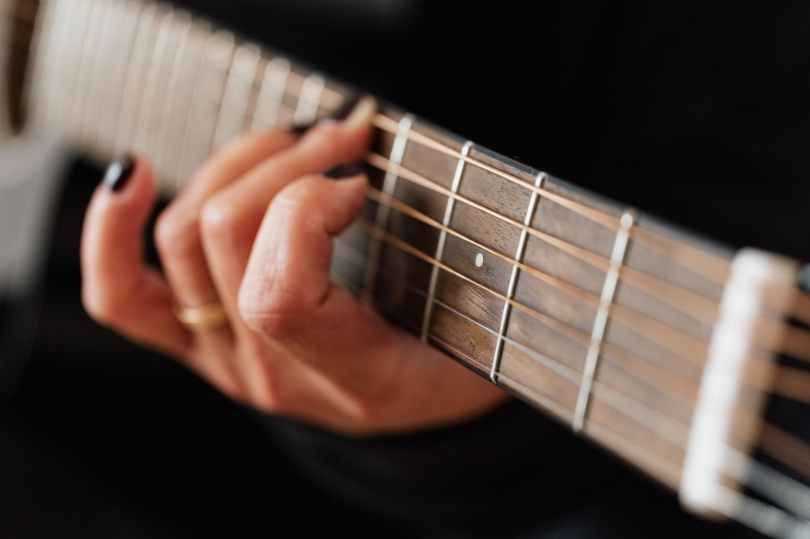
Learning by Doing: Teaching Guitar

One of the truest statements I’ve ever heard is “if you want to learn something, teach it.”  Much of my teaching career has been built upon that premise, and it’s stretched my mind and talents far beyond what I thought I was capable of achieving.

A young education major at the local liberal arts college once told me that it’s unethical to learn on the job when teaching.  As I recall, I laughed in his face, and said, “Kid, the only way to learn how to teach is by learning on the job.”  No one knows everything, especially educators (why do you think we became teachers?).

That’s certainly been the case with teaching guitar.  I’d always struggled to wrap my mind (and hands) around string instruments, and while I picked up bass (one note at a time is much easier than six), I assumed I’d never be able to play guitar.  Indeed, I’m still not very good at playing guitar, and would not consider myself a “guitar player.”

What I discovered is that as I taught guitar lessons—often fumblingly so initially—I was learning to play guitar.

Read More »

SubscribeStar Saturday: Concert Postmortem

Today’s post is a SubscribeStar Saturday exclusive.  To read the full post, subscribe to my SubscribeStar page for $1 a month or more.  For a full rundown of everything your subscription gets, click here.

My poor health recovered, I tested negative for The Virus, and the Spring Concert was a smashing success.  I managed to get back to work Wednesday, giving me time to build—for the first time since the 2019 Christmas Concert—my Frankenstein’s Monster sound system, rehearse my students, and wire up a ton of microphones, amps, keyboards, and the like.

After every big concert, I spend part of a class period conducting a “concert postmortem,” my pet term for reviewing the highs and lows of the previous night.  It’s a good opportunity to discuss elements that could be improved for the next concert, but also to allow the students to bask in the glory of their performance a little longer.

Not surprisingly, this process tends to work better with high school students, who have developed politeness filters and know how to phrase suggestions diplomatically.  They’re also veterans, so they understand better the realities of live performance, and don’t have unrealistic expectations.  Middle school students tend to either be over-awed by the experience (one student Thursday evening exclaimed, “That was awesome!”) or very critical of small errors.  That’s why we frame these discussions as “constructive criticism,” which helps the students understand the purpose is to build each other up and point out areas where we can all improve.

Regardless, I’m letting readers in on that process a bit with a general “concert postmortem,” including our finalized set list.

To read the rest of this post, subscribe to my SubscribeStar page for $1 a month or more.