SubscribeStar Saturday: Police State Raid

Today’s post is a SubscribeStar Saturday exclusive.  To read the full post, subscribe to my SubscribeStar page for $1 a month or more.

Well, as photog declared earlier this week on his blog Orion’s Cold Fire, we’re officially “a banana republic.”  The FBI raided President Trump’s home at Mar-a-Lago… for what?  Some documents?  Apparently, the President had already turned over some documents to the National Archives.  Since when does the National Archives get to send a domestic police force into the homes of former presidents to get McDonald’s receipts?

Just like the arrest of Roger Stone and the ginned up January 6th Committee hearings, we on the Right have always understood that actors on the Left enjoy a different, more lenient standard of justice than those of us on the Right.  In the pre-Trump world, there was at least some pretext of blind justice, with the progressives getting a wink and a nod for their malfeasance, with a conservative offered up sacrificially from time to time to appease the mob.

Now entire federal agencies—indeed, the vast majority of the federal government—are beholden to the Left.  The apparatus of the state is no longer a mostly-impartial arbiter and guarantor of justice; instead, it’s now the personal army and political secret police of the Democratic Party.

Why?  Because “Orange Man Bad.”

To post is a SubscribeStar Saturday exclusive.  To read the full post, subscribe to my SubscribeStar page for $1 a month or more.

TBT: Preserving Old Varieties

On Saturday I wrote a bit about an arrangement my neighbor and I have regarding my fig trees and grapevines:  I grow them, he picks them—and makes them into delicious preserves.  He’s also provided me with heirloom broccoli plants, which I shamefully think have largely died (though two stalks have somehow soldiered on through the hot summer months; I’m surprised they survived the heat!), and he grows an impressive garden himself.

So when casting about for this week’s TBT feature, this post about the Bradford watermelon—a variety thought lost to the world—fit neatly with what was already fresh on my mind.

There is so much variety out there compared to what the supermarkets put on offer.  We’d probably all be a lot happier and a good bit healthier if we tried some of these old varieties.

With that, here is 24 August 2021’s “Preserving Old Varieties“:

Read More »

Midweek Myers Movie Review: The Lion in Winter (1968)

As Ponty and I have been going through the worst movies ever, it seems like a palette cleanser is in order.  Too much of a good thing is a problem, but too much of a bad thing is probably worse (by definition, I suppose it is!).

Thanks to good ol’ Audre Myers, we have a reminder that plenty of good—indeed, great—things have been imprinted on celluloid.  Not every film is a woke stinker with a strident “strong female character” who lacks any flaws or shortcomings.

Indeed, this film demonstrates how really to write a “strong female character”—and it was released in 1968!  I thought those philistines were still dragging women to their caves by the hair back then.  Well, they don’t come much stronger than Eleanor of Aquitaine; portrayed by the hyper-patrician Katharine Hepburn, 1968 Hollywood would run circles around Brie Larson.

Well, enough of my pontificating.  Here’s Audre Myers’s—our own “strong female character” here at TPP—and her exquisite review of 1968’s The Lion in Winter:

Read More »

Monday Morning Movie Review: Portly’s Top Ten Worst Films: #2: Star Wars: The Rise of Skywalker (2019)

We’re nearly at the bottom, and my pick for this week—2019’s Star Wars: The Rise of Skywalker—probably is a bit of a giveaway as to my Number 1 pick.

The Rise of Skywalker is the final film in the Star Warssequel trilogy,” itself a bloated mess of plot holes, Mary Sues, wooden characters, and destroyed legacies.  It’s not the worst film in the trilogy, but it’s pretty dang close.

Read More »

SubscribeStar Saturday: The Second-Hand Economy

Today’s post is a SubscribeStar Saturday exclusive.  To read the full post, subscribe to my SubscribeStar page for $1 a month or more.

A neighborhood friend of mine and I have worked out an arrangement regarding my fig tree and grapevines:  I provide the fruit, he provides the jelly (before he gets angry, let me clarify that he actually makes preserves, and they’re delicious).  It’s a pretty good deal for me:  he and his son come by and pick figs (and grapes, soon), converting them into delicious preserves, which I enjoy after the fact.  All I do is keep the plants alive and give him access to my property.

Earlier this week, he and I spoke for a bit after he and his son partook in some morning fig harvesting (God is Good—it’s been a bumper crop this year, and the figs haven’t gone entirely to the birds and the beetles).  We talked about the figs and the muscadine grapes that will be ready for harvesting soon.  In doing so, he pointed out all of the possibilities in our neighborhood for similar collaborations:  those with some resource or item (in my case, figs and grapes), and those with the time and inclination to put them to use (in this case, my neighbor making preserves from them).

In years past, I’ve shamefully let my figs go unharvested, letting the brown birds and beetles strip the tree of its fruit before I could get to it.  One year I managed to get maybe a half-pound of figs from the tree, but my own negligence, coupled with a busy schedule (not to mention South Carolina’s intense summertime heat) has dissuaded me from picking the luscious fruit.  Even having gotten the fruit, I’m often at a loss as to what to do with it, other than pop full figs into my mouth.

Thus, the magic of this arrangement:  my neighbor has the time and the knowledge to put my resources to use; I simply have the resources.  He gets a good portion of preserves, and I get to enjoy some jars, too (and they’re really good preserves).

Regardless, in discussing the beauty of our arrangement of the possibility of other such collaborations around the neighborhood, we also discussed how much stuff—not just fruits and vegetables, but just sheer, material stuff—is just sitting around, unused, waiting to be put to some higher purpose—if only someone with the know-how, time, and ability could come along and put it to use.

The possibilities exist for an entire second-hand or recycled economy.  How often have you driven past someone’s home—usually way out in the country somewhere—to find their yard or a half-open shed full of goodies untouched by human hands (even if touched quite extensively by the ravages of time)?  But that junk—one man’s junk is a another’s goodies, I suppose—is actual, usable stuff—it can be put to good use.

In an age of hyperinflation, the expansion of a second-hand or cast-off or recycled economy takes on a whole new level of attractiveness.

Today’s post is a SubscribeStar Saturday exclusive.  To read the full post, subscribe to my SubscribeStar page for $1 a month or more.

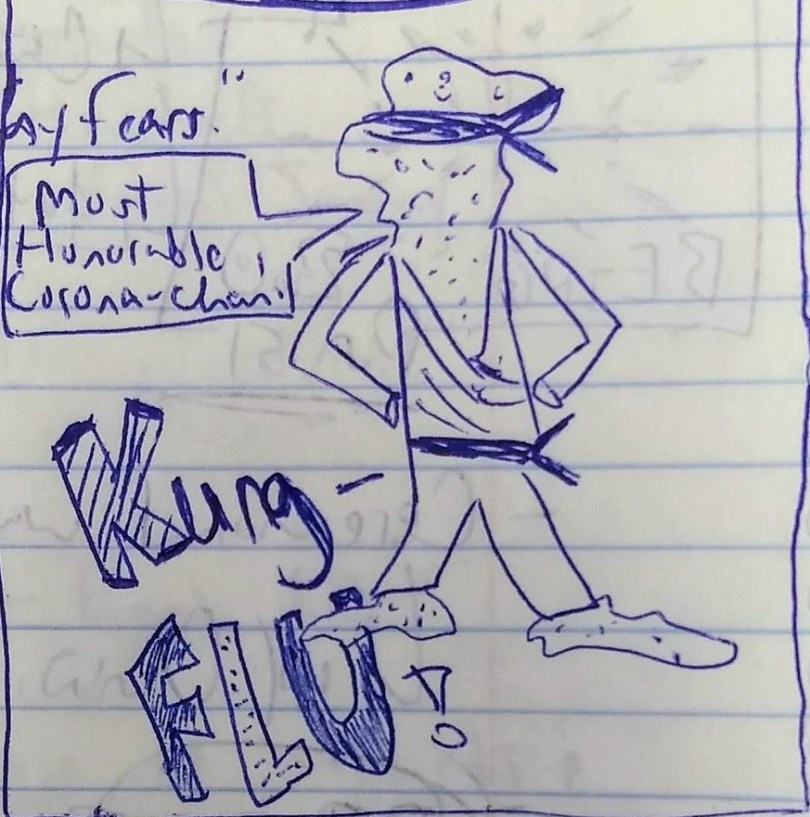
TBT^2: Phone it in Friday XI: Coronavirus Conundrum, Part IV: Liberty in the Age of The Virus

The Virus is like a bad movie series that just refuses to die.  There was a controversial but impactful first release that everyone was talking about, even if they didn’t see it.  Then there was the lackluster sequel, which still enjoyed some popular support, even though ticket sales were down.

Now it feels like we’re on the tired third film, which is a watered-down, ineffectual finale (one hopes) to a premise that is played out.  Sure, critics love it, but audiences are tired of its antics.

What still seems to make it into the script of every one of these films is the part where the government bureaucrats lock everything down and release a bunch of ghosts into Manhattan (uh, wait, what?).  Meanwhile, we all kind of sit by and twiddle our thumbs and put our masks on dutifully.

What happened to the band of merry wastrels who tossed tea into Boston Harbor, rather than comply with an odious monopolization of the tea trade?  Or the plucky scofflaws who made it impossible to enforce the Stamp Act?  I’d rather disguise myself as an Indian (feather, not dot) and caffeinate the water supply than put a mask on again (but that would be cultural appropriation, of course).

In short, why don’t we get a backbone, instead of cowering behind masks and locking ourselves indoors?  We’re literally cowering before an invisible enemy with a 99%+ survival rate.

Well, liberty is never easy.  Better to stay inside watching movies and disconnecting from reality, eh?

With that, here is 29 July 2021’s “TBT: Phone it in Friday XI: Coronavirus Conundrum, Part IV: Liberty in the Age of The Virus“:

Read More »

Monday Morning Movie Review: Portly’s Top Ten Worst Films: #4: The Wicker Man (2006)

Thanks go to Ponty, who mentioned in a comment—that I am not about to look up, ha!—this film.  You really helped me out with , but I’d like $3.23 for the RedBox rental, mate.  —TPP

This week’s flick is the second consecutive Nicolas Cage flick I’ve had to pan, which pains me:  Nicolas Cage is probably—and unironically—my favorite actor.  At his best, his loose cannon hamming can completely make a picture.  At his worst, he’s either too ridiculous—a caricature of his already cartoonish self—or too subdued, leaving the best arrow in his quiver unused.

In the case of this week’s film—The Wicker Man (2006), the abysmal remake of the 1973 classic—the poor presentation is, fortunately, not Cage’s fault exclusively.  He does deliver a rather lackluster performance, lacking either the over-the-top insanity of Vampire’s Kiss (1989) or the wordless panache of Willy’s Wonderland (2021), but it’s only occasionally bad.  Mostly, it’s just forgettable.

Perhaps it’s unfair to compare any remake to the original (with the exception of John Carpenter‘s The Thing, 1982), but remaking this film was a bad idea.  At least, the 2006 attempt is a very poor one indeed.

Read More »

SubscribeStar Saturday: The Portly Politico Summer Reading List 2022

Today’s post is a SubscribeStar Saturday exclusive.  To read the full post, subscribe to my SubscribeStar page for $1 a month or more.

It’s that time of year again:  summer!  That means we’re due for The Portly Politico Summer Reading List 2022!

For new readers, my criteria is pretty straightforward.  To quote myself from the 2016 list:

The books listed here are among some of my favorites.  I’m not necessarily reading them at the moment, but that doesn’t mean you shouldn’t!

Pretty vague, I know.  Additionally, I usually feature three books, plus an “Honorable Mention” that’s usually worth a read, too.

For those interested, here are the prior installments:

With that, here’s The Portly Politico Summer Reading List 2022:

1.) Quentin Tarantino, Once Upon a Time in Hollywood: A Novel (2021) – This novel—Tarantino’s first—is a novelization of his film Once Upon a Time in Hollywood (2019), a flick I really enjoyed, even though it appears I have not reviewed it on the site.  What makes it so fun is that it’s written like a pulp novel about the waning days of Hollywood’s golden age.  I’m only nine chapters (about 142 pages of 400) into the book, but as a fan of the film, I can heartily recommend it.  Like an novel (or, in this case, novelization) it can explore scenes and characters and backstories in more detail.  Considering the film is a daunting 161 minutes—nearly three hours—in length, it’s remarkable how much more can be explored in a book.

The novel shifts perspectives between different characters, but the main characters are washed-up cowboy actor Rick Dalton and his stunt double and personal driver, Cliff Booth.  Dalton’s career isn’t exactly dead, but his glory days are behind him, and he’s playing bit-parts as the “heavy” on Westerns.  Booth, a veteran of the Second World War with a fairly dark past, plays babysitter to the bipolar, alcoholic Dalton.  While it seems Dalton gets the better part of this arrangement, the pair form a mutually-beneficial bond—when Dalton works, Cliff does.

Dalton’s career is slowly starting to improve against the backdrop of the Manson Family, which begins its murderous spree in Los Angeles.  The film version presents an alternate version of the Sharon Tate murder, and I imagine the book is heading in the same direction.

For fans of Old Hollywood and Westerns—and, of course, the Zeitgeist of the late 1960s and early 1970s—it’s a must-read, and very fun, too.

To read the rest of this post, subscribe to my SubscribeStar page for $1 a month or more.

TBT^256: Happy Birthday, America!

On Monday, America celebrated its 246th birthday.  I don’t know what the word is for “250th” (bisesquicentennial?), but that will be fun when it arrives in 2026.  I’m still hoping to make it to the tricentennial in 2076, but I’m not holding my breath—I’ll be ninety-one-and-a-half (maybe I’ll blog about it—ha!)!  I also imagine the United States of that time will be as unrecognizable to us as the United States of today is unrecognizable to someone at the bicentennial, much less the centennial observance.

America is not in the best of times, but victories abound nonetheless.  Sure, prices are through the rough and shortages seem to be increasingly commonplace.  But babies have a chance at life now, and our most basic constitutional rights continue—for the time being—to be upheld, albeit imperfectly (we have what are essentially political prisoners wasting away in jail without a trial because they were invited to walk around the US Capitol Building).

Regardless, I’m proud to be an American, and I’m thankful to live in this country.  It’s not perfect, but it’s home.

With that, here is “TBT^16: Happy Birthday, America!“:

Read More »

SubscribeStar Saturday: Summer Camps 2022 Reviews

Today’s post is a SubscribeStar Saturday exclusive.  To read the full post, subscribe to my SubscribeStar page for $1 a month or more.
I spent the first three weeks of summer break running camps:  two sessions of the popular Minecraft Camp, and one session of the far-less-popular Rock ‘n’ Roll Camp.  These camps make up a substantial portion of my summertime earnings, and so are an important revenue stream for yours portly during the otherwise lean summer months.

In this post, I’ll discuss each camp briefly, then break down the financials, and how I netted (after expenses, but before taxes) $1965.64 across roughly forty-eight working hours.

To read the rest of this post, subscribe to my SubscribeStar page for $1 a month or more.