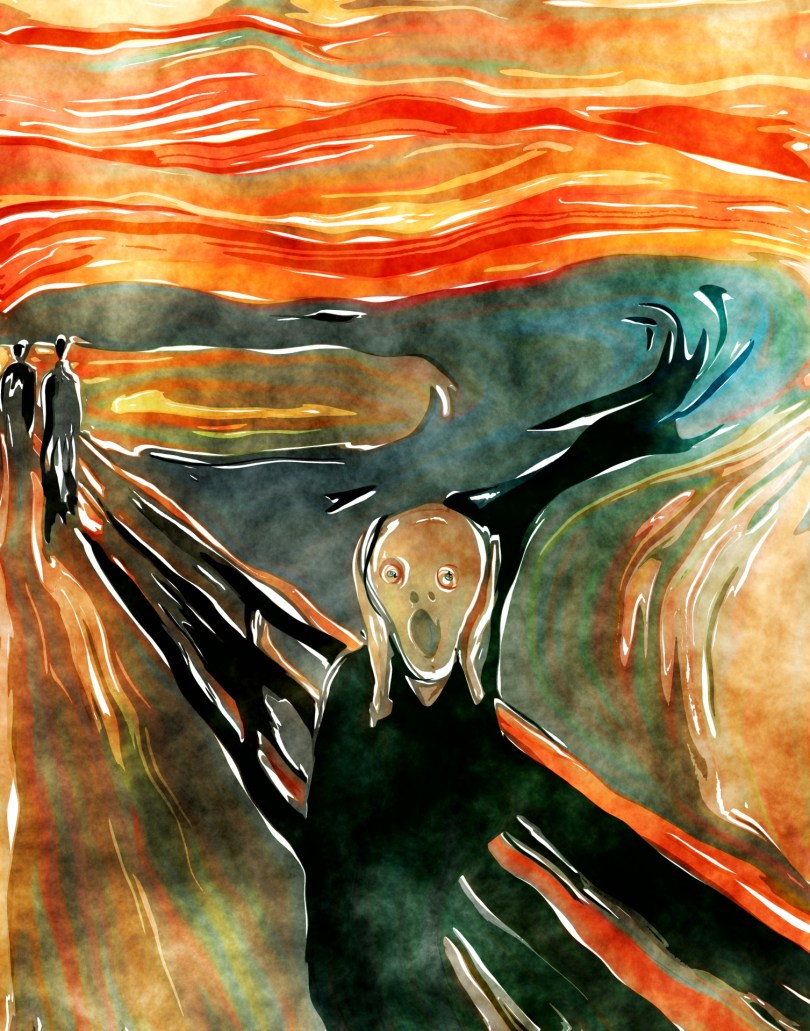
Losing the Faith

I’ve written quite a bit about the “God hole” in modern Western life, and how that place—intended for the indwelling of the Holy Spirit—is being filled with everything but.  We desperately search for meaning wherever we can find it—politics (for the progressives and some conservatives), witchcraft, power crystals, celebrity, money, sex, etc.

Part of this state of affairs stems from the persistent onslaught of postmodern, relativistic ideas that permeate our culture, so much so that they effectively infiltrate even our churches.  The ethos of “if it feels good, do it” sinisterly insinuates itself into Christian teachings in a form of Christology that reduces Jesus to a spiritual boyfriend who is unfailingly supportive of our bad life choices.

But Jesus is not a soy boy, and Christianity is not a pick-and-choose faith that is copacetic with sin.

Read More »

TBT: Progressivism and Political Violence II: Candace Owens Attack and the Deficiency of Decorum

About a year ago I wrote about the Leftist attack on Candace Owens and Charlie Kirk while they were attempting to enjoy breakfast.  Last summer, all the rage was for Leftist activists to harass conservatives and Trump administration officials while they were trying to dine.

Fast forward one year and we have conservative journalists getting smashed over their heads with concrete-filled milkshakes and guys in MAGA hats assaulted in the streets.  Nevertheless, the ranks of Conservatism, Inc., stubbornly insist on taking the high road, ruthlessly policing any threats to their Right, while shrugging helplessly—perhaps accompanied by a schoolmarmish finger wagging—as the Left ratchets up its wanton, unabashed violence.

Read More »

Unspeakable Horror

Blogger photog has a piece up at his blog, Orion’s Cold Fire, entitled “What I Took Away from the Weekend Horror Fest,” which sums up the root causes of this weekend’s two terrible shootings: fatherless, isolated young men with few prospects, few role models, and an excess of narrow ideology.

As I wrote way back in January, I don’t typically write about shootings, because I don’t have much to add, and because the discussion always (incorrectly) focuses on controlling guns, not on addressing the real underlying issue.  The United States doesn’t have a gun problem; we have a God problem.  More precisely, we’ve jettisoned any sense of a transcendent moral order in favor relativism and a form of neo-paganism.

Read More »

Unspeakable Fear

Scott Rasmussen’s Number of the Day for August 2 demonstrates the fear and distrust that grip our public discourse.  According to Rasmussen’s polling, 22% of voters are afraid to share their political views most of the time, with another 25% fearing to do so some of that time.  That means that 47% of voters are afraid to discuss politics with their co-workers, friends, neighbors, etc.

Of those voters polled, 39% who strongly approve of President Trump believe they are discriminated against because of their political views.

Read More »

Phone it in Friday III: Video Killed the Blogging Star

I’m heading up to Wilmington, North Carolina tonight to play a gigI played the same joint exactly a year ago, while I was living in a sleazy motel after my old place was flooded.  If you’re in the area, come on by, or check out my tour dates.

Regardless, your daily chum will continue in the vein of last Friday’s post, but with even less loving care.  In essence, I’m going to let you watch two talented individuals say important, insightful things.

It’s the blogging equivalent of pulling out that old media cart at school.  Everyone gets excited when the usual windbag kicks back and that tiny CRT television gets rolled out, its blue screen promising an hour of a grainy VHS tape.

Read More »

TBT: Democrats Show Their True Colors

Even after the rapid cultural changes I’ve witnessed since the Bush II administration, I’m always amazed how quickly our national debate changes.  We’re accelerating towards something, and fast.

One bit of evidence—when I wrote “Democrats Show Their True Colors” eleven months ago, it was still somewhat rare for Democrats to openly call themselves socialists.  Now, they’re all clamoring to assume the mantle of big government spendthrifts.

Read More »

The New Great Awakening

I just wrapped up the last session of my History of Conservative Thought course.  We spent the last day unpacking the “Introduction” to Richard Weaver’s Ideas Have Consequences (you can read my summary here).  We also discussed tax policy (an unexpected and pleasant pre-class discussion) and spending, and completed the “Debt Fixer” simulation from the Committee for a Responsible Federal Budget.

Towards the end of class, I also briefly touched upon the 2016 election of Donald Trump to the presidency.  I spoke extemporaneously, and largely touched upon the “forgotten men and women” theme—that is, that legions of voters perceived themselves to be overlooked, ignored, or even denigrated by the political and cultural arrangements of our time, and latched onto Trump’s candidacy as the best vehicle for expressing this sense of alienation.

At the top of my mind was a series of posts from my good e-pal photog, proprietor of the excellent blog Orion’s Cold Fire.  photog has a long post up entitled “The Great Awakening” that details the slowly dawning realization that millions of Americans were bamboozled by their political elites.  I highly encourage you check it out.

That essay comes on the heels of another photog post, one of his “American Greatness Post of the Day” features.  That feature links to a long essay by Matthew Boose, “The Great Excluded and Our Nationalist Future,” which casts our current political and cultural battles as one between the champions of multiculturalism versus the traditional American patriots.  The former believe America is “open to everyone”—except, of course, the benighted conservative Americans of flyover country—while the latter believe there is more to America than a set of abstract principles, and that our borders and traditions mean something.

photog and I both exist in “the thin space between the lumpen masses of the civic nationalists and the bomb-throwing bad-thinkers of the Post America far right,” as he aptly puts it.  We don’t accept the full-blown claims of the far/Alt-Right that America is doomed and our national heritage is irredeemable, nor do we think that one’s race is a determining factor in one’s ability to be a part of the American experiment.

But we also no longer believe that just getting the policy right will solve our problems.  As Weaver diagnosed in Ideas Have Consequences, our problems run deeper, to the level of ideas, but also to the metaphysical.  As Michael Knowles has said multiple times, our essential questions are not truly political, but are theological; that is, they are questions about who we are, what we believe, and what our place in the universe is.

Thus, we have another Great Awakening in American political and cultural life, a period during which we reexamine these fundamental questions.  For too long the radical, progressive Left has dominated how these theological questions are approached and considered.  The time has come for the Right to take its message to the people, and to restore a more traditional, satisfying, and godly sense of man and his place in Creation.

Ideas Have Consequences – Introduction

Tomorrow is the last day of my History of Conservative Thought class for the summer term.  It was a fun course to run, though if I offer it in the future, I’m hoping to firm it up and make it a bit more organized, with some lecture slides to go along with the document readings.

To end the course, students are reading the “Introduction” to Richard Weaver’s Ideas Have Consequences (1948), one of my favorite books of all time.  I reread the introduction before the start of every school year, especially if I’m teaching Philosophy, as it helps remind me why knowledge and learning are important.

They’re writing short papers about the “Introduction,” which we’ll discuss in class tomorrow.  To aid them—and, hopefully, to convince you to read Ideas Have Consequences yourself—I’m briefly summarizing Weaver’s ideas in this post.

Weaver starts his book declaring that it “is another book about the dissolution of the West.”  He argues that due to the “widely prevailing Whig theory of history,” modern man has come to believe that history is always proceeding in an upward direction—that is, that things are always getting better.

Weaver disagrees, of course, arguing that “modern man has become a moral idiot.”  He laments that, not only are people able to agree on the facts of their situation, they are utterly incapable of recognizing their own fallen state.  Despite that moral idiocy, man “has been not only his own priest but his own professor and ethics, and the consequence is an anarchy which threatens even that minimum consensus of value necessary to the political state.”  Put another way, people have decided subjectively that they know right and wrong, independent of any transcendent moral order or God, and the results are personal and political chaos!

Weaver goes on to recount the horrors modernity and self-deification have wrought:  massive wars, ruined cities, lost lives, and a general, nagging sense of powerlessness.  Weaver references specifically the destruction of the Second World War (though not by name), suggesting that the optimistic Whiggish interpretation of history is, on its face, verifiably false.

So, who is to blame for this general malaise in Western civilization?  According to Weaver, the “best representative of change… over man’s conception of reality” is William of Occam.  Most readers will know Occam from the concept of Occam’s Razor, the notion that the simplest explanation is usually the correct one.

Weaver, however, focuses on Occam’s doctrine of nominalism, a doctrine that “denise that universals have a real existence.”  In other words, there are no true universal, transcendent ideals—justice, mercy, grace, virtue, etc.—and no metaphysical Truth or higher power.  Further, nominalism “banish[ed] the reality which is perceived by the intellect… to posit as reality that which is perceived by the senses,” setting man “on the road to modern empiricism,” the idea that only that which we experience is “true.”

Weaver proceeds to take us down that road:  nature comes to be seen as fully intelligible, merely a set of “rational mechanism[s]” to be uncovered and understood; man comes to believe that does suffer from original sin, but is rather a perfectible being; any flaws from which humans suffer are necessarily due to their environment, not their own choices.

Most significantly, belief in God and religion—a higher Form of Truth that binds together the cosmos—become reduced to “‘humanized’ religion,” like deism (the belief in a Creator that set the universe into motion, but who never intervenes with His Creation).  These reduced religions are little more than venerable institutions with the veneer of respectability, but which succumb to the materialism of the humanist.

Soon humans lose all free will, becoming the materialist machines of nature like any other animal.  Institutions crumble, which man “rationalizes with talk of emancipation,” believing himself to be free from the restrains of the benighted past.

An interesting point that Weaver makes is that, in order to feel some semblance of the old virtues—ideals that men sense they should uphold, but which they cannot understand or articulate—they fight wars with “increased frequency,” invoking ideas like justice, honor, and valor in service to materialist ends.

Of course, there are those who champion modernity.  These “apostles of modernism,” as Weaver calls them, “usually begin their retort [to Weaver’s position] with catalogues of modern achievement, not realizing that here they bear witness to their immersion in particulars,” as opposed to transcendentals.  That is the source of my own critique of capitalism, the best socioeconomic system that materialist modernism can offer.  Weaver notes that many great civilizations have shown with effervescent splendor in their dying gasps of relevance, so merely having beautiful, ingenious stuff doesn’t mean a civilization isn’t dying.

Perhaps the best passage from Weaver’s “Introduction” is what I call “Weaver’s drunk,” located on page 15 of the 1984 paperback edition linked here.  Weaver argues that the material wealth and comfort of modernity holds within it its own destruction—the more comfort we have, the less willing we are to do the work necessary to maintain it.  Weaver compares this situation to that of the drunk who is so addicted to his drink, he is incapable of doing the work necessary to sustain his addiction.  He may succeed for a time, but the more besotted he becomes, the less capable he is.

There are so many nuggets of wisdom and Truth in just the “Introduction” to this work, and I haven’t touched on all of them.  I encourage everyone to read through the full “Introduction”—and the entire book—as soon as possible.  Reading it now, some seventy-one years after its original publication, is sobering due to its prophetic nature.  The situation Weaver described has not improved.  It is imperative, now more than ever, that we consume Weaver’s work and begin pushing for a revival of religious belief and a traditional view of the cosmos, and our place in it.

 

SubscribeStar Saturday: The Value of Hard Work

Today’s post is a SubscribeStar Saturday exclusive.  To read the full post, subscribe to my SubscribeStar page for $1 a month or more.

I’ve written quite a bit about work—or “hustlin’,” as I sometimes call it—on The Portly Politico.  That’s mostly because I’m frequently making excuses for the tardiness of my daily posts, which are, at times, legitimately difficult to complete some days due to how much work I’m doing.

A more important reason, though, is my belief that work is ennobling.  Its benefits exist beyond a paycheck, and reach deeper into our minds and souls.

To read the rest of this post, subscribe to my SubscribeStar page for $1 a month or more.

Phone it in Friday II: Boris, Bond, and Borders

It’s been a brutal workweek for yours portly.  “Brutal” is perhaps a bit of an overstatement, but it’s been busy, with a lot of late nights and early mornings.  Fortunately, I’ve been a painting dynamo, and all those music lessons and extra work are reaping dividends.

My planned post summarizing and analyzing the introduction to Richard Weaver‘s seminal Ideas Have Consequences, then, is going to wait until Monday, when I have a bit more mental energy to spare.  My students in History of Conservative Thought are writing an essay about the introduction to that book for their final class session, which is Tuesday.  It’s a dense read for high school students, so that post will help break down some of the main ideas for them.

Instead, this evening’s posts will be a rare “Phone if in Friday” featuring some pieces that crossed my transom today.  Enjoy!

Read More »