Cancelling Jesus

Yesterday, I wrote about the destruction of statues of American leaders—the destruction of American history.  My position is that tearing down virtually any statue—Confederate, Union, Theodore Roosevelt, etc.—is the untenable erasure of our nation’s history.  Further, the historic illiteracy of the woke SJWs has seen the defenestration of statues of abolitionists—an absurdity for groups that claim to be fighting against the legacy of slavery.

In that context, I made a big deal about the toppling of a statue of Abraham Lincoln.  Lincoln has assumed something of a demigod status in American history, one that glosses over some of the thorny issues of how to respond to the secession of the Southern States (a real question at the time was, having opted into the Constitution, could States later opt out; for a good biographical read on that issue, check out “A Voice of Reason” by John Marquardt at the Abbeville Institute).  Lincoln was certainly a man with many noble qualities, and a keen constitutional mind.  The toppling of his statues is the height of insanity—or nearly so.

In my haste, I neglected the even more egregious calls to destroy statues and stained glass windows depicting The most important Figure in world historyJesus Christ.

Read More »

Screwed by SCOTUS

My brother sent me a meme the other day:  a picture of nine Clarence Thomases under the heading “The Ideal Supreme Court“:

Memes are often pithy statements of the Truth, and, boy, this one nails it.  Given the treacherous and boneheaded rulings from the Supreme Court this week—particularly from perennial traitor Chief Justice John Roberts, joined in one ruling with milquetoast toady Neil Gorsuch—we could do for a Court full of Clarence Thomases.  Such a Court would understand the Constitution and the role of the Supreme Court in relation to it better than any Court we’ve had since the 1920s.

Read More »

Funcling II

Today’s post is extremely belated (and short) because I spent the day being a fun uncle with my niece and nephews, all of whom are under the age of five.  As you can imagine, I’m a bit drained, though not as much as usual.  Perhaps resting for two weeks has increased my stamina, rather than causing all of my minuscule muscle mass to atrophy a la George Costanza’s ill-conceived “Summer of George.”

With all the chaos swirling about in the ether of our civic life, spending time with family always reminds me of the truly important things in life.  Of course, that also makes me even angrier with white hot rage when I ponder the would-be progressive overlords who seek to destroy everything I love and cherish simply because I have the “wrong” politics, skin color, and sexual orientation.  If some child molester in drag gets hired to read storybooks to my niece and nephews at their local library (they wouldn’t be there in the first place, of course, but you know how these programs can pull a bait-and-switch on you), I’ll be the pitchfork-wielding peasant leading the mob to eject Frankenstein’s Monster from the premises.

Read More »

TBT: What is Conservatism?

I’m still struggling with fever and migraines, although both seem to be improving and growing milder.  Fortunately, I received word today that I do not have The Virus.  So now I have to get to the bottom of whatever malady plagues me.

Yesterday I launched the Summer 2020 session of History of Conservative Thought online; you can read about our discussion here.  As such, it seemed a good time to look back 2019’s What is Conservatism?,” the first post from the Summer 2019 run.

The post here details Russell Kirk’s “Introduction” to The Portable Conservative Reader, which has also been repackaged as “Ten Conservative Principles.”  It’s an important essay that details the general principles and attitudes of the conservative as he attempts to make sense of the world.

It’s influential, too, though Kirk’s influence has suffered somewhat versus Buckley-style fusionism.  The Z Man dedicated an entire podcast to the essay a few weeks ago.

It’s well worth a read.  But for now, here’s my summary of it in “What is Conservatism?“:

Today I’m launching a summer class at my little private school here in South Carolina.  The course is called History of Conservative Thought, and it’s a course idea I’ve been kicking around for awhile.  Since the enrollment is very small, this first run is going to be more of an “independent study,” with a focus on analyzing and writing about some key essays and books in the conservative tradition.  I’ll also be posting some updates about the course to this blog, and I’ll write some explanatory posts about the material for the students and regular readers to consult.  This post will be one of those.

Course Readings:

Most of the readings will be digitized or available online at various conservative websites, but if you’re interested in following along with the course, I recommend picking up two books:

1.) Richard Weaver‘s Ideas Have Consequences ($6.29):  this will be our “capstone” reading for the summer.
2.) The Portable Conservative Reader (edited by Russell Kirk):  we’ll do some readings from this collection, including Kirk’s “Introduction” for the first week.

Course Scope:

I’ll be building out the course week-to-week, but the ultimate goal is to end with 2016 election, when we’ll talk about the break down of the postwar neoliberal consensus, the rise of populism and nationalism in the West, and the emergence of the Dissident Right.

After the introductory week, we’ll dive into Edmund Burke, then consider the antebellum debates about States’ rights.  I haven’t quite worked out the murky bit during the Gilded Age, but we’ll look at the rise of Progressivism in the early twentieth century, then through the conservative decline during the Great Depression and the Second World War.

After that, it’s on to Buckley conservatism and fusionism, as well as the challenges of the Cold War and international communism.  Paleoconservatives like Pat Buchanan and (if I’m feeling edgy) Sam Francis will get shout-outs as well.

Week 1:  What is Conservatism?

That’s the basic outline.  For the first day, we’re going to look at the question in the title:  what is conservatism?  What makes one a conservative?  Feel free to comment below on your thoughts.

After we see what students think conservatism is, we’ll begin reading through Russell Kirk’s “Introduction” in The Portable Conservative Reader.  It’s an excellent overview of the question posed.  The first section of the lengthy “Introduction” is entitled “Succinct Description,” and it starts with the question, “What is conservatism?”

Not being one to reinvent what others have done better—surely that is part of being a conservative (see Principle  below)—I wanted to unpack his six major points.  Kirk argues that though conservatism “is no ideology,” and that it varies depending on time and country, it

“may be apprehended reasonably well by attention to what leading writers and politicians, generally called conservative, have said and done…. to put the matter another way, [conservatism] amounts to the consensus of the leading conservative thinkers and actors over the past two centuries.”

Kirk condenses that grand tradition into six “first principles,” derived largely from British and American conservatives.  To wit:

1.) Belief in a Transcendent Moral Order – conservatives believe there is higher authority or metaphysical order that human societies should build upon.  As Kirk puts it, a “divine tactic, however dimly descried, is at work in human society.”  There is a need for “enduring moral authority.”  The Declaration of Independence, for example, draws on the concept of “natural law” to complain about abuses of God-given rights.  The implication is that a good and just society will respect God’s natural law.

2.) The Principle of Social Continuity – Kirk puts this best:  “Order and justice and freedom,” conservatives believe, “are the artificial products of a long and painful social experience, the results of centuries of trial and reflection and sacrifice.”

As such, the way things are is the product of long, hard-won experience, and changes to that social order should be gradual, lest those changes unleash even greater evils than the ones currently present.  Conservatives abhor sudden upheaval; to quote Kirk again:  “Revolution slices through the arteries of a culture, a cure that kills.”

3.) The Principle of Prescription, or the “wisdom of our ancestors” – building on the previous principle, “prescription” is the belief that there is established wisdom from our ancestors, and that the antiquity of an idea is a merit, not a detraction.  Old, tried-and-trued methods are, generally, preferable to newfangled conceptions of how humans should organize themselves.

As Kirk writes, “Conservatives argue that we are unlikely, we moderns, to make any brave new discoveries in morals or politics or taste.  It is perilous to weigh every passing issue on the basis of private judgment and private rationality.”  In other words, there is great wisdom in traditions, and as individuals it is difficult, in our limited, personal experience, to comprehend the whole.

It’s like G. K. Chesterton’s fence:  you don’t pull down the fence until you know why it is built.  What might seem to be an inconvenience, a structure no longer useful, may very well serve some vital purpose that you only dimly understand, if at all.

4.) The Principle of Prudence – in line with Principles and , the conservative believes that politicians or leaders should pursue any reforms only after great consideration and debate, and not out of “temporary advantage or popularity.”  Long-term consequences should be carefully considered, and rash, dramatic changes are likely to be more disruptive than the present ill facing a society.  As Kirk writes, “The march of providence is slow; it is the devil who always hurries.”

5.) The Principle of Variety – the “variety” that Kirk discusses here is not the uncritical mantra of “Diversity is Our Strength.”  Instead, it is the conservative’s love for intricate variety within his own social institutions and order.

Rather than accepting the “narrowing uniformity and deadening egalitarianism of radical systems,” conservatives recognize that some stratification in a society is inevitable.  Material and social inequality will always exist—indeed, they must exist—but in a healthy, ordered society, each of these divisions serves its purpose and has meaning.  The simple craftsman in his workshop, while materially less well-off than the local merchant, enjoys a fulfilling place in an ordered society, one that is honorable and satisfying.  Both the merchant and the craftsmen enjoy the fruits of their labor, as private property is essential to maintaining this order:  “without private property, liberty is reduced and culture is impoverished,” per Kirk.

This principle is one of the more difficult to wrap our minds around, as the “variety” here is quite different than what elites in our present age desire.  Essentially, it is a rejection of total social and material equality, and a celebration of the nuances—the nooks and crannies—of a healthy social order.  “Society,” Kirk argues, “longs for honest and able leadership; and if natural and institutional differences among people are destroyed, presently some tyrant or host of squalid oligarchs will create new forms of inequality.”

Put another way:  make everyone equal, and you’ll soon end up with another, likely worse, form of inequality.

6.) The Principle of the Imperfectibility of Human Nature – unlike progressives, who believe that “human nature” is mutable—if we just get the formula right, everyone will be perfect!—conservatives (wisely) reject this notion.  Hard experience demonstrates that human nature “suffers irremediably from certain faults…. Man being imperfect, no perfect social order ever can be created.”  An Utopian society, assuming such a thing were possible, would quickly devolve into rebellion, or “expire of boredom,” because human nature is inherently restless and rebellious.

Instead, conservatives believe that the best one can hope for is “a tolerably ordered, just and free society, in which some evils, maladjustments, and suffering continue to lurk.”  Prudent trimming of the organic oak tree of society can make gradual improvements, but the tree will never achieve Platonic perfection (to quote Guns ‘n’ Roses:  “Nothing lasts forever, even cold November rain”).

Conclusion

Kirk stresses in the rest of the introduction that not all conservatives accept or conform to all of the six principles again; indeed, most conservatives aren’t even aware of these principles, or may only dimly perceive them.

That’s instructive:  a large part of what makes one conservative is lived experience.  “Conservatism” also varies depending on time and place:  the social order that, say, Hungary seeks to preserve is, of necessity, different than that of the United States.

Conservatism, too, is often a reaction to encroaching radicalism.  Thus, Kirk writes of the “shop-and-till” conservatism of Britain and France in the nineteenth century:  small farmers and shopkeepers who feared the loss of their property to abstract rationalist philosophers and coffeeshop radicals, dreaming up airy political systems in their heads, and utterly detached from reality.

If that sounds like the “Silent Majority” of President Richard Nixon’s 1968 and 1972 elections—or of President Trump’s 2016 victory—it’s no coincidence.  The great mass of the voting public is, debatably, quietly, unconsciously conservative, at least when it comes to their own family, land, and local institutions.  Those slumbering hordes only awaken, though, when they perceive their little platoon is under siege from greater forces.  When they speak, they roar.

But that’s a topic for another time.  What do you think conservatism is? Leave your comments below.

–TPP

Richard Weaver in the Age of The Virus

In the Age of The Virus, we’re beginning to reevaluate the way we live.  I’ve written quite a bit about distance learning, and photog has a piece up on his blog predicting a larger shift to remote work.  That transition would threaten micromanaging middle managers everywhere, though, and one doesn’t become a micromanaging middle manager without a knack of occupational self-preservation.

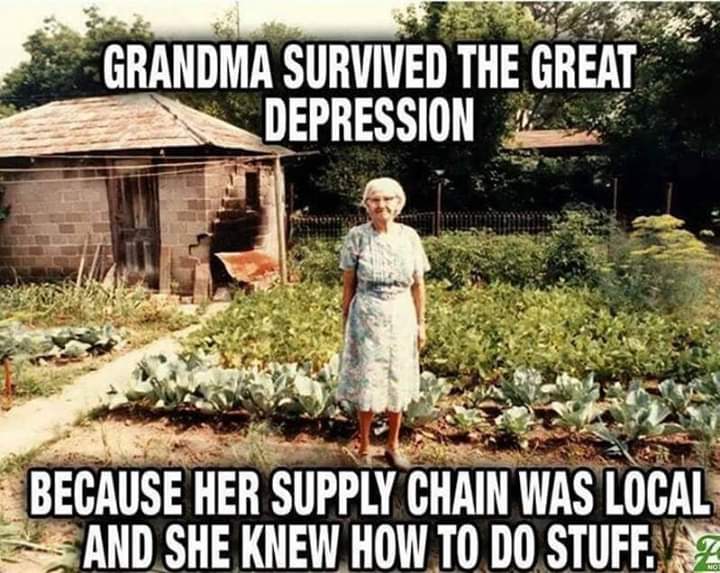
I’ve also been interested in the potential cultural impact.  Already there seems to be a minor revival in interest in gardening.  Part of that is prudent:  we need to have some food to fall back on should the supply chains face further disruption.

But I also suspect some of it is spiritual.  Modern man has become divorced from his roots in the soil—in Creation.  Modernity has liberated us from the constant fear of want, but that liberation came with a price:  we traded the liberty of the soil for the chains of comfort.  Growing a little vegetable garden, however meager, is a way to reconnect with the land, and with the beauty of God’s Creation.

Read More »

SubscribeStar Saturday: Family Time

Today’s post is a SubscribeStar Saturday exclusive.  To read the full post, subscribe to my SubscribeStar page for $1 a month or more.  For a full rundown of everything your subscription gets, click here.

This weekend’s SubscribeStar Saturday is a bit delayed due to some increased family time, particularly the celebration of my nephew’s third birthday.  One of the upsides to this disastrous coronavirus situation has been the sudden renewal of home life.

As we’ve reoriented our attitudes about and our relationships to work in such a dramatic way, the increased time at home and with loved ones has really highlighted how much happier our lives can be with the proper work-life balance.  Indeed, I’ve been more energized in my work than I have been in years in part because of the greater flexibility this otherwise terrible plague has afforded.

I’m cautiously optimistic that this shift could be more enduring than a couple of months of social distancing.  Indeed, “social distancing” may very well result in a renaissance of family togetherness.

To read the rest of this post, subscribe to my SubscribeStar page for $1 a month or more.

The Revival of Traditionalism?

Milo Yiannopoulos posted a screen shot yesterday of an essay from The Atlantic reading “How the Coronavirus Will Send Us Back to the 1950s” (the piece, by Helen Lewis, is now called “The Coronavirus Is a Disaster for Feminism“—a silver lining to this pandemic, I suppose).  His caption reads, “HOLY SH[*]T YES PLEASE[.]”

The Lewis piece is the usual feminist hand-wringing about the disparate impact of the coronavirus on women.  Feminists always find a way to make global catastrophes about them, and not about everyone who is truly suffering.  The attitude seems to be, “yes, yes, people will die, but why do I have to make any sacrifices or trade-offs for the people I ostensibly love?”

Read More »

High-Tech Agrarianism

The coronavirus situation—which I am convinced is both quite serious, but also inspiring some huge overreactions—has created a world that feels almost entirely different than it did even a few days ago.  This time last week, I was convinced that the whole thing was way overblown, and that life would largely continue apace, minus some school closures here and there.

By Friday evening I was growing more concerned, as everything began to get closed or cancelled.  I proctored the SAT Saturday morning and even went out of town that evening.  At that point, I thought the risk of my school closing was greater than it had been even two or three days before, but I still figured it was a relatively remote possibility.

Then Governor McMaster announced the closure of all South Carolina public schools (I teach at a private school, but we always follow gubernatorial closures)—and a bunch of other stuff shut down.  I picked up dinner at a Hardee’s in Florence, South Carolina Monday evening after a guitar lesson, and it was surreal—everything was gone from the front, and the cashier had to give me a lid and straw according to their new cleanliness guidelines.

(Let’s take a moment to thank all those service industry folks and long-distance truckers who are continuing to work and risking exposure; they are unsung heroes.  Also, spare a thought to people in those industries that are out-of-work at the moment.  They need our love and charity now more than ever.)

That’s all to say that, in a remarkably short period of time, the United States has undergone a major paradigm shift.  The world of Saturday, 14 March 2020 at 2 PM—when I emerged from the cocoon of extended time SAT testing—was a different than the world of Wednesday, 18 March 2020 at 9 PM (when I’m writing this very belated blog post).

One trend—that I think will be positive if it endures—is the implicit rejection of globalism.  People are suddenly awakening, dramatically, to the manifold downsides of open borders and excessive global economic integration.  Suddenly, localism is back in vogue.

Read More »

SubscribeStar Saturday: Social Peace Requires Social Capital

Today’s post is a SubscribeStar Saturday exclusive.  To read the full post, subscribe to my SubscribeStar page for $1 a month or more.  For a full rundown of everything your subscription gets, click here.

Yesterday I wrote (in essence) that this whole coronavirus fiasco is going to clarify a lot of things.  For one, we’re seeing the lethal consequences of open borders thinking and political correctness.  We’re not allowed to say that it’s China’s fault, even though we all know it is.  Every prudent person knows that, for better or for worse, you should avoid Chinese people who are fresh from China.  Similarly, people are going to realize that throwing open our borders to anyone is a bad idea.

What I most fear, though, is what will happen if things get really tight.  Right now there’s a run on toilet paper.  That’s ultimately more humorous than dangerous; there’s always Kleenex, paper, or—if it comes to it—leaves and a hot shower.

But what if people can’t get food?  Or medicine?  The latter is far likelier, given our dependence upon China for ingredients and raw materials necessary for many medicines (a degree of autarky isn’t such a bad idea after all).  But the former could be a possibility if supply chains are seriously disrupted.  Again, I don’t think it will come to that, but it makes sense to prepare for the worst.

In the past, communities could rely on high degrees of social capital to safeguard social peace in times of trouble.

To read the rest of this post, subscribe to my SubscribeStar page for $1 a month or more.

TBT: The Human Toll of Globalization

One of the more interesting developments in conservatism since Trump’s rise in 2015-2016 has been a reevaluation of our basic economic policy.  Much of the ideas debated originated, in our modern political era, with Pat Buchanan.  For decades, the assumption among conservatism was that economic efficiency was the highest good, as it lowered costs and eliminated or reduced government overreach.

That was a reasonable set of assumptions when our nation shared a common culture, and when the United States dominated global markets hegemonically.  But the goal of reducing the size of government morphed pathologically into the mad worship of Efficiency above all else.  We sold out social capital—stable families, cohesive communities, robust civil society—for quick cash.

That’s the gist of Z-Man’s post today, “Middle-Man Conservatism.”  Tucker Carlson has similarly touched upon the woeful consequences of worshiping Efficiency-for-its-own-sake.  Sure, Americans possess a pioneering spirit—we’ll move to the oil fields in North Dakota if we have to do so—but we’re still motivated by the same things other humans are:  family, community, belonging.  Gutting our communities to save fifty bucks on a washing machine is a ludicrous trade-off.

Read More »