TBT: Mahler’s Composing Shack

We’re getting into the time of year when my personal creativity seems to spark.  I should be way more productive creatively in the summer, when I enjoy loads of unstructured time, but I find that I work better in the constrains and confines of a busy schedule.  For whatever reason, that extra pressure helps me to eke out, if not diamonds, then at least some lesser gems.

One well from which I have drawn some considerable inspiration the last couple of years was my Pre-AP Music Appreciation class.  It was a broad survey of Western music from the medieval period to the present, with a strong emphasis on the Baroque, Classical, and Romantic periods.  Due to a combination of scheduling difficulties and lower enrollment last year, the class did not run this year.

On the one hand, I’m thankful—it’s given me more time to focus on other endeavors.  On the other, I do miss the almost-daily baptism in the works of some of the greatest composers in the Western canon.

One element of the course that was particularly intriguing was learning about the lives and creative processes of the composers.  Many of them lived quite tragic lives; others (rarer, it seems, among composers) lived quite contentedly.

Gustav Mahler seemed to have developed a nice little work routine, as detailed in this post from October 2021.  I like the idea of having a stripped-down cottage by the sea, with a healthy breakfast brought to me as I work.  Sounds like the good life!

With that, here is 13 October 2021’s “Mahler’s Composing Shack“:

Read More »

Hustlin’ with Private Lessons

The school year is back in full swing, and with the brief respite of Labor Day behind me, it’s a long stretch of mind-molding from here until Thanksgiving.

Fortunately, the school year means music lessons, and music lessons—as one former colleague, now retired, frequently reminds me—mean money.

I don’t love money, but I certainly need it.  And love teaching music lessons, so it’s a happy way to bring in some extra bacon while also teaching kids (and adults!) to make music.  There are few things I enjoy  more than nurturing a love of music; if I make a few quid in the process, well, all the better!

The Lord has blessed me with an abundance—perhaps an over-abundance—of lessons.  At the time of this writing, I am sitting at twenty-six lessons a week across twenty-four students.  Scheduling has been a bit of a nightmare, but I think I have it largely figured out (of course, whenever I think that, some conflict arises and I have to play scheduling roulette—ha!).

Read More »

Mahler’s Composing Shack

While teaching Pre-AP Music Appreciation last school year, I stumbled upon an excellent YouTube channel, Inside the Score, which features videos explaining and analyzing some of classical and Romantic music’s greatest works and composers.  It’s a wonderful resource for exploring famous works in greater depth, and has greatly enhanced my own appreciation for music.

At some point, I ended up on Inside the Score‘s mailing list, and I receive little e-mail newsletters from the site periodically.  These are like delicious, bite-sized treats compared to the longer videos (which themselves are by no means daunting, coming it at around twenty minutes a pop).

Recently, one of these morsels found its way into my inbox:  a look at Gustav Mahler‘s daily routine.  Mahler wrote incredibly long symphonies—to this day, the single longest piece of music I have ever sat and listened to live is Mahler’s Fifth Symphony, which clocks in at an impressive seventy-five minutes—and did so while touring the world as a conductor.  According to Inside the Score, Mahler had summers off to compose at a little shack on the Attersee in Austria, and stuck to a fairly consistent schedule.

Read More »

SubscribeStar Saturday: Small-Scale Entrepreneurism

Today’s post is a SubscribeStar Saturday exclusive.  To read the full post, subscribe to my SubscribeStar page for $1 a month or more.  For a full rundown of everything your subscription gets, click here.

Last night was my first ever Spring Jam, and my second ever front porch concert.  The first such concert, my Halloween Spooktacular, was far more successful than I imagined.  At the time of this writing—which is actually before the concert (gasp!)—I don’t know how well the Spring Jam will go financially, but I’ll have detailed numbers, as well as an overall review of the event, next Saturday.

That said, in putting together this second front porch concert, I’ve run into a few more hiccups than last time.  Most of these have been relatively minor—and one of them quite major—but they’ve taught me some lessons for next time.

Most importantly, they’ve driven home the risks and opportunities inherent in putting on any endeavor.  Impresarios past and present know well the risks of producing any kind of stage or musical production.  Even at the very small scale at which I am working, some risks are present.

To that end, allow me to share with you some of the learning opportunities putting together this Spring Jam has afforded me, and how these lessons can be applied to future entrepreneurial ventures of any kind.

This post will be finished later; I was slammed with the Spring Jam and wasn’t able to finish the subscriber essay.  I’ll let y’all know when I have it done.  Apologies!  —TPP

To read the rest of this post, subscribe to my SubscribeStar page for $1 a month or more.

TBT: My Musical Philosophy in Song: “Delilah”

Later this month I’m hosting another front porch concert, following the success of my Spooktacular event in October.  I’m quite excited to do another front porch concert, and I’m interested to see how the May date will stack up compared to Halloween.  I’ve also ordered some great t-shirts, which I will have available on my Bandcamp merch page soon.

In preparing for the concert, I thought it might be a good time to look back at a post I wrote one year ago today, about the Tom Jones song “Delilah.”  The first time I truly heard the song was when I heard Bruce Dickinson’s version.  The Iron Maiden singer nailed the performance, and I immediately set about learning the song.

Of course, I wrote all of this a year ago, so I’ll let the original speak for itself.  Here is 6 May 2020’s “My Musical Philosophy in Song: ‘Delilah’“:

Read More »

Sheet Music Burning

The latest target of the woke elites and their braying mobs is—that great symbol of imperialism and Western dominance—sheet music.

Apparently, some Oxford dons are considering removing sheet music and the ability to read traditional notation from its curriculum.  One quotation from The Telegraph article notes that “The Oxford academics went on to pronounce that teaching the piano or conducting orchestras could cause ‘students of colour great distress’ as the skills involved are closely tied to ‘white European music’.”

This latest crusade is the musical equivalent of the effort in English departments across the country to downplay the teaching of grammar.  Sure, one can make plenty of excellent music without knowing how to read notation, but why limit one’s self to tabs or lead sheets?  I can certainly communicate certain ideas without adverbs, adjectives, or even pesky commas, but doing so severely limits the range of expression.

Read More »

The Joy of Romantic Music

This semester started with two weeks of online learning (of which today is the last day before students and teachers return to campus after Martin Luther King, Jr. Day), so it’s been an unusually slow start to the already sleepy January term.  However, that hasn’t stopped my music classes from listening to great music; indeed, we’re now covering what is perhaps my favorite period in the history of Western music:  the Romantic Era.

While I adore Baroque and classical composers and their works, Romantic music builds upon the forms established in those eras, stretching and expanding upon them to reach new heights of emotional intensity and musical expressiveness.  The music of the Romantic composers delights with its musical exploration of the supernatural, the mysterious, the Gothic, and the nationalistic.

Read More »

Stop Amending the Classics, Bring Back Melody

This time of year, this blog focuses big time on Christmas carolstheir histories, the theory behind them, their compositions, etc.  One of the great joys in my life is playing and singing these carols.  They are sweet but powerful musical retellings of the Birth of Jesus.

One thing I’ve noticed, though, is that churches have taken these classics and, in an attempt to check the “contemporary Christian music” box, added unnecessary and musically-boring codas to them.  This past Sunday, my parents’ church’s praise team was leading the congregation in a stirring singing of “O Come, All Ye Faithful“—and then tacked on a needless extra chorus written in a modern style.  The additional chorus was okay, but it paled in comparison to the majesty and tunefulness of the carol it amended.  The church went from a lusty chorus of socially-distanced congregants to a few people mumbling along to the tuneless new chorus.

Read More »

The Joy of Music

One of the greatest joys in life is music.  Regular readers will know that I love musicplaying it, writing it, singing it, arranging it, analyzing it, launching it into space, etc.  As an art form, I believe music is uniquely suited to communicating ideas and beauty across time, space, and cultures.  It can be intensely nationalistic, yet still universal.

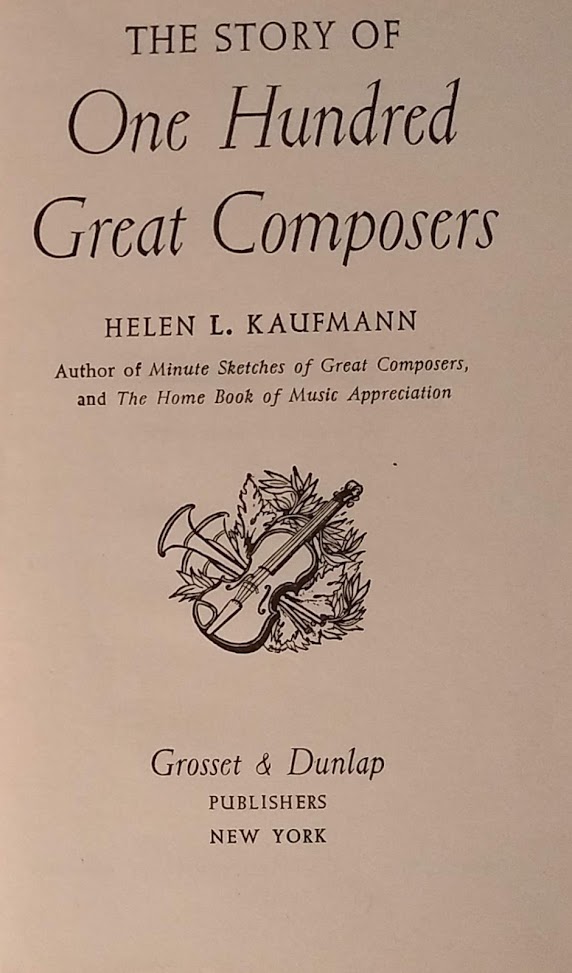
We’re back to distance learning today after a positive case of The Virus, and since it’s the day before Thanksgiving Break—historically the biggest blow-off day of the school year—my administration decided to play it safe and declare today a distance learning day.  As such, I took the assignment derived from The Story of 100 Great Composers and ported it to my high school music classes.  Those classes will share about their composers today.

Read More »

Hand it to Handel

One nugget of wisdom I’ve heard before is “if you want to learn something, teach it.”  As a private school educator who taught pretty much every course in the standard high school social studies curriculum and a plethora of music courses, I can attest to the Truth of this statement.  I essentially taught myself, for example, the highlights of Western philosophy from teaching a Philosophy course for many years (a course I very much wish the school would revive).

I’m shifting increasingly towards teaching music exclusively (though I’m still teaching a couple of American History survey courses), and teaching a Pre-AP Music Appreciation class has been one of the great joys of that transition.  Years ago I created and taught a course called “History of American Popular Music,” which covered the early Tin Pan Alley tunes all the way through blues, jazz, rock ‘n’ roll, and beyond.  This Pre-AP course is focused on the great works of Western music, going back to the medieval period.

Currently, we’re wrapping up a big unit on Baroque music.  The Baroque style—as epitomized by greats like Bach, Monteverde, Corelli, Handel, and others—delights in contrasts.  Just as Baroque paintings highlight stark contrasts between light and dark, Baroque music revels in sudden contrasts in dynamics.  It also loves to play around with complexity, as any Bach fugue will quickly demonstrate.

The last composer in our unit is George Frideric Handel.  Handel, a German-born composer, made a major splash upon his arrival in England in the 1710s, where he sought to introduce Italian opera to sophisticated London crowds.  What was meant to be a temporary visit turned into over four decades, and Handel is interred at Westminster Abbey—a huge honor.  It’s one of those delightful twists of history that Handel the German became one of the most English composers in history—and one of the greatest composers of all time.

Read More »