#MAGAWeek2018 – John Quincy Adams

John Quincy Adams

If yesterday’s MAGA Week profile of George Washington was straight from “American History Greatest Hits, Volume I,” today’s selection is like a bootlegged deep-cut from an obscure local musician’s live show.  John Quincy Adams—an American diplomat, Secretary of State, President, and Congressman—deserves better.

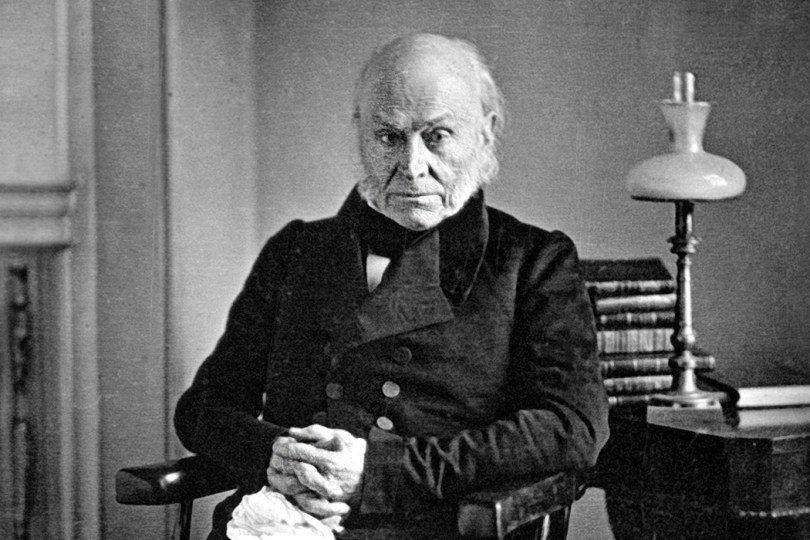
US History students of mine for years have recoiled at the dour daguerreotype portrait of our somewhat severe sixth President.  But behind that stern, austere visage churned the  mind of a brilliant, ambitious man—and probably the greatest Secretary of State in American history.  I will be focusing on Adams’s tenure in that position in today’s profile.

An “Era of Good Feeling”

Adams was one of several “all-star” statesmen of the second generation of great Americans.  After the careers of George Washington, Alexander Hamilton, Thomas Jefferson, and John Quincy’s father, John Adams, a new, youthful cadre of ambitious and talented national leaders took their place at the helm of a nation that was growing and expanding rapidly.  From the ill-fated War of 1812 through the Mexican War, leaders like John C. Calhoun, Daniel Webster, Henry Clay, and Andrew Jackson—the populist odd-man out—forged a national identity and sought to navigate the nation through its early growing pains.

John Quincy Adams was among this group.  After the War of 1812, his father’s old Federalist Party largely died out, both due to the treasonous actions of the so-called “Blue Light” Federalists (who openly sided with the British) and to demographic changes brought about by westward expansion and the Louisiana Purchase in 1803.  More Americans were small, yeoman farmers, and the Federalists’ pro-British, pro-industry, pro-commerce platform held little appeal for feisty frontiersman who were suspicious of a strong federal government and the hated Second Bank of the United States, charted in 1816.

As such, the United States entered an “Era of Good Feeling” under President James Monroe, in which one party, the Democratic-Republican Party, remained.  Monroe’s cabinet was a “who’s who” of young, dynamic men, and Adams was his Secretary of State.

Secretary of State

It was in this context that Adams made his most significant contributions to American foreign policy and nationalism.  While serving as Secretary of State, he laid out a vision for America’s future that held throughout the nineteenth century.

In essence, Adams argued that the United States should pursue a realist foreign policy that avoided wars and foreign entanglements; that the nation should not seek a European-style “balance of power” with its Latin American neighbors, but should be exercise hegemonic dominance in the Western Hemisphere; and that the United States should gain such territory as it could diplomatically.

In 1821, Adams famously issued his warning against involvement in foreign wars of liberation.  The context for this warning was the Greek War of Independence from the Ottoman Empire, an endeavor that was hugely popular in Europe, particularly in Britain.  Many Americans urged Congress to intervene in the interest of liberty, and for Americans to at least send arms to help in another fledgling nation’s war for independence.

Adams perceptively saw the dangers inherent in the United States involving itself in other nations’ wars, even on the most idealistic of grounds.  To quote Adams at length:

“Wherever the standard of freedom and Independence has been or shall be unfurled, there will her heart, her benedictions and her prayers be. But she goes not abroad, in search of monsters to destroy. She is the well-wisher to the freedom and independence of all. She is the champion and vindicator only of her own. She will commend the general cause by the countenance of her voice, and the benignant sympathy of her example. She well knows that by once enlisting under other banners than her own, were they even the banners of foreign independence, she would involve herself beyond the power of extrication, in all the wars of interest and intrigue, of individual avarice, envy, and ambition, which assume the colors and usurp the standard of freedom. The fundamental maxims of her policy would insensibly change from liberty to force…. She might become the dictatress of the world. She would be no longer the ruler of her own spirit.” (Emphasis addedSource:  https://www.mtholyoke.edu/acad/intrel/jqadams.htm)

If America were to involve itself in open-ended wars of liberation—even once!—it would set a dangerous precedent that the United States would become constantly embroiled in the squabbles of other nations.  No matter how well-meaning, such intervention would commit the nation to a disastrously unlimited policy of nation-building and war.

The Transcontinental Treaty (1819)

Prior to rumblings for intervention in Greece, Adams brokered the purchase of Spanish Florida in a rather amusing fashion.  The hero of the Battle of New Orleans, General Andrew Jackson, pursued a group of Seminole Indians into Florida, violating orders to respect the international border.  In the process, Jackson attacked a fort manned by Seminoles and escaped slaves, killed two British spies, and burned a Spanish settlement.

Instantly, an international crisis seemed imminent.  To a man, President Monroe’s cabinet demanded disciplinary action be taken against General Jackson.  It was Adams—who, ironically, would become Jackson’s bitterest political opponent in 1824 and 1828—argued against any such action, and planned to use Jackson’s boldness to America’s advantage.

With apologies to Britain and Spain, Adams pointed out that, despite the government’s best efforts, Jackson was almost impossible to control, and was apt to invade the peninsula again.  Further, Spanish rule in Florida was increasingly tenuous, due to the various Latin American wars of independence flaring up at the time.  With revolts likely—and facing the prospect of another Jackson invasion—Spain relented, selling the entire territory for a song.

The Oregon Country and the Convention of 1818

Adams was also key in securing the Oregon Country for the United States, although the process was not completed in full until James K. Polk’s presidency, some thirty years later.  The Oregon Country—consisting of the modern States of Washington and Oregon—was prime land for settlement, but the United States and Great Britain both held valid claims to the territory.

Adams realized that the United States could afford to be patient—given America’s massive population growth at the time, and its citizens’ lust for new lands, Adams reasoned that, given enough time, American settlers would quickly outnumber British settlers in the territory.

Sure enough, Adams secured another territory for the United States, albeit in far less dramatic fashion that the acquisition of Florida one year later.

The Monroe Doctrine (1823)

Perhaps Adams’s greatest contribution to the United States was his work on the Monroe Doctrine in 1823.  Once again, Adams’s diplomatic brilliance came into play.

Adams sought to keep the United States out of foreign wars, but he also wanted to keep European powers out of the Western Hemisphere.  As Spain continued to lose its grip on its American colonies, the autocratic nations of Russia, Prussia, and Austria (the Austrian Hapsburg controlled Spain at this time) sought to reestablish monarchical rule in the Western Hemisphere.

President Monroe and Secretary Adams were having none of it—nor was was Great Britain, which enjoyed a brisk trade with the newly-independent republics of Latin America.  To that end, Britain proposed issuing a joint statement to the world, with the effect of committing both nations to keeping the new nations of Latin American independent.

Monroe was excited at the idea, but in his ever-prescient manner, Adams argued for caution.  Were the United States to issue the declaration jointly with Britain, they would appear “as a cockboat in the wake of a British man-o-war.”  It would be better, Adams argued, to issue a statement unilaterally.

The United States had no way, in 1823, to enforce the terms of the resulting Monroe Doctrine, which pushed for three points:  Europe was to cease intervention in the affairs of the Western Hemisphere (non-intervention); Europe was to cease acquiring new colonies in the Western Hemisphere (non-colonization); and the United States would stay out of open-ended entanglements and alliances with Europe (isolation).

However, Adams knew that Britain would enforce the Monroe Doctrine with its mighty navy, even if the United States issued it unilaterally, because it would be in Britain’s national interest to do so.  Sure enough, Adams’s shrewd realism won the day, and, other than France’s brief occupation of Mexico during the American Civil War, European powers never again established colonies in the New World.

After Monroe’s Cabinet

For purposes of space and length, I will forego a lengthy discussion of Adams’s presidency and his tenure in Congress.  He was an ardent nationalist in the sense that he sought an ambitious project of internal improvements—roads, canals, harbors, and lighthouses—to tie the young nation together.  In his Inaugural Address, he called for investment in a national university and a series of observatories, which he called “lighthouses of the sky,” an uncharacteristically dreamy appellation that brought him ire from an already-hostile Congress.

His presidency, too, was marred by the unusual circumstances of his election; Adams is the only president to never win the popular or electoral vote, or to ascend to the position from the vice presidency.  That’s a story worth telling in brief, particularly for political nerds.

The presidential election field of 1824 was a crowded one, and the “Era of Good Feeling” and its one-party dominance were showing signs of sectional tension (indeed, the second system of two parties, the National Republicans—or “Whigs”—and Jackson’s Democratic Party, would evolve by 1828).  There were four candidates for president that year:  Andrew Jackson, John Quincy Adams, Speaker of the House Henry Clay, and Secretary of Treasury William Crawford of Georgia.

Jackson won a plurality of the electoral votes—99—but no candidate had a clear majority.  In this event, the top three candidates are thrown to the House of Representatives, where each State’s delegation votes as one.  Crawford, who finished third, was deathly ill, and was not a suitable candidate, and Henry Clay, in fourth, was not eligible constitutionally.

That left the rabble-rousing Jackson and the austere Adams.  Clay, as Speaker of the House, held immense influence in Congress, and could not stand Jackson, so he threw his support behind Adams, who won the election in Congress.

Apparently losing all the wisdom and prudence of his days at the State Department, Adams foolishly named Clay as his new Secretary of State—an office that, in those days, was perceived as a stepping stone to the presidency.  Jackson supporters immediately cried foul, arguing that it was a “corrupt bargain” in which Clay sold the presidency in exchange for the Cabinet position.

While it appears that Adams sincerely believed Clay was simply the best man for the job, the decision cast a pall over his presidency, and Jackson supporters would gleefully send their man to the Executive Mansion in 1828.

At that point, Adams expected to settle into a quiet retirement, but was elected to represent his congressional district in 1830.  During his time in Congress, he fought against slavery and the infamous “gag rule,” which prevented Congressman from receiving letters from constituents that contained anti-slavery materials.  He was also a vocal opponent of the Mexican War—as was a young Abraham Lincoln during his single term in Congress—and died, somewhat disgracefully, while rising to oppose a measure to honor the veterans of that war.

Regardless, Adams’s career shaped the future of the country, gaining it international prestige and setting it on track to emerge as a mighty nation, stretching from sea to shining sea.  Through his service and genius, Adams made America great—and, physically, in a very literal sense.

Quick References

#MAGAWeek2018 – George Washington

It’s July Fourth week here in the glorious United States, and in the spirit of good, old-fashioned patriotism, I’m dubbing this week “MAGA Week 2018” (and adopting the hashtag in celebration—please share this post with the appropriate dose of shameless promotion I crave).  Each day I’ll be highlighting some historic individual who, in his or her own way, made America great again in their respective time.

George Washington

As with all American firsts, we’re starting with the first President of the United States, George Washington.  A bit cliche, perhaps, but I believe that we take George Washington’s legacy for granted.  Yes, he’s ubiquitously arrayed on our currency, and he shows up around Presidents’ Day in commercials for local car dealerships (“I cannot tell a lie—the price on these 2018 Chevy Silverados is unbeatable!”), but Washington has suffered at the hands of social justice warrior academics and white-male bashers.

Of course, none of those Gender Studies majors could even bash our first President were it not for his choices in and before taking office.  Indeed, we owe an immense debt of gratitude to George Washington for the system of government we enjoy today.

Surrendering Power

Washington is not some kind of patriotic demigod—he more or less blundered the British Empire into the lengthy and expensive Seven Years’ War/French and Indian War with France—but he did something that few military men have ever done in history:  he voluntarily gave up power.

George Washington received a commission from the young Continental Congress to lead the Continental Army in 1775.  On 23 December 1783, General Washington resigned his commission, surrendering his commission back to the civilian authority that originally granted it.

Historically speaking, it is hard to articulate how rare such an action is.  Washington could have gone the direction of the “George Washington of South America,” Simon Bolivar, and continued to fight for more power, or to expand the Revolution abroad.  Many men in his position—a position of immense popularity and holding the keys to the nation’s fighting force—would have forced the Continental Congress at gun point to extend “emergency powers” or the like to them.  Washington could easily have made himself King of the United States.

Instead, Washington followed the model of the humble Roman farmer Cincinnatus, who saved the young Roman Republic and promptly returned to his plow.  Thus, Washington is remembered to this day as “The American Cincinnatus.”

The Newburgh Conspiracy

Before he surrendered his commission, Washington narrowly saved the fledgling young Republic once again.  In Newburgh, New York, a group of disgruntled soldiers, upset that they had gone unpaid for so long, began to foment a conspiracy to march on Philadelphia, demand their wages on gunpoint, and, should the Continental Congress refuse, overthrow the assembly by force.  Such an uprising would have been disastrous, and could have ushered in a military junto, supplanting the Articles of Confederation.

Despite his best efforts, Washington could not win over the hardened veterans with eloquence.  He produced a letter from a soldier to read aloud to the rowdy bunch of soldiers, then fumbled about in his coat pocket for his glasses.

As he put on his glasses, Washington remarked, “Gentleman, you must pardon me, for I have not only grown gray but almost blind in service to my country.”  Washington’s soldiers had never seen him in such a light, and began to weep openly.  Thus, General Washington prevent a military coup simply by donning his glasses.

Shays’ Rebellion

After Daniel Shays’ Rebellion in 1786-87, Washington again—reluctantly—returned to public life, and was among the handful of men who began to push for a stronger national government.

Shays’ Rebellion shook many leading Americans to the core.  The State of Massachusetts, which was diligently and vigorously paying off its debts from the American Revolution, placed heavy demands on the limited resources of farmers in the western portion of the State (a recurring theme in American history—the tension between eastern commercial elites and western farmers).  As many farmers were unable to pay their debts—much less in the hard currency specie the law required—they faced debtors’ prison or confiscation of their property.

Their backs against the wall, the young Daniel Shays led an ad-hoc army of about 4000 men to occupy courthouses to prevent foreclosures and seizures of property.  Ultimately, the State of Massachusetts had to raise a private militia, as no other States would send troops to assist what they saw as a matter exclusive to Massachusetts.

Shays’ Rebellion highlighted the need for a stronger central government than the Articles of Confederation provided.  The Articles did not give the federal government the ability to tax the States or imports, and while a national army technically existed, it could only requisition troops from the States, and it had no way to compel the States to provide troops (seeing as it lacked a national military).

Reluctantly, Washington came out of retirement, and presided over the Constitutional Convention in 1787.

First President

Once the Constitution was ratified in 1789, the nation faced a number of problems that had gone unresolved during the long years under the Articles of Confederation.  America in the 1780s was economically depressed and suspicious of national authority (the latter is not entirely a bad quality), and it had failed to fulfill several of its obligations to Great Britain under the Treaty of Paris of 1783, the treaty that ended the Revolutionary War.  Additionally, the French Revolution broke out in 1791, creating a sticky situation between the young Republic and its technical Revolutionary allies.

The only man who could engender the support of all thirteen States was George Washington, who won unanimously in the Electoral College.  At his Inauguration, Washington wore a simple, brown suit—the attire of a common but respectable gentleman of the time—and eschewed any regal titles.  Vice President John Adams, knowing the difficulty of the job any President would face, proposed the unwieldy, monarchical title “His Highness, President of These United States, and Protector of Their Liberties” (in response, congressmen snickered that Adams should be called “His Rotundity”).  Washington wisely adopted the simple “Mr. President.”

The Whiskey Rebellion

In 1795, during his second term, George Washington faced the Whiskey Rebellion in Pennsylvania.  Like Shays’ Rebellion, the uprising pitted the interests of the nationalists against rural farmers.  Western farmers, lacking reliable transportation and long transport times, relied on converting their corn into whiskey, which would survive the long, arduous trip to market.  The Federalist-dominated Congress placed an excise tax on whiskey as a way to increase revenue, placing a heavy burden on western farmers (who, incidentally, tended to vote for Thomas Jefferson’s new Democratic-Republican Party).

Farmers began refusing to pay the tax, and assembled a militia to prevent its collection.  This time, however, things went differently—George Washington, as Commander-in-Chief, personally led the Army to face the farmers.  At the sight of the American military, the farmers threw down their weapons and dispersed.  Washington—in one of his multiple instances of magnanimity and mercy—pardoned the leaders of the rebellion, sparing them the hangman’s noose.

The lessons of the Whiskey Rebellion were clear:  good order must be maintained; armed insurrection is not tolerated; change must occur at the ballot box, not by force of arms.  Washington’s response to the Whiskey Rebellion cemented the authority of the Constitution, which had survived one of its first major tests.

End of Presidency

Washington served ably as President, keeping America out of France’s costly and radical revolution, establishing good government, and uniting a young country that was suspicious of centralized power.  And, once again, Washington yielded power, opting to serve only two terms—an important precedent that every President followed until Franklin Delano Roosevelt.

That final act cannot be dismissed too quickly.  Had Washington served a third term, he would have died in office.  The precedent would have been set that any President should try to hold onto power as long as was electorally feasible—or by extra-constitutional means, if necessary.

In his Farewell Address, Washington spelled out the ingredients that make a good government work.  He wrote, “Of all the dispositions and habits which lead to political prosperity, religion and morality are indispensable supports…. It is substantially true that virtue or morality is a necessary spring of popular government.”

We would do well to remember his words—and, I fear, we have forgotten many of them.

Fortunately, God blessed the United States with George Washington, and worked through him to make ours a more perfect union.  At multiple times in our young Republic’s history, George Washington Made America Great Again!

Quick References

Breaking: Trump Nominated for Nobel Peace Prize

Breaking news, c/o of a former student who sent the linked article:  President Donald Trump has been nominated for the Nobel Peace Prize for his work toward the denuclearization of North Korea.

President Trump was nominated by two members of Norway’s Progress Party, a conservative party that supports lower taxes and limited immigration, so it’s no surprise on that front, and it’s still a long way from winning the coveted Prize itself.

Nevertheless, it’s a victory for Trump, the peace process, and the hopes for peace on the Korean Peninsula.  It’s also much more deserved than President Obama’s 2009 Peace Prize win, which was awarded simply because he was “cool” and went on his Mid-East “apology tour.”

Despite negative publicity from the child separation policy—which Trump is also making moves to end as I write—the President is having a great week.

First, peace on the Korean Peninsula.  Next, liberty among the stars.  Congratulations, Mr. President!

Open Borders is the Real Moral Crisis

I typically avoid wading into fashionable-for-the-moment moral crusades, but the hysteria over children being separated from their parents at the border is ludicrous, and demonstrates the typical “facts over feelings” emotionalism that mars our immigration debate.  That feel-goodism is why we’re even in this mess—if it can be characterized as such—in the first place.

Because I’ll be deemed a monster—“Won’t somebody please think of the children!“—for not unequivocally denouncing this Clinton-era policy, I’ll issue the usual, tedious disclaimers:  yes, it’s all very tragic; yes, it could be handled better; yes, I would have been terrified to be separated from my parents at such a young age; etc.

Now that the genuflecting to popular pieties is out of the way, let me get to my point:  this entire situation would be a non-issue if we had simply enforced our immigration laws consistently for the past thirty years.  President Trump isn’t the villain here (if anything, Congress is—they can take immediate action to change the policy or come up with some alternative—but I don’t even think they’re wrong this time); rather, the villains are all those who—in the vague name of “humanity” and “human rights”—ignored illegal immigration (or, worse, actively condoned it).

Sadly, it is an issue.  But what else are we to do?  Years of non-enforcement have sent the implicit but clear message to potential illegal immigrants that we don’t take our own borders (and, by extension, our national sovereignty and rule of law) seriously, and that if you’re sympathetic enough, you’ll get to skip the line.  Folks come up from Mexico and Central America fully expecting that, after some brief official unpleasantness, they can dissolve into the vastness of the United States and begin sending remittances back to their relatives—who may then pull up stakes and come.

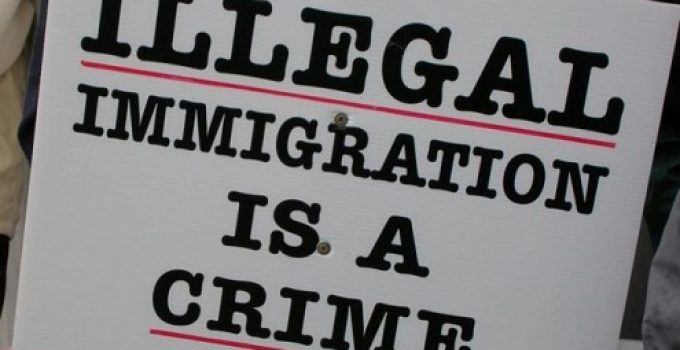
Further, sneaking into the country illegally is a crime, and the United States has every right to enforce its laws, including those pertaining to immigration.  Mexico, similarly, has that right—and uses it unabashedly to police its own border (or to let Central American migrants waltz through on their way to the Estados Unidos).  Naturally, the punishment for breaking laws is often detainment, and the kiddies don’t join dad in his cell.

To give a common example:  what happens to the children of, say, an American heroin dealer when he’s arrested and sentenced to ten years in a drug bust?  His children—if they have no relatives willing or able to take them in—go into the foster care system.  It’s tragic, it’s terrible, but it’s part of the price of committing a felony.  No one wants it to happen, but it’s a consequence of one’s actions.  This reason is why crime is so detrimental to society at large, even beyond the immediate victims.

Unfortunately, a combination of winking at immigration enforcement (“eh, come on—you won’t get deported”), feel-good bullcrap (as my Mom would call it), and Emma Lazarus Syndrome (trademarked to The Portly Politico, 2018) have contributed to the current nightmare situation.  Now that an administration is in office that actually enforces the duly legislated law of the land—and at a point at which the problem has ballooned to epic proportions due to past lax enforcement—the problem is far thornier and more consumed with emotional and moral peril.

As any self-governing, self-sufficient adult understands, sometimes doing what is necessary is hard.  I do feel for these children who are stripped from their parents arms (although, it should be noted, usually for only a matter of hours), but who cares about my feelings?  We can have compassion for those who try to arrive here illegally, as well as their children, without attempting to take on all of their problems, and without sacrificing our national sovereignty and our laws in the process.

The United States is the most generous nation in the world—and the most prosperous—but we cannot take everyone in; to do so would not make everyone else better off, but would rather destroy what makes America the land of compassion, liberty, prosperity, and charity that it is.

***

For further reference, I recommend the following videos, the first from the brilliant Ben Shapiro, the second from Dilbert creator Scott Adams:

https://www.youtube.com/watch?v=OWWVaLlpq7s&t=2134s

I’d also recommend this piece from National Review columnist Richard Lowry, which is quite good:  https://www.nationalreview.com/2018/05/illegal-immigration-enforcement-separating-kids-at-border/

And, finally, this piece from Conservative Review‘s Daniel Horowitz, which explains the true moral toll of illegal immigration—and misplaced compassion—very thoroughly:  https://www.conservativereview.com/news/the-immorality-of-the-open-borders-left/

Breaking: President Trump Creates Space Force

Apparently, President Trump is one of my readers:  this afternoon, the President issued an executive order charging the Department of Defense and the Pentagon with creating a separate “Space Force.”  Trump said that “we must have American dominance in space” (emphasis added).

I wrote about this very topic one week ago today.  Excellent move, President Trump.  I’m going to push my nephew hard to join our X-Wing Division in 2035.

Here’s a clip of the speech from C-SPAN:

Three Years of Excellence

Father’s Day—16 June 2018—marked three years since President Donald Trump’s now-legendary descent down the golden escalator at Trump Tower, following by his controversial but true-to-form announcement that he would be seeking the Republican Party’s nomination for President.

I was, initially, a Trump skeptic, and I voted for Texas Senator Ted Cruz in the South Carolina primaries the following February.  When Trump first announced, I wrote him off—as so many others—as a joke.  I appreciated his boldness on immigration, but I still thought the PC Police and the campus Social Justice Warriors were firmly in control of the culture, and that no one could speak hard truths.

I also remembered his brief flirtation with running in 2012, and thought this was just another episode in what I learned was a long history of Trump considering a presidential bid.  At the South Carolina Republican Party’s state convention earlier in 2015, I asked two young men working on Trump’s pre-campaign (this was before The Announcement) if he was really serious this time.  The two of them—they looked like the well-coifed dreamboat vampires from the Twilight franchise—both assured me that Trump was for real, and I left with some Trump stickers more skeptical than ever (note, too, that this was before the distinctive but simple red, white, and blue “Trump” lawn signs, and definitely before the ubiquitous “Make America Great Again” hats).

I even briefly—briefly!—considered not voting for Trump, thinking that he was not a “real” conservative.  I still don’t think he’s a conservative in the way, say, that a National Review columnist is (although, the way they’ve gotten so noodle-wristed lately, that’s a good thing; I’ve just about lost all respect for David French’s hand-wringing, and Kevin Williamson went off the deep-end), but rather—as Newt Gingrich would put it—an “anti-Leftist.”  That’s more than enough for me.

But my conversion to Trump came only belatedly.  I can still find a notebook of notes from church sermons in which I wrote, “Ted Cruz won the Wyoming primary.  Thank God!” in the margins.

Then something happened—something I predicted would happen on the old TPP site—and I couldn’t get enough of the guy.  It wasn’t a “road to Damascus” epiphany.  I started listening to his speeches.  I read up on his brilliant immigration plan (why haven’t we taxed remittances yet?).  I stopped taking him literally, and began taking him seriously.

And I noticed it happening in others all around me.  Friends who had once disdained the Republican Party were coming around on Trump.  Sure, it helped that Secretary Hillary Clinton was a sleazebag suffused with the filth of grasping careerism and political chicanery.  But more than being a vote against Hillary, my vote—and the vote of millions of other Americans—became a vote for Trump—and for reform.

Trump made politics interesting again, too, not just because he said outrageous stuff on live television (I attended his rally in Florence, South Carolina before the SC primaries, and I could feel his charisma from 200 feet away; it was like attending a rock concert).  Rather, Trump busted wide open the political orthodoxy that dominated both political parties at the expense of the American people.

Take trade, for example.  Since World War II, both Democrats and Republicans have unquestioningly supported free trade.  Along comes Trump, and suddenly we’re having serious debates again about whether or not some tariffs might be beneficial—that maybe it’s worth paying a little more for a stove or plastic knick-knacks if it means employing more Americans.

That’s not even to mention Trump’s legacy on immigration—probably the most pressing issue of our time, and one about which I will write at greater length another time.

Regardless, after over 500 days in office, the record speaks for itself:  lower taxes, fewer regulations, greater economic growth, greater security abroad.  At this point, the only reasons I can see why anyone would hate Trump are either a.) he’s disrupting their sweet government job and/or bennies; b.) they don’t like his rhetorical style, and can’t get past it (the Jonah Goldbergite “Never Trumpers”—a dying breed—fall into this group); or c.) they’re radical Cultural Marxists who recognize a natural foe.  Folks in “Option B” are probably the most common, but they’re too focused on rhetoric and “decorum”—who cares if he’s mean to Justin Trudeau if he gets results?  The folks in “Option C” are willfully ignorant, evil, or blinded by indoctrination.

As the IG report from last Thursday revealed—even if it wouldn’t come out and say it—the Deep State is very, very real.  That there were elements within the FBI willing to use extralegal means to disrupt the Trump campaign—and, one has to believe, to destroy the Trump presidency—suggests that our delicate system of checks and balances has been undermined by an out-of-control, unelected federal bureaucracy.  Such a dangerous threat to our republic is why we elected Trump.

President Trump, keep draining the swamp.  We’re with you 100%.


North Korea Reflections

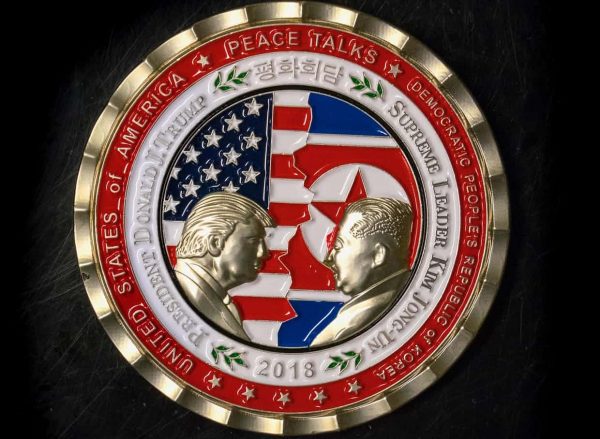
Wow, what a week.  President Trump met in Singapore with North Korean dictator Kim Jong-un, an historical meeting the effects of which we still don’t fully know or understand.  Will Kim stick to his pledge to denuclearize the Korean Peninsula?  Can we trust him?  Is President Trump playing another masterful round of 4-D chess, or simply legitimizing a brutal regime and its evil leader?

Questions abound, as do interpretations.  Ben Shapiro at The Daily Wire (video below) argues that conservatives are getting too excited, too soon, and purely on a partisan basis.  While I do think we should proceed with caution—the Kim family has promised denuclearization eight times before—there is reason for optimism.

Historically, I would point to Mikhail Gorbachev’s 1988 visit to the United States, in which he fell in love with the country.  The same criticisms abounded then—“human rights abuses!,” “gulags!,” etc.—and, while those criticisms were as true for the Soviet Union as they are—and even more so!—for the Kim regime, the door was opened for diplomacy, leading to the Intermediate-Range Nuclear Force (INF) Treaty.  Ultimately, the Soviet Union collapsed, largely peacefully.

Kim seems to have some similarities to Gorbie, and some key differences from other authoritarian and totalitarian regimes in the world today.  For example, Kim seems genuinely to love Western culture—he hangs out with Dennis Rodman, he eats McDonald’s (clearly).

I keep hearing the usual objections from the Left—“conservatives criticized Obama for negotiating with Iran!  How is this different!”  For one, Trump didn’t load up palettes full of cash without congressional approval and fly it into the regime while it was under intense sanctions.  He also didn’t give Kim everything he wanted so he could destabilize an entire region based on an AP Comparative Government-level of understanding of the nation’s political system.

Further, Iran is a regime based on a radical ideology—Shi’a Islamism—that doesn’t acknowledge the existence of Israel and is actively, if covertly, at war with its Sunni neighborsIran is the leading state-sponsor of terrorism.

North Korea is certainly a terrible, totalitarian place, but the old ideology of Juche seems quaint.  No one is going to blow themselves up to wear coveralls made from refined clay.

Cuba, too, is an old-school Cold War frontier, but the Obama administration got nothing from Cuba when it lifted the embargo—not even the release of political dissidents!  The Cuba analogy fails, too, because we’ve already defanged Cuba, and have nothing to gain from opening up relations.  Keep grinding out the sanctions there, for the sake of Cubans.

Consider, too, President Richard Nixon’s “opening” of China in the 1972.  He met with the bloodiest dictator of the 20th century, Chinese Chairman Mao Zedong, which caught the ire of conservatives and anti-Communists in the West.  While Mao’s atrocities and lethal policies were devastating to human life and contributed to the annals of misery Communism has inflicted upon humanity, Nixon and Henry Kissinger realized the diplomatic opportunity that presented itself, and took the plunge.  China is still authoritarian and aggressive, but it’s beginning to fit in with the respectable, stable nations of the world.

Similarly, North Korea must be a liability to China, which is surely fed up with its tin-pottery.  While China dreads seeing a unified Korean Peninsula, that might be better than dealing with a client-state that is becoming less of a strategic asset and more of a liability.  Trump’s “war of words” last summer—including the hilarious “my button is bigger” tweet—played the game that Kim and the ChiComs understand.  That’s why the President and Kim met, and why Kim will come to the United States.

That brings us back to Gorbie’s 1988 visit—just as he was enamored by the USA, I predict that Kim will be similarly blown away (and not via assassination, as Ben Shapiro mused about in one of his recent podcasts [Note:  I watch Shapiro’s podcast, The Ben Shapiro Show, daily, and at the time of writing I could not find in which recent podcast he talked about assassinating foreign leaders, but he quipped that he disagreed with the Carter-era prohibition on taking out particularly wicked heads of state; I’m just not willing to go back through hours of video to find it]).

Have you ever seen recent immigrants from other countries that have this really one-dimensional idea of America?  They think it’s all fast cars, hot babes, overweight cowboys, New York City, and rap music—and they eat it up, assimilating whole-hog in the most cartoonish way possible.  I would not be surprised if Kim took the same route.  He’s already chillin’ with Dennis Rodman.  Homeboy’s going to be wearing a Chance the Rapper ballcap and eating French fries by the end of his first round of golf at Mar-a-Lago.

And what of Dennis Rodman?  My earliest memory of D-Rod was a picture of him sporting bright green hair and a bunch of piercings—keep in mind, this was probably the 1990s, when the average person didn’t color his hair and get covered in tattoos (“this one represents my individuality”)—and I always assumed he was a crazy attention hog.  When I heard he was hanging out with Kim Jong-un, I figured he’d gone full Jane Fonda.

But… maybe he really was trying to create understanding between the United States and North Korea.  Maybe he was trying to bridge a gap across political systems and cultures.  And—maybe it worked.

I’ve watched Rodman’s interview with CNN’s Chris Cuomo (video below)—the one in which Rodman is sporting a “Make America Great Again” hat—and I don’t think his tears are fake.  When I saw the clip originally on The Ben Shapiro Show, I was in awe.  Here was a guy whose heart was open for all to see on national television.  When he said (paraphrasing) “Even when no one would believe and no one would listen, I kept going, because I believed we could work out our differences,” my jaw dropped.

How many times, as a conservative in a progressive culture, have you felt alone, but you kept soldiering on, knowing that there was hope, that what you believed was right, even when you couldn’t articulate it in the face of overwhelming opposition?  I doubt I’ll ever write this again, but in that moment, I identified with Dennis Rodman.  I understood him.

Do not take anything I’ve written here as a trivialization of North Korea or the Kim family’s decades of atrocities.  The people of North Korea are brainwashed and abused, put to death for exchanging James Bond DVDs, starving because their terrible government doesn’t function properly, and their leaders have purposefully isolated them from the world.  It’s an hellacious place, and we shouldn’t legitimize an evil, totalitarian despot.

BUT—if President Trump can sway Kim Jong-un, and begin the liberalization of North Korea—if not the reunification of the Korean Peninsula—it will do the most since the opening of China in 1972 to improve the lives of millions of people.  The North Korean people will be brought out of the darkness and into the community of nations.

Yes, China is still authoritarian, and denies its people their basic political and civil rights, but North Korea can have the chance to forge its own path forward.  South Korea was under a military dictatorship until the 1980s; it’s now one of the freest, most prosperous nations in the world (and really good at Starcraft).

Only time will tell.  My prayers go out to the people of North Korea, and I urge my readers to pray for them, as well—and that President Trump and Kim Jong-un have the wisdom and discretion to act in the best interest of liberty.

4.8% Economic Growth?!

Remember when President Obama, in Carter-esque fashion, gravely warned the American people that 2% annual GDP growth was the new normal?

The parallels between Obama and Carter’s doom-and-gloom economic forecasts–and between Reagan and Trump’s pro-American optimism–once again come to the fore with the latest predictions from the Atlanta Fed.

A piece at Breitbart notes that annualized GDP growth for the second quarter of 2018 is a whopping 4.8%.  And that’s despite threats of a trade war.

Maybe the scare over tariffs is premature, or the United States is in a position to benefit from playing some hardball on trade.  Free trade is not an unalloyed good, though it is certainly beneficial, and tariffs are not unequivocally bad.

Mostly, though, it seems that the tax cuts are working.  America is getting its economic groove back.  Trump is making America great again by getting government out of the way and letting business thrive.