SubscribeStar Saturday: Rule of Law Matters

Today’s post is a SubscribeStar Saturday exclusive.  To read the full post, subscribe to my SubscribeStar page for $1 a month or more.  For a full rundown of everything your subscription gets, click here.

Also, the delayed Universal Studios post is now available to subscribers:  “Universal Studios Trip No. 3.”

During the recent incarnation of the domestic terror organization Black Lives Matter, a group of BLM organizers in Florence, South Carolina received permission to paint a “Black Lives Matter” mural on a section of street in downtown Florence.  The mural is meant to depict various scenes from African and African-American history, including some Egyptian elements.

The mural itself was a community effort, and took around three or four days to paint.  In all fairness, it was a peaceful project with the full support of the City of Florence, and seemed to be an expressive way for the black community to participate in a project that isn’t overtly destructive.  Creating art—even historically inaccurate, propagandist art—is generally preferable to looting stores.

However, the City of Florence has decided to remove the mural.  Naturally, it’s resulted in a lot of weeping and gnashing of teeth from blacks and gentry white liberals in Florence, who are accusing Mayor Wukela—a red-diaper baby and progressive Democrat—of racism, of suppressing black voices, and the usual litany of complaints.

Of course, that has nothing to do with why Florence City Council—which is overwhelming Democratic and heavily African-American—is removing the mural.

To read the rest of this post, subscribe to my SubscribeStar page for $1 a month or more.

TBT: High-Tech Agrarianism

Lately I’ve been heavily focused on yard work, as my lawn and flower beds were resembling an abandoned lot more than a well-maintained lawn.  As such, I’ve had small-scale farming on the brain more lately, even though the only edibles I planted were one forlorn banana pepper plant and some oregano (although the celosia leaves are edible before the plants flower).

Naturally, my mind returned to this March 2020 essay, “High-Tech Agrarianism.”  It’s perhaps a testament to how much we have adjusted to The Age of The Virus that I did not go out and till my half-acre, instead letting it loose to its recent weedy state.

Reading over this essay, which I wrote in the week after South Carolina schools shut down, it’s interesting how much I’ve mellowed on The Virus.  I was skeptical of it beforehand, but when schools were shuttered for the last two months of the academic year, the sense that something big was wrong only grew.  The most remarkable aspect of The Virus is that, even with shutdowns, the economy kept going, and there’s not the same sense of depressing listlessness that reigned during the Great Recession.

Of course, the economic fallout may very well be delayed, and I’m in a much better position financially and professionally this time around than I was in 2009.  The government distributing $1200 checks and propping up businesses probably smoothed out the economic disruption a bit, too.

It’s also interesting that other than wearing masks and sanitizing ourselves and our things constantly, life seems to be marching on more normally.  The True Believers in The Virus scold large gatherings, but people want to be together.  We can limit crowds only so much—people are going to congregate.

The Age of The Virus aside, the idea of tilling suburban and small town acreage is a prudent, if difficult, job.  I still maintain it’s a better use of land than a lawn.  Instead of mowing and edging, put that effort towards watering, weeding, and fertilizing.  Crops look good—and taste good, too.

That last paragraph probably highlights my ignorance about agriculture—something I’m working on as I flirt more and more with the idea of converting my yard into arable square feet.  We’ll see where I am in another six months.

Here’s “High-Tech Agrarianism“:

The coronavirus situation—which I am convinced is both quite serious, but also inspiring some huge overreactions—has created a world that feels almost entirely different than it did even a few days ago.  This time last week, I was convinced that the whole thing was way overblown, and that life would largely continue apace, minus some school closures here and there.

By Friday evening I was growing more concerned, as everything began to get closed or cancelled.  I proctored the SAT Saturday morning and even went out of town that evening.  At that point, I thought the risk of my school closing was greater than it had been even two or three days before, but I still figured it was a relatively remote possibility.

Then Governor McMaster announced the closure of all South Carolina public schools (I teach at a private school, but we always follow gubernatorial closures)—and a bunch of other stuff shut down.  I picked up dinner at a Hardee’s in Florence, South Carolina Monday evening after a guitar lesson, and it was surreal—everything was gone from the front, and the cashier had to give me a lid and straw according to their new cleanliness guidelines.

(Let’s take a moment to thank all those service industry folks and long-distance truckers who are continuing to work and risking exposure; they are unsung heroes.  Also, spare a thought to people in those industries that are out-of-work at the moment.  They need our love and charity now more than ever.)

That’s all to say that, in a remarkably short period of time, the United States has undergone a major paradigm shift.  The world of Saturday, 14 March 2020 at 2 PM—when I emerged from the cocoon of extended time SAT testing—was a different than the world of Wednesday, 18 March 2020 at 9 PM (when I’m writing this very belated blog post).

One trend—that I think will be positive if it endures—is the implicit rejection of globalism.  People are suddenly awakening, dramatically, to the manifold downsides of open borders and excessive global economic integration.  Suddenly, localism is back in vogue.

One of my musician friends, a bit of a Sandersnista hippie-dippie type (but attractive enough to get away with it) has been posting Left-leaning memes consistently throughout this crisis.  But one meme caught my eye:
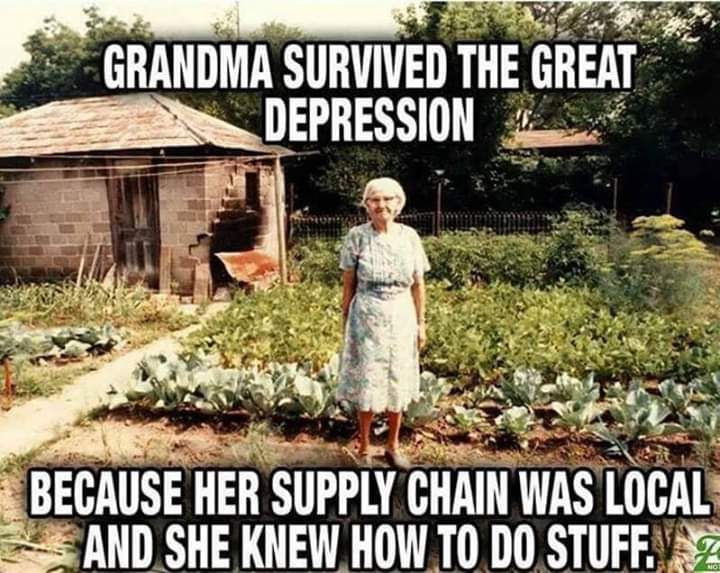
Grandma - Local Supply Chain

Here’s good ol’ Granny tending her garden.  The meme is right:  I know from family lore that my Mamaw and Papaw fed themselves, their children, and a lot of other folks in the mountains of southwestern Virginia during the Depression with chickens and crops they raised themselves.

That got me thinking:  could America see the return of widespread of homesteading, or some modern-day version of Jeffersonian agrarianism?

I was pondering this question on my way to church tonight (yes, yes, social distancing, etc., but it’s a small church, and we had a very small turnout, so I’m sure it was fine to attend), driving through the fields on the outskirts of Lamar.  I began pondering the notion of a society with our level of information technology, but that saw most Americans farming or gardening for at least a small bit of their sustenance.

Such a system would be “high-tech agrarianism”—it would combine modern technology, especially information technology like the Internet, with millions of freehold agriculturalists.  Yes, we’d still have the huge mega-farms, we’d have people working in offices, etc.  But people would be making good use of their land, too, growing crops instead of grass.

Of course, I then began to ponder if such a society could have ever developed organically.  My instinct is no—it required the massive integration of local, regional, and national economies to raise production efficiency to the point that we can have widespread, niche-y specialization in tens of thousands of fields.  Greater efficiency fed into greater technological advancement, which in turn led to greater efficiency—and on and on and on, in a revving upward cycle.

But now we’re staring down this virus, which is leading governments all over the world to close stores, cancel events, lay off workers, turn away elderly patients, and on and on.  Those long, efficient supply chains are massively disrupted.  People are hoarding toilet paper and bread in the hopes of riding out likely (and, in some places, actual) quarantines.

I’m assuming life will return to normal… eventually.  But when?  So far, many of my assumptions about the pandemic have been incorrect (it turns out this time, the media wasn’t just crying wolf—well, not entirely, anyway; it still seems that some of this panicked response is driven by ridiculous media spin and speculation).  If we continue down this road of greater and greater decentralized isolation, people are either going to riot, or figure out how to provide for themselves.

In such a world, maybe high technology and small-scale farming could work keyboard-in-glove.  I’ve long advocated for some return to a simpler, more agrarian, more localized life.

Of course, I’m romanticizing America’s Jeffersonian past.  Farming is hard—and risky (of course, that hardness made our nation great).  I certainly don’t know anything about it—another truth to the meme above.  Also, if we’d continued as a mostly farming nation, we wouldn’t have the means to fight this virus, or to figure out how to fight it.

That said, converting your half-acre lawn into a garden full of corn, squash, peppers, lettuce, cabbage, beans, berry bushes, etc., seems like a far more productive use of your little plot of land, and one that could save your life and the lives of others in a pinch.  That seems sensible.

We could also do with some can-do gumption, like Granny had.

Home Depot is operating on shortened hours, but they’re remaining open.  Maybe now is the time to buy a roto-tiller.

Donate to The Portly Politico

Support quality commentary on politics, education, culture, and the arts with your one-time donation.

$5.00

Lazy Sunday LXXVII: Rural America

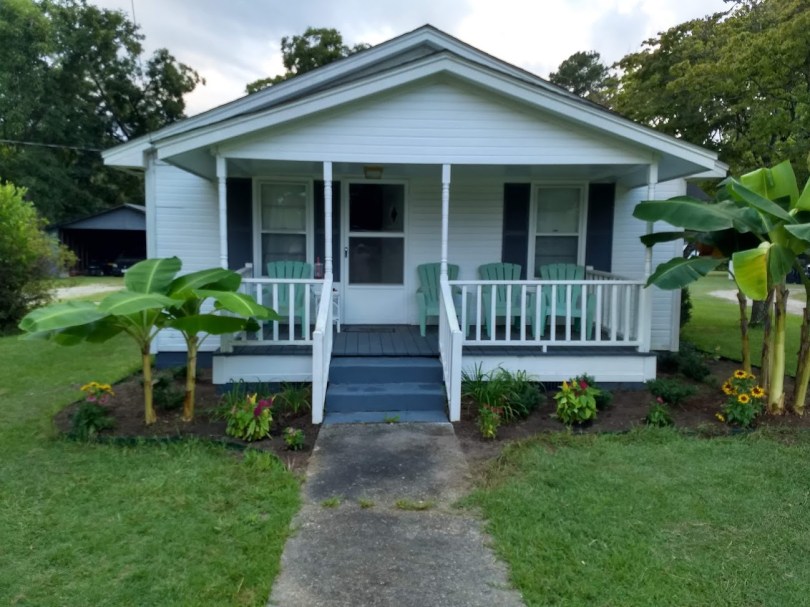
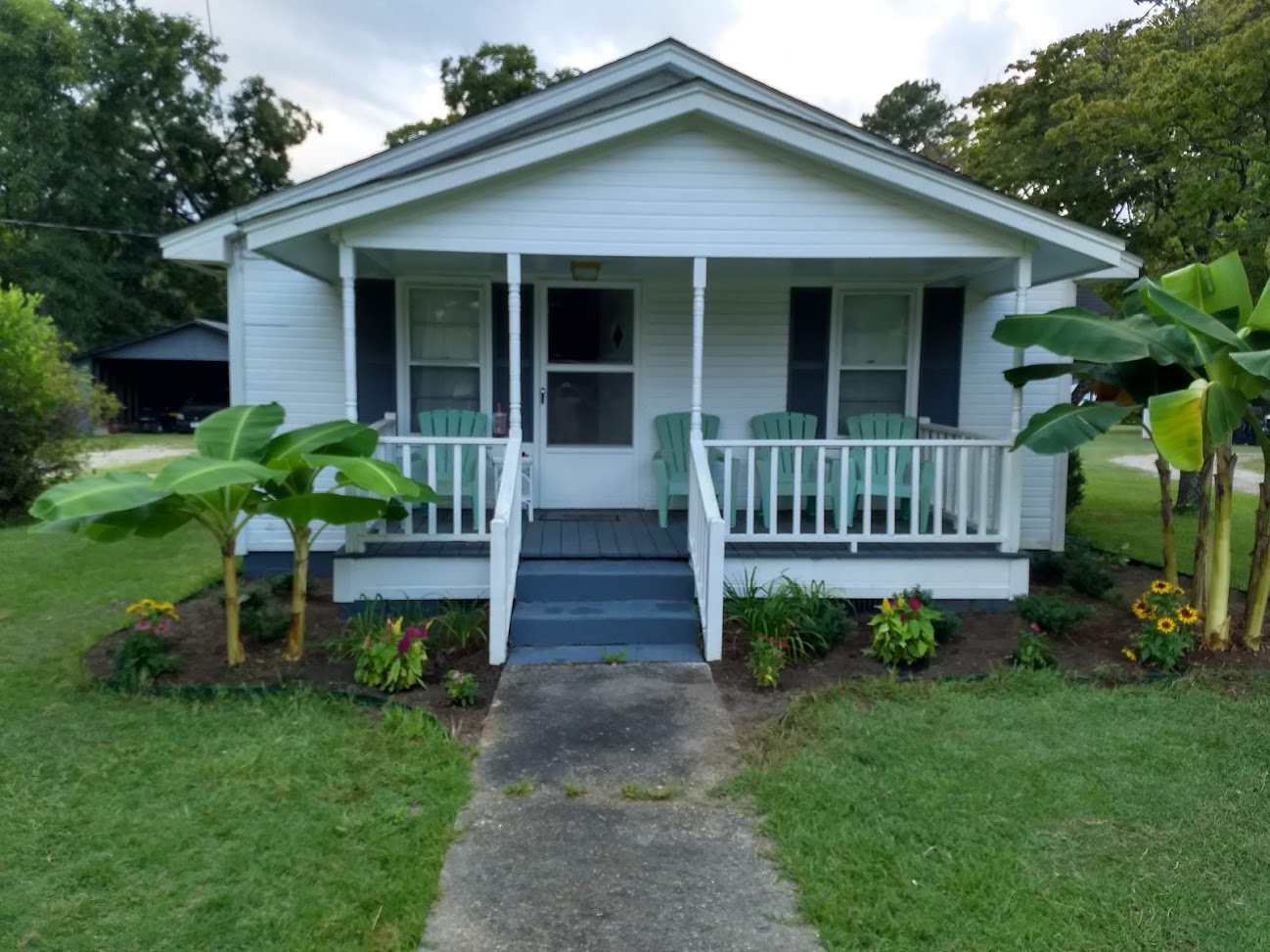
After a week of incredibly hot weather here in South Carolina, Saturday brought a blessed drop in both the temperature and humidity—a foretaste of autumn.  My girlfriend and I spent Saturday weeding my disgracefully overgrown flower beds, which were mostly weeds strangling the life out of everything but the hardiest of perennials (and my robust banana trees).  We then did some new plantings (with a few more to put in, as well as some mulch).  The results were pretty good:

Lamar House - After Planting, 5 September 2020

It felt good to get our hands (and clothes, and faces) dirty, digging through the dirt and nurturing plant life.  My mother is an expert gardener, so I’ve picked up a few simple techniques from her; otherwise, we just bought flowers we liked and plopped ’em in with some in-ground bedding soil and a some water.  Fingers crossed that everything survives.

My mind has been on the soil lately, and our connection to it.  I have a fondness—perhaps a tad romantic—for country life.  With current trends in the cities—rising home prices, rising property taxes, and rising urban violence—country life seems like an attractive, even inevitable, alternative.

As such, I thought I’d dedicate this week’s Lazy Sunday to some pieces about rural America:

  • TBT: Rustics Have Opinions, Too” – This piece dates way back 2009, when the blog was in its first iteration on Blogger, and I was still enthralled with “Randian-libertarian economic” philosophy.  Such are the follies of youth.  However, I did notice even then the deep disdain of limousine liberals for the rest of us here in “flyover country,” a disdain that, at least in part, accounts for the TEA Party movement and the Trumpian revolt of 2016.
  • High-Tech Agrarianism” – When The Virus hit, people were in a tizzy about having enough toilet paper and food.  People gained a renewed interest in gardening as a source of sustenance, not just beauty.  In this post, I mused about a possible return to small-scale homesteading, coupled with our advanced information technology.  Essentially, I posited a world in which people still work, albeit increasingly from home and on more flexible hours, and can use their time to tend to small crops to supplement their diets.
  • SubscribeStar Saturday: The Future is Rural” – One of two recent posts on the lure of rural America and small town life, I argue here that life in the country offers many attractive incentives for working families.  Not only are cities pushing people away with high prices and crime; the country is ready to take in telecommuters who earn good money but want a low cost of living in a safe, healthy environment.
  • SubscribeStar Saturday: Small Town Natalism” – The second post in my Saturday series about small town and rural living, this post is a preliminary sketch of a policy proposal:  applying nationalistic, pro-birth natalist policies to the small town context.  Instead of wasting money on seldom-used public facilities, local governments could offer a stipend to married families with children to encourage increased birth rates.  That would grow towns organically and attract new residents, thereby broadening the tax bases in often distressed rural areas.

That’s it for this week.  The garden is calling to me.  Time to put down some mulch!

—TPP

Other Lazy Sunday Installments:

Small Town Natalism

Today’s post is a SubscribeStar Saturday exclusive.  To read the full post, subscribe to my SubscribeStar page for $1 a month or more.  For a full rundown of everything your subscription gets, click here.

Last Saturday I argued that “The Future is Rural.”  With the rise in urban violence (that seems to turn up every presidential election year) and unsustainable living costs, coupled with the spread of telecommuting and improved Internet access, I predict that more and more Americans will flee to the countryside.

Even with the tide turning in favor of rural and small town life, local and county governments can take some proactive steps to attract residents.  If the goal is to attract working families consisting of committed parents, localities need to get creative.

The usual approach to building up revenue in small towns is to spend lavishly on parks and sports fields.  Large cities famously subsidize the NFL with billions in stadium construction, but small towns routinely fall into these construction boondoggles.  The premise is that new softball fields will bring in summer travel leagues, generating local tourism dollars, which is always how new ball fields are sold to the public.  Of course, the maintenance of these facilities are added into a locality’s annual budget, becoming recurring expenses, on top of the initial cost of production, which is often debt-financed.

Rather than spend public money on baseball diamonds and—even worse—soccer fields, small towns hoping to attract working families should use that money for something far more precious:  children.

To read the rest of this post, subscribe to my SubscribeStar page for $1 a month or more.

Donate to The Portly Politico

Support quality commentary on politics, education, culture, and the arts with your one-time donation.
$10.00

SubscribeStar Saturday: Returning to School in The Age of The Virus

Today’s post is a SubscribeStar Saturday exclusive.  To read the full post, subscribe to my SubscribeStar page for $1 a month or more.  For a full rundown of everything your subscription gets, click here.

This past Monday teachers returned to work at my small private private school.  We start classes this Thursday, 24 August 2020.  We’ll be holding classes in-person and on-campus, with a number of new safety and sanitation protocols to attempt to limit the spread of The Virus.

It is in times like these that I’m glad I have been teaching for a decade.  My heart goes out to the new and first-year teachers, who are entering the classroom for the first time in highly atypical—indeed, unprecedented—conditions.  Building and planning out courses is a heavy enough load for a first-year teacher; doing so while enforcing various mask and social-distancing policies on rowdy youngsters is a Herculean task.

Needless to say, school is going to look a bit different this year.  Most of the changes are fairly doable, but it’s going to take consistent enforcement to implement them, and it’s really going to require a culture change at our school.  Our formerly informal but professional culture among teachers, administrators, and students is likely to become far more regimented.

A note to subscribers:  I finally caught up on tardy posts.  “Universal Studios Trip No. 2” and “Family Fun Time” are complete and available for $1 and higher subs.  Thank you for your patience!

For $5 subs, earlier in the week I posted “BONUS Doodles I“—one of several random perks for $5 and up subs.

To read the rest of this post, subscribe to my SubscribeStar page for $1 a month or more.

Old-School Fun

While on vacation, the last thing I want to think or write about is all the unpleasantness in the world.  If I’m having fun (and, presumably, I am!), why not my loyal, dogged, faithful, persistent, lovable readers?  (After all that flattery, why not check out my SubscribeStar page, hmmm?)

My local paper ran a story on Monday about the discount cinema in Florence, the Julia 4.  Because fun is outlawed in The Age of The Virus (yes, yes, I know I’m at Universal Studios—it’s a joke), we can’t see movies anymore.  The Julia’s solution:  become a drive-in theater.

Read More »

SubscribeStar Saturday: Lamar Special Election Analysis

Today’s post is a SubscribeStar Saturday exclusive.  To read the full post, subscribe to my SubscribeStar page for $1 a month or more.  For a full rundown of everything your subscription gets, click here.  NEW TIER: $3 a month gets one edition of Sunday Doodles every month!

As readers know, I ran in the Lamar, South Carolina special election for Town Council this past Tuesday.  Former Town Councillor Tamron McManus resigned earlier in the year, triggering a special election.  The election was originally slated for 12 May 2020, but was rescheduled to 14 July 2020 due to The Virus.

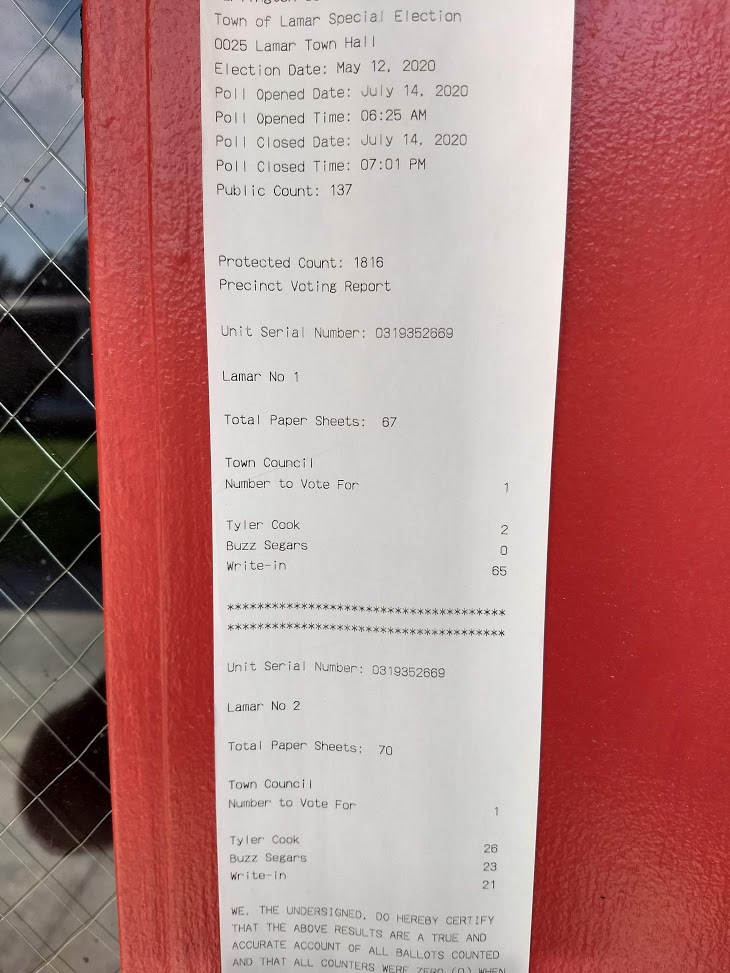
I posted the results on Wednesday, after I spoke with the Darlington County Election Commissioner.  Of the two filed candidates—Buzz Segars and myself—neither candidate won.  There was a surprise, sleeper, dark-horse write-in candidate, Mary Anne Mack, who blew both of us away.  The final tally was 86-28-23, Mack, Cook, Segars (read Wednesday’s post for the full breakdown).

In my results post, I wrote that “I will offer more detailed analysis in this Saturday’s edition of SubscribeStar Saturday.  Some of my insights, while I believe accurate, are a bit spicy, and should be behind a paywall.”

So, as promised, here is my analysis of this highly unusual election.  While Lamar is a small town of just under 1000, I think this election has some important implications for small municipal elections, especially in the South.  The Mack Strategy of running a quiet write-in campaign among a tight-knit group, thereby catching the publicly announced candidates off-guard, could be hugely effective.  Implementing it—or learning to combat it—could significantly change municipal elections in rural and small town communities.

The rest of this post will be available on my SubscribeStar page shortly.  I am attending a family wedding this afternoon and will be a tad delayed completing the post.

To read the rest of this post, subscribe to my SubscribeStar page for $1 a month or more.

Lamar Town Council 2020 Special Election Results

Yesterday Lamar held a rescheduled special election for a vacant Town Council seat.  I was hoping to have the results last night, but when I drove by Lamar Town Hall around 8:30 PM, the results were not posted to the front door.

I spoke with Darlington County Election Commissioner Hoyt Campbell this morning, however, and he gave me the results over the phone.  He also said the poll workers might have posted the voting machine receipts to one of the side doors of Town Hall.  Sure enough, I drove down there this morning and they were on a side door.  That occurred to me last night, but the prospect of lurking around a public building at dusk struck me as a tad sketchy.

The results were surprising—shocking, really.  This little off-cycle, middle-of-summer, Age of The Virus election came with an interesting twist.

Read More »

Special Election Day 2020

Last November, my little town held town council electionsNeither of the people I voted for won, and the two incumbents won reelection (there were two separate seats up, so we got to vote for two separate candidates).

In March, one of the Town Councillors resigned for reasons still unknown to me, which triggered a special election. I filed to run for Town Council on Friday, 13 March 2020—the Friday before all the schools in South Carolina shut down and went to distance learning.

With The Virus hitting, the special election was moved from its original date on Tuesday, 12 May to today, Tuesday, 14 July 2020.  My plan was to keep it simple, just talking to people and maybe going door-to-door, but quarantining—as well as a good bit of time on the road this summer—prevented that.  It also didn’t help that I was cooped up inside for two weeks with a gnarly virus (fortunately, I tested negative for The Virus, but I’m skeptical as to the accuracy of that test).

But that’s mostly me making excuses for myself.  I could have done more.  I did talk to my neighbor and a few other folks.  One older man approached me while I was loading my car up one morning and complained about a house with caged pit bulls in the backyard; he wanted me to introduce an ordinance banning pit bulls “when you get elected.”  I’ve actually given that a great deal of thought, and might explain my thinking on that proposal in a future post.  It will certainly become more relevant if I get elected.

As for the campaign, I resolved to spend $0 campaigning.  I didn’t do any fundraising, or even funded anything myself (other than spending $31 for the filing fee).  There’s no need to spend scads of money in a local election in a town of approximately 950 people.  Public office should be attainable to anyone, especially at the local level, and I want to see if that’s doable.

I did, however, create a small (free!) Facebook page eight days ago.  I wrote a short post explaining my vision for the town:

My basic pitch:  Lamar is centrally-located in a rapidly growing part of South Carolina.  Working families, especially young ones just starting out, are finding it more difficult to buy homes in the larger neighboring municipalities.  Lamar is well-positioned to welcome those young families with friendliness, affordable real estate, low taxes, and proximity to the three large towns in the area (not to mention two Interstates).

Read More »

TBT: Southern Conservatism: John Randolph of Roanoke

A lodestar of modern conservatism is that the federal government is too powerful and overreaching, and that power should be devolved back to the States and local governments.  That such devolution rarely occurs, even under Republican presidents, is just further evidence of how entrenched the bureaucratic class is within the Beltway swamp.  It’s easy to see the extension of federal power since the New Deal programs of the 1930s and the government’s control of the economy during the Second World War, followed by Johnson’s Great Society and various big government schemes to solve our problems.

But these concerns about the growth of federal power are not new, and there were already grumblings about them in the earliest years of the Republic.  In yesterday’s History of Conservative Thought session, we analyzed John Randolph of Roanoke‘s “King Numbers” speech, in which the aging but feisty Virginia decried the overreach of federal power—in 1830!

The occasion for Randolph’s speech was the Virginia Constitutional Convention of 1829-1830, in which the State sought to revise its constitution with a number of—as Randolph called them—“innovations,” including age requirements to serve in the Virginia House of Delegates (25) and the State Senate (30).  Another proposed change was the elimination of property qualifications to vote.

Randolph vehemently opposed these reforms on the grounds that the Virginia Constitution in its then-current form was the greatest charter of government ever conceived, and that it had been wholly sufficient in serving as the sole block on the expansion of federal power.  Randolph also argued that the US Constitution, rather than dealing with the external issues of national defense and regulating foreign affairs and commerce, had instead turned its focus inwards, seeking to regulate the States.

It’s fascinating to read now, nearly two hundred years later, Randolph’s antebellum arguments against the aggrandizement of federal power, at a point when the federal government under the Constitution was barely forty-years old.  One of Randolph’s most interesting points was that, regardless of what the Constitution said it was designed to do, the reality was much different.

One of the students asked what Randolph would think if he saw things today, and I said, “He’d probably have a stroke.”  Far from being the last stand against and check on federal authority, Virginia now is the compliant handmaiden to federal expansion, as Northern Virginia is the home of the Swamp People that operate the federal bureaucracy.

It’s unfortunate that we’ve forgotten Randolph today.  Even in his own time, he was considered somewhat of an eccentric.  But eccentrics make life interesting, and this one certainly issued some strong warnings, even at that early date, about the danger of excessive federal power and the erosion of States’ rights.

With that, here is 24 June 2019’s “Southern Conservatism: John Randolph of Roanoke“:

As my History of Conservative Thought course rolls on, I’m learning more about the forgotten byways and overgrown, stately ruins of the various branches of conservatism.  Students this week are reading a couple of documents from John Adams and Alexander Hamilton, the two founders of the Federalist Party, and key to the passage of the Constitution.  Hamilton, the author of the bulk of the pro-ratification Federalist Papers, also created the financial system upon which the United States functions today.

Hamilton and Adams have both enjoyed renewed interest in recent years, Hamilton due to the smash Broadway musical about his life, and Adams from a critically-acclaimed HBO series (one that, sadly, takes some unnecessary artistic license with the past).  In the case of Hamilton, American history students are often enthusiastic to get to him in my AP US History course, and Hamilton mega-fans often know more about the first Secretary of Treasury than I do.

But we’re reading a speech from another important figure from American history, albeit one largely forgotten:  John Randolph of Roanoke.

Randolph of Roanoke, sometimes considered the “American Burke,” was part of the Virginia planter aristocracy and a staunch republican, in the sense that he opposed centralization of power while supporting a strict interpretation of the Constitution and a limited government at every level.  He was one of the so-called “Old Republicans,” a group within the dominant Democratic-Republican Party of the Jeffersonian and Jacksonian era that adhered strictly to the Constitution, and which believed the States possessed a check on the federal government’s power.

He was also a traditionalist, and his powerful “King Numbers” speech at the Virginia Constitutional Convention in 1829-1830 represents a hearty endorsement of conservative principles, prudently applied.

Randolph of Roanoke makes several important points in the speech, but two stick out to me immediately:  his detestation for the tyranny of majority (the “King Numbers” referenced throughout the speech), and his love of Old Virginia.  On the latter point, he was quite eloquent:  not only did he argue that Virginia was a bulwark against an overreaching federal government (remember, he’s making this point in 1830), he also notes that its constitution was entirely sufficient to the task.

He argues early in the speech that there is no need to change Virginia’s constitution, because no one had brought any provable objections against it!  It’s the essence of a conservative argument.  Further, Randolph of Roanoke decried the mania for what he called “innovation,” a kind of reform-for-reform’s-sake, at the expense of the tried-and-true.

As to the tyranny of the majority, Randolph of Roanoke points in “King Numbers” to the absurdity of giving some men or factions greater power simply because they can win by one or two votes.  He uses examples—unfamiliar to many modern readers—of the Tariff of 1816 (one of my tariffs the Southern planters and yeoman farmers alike found odious and burdensome) and the Missouri Compromise of 1820, the latter passing by a mere two votes.

We praise “democracy” now, but the Founders of our nation feared unbridled democracy as a form of mob rule, which would inevitably yield tyranny at the hands of a charismatic demagogue.  Randolph of Roanoke makes the rather compelling point that even in representative government, mere majoritarianism can be quite destructive, as the side with the majority actually benefits if it can seize that majority by a narrow margin:  that’s just more of their opponents who lose!

Randolph of Roanoke, like many men of his time and station, was an unapologetic defender of slavery, which likely accounts for part of his fall from our curricula (although he emancipated all of his slaves upon his death).  His anti-nationalism (in the sense that he was opposed to a powerful federal government) is also at odds with the prevailing trend in American history textbooks to applaud whenever the national government aggrandized itself at the expense of the States.

Regardless, we would do well to read him again.  He was, even for his time, a bit of an oddball, but his quick wit and vast depth of knowledge, as well as his love his State (he believed Virginia was the great inheritor of Greco-Roman and British Common Law) were inspiring to his fellow Virginians.  They could be inspiring for us, too, and all lovers of liberty.