TBT^65,536: On Ghost Stories

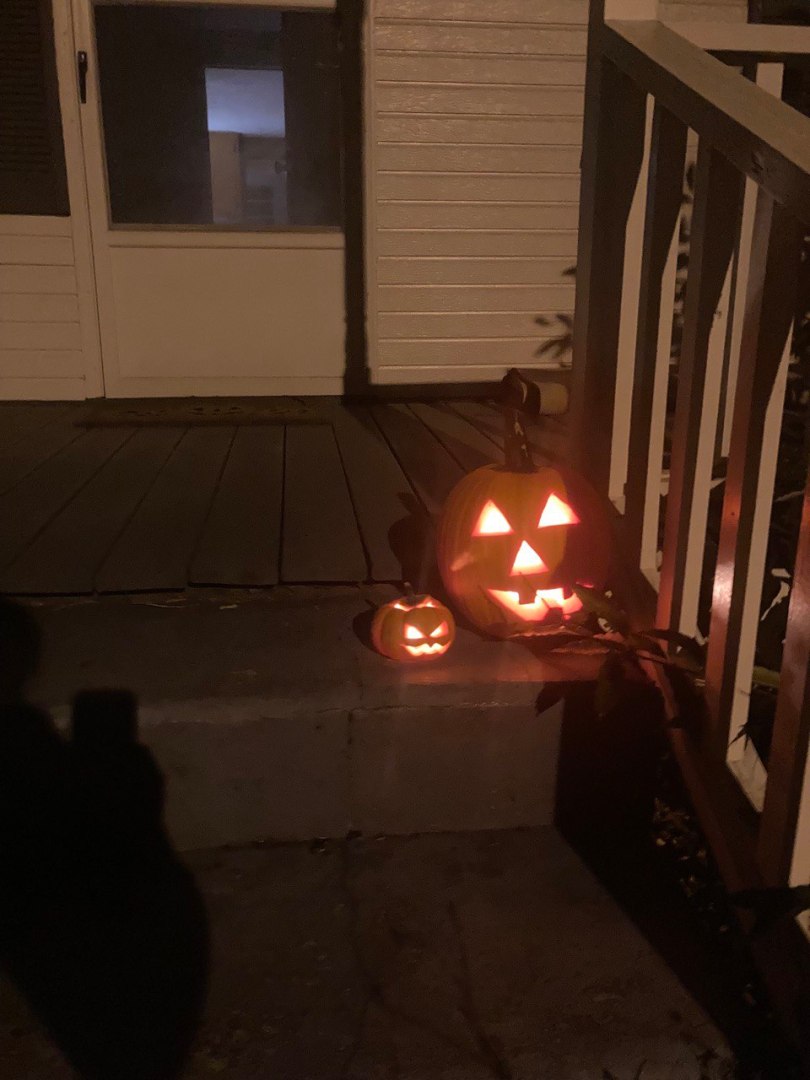
That sweet, crispy, autumnal feel is in the air, which means it’s the perfect time for ghost stories.  I love reading a good ghost story as the days grow shorter and darker, and the wind whips leaves through the streets.

Thanks to Ponty’s recommendation that I review The Haunting (1963) for 31 Days of Halloween, I’m going to crack open Shirley Jackson’s The Haunting of Hill House (that’s an Amazon Affiliate link; I receive a portion of purchases made through that link, at no additional cost to you), which I first read a few years ago.  It’s more about the ghosts of the main character’s tortured psyche, but it blends the thin veil between psychological torment and the possibility of non-corporeal supernatural apparitions influencing events in this world.

With that, here is 17 October 2024’s “TBT^256: On Ghost Stories“:

Read More »

TBT: Stone Cold Sunday

With the dawn of the Second Trumpian Golden Age, I’ve been reflecting a bit about the First.  Trump’s first administration, in retrospect, was less-focused and more carnival-esque than what his second appears to be.  Trump is a wiser man, and knows who he can—and cannot—trust.

But part of the fun of the first Trump presidency was the cavalcade of grifters, courtiers, and hangers-on who hitched their wagon to Trump’s star.

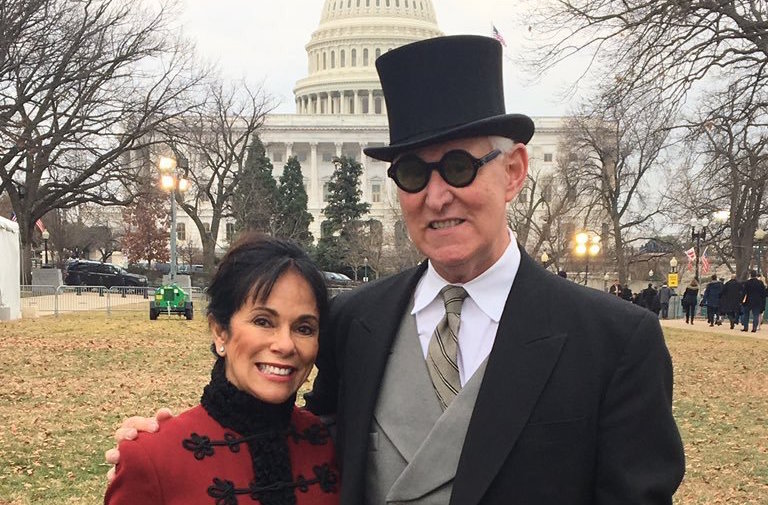
One of those was Roger Stone, who actually was an important figure while also embodying the kind of naughty, playful, mirthful, bawdy side of the Trump phenomenon.  I wrote a review of his book Stone’s Rules: How to Win at Politics, Business, and Style back in 2019, and it seemed like an appropriate time to revisit it.

Note that the link above is an Amazon Affiliate link; if you purchase anything through that link, I receive a portion of the proceeds, at no additional cost to you.  I’m required to point that out.

With that, here is 10 February 2019’s “Stone Cold Sunday“:

Read More »

TBT^256: On Ghost Stories

‘Tis the season, my friends—the spooky season!  And it’s a time for reading some good ghost stories.

I have been reading William Peter Blatty’s The Exorcist—talk about a spooky read (the link to the book is an Amazon Affiliate link; if you make a purchase through that link, I receive a portion of the proceeds, at no additional cost to you)!  By the time this post goes live, I should also be diving into some classic Victorian ghost stories.

I don’t have much to add to this year’s commentary about my favorite short story genre.  The world provides plenty of spooks of its own, so it seems appropriate to enjoy some escapism with stories of haunts of a more metaphysical nature.

Of course, most of our problems are, ultimately, spiritual in nature, so perhaps diving into some ghost stories might be preparation.  Or they’re just fun to read—you decide!

With that, here is 19 October 2023’s “TBT^16: On Ghost Stories“:

Read More »

Offensive Poems: With Pictures Preview: “Cute But Offensive Extraterrestrial” & “Space Frog”

The following is a re-posting of this past Sunday’s edition of Sunday Doodles (Sunday Doodles CXCV), which is normally a perk for $5 and up subscribers to my SubscribeStar Page.  The post serves as a preview, of sorts, to the kind of content that will make up (I hope!) my third book, tentatively entitled Offensive Poems: With Pictures.  I thought I’d bring it to the masses—you, my beloved free subscribers and daily readers—to get feedback—and to let you in on this new project.  —TPP

Typically, Sunday Doodles is reserved for the classy $5 and up subscribers, while $3 a month gets the first Sunday of the month to gawk at doodles.  However, I’m opening this post up to all subscribers.

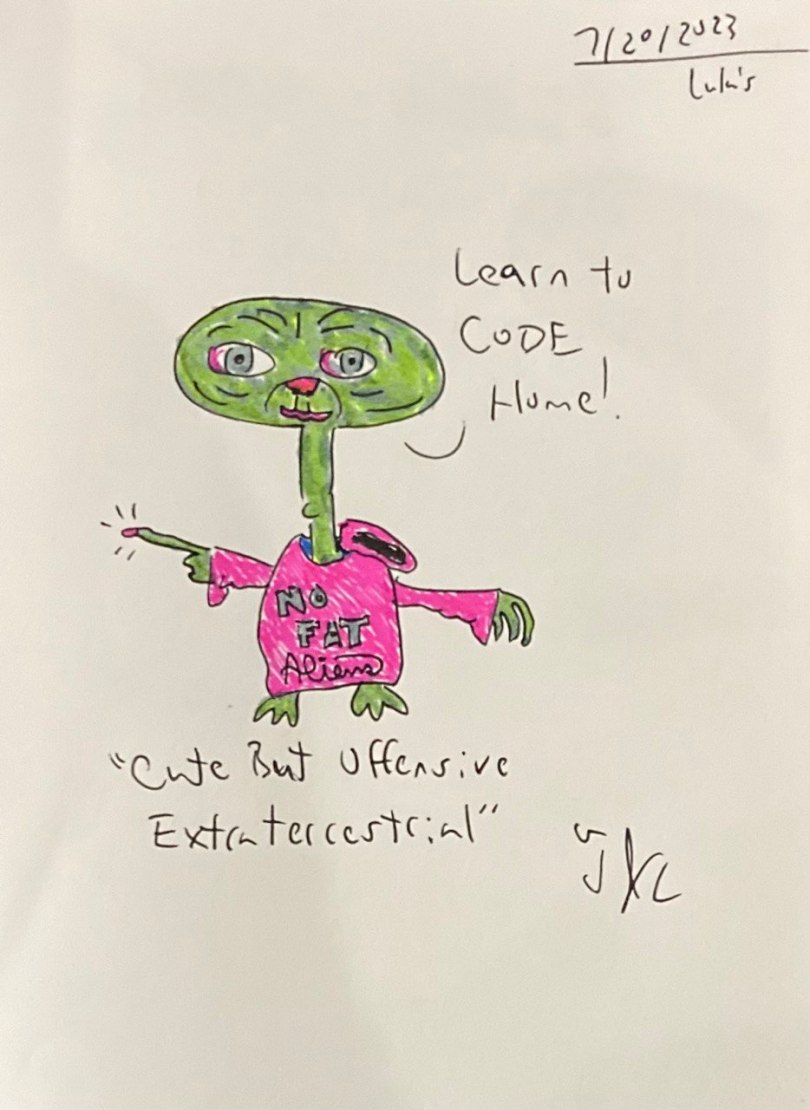
That’s because this weekend’s edition of Sunday Doodles features a preview of my current book project, Offensive Poems: With Pictures.  This project started almost by accident—I was doodling at an open mic night on Tuesday, 18 July 2023, and started sketching people around me.  Two nights later—Thursday, 20 July 2023—at another open mic, I drew “Cute But Offensive Extraterrestrial”; he prompted me to write the haiku “Learn to Code.”

That got me thinking:  what if I wrote a red-pilled haiku for every doodle?  I was already toying with the idea of writing poems to accompany each doodle, but I wasn’t thinking of making them a satirical commentary on the strange times in which we find ourselves.  Now, I can’t stop coming up with pithy verses about the various sacred cows and empty bromides of our time.  It’s remarkable how many Leftist slogans are seven-syllables, which works great for that second line of each haiku.

Why haiku?  I like the challenge of stating a complex sets of ideas in seventeen syllables.  The structure of a haiku—five syllables in the first and third lines, seven syllables in the second/middle line—means I have to be extremely efficient with words.

And, to be totally honest, I just find haiku easier to work with than other poetic forms.  It offers enough flexibility in terms of rhythm, meter, etc., for a hedge-poet like myself to play around with.  Once I have to worry about iambic pentameter, for example, and stressed and unstressed syllables, it’s a bit too much for yours portly.

That said, I wanted some form, as I find most free verse to be too loose.  There is something to be said for structure, as it forces me to think intentionally about every word.  Also, I find that much free verse quickly becomes indistinguishable from prose.  Much of it seems like prose writing with random or mildly clever line breaks.

So!  Enough rambling.  Let’s get to the doodles!

Read More »

The Importance of Science Fiction

Science fiction is amazing.  When it comes to fiction, it is probably my favorite genre, second to (but rivaling) only the ghost story.  Science fiction is a form of speculative fiction, which—as the name suggests—speculates about future events.

But the best science fiction doesn’t just look into the future—it tells us about ourselves, past, present, and future.  That so much of the great science fiction of the twentieth century has come true, to one extent or another, is indicative of the power of the genre to diagnose social developments, if not to predict them precisely.

The latest uproar over artificial intelligence—and the apparent willingness, blind or intentional, to develop it beyond all sensible precautions—is a prime example of the failure to take the warnings of science fiction seriously.

Science fiction is not Scripture—far from it!—but we ignore its warnings at our peril.

Read More »

Spring Break Short Story Recommendation 2023: The Haunting of Hill House

Today’s installment of Spring Break Shorty Story Recommendations is actually not a short story, but rather a novella or short novel, Shirley Jackson’s The Haunting of Hill House.  My copy is the 1984 Penguin Books edition, which runs at about 246 pages of text.  That seems like standard novel length, but the print is a bit large, and while there are distinct chapters, the book feels like a very long short story or a shorter novel.

Nevertheless, it’s my blog and I have decided to feature this chilling novella in this year’s Spring Break Short Story Recommendations.  It is a classic of the haunted house genre, and is a powerfully psychological tale.

Read More »

Spring Break Short Story Recommendation 2023: “Barn Burning”

In lieu of the typical Monday Morning Movie Review today, I’m dedicating most posts this week to reviews of short stories (and possibly one short novella).

Spring Break has sprung, which means it’s time for my annual Spring Break Short Story Recommendations.  Spring Break is one of the few times each year where I find myself with the leisure time necessary to read literary (and non-literary) short stories, and to celebrate this wonderful format.

It seems that in our age of hyper-connectivity and bite- (and byte-) sized content, we’re either reading massive amounts of digital fast food (like this blog), or settling in over the course of many evenings with long-form novels.  My perception could be completely slanted towards my own experience—quite likely—but I get the sense that the noble short story has suffered somewhat.

(A quick aside:  for the best bite-sized writing I’ve yet to find on the Internet, check out Stacey C. Johnson‘s blog Breadcrumbs; her writing is so inviting and mysterious, and probes at the interesting corners of life.  Check out her piece “Survey of Poetry“; it’s excellent, and it’s about a mischievous [and real!] octopus.)

Even if I’m wrong about that assessment, I am right about this one:  the short story is a form worth preserving.  I have long harbored, though not acted upon, ambitions to write a collection of short stories; perhaps I’ll one day put cursor to digital paper and get the thing done.  My own incalcitrance, however, is no reason for you not to read (or write!) short stories.

All philosophical ramblings aside, let’s get to today’s short story:  William Faulkner’s “Barn Burning“:

Read More »

Son of Sonnet: The Ballad of Forgotten Dreams

Son of Sonnet is back with a mildly post-apocalyptic poem.

The premise is intriguing; Son tells me the request was for “a poem about being a feminist in a world where you’re the only female human left. Every other human is a male.”  That sounds like the premise of a 1970s sci-fi flick!

Naturally, it’s not a great existence, but the feminist seems to realize the error of her ways.  These lines were particularly poignant:  “I learned a lesson through romance/That man may build for woman’s sake.”  How very true—I’ve accomplished a great deal in my life simply because I wanted to impress women.  I think that’s probably true for most men.

With that, here is Son of Sonnet’s “The Ballad of Forgotten Dreams”:

Read More »

Poem: The PACs

My call for submissions continues to yield fruit—KC, a regular contributor to and participant in the Dragon Common Room Telegram chat and its various projects—reached out with this poem, which she says is “a satirical take on Dr. Seuss’s poem ‘The Zax‘….”

When I asked KC if she had any biographical information she’d like to share, she said, “I don’t! Sorry!  I’m literally just a bored housewife who writes for fun.”  Then she sent along something a bit more indicative of her talents:  she “is one of the writers of Rachel Fulton Brown’s Dragon Common Room Books; a contributing author to Centrism Games, Aurora Bearialis, and the upcoming Draco Alchemicus.  But mostly she is a wife and mother who writes for the she[e]r fun of it.”

As we head into the election season, this little poem is a fun reminder of the perils of Uniparty politics.

With that, here is KC’s “The PACs”:

Read More »