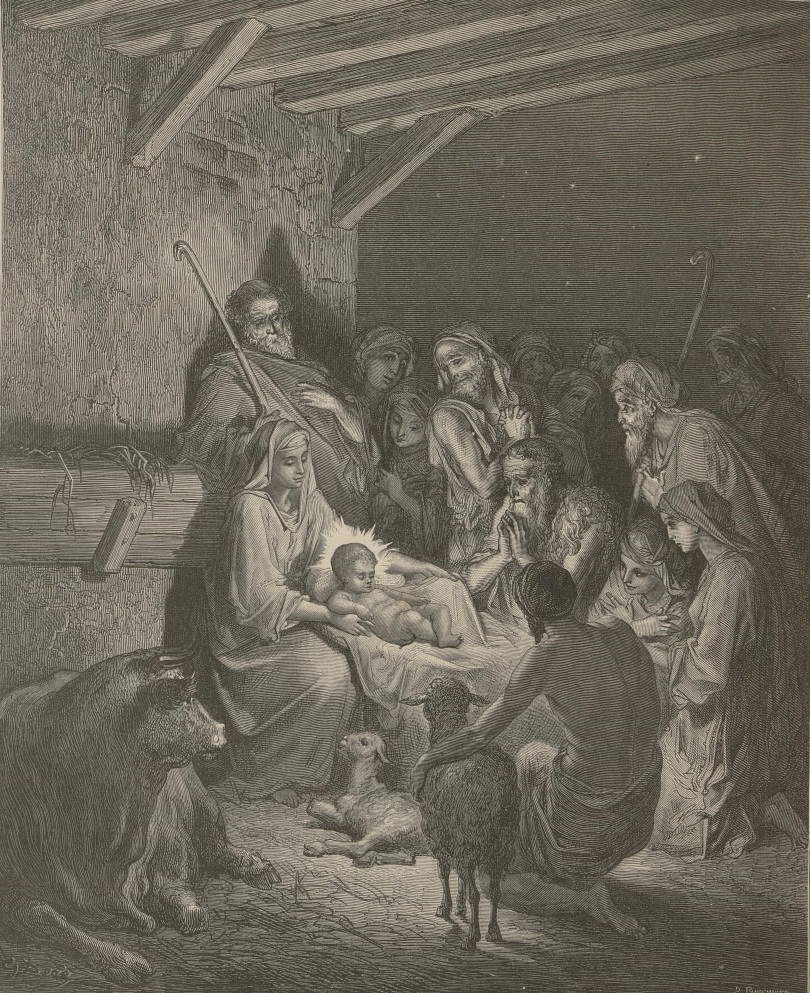
Flashback Friday: Christmas and its Symbols

It’s Christmas!  Another magical day to celebrate the birth of our Lord and Savior, Jesus Christ.

2020 was a tough year, but Christ is mightier than The Virus.  Thank God—literally!—for sending His Son.

Have a wonderful, safe, loving Christmas Day.  God Bless all of your for your support and generosity, and for being such amazing readers.

Here’s 25 December 2019’s “Christmas and its Symbols“:

Read More »

TBT: Christmas Eve

Here we are—another Christmas Eve.  It’s a night full of magic, mysticism, and wonder—the Light and holy version of Halloween, when the tenuous division between our corporeal existence and the supernatural world is thin.

Last year I wrote of my family’s Christmas Eve traditions, which are changing up a bit again this year.  In lieu of the usual evening candlelight service, we’re going to an afternoon service at a church in my younger brother’s neck of the woods.  Afterwards, we’ll be enjoying Chinese food—a newer tradition for us—and some fondue, a tradition from my sister-in-law’s side of the family.  We’re beginning to sound like 1970s Jews on Christmas.

Here’s wishing you and yours a very Merry Christmas tomorrow—and some Christmas Eve merriment tonight!  With that, here is 24 December 2019’s “Christmas Eve“:

Read More »

SubscribeStar Saturday: The Mainstreaming of Secession

Today’s post is a SubscribeStar Saturday exclusive.  To read the full post, subscribe to my SubscribeStar page for $1 a month or more.  For a full rundown of everything your subscription gets, click here.

The American experiment in self-government is at perhaps its lowest ebb since the 1850s, a decade whose division and partisan rancor rival our own.  That decade’s statesmen’s failures to address sectional tensions—and, ultimately, to reconcile two fundamentally incompatible views of the world—resulted in the secession of eleven States that no longer believed the national government was acting in accordance with the Constitution.

It brings me no joy to make such a grim assessment, nor to contemplate what comes next as a result, but it is a necessary task.  My sincerest wish is that our great Union remain intact, and that we see some restoration of constitutionalism.  An increase in States’ rights and federalism—greater sovereignty at the State level and less power at the federal level—would go a very long way in resolving at least some of our national issues.

Unfortunately, I and others are increasingly drawing the conclusion that such a restoration is, at best, extremely unlikely and, at worst, impossible in an age of totalizing progressivism.  When even Rush Limbaugh is musing about secession (H/T to photog at Orion’s Cold Fire) and a George Mason law professor is writing seriously on the subject, we can no longer laugh off the notion.  Secession may be the future.

To read the rest of this post, subscribe to my SubscribeStar page for $1 a month or more.

Hark! The Herald Angels Sing

Last December I dedicated several posts to reviewing and analyzing some of my favorite Christmas carols.  It’s the season for playing and singing them, and the more I dive into their histories, the more I appreciate them.

One carol that escaped my notice last year was “Hark! The Herald Angels Sing.”  It’s one of my favorites, so I’m surprised I didn’t write about it (although it did enjoy the spotlight in my Christmas Day post).

Apparently, my pastor noticed—not that I didn’t write about it on this blog, which I’m certain he doesn’t know exists, but that I didn’t play it at church.  In one of his sermons, he said, “One of my favorite carols is ‘Hark! The Herald Angels Sing.’ I didn’t hear it this Christmas season.  I don’t know why they didn’t play it, but…” and then he went on to make whatever point he wanted to make.  Of course, all he had to do was ask, and I would have played it!

Read More »

Pearl Harbor Remembrance Day 2020

When writing this morning’s post about “Away in a Manger,” I completely neglected to mention or recognize the anniversary of the Japanese attack on Pearl Harbor on 7 December 1941.  That attack—premised on the ludicrous idea that attacking America would cow our nation into re-opening trade exports to Japan’s thirsty navy—brought the United States into the Second World War, with Adolf Hitler foolishly declaring war on the United States three days after the Japanese attack.  The attack also resulted in 2403 American deaths, both military and civilian, as well as the destruction of a huge chunk of America’s Pacific Fleet.

The world is a very different place than it was in 1941.  In scanning Pearl Harbor headlines, one Business Insider headline seemed indicative of our fear of death:  that daily deaths last week were higher than the number of deaths on the “date which will live in infamy.”  Never mind that the nation’s population is substantially larger and more elderly (and, dare I say, less healthy) than it was in 1941.  The Virus is a quasi-mystical force to be feared, so we huddle alone in our homes and avoid contact (ironically engaging in the very Japanese activity of mask-wearing).

By contrast, the response from Americans in 1941 was valorous.  Hundreds of thousands of young men volunteered.  My own paternal grandfather, who was only sixteen at the time, enlisted.  He did so by purchasing a huge Bible, and then filled out the family genealogy by antedating his birth by two years.  He then took the Bible and kicked it around in the dust of the road to give it the appearance of age, and presented the Bible and its doctored genealogy to the recruiting office.  Pretty soon he making air supply runs for Uncle Sam.

What would happen now if the ChiComs the West Coast (actually, that might save the Republic…)?  I have a hard time believing soy boys would be rushing to enlist.  After all, they’ve been indoctrinated into believing our nation is a wicked tool of imperialism.  They’d probably welcome our new Chinese overlords.

But perhaps the Spirit of ’41 is still strong in America.  I like to think it is, at least here in the South.

Regardless, let us never forget the men who gave their lives that day, and throughout the war.  They defeated great evil, and made America great.

God Bless.

—TPP

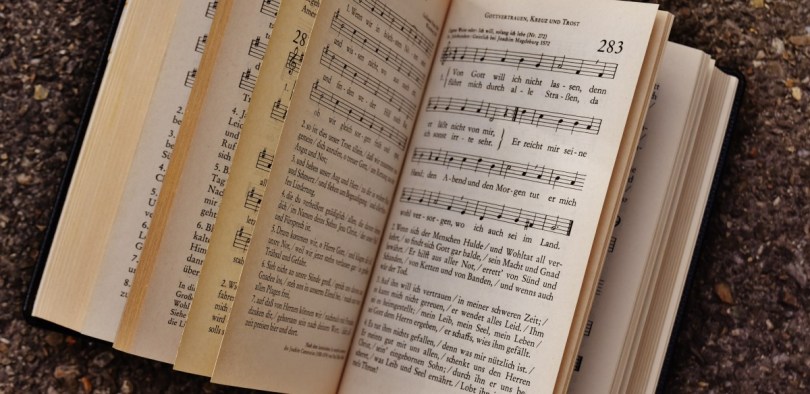
The Joy of Hymnals II: The Cokesbury Worship Hymnal

This week I’ve been teaching and learning a great deal about George Frideric Handel, the great German composer who became, over his long life, a great British one.  In discussing Handel and other Baroque composers with my students, we also veered into the world of hymns.

Hymns were and are important in Protestant congregations as simple, memorable tunes with theologically rich texts.  Hymn melodies are often based on folk tunes or popular compositions.  In some cases, such as the lovely Christmas carolSilent Night,” the text is written first, then set to music (indeed, most hymns, being based on Scripture, evolved this way).  Sometimes the tune is written, then an enterprising poet sets the text.  Such was the case with Isaac Watts, who set his text for “Joy to the World” to a Handel melody.  And, of course, there are hymns written and composed by the same person.

In talking about hymns, I brought to my students a slender little hymnal in my small collection of them, The Cokesbury Worship Hymnal.  From what I can gather, my copy was published in or after 1966, when the copyright from 1938 was renewed.  There is a stamp on the inside front cover stating that the hymn book once belonged to Carteret Street Methodist Church, which I thought was in Charleston, but appears to be in Beaufort, South Carolina.  The hymnal includes 296 hymns, with fifty responsive readings—a good collection, but slim by the standards of a pewback hymnal.

Read More »

TBT: Trump Stands for Us

With the 2020 election still on the ropes, it’s easy to get discouragedWe’ve witnessed Democrats get away with voter fraud for decades, so what makes this election any different?  Add to the mix the moralizing self-rationalization that surely must motivate many of the poll workers perpetuating the fraud (remember, these people think they are saving the country by doing everything possible to remove Trump from office), and the situation seems dire at times.

But we can’t give up on our man.  Donald Trump didn’t give up on us.  Yes, I know he mildly denounced the Proud Boys, but as even Gavin McInnes noted, Trump probably doesn’t even really know who the Proud Boys are.  Maybe he should, but if he knew the PBs, he’d probably applaud their patriotism.

Leave that aside.  President Trump delivered—big time—for his supporters.  Three Supreme Court justices.  Hundreds of lower court judges.  Lower taxes.  No more critical race theory training for federal employees.  Substantial protections for religious liberty.  A roaring economy.  And, quite frankly, common sense.

In looking back to November 2019’s archives, I found this post from 4 November 2019, “Trump Stands for Us.”  It’s a powerful reminder for why we love Trump, and how he’s fought for us.  Now it’s our time to fight for him:

Read More »

Wayback Wednesday: Memorable Monday: Veterans’ Day 2018, Commemoration of the Great War, and Poppies

While preparing a separate post on hymns (which I will likely post Friday), it occurred to me that today is Veterans’ Day in the United States, the observance formerly known as Armistice Day.  I’ve never thrown back to past posts on a Wednesday before, but it seemed fitting to recognize our fallen heroes on the day.

Last year I looked back at a Veterans’ Day post from 2018.  The post itself was originally delivered as remarks to the Florence County (SC) Republican Party, and was the most affecting of my old “Historical Moments” I’ve ever delivered.

It’s hard to believe that the centennial observance of the Great War has already passed, yet we’re still dealing with the fallout from that terrible war just over a century later.  The more I’m learning about the great Baroque, classical, and Romantic composers of Europe, the more the senseless loss and nihilistic destruction of that conflict weighs on me—and that the shimmering, confident civilization that fostered those composers also destroyed itself.

Read More »

Hand it to Handel

One nugget of wisdom I’ve heard before is “if you want to learn something, teach it.”  As a private school educator who taught pretty much every course in the standard high school social studies curriculum and a plethora of music courses, I can attest to the Truth of this statement.  I essentially taught myself, for example, the highlights of Western philosophy from teaching a Philosophy course for many years (a course I very much wish the school would revive).

I’m shifting increasingly towards teaching music exclusively (though I’m still teaching a couple of American History survey courses), and teaching a Pre-AP Music Appreciation class has been one of the great joys of that transition.  Years ago I created and taught a course called “History of American Popular Music,” which covered the early Tin Pan Alley tunes all the way through blues, jazz, rock ‘n’ roll, and beyond.  This Pre-AP course is focused on the great works of Western music, going back to the medieval period.

Currently, we’re wrapping up a big unit on Baroque music.  The Baroque style—as epitomized by greats like Bach, Monteverde, Corelli, Handel, and others—delights in contrasts.  Just as Baroque paintings highlight stark contrasts between light and dark, Baroque music revels in sudden contrasts in dynamics.  It also loves to play around with complexity, as any Bach fugue will quickly demonstrate.

The last composer in our unit is George Frideric Handel.  Handel, a German-born composer, made a major splash upon his arrival in England in the 1710s, where he sought to introduce Italian opera to sophisticated London crowds.  What was meant to be a temporary visit turned into over four decades, and Handel is interred at Westminster Abbey—a huge honor.  It’s one of those delightful twists of history that Handel the German became one of the most English composers in history—and one of the greatest composers of all time.

Read More »

TBT: The Invasion and Alienation of the South

Sheldon_Church_2

Tip The Portly Politico

Support quality commentary on politics, education, culture, and the arts with your one-time donation.

1.00 $

With the election still in the balance—it may be decided by the time you read this post—and two formerly conservative Southern States up for grabs, I thought it would be timely to revisit this piece, “The Invasion and Alienation of the South,” which looks at Leslie Alexander’s post “Stranger in a Strange Land.”  In that piece, Alexander writes about the hollow, joyless cosmopolitanism of living in Dallas—a stark contrast to the tight-knit cordiality and tradition of her native Louisiana.

While watching the election returns, it occurred to me that Georgia and North Carolina should not be risky toss-ups, and Virginia never should have been lost to hordes of Swamp People.  It’s an irony of history that Washington, D.C., was placed next to Virginia so the ornery planters, suspicious of federal power, could keep a closer eye on the national government.  Now, that bloated national government dominates politics in Virginia through its largess.

Meanwhile, transplants from up North have infested previously conservative States.  Charlotte, North Carolina has become a wretched hive of globalist scum and villainy.  During my online dating days, I would routinely get matched with babes from Charlotte; invariably, they were always from Ohio, or New York, or California—never actually true North Carolinians.

It’s one thing when local blacks vote Democratic.  Fine—we’re at least part of the same(-ish) Southern culture, and we’ll help each other out.  But then gentry white liberals start coming down here, ruining our politics and our cities.

Now, we live in a world in which Joe Biden might win Georgia, and North Carolina—NORTH CAROLINA—has become a nail-biter every four years.

Such is the price of our addiction to economic growth and convenience.  What we’ve gained in luxuries we have lost in heart.  We have paid for them with our souls.

Here is November 2019’s “The Invasion and Alienation of the South“:

Read More »