Inspector Gerard eBook is Coming 1 April 2021 (Out NOW in Paperback)!

This announcement is no April Fool’s joke:  next Thursday, 1 April 2021, I’ll be releasing my first-ever book, The One-Minute Mysteries of Inspector Gerard: The Ultimate Flatfoot, available as a digital eBook (available 1 April) and a physical paperback (available now!).

Inspector Gerard is an absurdist, postmodern, film noir private investigator who always solves his cases—sometimes before he’s even seen the clues!

Read More »

Interview with photog

Longtime readers know that photog of Orion’s Cold Fire is a blogger buddy of mine.  He recently proposed we “interview” one another via e-mail—a project we both hope more folks will engage in soon.  We asked each other five questions and responded.  You’ll be able to read my responses at his blog this morning, too.

Here are photog’s responses to my questions, reproduced without editing, other than for style and for adding links to the books he referenced:

Read More »

TBT: The Boogie Woogie Flu

In looking back at posts from March 2020, it’s wild how many of my posts were about two plagues on humanity:  the Democratic Party primaries and The Virus.  What’s particularly interesting is how those posts—including the one below—still assumed that life would begin returning to normal after two weeks; after all, we were all promised “two weeks to flatten the curve,” and now we’re living under perpetual public health tyranny.

Amidst all of that plague talk, I penned a short post about the Strasbourg “Dancing Plague” of 1518.  After being told to vegetate indoors for a year, I’m beginning to think a mystery plague that causes hysterical dancing might be preferable to the foolishness we’re enduring at present.

But I’ll keep the preamble brief and let the post do the talking.  Here is 23 March 2020’s “The Boogie Woogie Flu“:

Read More »

TBT: Lazy Sunday LIX: The God Pill Series

Former pick-up artist and born-again Orthodox Christian Roosh V has a new book out about his miraculous conversion away from a life of casual sex to a life devoted to serving Jesus Christ.  The book, American Pilgrim, is one-part travelogue, one-part social commentary, and one-part testimony (according to what I’ve read about the book; I hope to purchase my own copy soon).

To celebrate Roosh’s nearly-four-hundred-page release, I thought it would be worth dedicating this week’s TBT to looking back at The God Pill Series, a series of three posts about Roosh’s conversion.  Many of Roosh’s former colleagues in the PUA world were suspicious of his conversion, but I detected something deep and sincere in it—chiefly, because no one becomes a Christian in 2021 expecting to make more money (the primary charge being that Roosh was “reinventing” himself to cash in; unpublishing all of his pick-up books suggested otherwise).

So here’s to celebrating a new brother in Christ.  Here’s April 2020’s “Lazy Sunday LIX: The God Pill Series“:

Read More »

Friday Morning Reading: The Story of One Hundred Great Composers

Today my school is doing its second Live Remote Learning Rehearsal days.  These are days for us to test out remote learning in the event The Virus necessitates returning to distance learning full-timeLast time teachers tuned in from home while teachers were on-campus.  This time, both teachers and students are able to work from home, so I’ve been enjoying a more leisurely morning.

Indeed, I just wrapped up my first morning class of the day, a section of Middle School Music.  The students in that section wrote brief, rough draft biographies of renowned composers, and after giving them feedback in-class yesterday, they presented on their composers this morning.  It was a good lesson for digital learning, as it required their active participation for the bulk of the class, and they all did quite well.

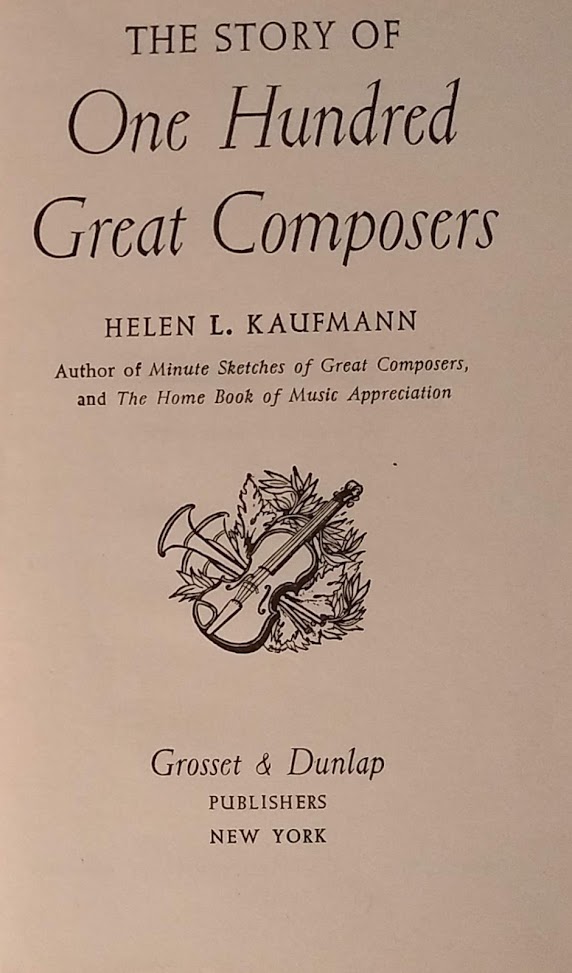
I’ve assigned composer biographies in music courses for years, but what inspired the assignment this time around was the rediscovery of a charming little book I keep on a small end table in my den:  Helen L. Kaufmann’s The Story of One Hundred Great Composers.  Published in 1943, the book is a tiny, pocket-sized digest of two-to-three-page entries—arranged chronologically—of composers from the sixteenth century forward.

Read More »

TBT: On Ghost Stories

Today marks the first day of October, perhaps my favorite month of the year.  We’re already getting that first crisp coolness in the air here in South Carolina, and it’s feeling more and more like autumn every day.

So with Halloween just thirty days away, I thought it would be fun to look back at a post from last “All Hallowe’s Eve Eve,” as I wrote at the time:  one all about ghost stories.

I finally finished slogging my way through The Penguin Book of Ghost Stories, thanks in no small part to quarantine.  It’s an excellent collection, and I stand by my recommendation from last October, but there are a handful of stories that are way too long—or dense.

I’m now reading through a more accessible, far lighter read:  the classic Tar Heel Ghosts by John Harden.  It’s a collection of North Carolina-based ghost stories published in the 1950s, so it has that pleasing sense of implicit patriotism and love of place that is now so sadly missing from our cynical, cosmopolitan writing of today.  Like The Story of Yankee Whaling, it possesses a refreshing innocence about and love for its subject:  no hand-wringing over now-unfashionable ideas, no condemnation of a lack of diversity, no talk of “marginalized” groups being “unrepresented.”

I picked up the book sometime in my childhood on a family trip, but I don’t think I ever finished the collection.  I’m rectifying that all these years later, and I’m thoroughly enjoying it.  I also plan to reread Ray Bradbury’s The Halloween Tree, one of my favorites to pull out this time of year.

Here’s hoping you find some spooky tales of your own to curl up with on these cold, October nights.  Here’s October 2019’s “On Ghost Stories“:

It’s Halloween!  Well, at least it’s All Hallow’s Eve Eve, but that’s close enough for some ghoulishly delicious ghost stories.

I love a good ghost story.  The Victorians did the genre best, but many writers since have honed it further, adding their own unique twists and scares.  Even Russell Kirk, the great conservative philosopher, was a fan of ghost stories.  Indeed, his bestselling book was a ghost story.

For the Victorians, ghost stories were told at Christmastime.  This timing, while peculiar to modern readers, makes sense intuitively—Christmas is a time for remembering the past, in part (perhaps especially) our honored dead (just ask Washington Irvingif he comes by to haunt you).  The “ghosts” of departed loved ones linger closely during those long, frosty nights.  The inherent nostalgia of Christmas and the winter season—and bundling up next to a crackling fire—sets the perfect mood for ghostly tales.

Nevertheless, what other time of year can beat Halloween for a good tale of witches and werewolves; of monsters and mummies; of ghouls, goblins, and ghosts?

As such, I’d encourage readers to check out “Nocturne of All Hallow’s Eve,” a deliciously frightening, blood-soaked tale of the supernatural and the macabre from Irish-American author Greg Patrick.  Alternative fiction website Terror House Magazine posted it back in September, and I’ve been saving it to share on the blog until now.

Patrick’s style conjures the dense verbiage of Edgar Allan Poe.  Indeed, he overdoes it a bit (see his more recently published “The Familiar“).  But his subject matter is pure Halloween—the tenuous space between the natural and the supernatural, the mysterious rituals, and on and on.

If you’re still in search of some ghostly reads, check out The Penguin Book of Ghost Stories.  It’s the collection I’ve been reading since my trip to New Jersey this summer.  It’s a truly spine-tingling collection that covers some of the great—and many of the undeservedly unsung—writers of the genre, the men and women who truly created and molded what makes a good ghost story.

So wherever you find yourself the next couple of nights, curl up with a good book, a warm fire, and a good ghost story (and maybe someone else, if you’re so inclined).  You and the ghosts will be glad you did!

Ghost

Donate to The Portly Politico

Support quality commentary on politics, education, culture, and the arts with your one-time donation.

5.00 $

TBT^2: Back to School with Richard Weaver

Today marks the first day of school for the 2020-2021 school year:  The Year of The Virus, if we were to affix a Chinese Zodiac-style name to it.  It’s going to be the most unusual school year any of us have ever experienced, I imagine.  Please keep teachers, students, administrators, and staff in your prayers.

As I’ve noted often, I reread at least the introduction to Richard Weaver’s Ideas Have Consequences every school year.  The introduction offers a strong diagnosis of modernity’s ills, and it reminds me why teaching is so important—not just the accumulation of random facts into worldly knowledge, but to inculcate deeper knowledge and virtue—what we might call “wisdom.”

Here is “TBT: Back to School with Richard Weaver“:

Every year I try to reread the introduction to Ideas Have Consequences, Richard Weaver’s masterful work of analysis and prophecy.

With school starting back in just FOUR DAYS—may God have mercy on us all—it seemed germane to bring back this post from 2018, itself a contextualization of a Facebook post from 2014.

Here is “Back to School with Richard Weaver“:

Every year, I try to sit down and re-read at least the introduction to Richard Weaver’s seminal Ideas Have Consequences, probably the most powerful book I’ve ever read.  I tend to undertake this re-reading around the time school resumes, as it helps remind me why I teach.

In addition to Ideas Have Consequences, Weaver wrote some of the most eloquent essays on the South—and what it means to be Southern—in the twentieth century.  In 2014, I posted the following quotation on Facebook; I will allow it to speak for itself[:]

I’m undertaking my annual baptism in the works of Richard Weaver to focus my philosophical thinking for a rapidly approaching school year, and, as always, I’m presented with an embarrassment of riches. Few thinkers cram so many nuggets of truth into so little space. Every paragraph of Weaver’s writings yields insights that speak to the very heart of humanity.

Read More »

Passing of Bernard Bailyn

Last week, legendary historian of colonial America Bernard Bailyn passed away at the age of 97, making his own voyage into the next life.  Blogger buddy Gordon Sheaffer at Practically Historical wrote a brief but effective tribute to Bailyn earlier this week.

As Sheaffer wrote Monday:

No other scholar impacted the study of the American Revolution more than Bailyn. His masterwork, The Ideological Origins of the American Revolution, continues to challenge readers 50 years after it was published. Bailyn was able to express the unique qualities of American civilization without politicizing the history with talk of exceptionalism.

I have not read—to my great shame and discredit—The Ideological Origins of the American Revolution, but I have read Bailyn’s The Peopling of British North America: An Introduction, a much shorter work that serves as an introduction to a larger study on the settlement of British North America.  The book is so good, and gives such a flavor for the various peoples that settled in the original thirteen colonies, I once assigned it as summer reading for my very first AP US History class back in 2011.  It’s an accessible book, but it was a bit much for rising high school sophomores.

That said, I’ve been searching for my copy this morning in my classroom, without any luck.  Hopefully it will turn up soon.  My dad and I were talking about Bailyn’s death, as there was a small bit about it in the newspaper, and he expressed interest in reading it.  I also wouldn’t mind rereading it, as I haven’t done so in nearly a decade.

Even so, bits of it stick out to me.  Near the end of the book, Bailyn briefly explores the odd religious sects, mostly German, that came to the colonies.  I distinctly recall him writing about a self-proclaimed prophet or sage living in a cave in Pennsylvania.  There were multiple sects and utopian movements and cults and denominations popping up in British North America during the First Great Awakening, which reached its peak sometime in the 1740s and greatly influenced the American Revolution.

In an age of toppling statues and lurid efforts to erase our national history and faith (to be replaced with… what?), Bailyn’s works take on increased importance.  Let us hope he isn’t summarily cancelled like everything else that is good, decent, and doesn’t inherently hate America.

Walkin’

Yesterday morning, longtime Nebraska Energy Observer contributor Audre Myers shared a charming post, “Walking …“—a reflection of the late 1960s and Woodstock.  Regular commenter Scoop posted an achingly nostalgic response that sums up the significance of Woodstock to that cohort of early Boomers—it was the last incandescent burst of rock ‘n’ roll’s triumph before petering out in the 1970s (which, I would argue, is when hard rock got good).

The tug of nostalgia is a strong one.  I’m only thirty-five, and I already feel it from time to time.  Indeed, I’ve always been a sucker for nostalgia, which a psychologist might argue is one of the reasons I studied history.  Perhaps.  I also just enjoy learning trivia.

Regardless, Audre’s post caught my attention because I have been contemplating the literal, physical act of walking lately (although I often take metaphorical strolls down memory lane, too).  I’ve put on a bit of weight in The Age of The Virus, so I’ve taken up walking as a way to complement a regimen of calorie counting (which is more of a loose, back-of-the-envelope calorie guesstimate each day).

I’m trying to get in around two miles of focused walking a day, mostly around Lamar.  Although work commitments don’t always make that possible, I do find that simply going about my work results in around two miles of walking in aggregate.  I’m curious to see what my step totals will be once the school year resumes, and I’m dashing about between classes, pacing the rows of students, and striding across the boards as I teach.

I’m not a runner, by any means.  My older brother loves to run, and has the physique to show for it.  More power to him, but I know myself well enough to know it’s not something I want to do.  Runners swear oaths to running’s efficacy and delights, but gasping for breath in 100-degree weather with maximum humidity doesn’t appeal to me.  Walking at a brisk clip in that weather, though, is at least bearable—once I’ve embraced the stickiness and the sweat, I can go for a couple of miles easily, and sometimes three or four.

Read More »

Fifty Years of Radical Violence

On the Right, we tend to point to the 1960s as the decade when everything went wrong—the rise of the counterculture, the anti-war movement, the radicalization of campuses.  Or we’ll look back to the Progressive Era of the first two decades of the twentieth century, or the Frankfurt School that introduced “Cultural Marxism” to our universities.  Deep students of ideological infiltration will point to the American infatuation with German Idealists and the German model for higher education.

But in focusing so intensely on the 1960s, we overlook the following decade—the sleazy, variety show-filled 1970s.  Of course, what we think of as the cultural and social upheaval of the 1960s really occurred mostly in early 1970s.  Indeed, I suspect that so much of the romanticizing (on the Left) of the 1960s is because of the Civil Rights Movement, which now holds a place of uncritical holiness in our national mythology.  It probably also has to do with the dominance of early Baby Boomers in media and the culture for so long—they built the counterculture, and they still idealized their youthful misadventures as tenured radicals.

Regardless, good old Milo posted a link on his Telegram feed urging followers to “Read this.”  “This” was a book review, of sorts, of Days of Rage: America’s Underground, the FBI, and the Forgotten Age of Revolutionary Violence by Bryan Burrough.  In his review of the book, author Brian Z. Hines writes that

Days of Rage is important, because this stuff is forgotten and it shouldn’t be. The 1970s underground wasn’t small. It was hundreds of people becoming urban guerrillas.  Bombing buildings: the Pentagon, the Capitol, courthouses, restaurants, corporations. Robbing banks. Assassinating police. People really thought that revolution was imminent, and thought violence would bring it about.

Read More »