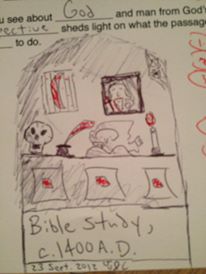
Monsters

Back in May I stumbled upon an online culture journal, The Hedgehog Review, a publication of the Institute for the Advanced Studies of Culture.  I don’t know much about either the publication or the IASC, other than they’re based out of the University of Virginia, so I can’t speak to their degree of implicit Leftist infiltration, but default position is that any organization in 2020 that isn’t explicitly conservative is probably Left-leaning.

It’s sad that I even have to make that disclaimer, because some part of me still clings to the old ideal of a broad, humanistic approach to knowledge—that we should examine ideas on their own merits, not on the politics of the entities espousing them.  I still believe that ideal is worth pursuing; I just also believe it is currently dead, or at least on life-support.

But I digress.  The then-current issue of The Hedgehog Review was dedicated entirely to the theme of “Monsters.”  It being the Halloween season, the time seemed ripe to revisit those pieces, and the idea of “monsters.”

Read More »

Phone it in Friday XV: Blogger Buddies

It’s been another crazy week, but the rhythms of the school year are beginning to fall into their familiar patterns.  That said, I’ve put in more hours working this week than any in a long time.

Regular readers know what that means:  another edition of Phone it in Friday, now reaching its fifteenth installment.

It’s been a week for shout-outs to other commentators and platforms, so I figured I’d continue with that theme and recommend some of my blogger buddies to you.  I have to give a big hat tip for this idea to one of my best blogger buddies, photog, over at Orion’s Cold Fire.  He wrote a post—“A Word of Thanks to Our Boosters“—highlighting some of those blogs that routinely link to his page or reference his writing, and yours portly made the list.  Thanks, photog!

So on this rainy, overcast Friday, here are some excellent blogs for your consideration:

Read More »

Things That Go Bump in the Night

Audre Myers over at Nebraska Energy Observer always has some interesting observations about the world around us (indeed, once a week she writes a post called “Random Observations“—check it out).  Her latest post—the whimsically titled “ooOOoo – BOO!“—explores the world beyond our observation, the world of ghosts, spirits, demons, and “haints.”  It’s also the world of angels, and of God.

Myers makes a point that that really hit me when I was in college taking a senior seminar history course called “Society and the Supernatural”:  that as Christians, if we believe in the Holy Trinity, we also have to believe in a broader supernatural world.  For Christians, there is ample scriptural evidence of not just the presence of the Holy Spirit, but also of angels—with their own hierarchy and roles—and demons, those fallen angels that joined Lucifer in his prideful rebellion against God.  The Bible speaks often of “principalities” and spirits that rule over ungodly nations.

How far beyond Scripture such supernatural creatures extend is a source of speculation and debate, and I suspect we won’t truly know until we’re on the other side.  There is a danger in exploring the non-godly supernatural, as it opens spiritual doors within us that could make us susceptible to demonic influence—or, at the extremes, possession.  Compulsive sinning can have the same effect, but messing with the occult—even out of an innocent curiosity to understand that world better—seems far likelier to result in catastrophic unintended consequences.

What I did learn in that college course, though, was that at least one member of the Scottish Enlightenment (whose name and work I cannot locate—blast!) expended a great deal of energy trying to discover fairies (apparently, people are still looking for them).  He reasoned that if fairies, giants, and other mythical creatures of Scottish folklore existed, that would prove the existence of the supernatural.  If the supernatural is real, God is real; if God is real, then fairies can exist.

Our groping, grasping attempts to understand the supernatural are, well, natural—it’s certainly a fascinating subject.  But the Bible makes it clear what fate awaits us if we accept Christ—and what awaits us if we reject Him.

Still, I do not discount out-of-hand the possibility of supernatural presences beyond what we know from Scripture.  I don’t want to go poking around in their domains for the reasons stated above, but it’s intellectually arrogant and shortsighted to assume we know everything.  That’s the folly of our modern age—we applaud ourselves for demystifying the world, yet we’re more lost and in the dark than ever.

And what of those Scottish fairies?  Surely their existence is more than the feeble attempts of ancient minds to explain the natural world, as the priests of scientism and materialism would argue.  No, there is too much anecdotal evidence—across thousands of years and cultures—to discount the existence of such things.

All I know is that Jesus is alive—and all this talk of ghosts has me excited for Halloween.

Walkin’

Yesterday morning, longtime Nebraska Energy Observer contributor Audre Myers shared a charming post, “Walking …“—a reflection of the late 1960s and Woodstock.  Regular commenter Scoop posted an achingly nostalgic response that sums up the significance of Woodstock to that cohort of early Boomers—it was the last incandescent burst of rock ‘n’ roll’s triumph before petering out in the 1970s (which, I would argue, is when hard rock got good).

The tug of nostalgia is a strong one.  I’m only thirty-five, and I already feel it from time to time.  Indeed, I’ve always been a sucker for nostalgia, which a psychologist might argue is one of the reasons I studied history.  Perhaps.  I also just enjoy learning trivia.

Regardless, Audre’s post caught my attention because I have been contemplating the literal, physical act of walking lately (although I often take metaphorical strolls down memory lane, too).  I’ve put on a bit of weight in The Age of The Virus, so I’ve taken up walking as a way to complement a regimen of calorie counting (which is more of a loose, back-of-the-envelope calorie guesstimate each day).

I’m trying to get in around two miles of focused walking a day, mostly around Lamar.  Although work commitments don’t always make that possible, I do find that simply going about my work results in around two miles of walking in aggregate.  I’m curious to see what my step totals will be once the school year resumes, and I’m dashing about between classes, pacing the rows of students, and striding across the boards as I teach.

I’m not a runner, by any means.  My older brother loves to run, and has the physique to show for it.  More power to him, but I know myself well enough to know it’s not something I want to do.  Runners swear oaths to running’s efficacy and delights, but gasping for breath in 100-degree weather with maximum humidity doesn’t appeal to me.  Walking at a brisk clip in that weather, though, is at least bearable—once I’ve embraced the stickiness and the sweat, I can go for a couple of miles easily, and sometimes three or four.

Read More »

The Cultural Consequences of the American Civil War

On Wednesday, 13 May 2020, blogger Audre Myers posted a piece at Nebraska Energy Observer entitled “What Do You Think?”  The piece prompted readers to answer the question “Would we be the America we are if the Civil War had never been fought?”

Below is my response, which you can also view here.  The TL;DR summary of my answer is that, while it was good that the Union was preserved and that slavery was abolished, it came with some heavy fees—the expansion of federal power (and the loss of liberty inverse to federal expansion), the erosion of States’ rights, and—most importantly—the triumph of Yankee progressivism over Southern traditionalism.

The temptation is always to reduce the American Civil War to being ONLY about slavery.  Slavery was, obviously, a huge part of the Southern economy and culture, and motivated a great deal of Southern politics at the national level.  But slavery was not the be-all, end-all of the “Lost Cause.”  There were legitimate constitutional questions at play.  Indeed, an open question—one the American Civil War closed by force of arms—was that, having opted into the Constitution, could States later opt out?  John Randolph of Roanoke, among others, seemed to believe this question was legitimate, and such an exit was allowed—even acknowledged.

Of course, the slavery narrative serves modern progressive ends.  It allows for throwing the baby—States’ rights—out with the bathwater.  Suddenly, States’ rights becomes “code,” in the progressive mind, for justifying slavery or segregation.  Yes, States’ rights was invoked to support wicked things.  Nevertheless, it is fully constitutional—just ask the Tenth Amendment.

Nullification and secession were dangerous doctrines, but the loss of them also meant that the federal government could expand with far fewer limits on its power.  The States lost the nuclear option, so to speak, of bucking unconstitutional acts (although, to be fair, States can challenge such acts more peacefully through lawsuits against the federal government—even if those cases are heard in federal courts).  Seeing as we’re living in times when a peaceful separation between fundamentally opposed ideologies may be the most attractive option for the future of our nation, it’s worth reviewing the history of these ideas.

Well, that’s enough preamble.  After two days of self-indulgent, girly navel-gazing, it’s time for some substance:

Read More »