Phone it in Friday CXIV: YouTube Roundup CLXXIV: Cruise Art

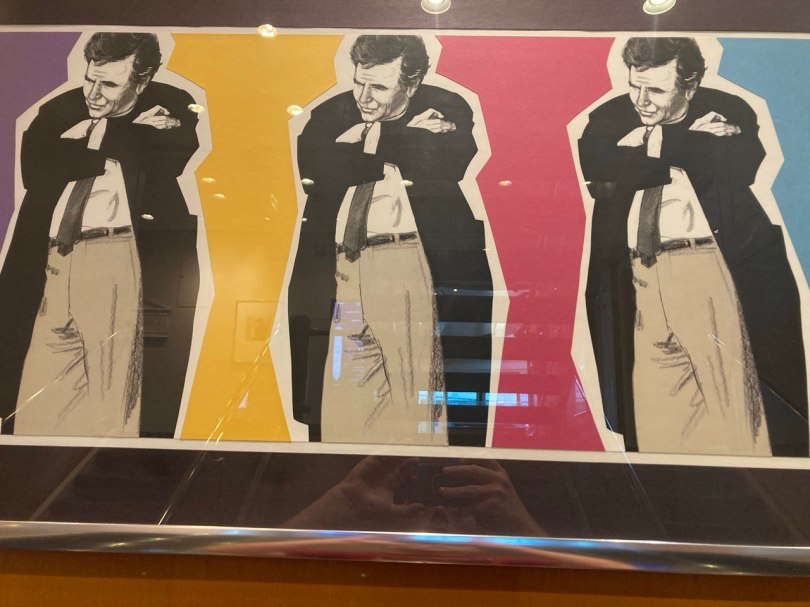
Dr. Wife and I took a cruise for our honeymoon aboard Royal Caribbean‘s Explorer of the Seas. The artwork impressed, delighted, and even confounded me.

As such, I put together a brief video showcasing some of the art onboard the ship.  This video only captures a small fraction of the collages, paintings, photographs, mosaics, etc., aboard Explorer of the Seas.  The selections were often odd, but they really fit the atmosphere of the ship, and added a touch of elegance and class to the cruise.

Read More »

Flashback Friday^16: Brack Friday Bunduru: Workers Need a Break

When I first wrote about workers needed Thanksgiving Day off, I was experiencing pretty severe burnout myself.  I do still believe that the Black Friday creeping into Thanksgiving is reprehensible, but I also realize my own stress was playing a role in my analysis.

Of course, this Black Friday I’m bunduru’d with Dr. Wife on the high seas, so I’m absolutely getting a break.  Indeed, I might be eating pizza covered in gravy and leftover turkey from last night’s onboard Thanksgiving feast (I assume we had one; I’m writing this post way beforehand).  While I’m enjoying the Thanksgiving Lover’s Pizza, though, millions are schlepping into retail stores at 4 AM to help grannies save pennies on toaster ovens.

Well, who doesn’t love a good deal?  But a better deal would be shuttering retailers all day on Thanksgiving so employees can rest up and spend time with family before being berated by penny-pinching Karens.

With that, here is 25 November 2022’s “Flashback Friday^4: Brack Friday Bunduru: Workers Need a Break“:

Read More »

TBT^16: Modern Art and Influence

I’m currently reading through J.D. Cowan‘s short book The Pulp Mindset: A NewPub Survival Guide (those are Amazon Affiliate links; I receive a portion of any purchases made through those links, at no additional cost to you), which isn’t precisely a guide on how to write pulp but, rather, an extended argument for why one should write pulp.  Cowan unapologetically—indeed, enthusiastically—argues that the “low art” of the pulps provides readers what they want:  action and wonder.  He makes a reasonable argument for reviving this older form of writing, which features punchy writing and upright heroes:  audiences want to read such stories, but “OldPub” (his term for the current publishing industry) prefers massive tomes that push approved messages.  Readers lose out, therefore, on good stories, and the publishing industry is dying as a result.

That’s gotten me thinking about art and writing and what not.  Last summer, a guest writer, Brian Meredith, wrote a post entitled “There’s No Such Thing as Bad Art” here at TPP.  I don’t precisely agree—I think we can have (more or less) objective standards for what qualifies as good art and literature—but he does touch upon what I think is the important distinction between “low” and “high” art.  Cowan argues in his book that pulps are “low art,” but that doesn’t make them worthless.  But both low and high art can, I would argue, be quite bad.  Just take this example from author and poet Liza Libes (Libes is an exquisite writer; she’s just sharing an excerpt from some trashy “romance” novel); no one can read that and not realize it’s awful writing (and not just because of the lurid subject matter).

But the worst art is art that is only valuable in the financial sense because the people making it are either a.) well-connected and/or b.) elevated because of some perceived victim status.  We’ve had too much of both lately, and it’s why—as Cowan argues—the publishing and film industries are dying slow deaths (and, yes, yes, shortened attention spans due to TikTok and what not play a role, too, I’m sure, but people go to those platforms because they at least give folks what they want).  That was the crux of this post, first written back in 2021 and reblogged mercilessly every summer.

With that, here is 25 July 2024’s “TBT^4: Modern Art and Influence“:

Read More »

TBT: Support Culture, Not Political Machines

The big scuttlebutt in the conservative world is the rumor that Ben Shapiro‘s The Daily Wire may be going bankrupt.  I have no idea if that is true or not, although their longtime co-founder, Jeremy Boreing, is apparently stepping down from his position as co-CEO.

It’s a good reminder that some of these big-named conservative commentators are often too big for their own good.  In some ways, having a bigger brand and presence means you also have to walk a thinner and thinner line.  I am increasingly ambivalent about Shapiro, who I think hedges his bets too much.  He was flat-out anti-Trump eight years ago, and now acts like he was leading the charge for Trumpism in 2015.  Balderdash!

Whatever happens at The Daily Wire, Ben Shapiro is going to be okay.  He’s got book royalties, a nationally-syndicated radio show, a popular podcast, etc., etc., etc.

But you know who does need support?  The small fries.  But not just the political commentary small fries:  the artists, authors, writers, composers, musicians, painters, craftsmen, etc., the people who are making culture on a shoestring budget and a prayer.

Not just me, either, but that would be nice.

With that, here is 19 April 2024’s “Support Culture, Not Political Machines“:

Read More »

TBT^4: Modern Art and Influence

The state of modern art is not exactly a pressing concern in a nation wracked with attempted assassination attempts and listless, anxious youths.  At this point, I suspect most of my readers will realize that modern art is something of a joke played on the rich and gullible to separate them from their money.  It’s also an attack on Beauty, one intended to demoralize us.

What I learned shamefully recently is that modern art was also a CIA psy-op.  That’s not some wild-eyed conspiracy theory; it’s so well-documented and mainstream, even the BBC wrote about it—in 2016 (see, I’m late to the party)!

I’m actually not opposed to government funding for the arts, but whenever the government gets involved with anything, there is the risk that the government will pervert and distort what the art is supposed to be.  One very real risk is that “art” will devolve into propaganda.  That’s fine if we’re fighting the Second World War and need to inspire people to fight Hitler and the Japanese; if we’re trying to demoralize our own populace with nastiness, it’s not.

The other, related risk is that the government will fund art that we don’t like, personally or collectively.  The government is ostensibly “of the people,” but when everyone allegedly is in charge, no one is.  The functionaries responsible for handing out National Endowment for the Arts grants are likely doing so based on qualities of the artist—race, regime-approved ideology, gender, etc.—rather than any actual technical skill.  So we end up with patronage not of skilled artists, but well-connected or demographically-approved artists.  The results are predictably terrible, and we’re all flummoxed as to why we spent $2 million of taxpayer money on it.

A healthy government that actually cared about its people would fund art that promotes Beauty and Truth.  If we had such a government, I’d be all for government funding of the arts.  Indeed, we probably do have that at the local and State levels.  I personally love that the City of Columbia, South Carolina subsidizes the South Carolina Philharmonic.  Many Republicans and/or conservatives would balk at that, but it is a worthwhile investment to keep classical music alive in—let’s face it—the “Sahara of the Bozart,” as H. L. Mencken cruelly (and, I think at the time, unfairly) labeled the South.

I feel like I’m contradicting myself a bit here, so to distract from that—and to get on with the post—here is 27 July 2023’s “TBT^2: Modern Art and Influence“:

Read More »

SubscribeStar Saturday: Chicago 2024, Part II: Through Mordor and Onto the River

Today’s post is a SubscribeStar Saturday exclusive.  To read the full post, subscribe to my SubscribeStar page for $1 a month or more.  For a full rundown of everything your subscription gets, click here.

After visiting Willis Tower my brother and I had to make a long walk across Chicago to a boat landing, where we would embark on a ninety-minute cruise of the river.  The purpose of the tour was to showcase the incredible architecture in Chicago.

My brother is a bit of a Romantic—even more so than yours portly—and wanted to walk along the river for as much of our route as possible.  I was fine with that, but in following our GPS directions, we realized that it would not be feasible to follow the river on the side of the street where we needed to be.  I pointed out that we could cross back over the river and enjoy the river walk on that side, but that we’d be on the river for over an hour soon enough, so we might as well just follow the GPS.

Well, my brother’s Romantic wanderlust was right.  My route took us along Lower Wacker Boulevard.  Wacker is a multi-level street—it gets to as high as three levels—and the underside of the street is basically an underground tunnel.  It’s full of steam pipes, service accesses, and darkness.

And a dead pigeon.  When we emerged on the other side, my brother remarked that we’d been through Mordor.

To read the rest of this post, subscribe to my SubscribeStar page for $1 a month or more.

Support Culture, Not Political Machines

Last week regular contributor and senior correspondent Audre Myers wrote a piece for Nebraska Energy Observer entitled “Lets Chat” [sic].  In the piece, Audre ponders the question of whether or not to continue donating to the Republican Party (by which I take her to mean the Republican National Committee), and solicits readers for their opinions on the issue.

Audre is quite aware of the perfidious machinations of the RNC, but the source of her quandary is whether or not to help cash-strapped President Trump with his campaign.  If you’re going to give any money to any candidate, my personal, unsolicited advice is to give to only two sources:  Trump’s presidential campaign directly—not through the RNC or any PAC—and to local candidates (or, alternatively, your county GOP).  That’s where your money will have the most impact.

Overall, though, I advise strongly against giving any money to out-of-state political campaigns or to political parties generally.  Indeed, in my comment on Audre’s piece, I argued that our money is much better spent supporting small conservative creators.  I think I made a compelling case:

Read More »

TBT^2: Little Paintings

During The Age of The Virus I took up painting as a little hobby, and came to enjoy it.  Let me emphasize the word “hobby“—I am not a skilled painter, and while I have sold a few of my works (mostly to family members), it’s been an overall money-losing excursion.

I attempted to sell paintings at the South Carolina Bigfoot Festival last October, and managed to unload a single painting.  Of course, the little girl who purchased that painting loved it; it was a strange, whale-like creature that she took to be the Loch Ness Monster, and she adored it.  It’s one of the few paintings I failed to photograph, so I can’t show it here, but that’s immaterial—it was sweet seeing that little girl’s face light up.

Of course, the brightening of little girl’s faces doesn’t put cornflakes on the table, so I’m officially proclaiming my foray into painting as a possible commercial endeavor a failure.  As a hobby, though, it’s something I still enjoy doing, and I’ll do some light sales on the side for anyone interested.  Otherwise, I’m not going to push it aggressively as a possible revenue stream.

For those that are interested, I use these little canvasses for my paintings (note—that link is an Amazon Affiliate link; I receive a small portion of any purchase made through that link, at no additional cost to you).  Like everything, they’ve gone up in price, but they’re a pretty good deal for small (5″x7″), thin canvasses, and they’re easy to use.  There’s also an adorable 3″x5″ variety, which I am excited to try.  I like the idea of index card-sized paintings.

With that, here is 23 February 2023’s “TBT: Little Paintings“:

Read More »

Celebrating the Life of a Friend

My friend Jeremy Miles passed away last year after a brief struggle with cancer.  He was a gifted poet, with several self-published volumes before his passing.  I highly recommend his poetic output.

Besides being a great poet and a great friend, Jeremy was a builder of community.  It’s not what you’d expect from a Gen Xer clad entirely in black from head-to-toe, often with a trench coat, always with his signature black hat.  Our mental image of such a figure is a misanthropic outsider, or a socially awkward anime fanboy.

He was neither—well, maybe he was a little misanthropic, but aren’t we all after a certain age?  Regardless, he became an essential part of, and helped to build, a thriving open mic scene in the glorious Before Times, in the Long, Long Ago, before The Age of The Virus.

His longtime girlfriend/common-law-wife hosted a celebration of life/memorial service/birthday party in late January 2024 to celebrate Jeremy’s life and what would have been his birthday.  She wanted it to be an open mic, and I’m sure Jeremy would have approved.

Read More »

Monday Morning Movie Review: Black Swan (2010)

Natalie Portman and Mila Kunis in their prime, partying in New York City and breaking their toes dancing ballet.  What’s not to love about Darren Aronofsky’s 2010 masterpiece Black Swan?

Well, there’s probably something wrong with it, but I enjoyed this film immensely.  I remember when Black Swan was in the theaters.  The nation was still in the depths of the Great Recession.  The T.E.A. Party was a valid political movement, and hadn’t yet been co-opted by charlatans.  I weighed 290 pounds and worked a job I hated.

Yet I somehow missed it at the time, although it looked like a flick I wanted to see.  I’m not big on ballet, but who wouldn’t want to gawk at Natalie Portman?  There are many arguments against anti-Semitism, but simply saying, “look at Natalie Portman” is probably the strongest expression of pro-Semitic sentiment.

Lustful digressions aside, my girlfriend and I watched Black Swan on our mountain excursion, and it stuck with me for days.  In quiet moments as we hiked or drove throughout the Appalachian Mountains of North Carolina, I’d think about scenes and ideas from the film, and we’d inevitably discuss them.

Read More »