
Lazy Sunday LXXXVIII: Questions, Part III

We’re trucking one with more question-based posts in this third installment of Questions.  This trio of posts is kind of fun (well, except the one about people with the goods on the Clintons ending up conveniently dead).  I was trying to do these in chronological order based on their posting date on the WordPress site, but apparently the Space Force piece slipped through the cracks.

Here it is—with two other questioning posts—for your enjoyment:

  • Why the Hate for Space Force?” (and “TBT: “Why the Hate for Space Force?“) – When President Trump announced the creation of Space Force—an independent branch of the military dedicated to the defense of outer space—I was over the moon (pun intended).  It just makes sense—the next strategic frontier will be space.  We don’t want the ChiComs pointing death lasers at us from low-earth orbit, right (or, more plausibly, disabling our communications satellites)?  So I was surprised to witness the sheer mockery coming from the Left.  Never mind their darling, John F. Kennedy, energized the space race in the 1960s.
  • Clinton Body Count Rising?” – Everyone knows Jeffrey Epstein didn’t kill himself.  That so many people of all political persuasions know Epstein was murdered indicates the incredibly low level of trust in our society today.  But it also points to the sinister nature of elites.  The Clintons may be yesterday’s news in the Democratic Party, but their tactics have become the norm.  Evil is infectious, and slippery.
  • Saturn: The Creepiest Planet?” – I’ve written many times before about my love of outer space (see also—the post you’re reading).  But I’ve always possessed a strange fondness for Saturn, that most elegant of the gas giants.  Jupiter might hold the title for most regal, but Saturn is so stately, like a princess of the night sky.  But according to radio signals emitted from the planet, it sounds super creepy—the point of this fun, throwaway post.

That’s it for this week.  Keep watching the stars—and watching out for the Clintons.  Gulp!

Happy Sunday!

—TPP

Other Lazy Sunday Installments:

Tip The Portly Politico

Support quality commentary on politics, education, culture, and the arts with your one-time donation.

$1.00
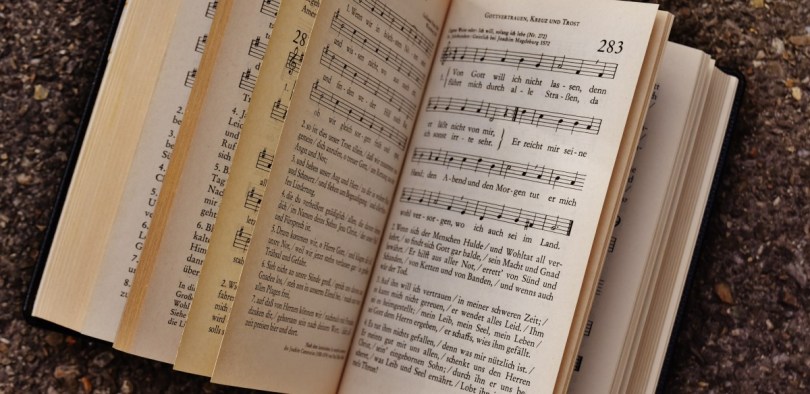
The Joy of Hymnals II: The Cokesbury Worship Hymnal

This week I’ve been teaching and learning a great deal about George Frideric Handel, the great German composer who became, over his long life, a great British one.  In discussing Handel and other Baroque composers with my students, we also veered into the world of hymns.

Hymns were and are important in Protestant congregations as simple, memorable tunes with theologically rich texts.  Hymn melodies are often based on folk tunes or popular compositions.  In some cases, such as the lovely Christmas carolSilent Night,” the text is written first, then set to music (indeed, most hymns, being based on Scripture, evolved this way).  Sometimes the tune is written, then an enterprising poet sets the text.  Such was the case with Isaac Watts, who set his text for “Joy to the World” to a Handel melody.  And, of course, there are hymns written and composed by the same person.

In talking about hymns, I brought to my students a slender little hymnal in my small collection of them, The Cokesbury Worship Hymnal.  From what I can gather, my copy was published in or after 1966, when the copyright from 1938 was renewed.  There is a stamp on the inside front cover stating that the hymn book once belonged to Carteret Street Methodist Church, which I thought was in Charleston, but appears to be in Beaufort, South Carolina.  The hymnal includes 296 hymns, with fifty responsive readings—a good collection, but slim by the standards of a pewback hymnal.

Read More »

Wayback Wednesday: Memorable Monday: Veterans’ Day 2018, Commemoration of the Great War, and Poppies

While preparing a separate post on hymns (which I will likely post Friday), it occurred to me that today is Veterans’ Day in the United States, the observance formerly known as Armistice Day.  I’ve never thrown back to past posts on a Wednesday before, but it seemed fitting to recognize our fallen heroes on the day.

Last year I looked back at a Veterans’ Day post from 2018.  The post itself was originally delivered as remarks to the Florence County (SC) Republican Party, and was the most affecting of my old “Historical Moments” I’ve ever delivered.

It’s hard to believe that the centennial observance of the Great War has already passed, yet we’re still dealing with the fallout from that terrible war just over a century later.  The more I’m learning about the great Baroque, classical, and Romantic composers of Europe, the more the senseless loss and nihilistic destruction of that conflict weighs on me—and that the shimmering, confident civilization that fostered those composers also destroyed itself.

Read More »

Hand it to Handel

One nugget of wisdom I’ve heard before is “if you want to learn something, teach it.”  As a private school educator who taught pretty much every course in the standard high school social studies curriculum and a plethora of music courses, I can attest to the Truth of this statement.  I essentially taught myself, for example, the highlights of Western philosophy from teaching a Philosophy course for many years (a course I very much wish the school would revive).

I’m shifting increasingly towards teaching music exclusively (though I’m still teaching a couple of American History survey courses), and teaching a Pre-AP Music Appreciation class has been one of the great joys of that transition.  Years ago I created and taught a course called “History of American Popular Music,” which covered the early Tin Pan Alley tunes all the way through blues, jazz, rock ‘n’ roll, and beyond.  This Pre-AP course is focused on the great works of Western music, going back to the medieval period.

Currently, we’re wrapping up a big unit on Baroque music.  The Baroque style—as epitomized by greats like Bach, Monteverde, Corelli, Handel, and others—delights in contrasts.  Just as Baroque paintings highlight stark contrasts between light and dark, Baroque music revels in sudden contrasts in dynamics.  It also loves to play around with complexity, as any Bach fugue will quickly demonstrate.

The last composer in our unit is George Frideric Handel.  Handel, a German-born composer, made a major splash upon his arrival in England in the 1710s, where he sought to introduce Italian opera to sophisticated London crowds.  What was meant to be a temporary visit turned into over four decades, and Handel is interred at Westminster Abbey—a huge honor.  It’s one of those delightful twists of history that Handel the German became one of the most English composers in history—and one of the greatest composers of all time.

Read More »

TBT: The Invasion and Alienation of the South

Sheldon_Church_2

Tip The Portly Politico

Support quality commentary on politics, education, culture, and the arts with your one-time donation.

1.00 $

With the election still in the balance—it may be decided by the time you read this post—and two formerly conservative Southern States up for grabs, I thought it would be timely to revisit this piece, “The Invasion and Alienation of the South,” which looks at Leslie Alexander’s post “Stranger in a Strange Land.”  In that piece, Alexander writes about the hollow, joyless cosmopolitanism of living in Dallas—a stark contrast to the tight-knit cordiality and tradition of her native Louisiana.

While watching the election returns, it occurred to me that Georgia and North Carolina should not be risky toss-ups, and Virginia never should have been lost to hordes of Swamp People.  It’s an irony of history that Washington, D.C., was placed next to Virginia so the ornery planters, suspicious of federal power, could keep a closer eye on the national government.  Now, that bloated national government dominates politics in Virginia through its largess.

Meanwhile, transplants from up North have infested previously conservative States.  Charlotte, North Carolina has become a wretched hive of globalist scum and villainy.  During my online dating days, I would routinely get matched with babes from Charlotte; invariably, they were always from Ohio, or New York, or California—never actually true North Carolinians.

It’s one thing when local blacks vote Democratic.  Fine—we’re at least part of the same(-ish) Southern culture, and we’ll help each other out.  But then gentry white liberals start coming down here, ruining our politics and our cities.

Now, we live in a world in which Joe Biden might win Georgia, and North Carolina—NORTH CAROLINA—has become a nail-biter every four years.

Such is the price of our addiction to economic growth and convenience.  What we’ve gained in luxuries we have lost in heart.  We have paid for them with our souls.

Here is November 2019’s “The Invasion and Alienation of the South“:

Read More »

The Land and Heritage

A major theme of this blog has been the restoration of rural America, and the promotion of the idea that the future of the United States rests in its rural areas and small towns.  I have often touted the affordability and the decency of the country as major selling points to those looking for a change of scenery.

So this piece at The Abbeville Insitute—Travis Holt’s “Thirty Pieces of Silver“—grabbed my attention.  Holt is a native son of the Ozarks in Arkansas, and he writes movingly about how his ancestors carved a livelihood out of the rough mountains of a challenging wilderness.  He details the sweat and toil that went into improving the land, and of gradually expanding small family plots.

Holt also describes a process all-too-familiar in the New South:  the commercialization of those hard-won family plots.  Holt does not denounce the sale of family lands in general, as he recognizes the economic hardships and the lure of better lives, but he does lament the sacrifice of heritage, history, and family to the whims of the market.  His essay grapples with the complexity of that loss, and his own determination to keep his familial lands.

Read More »

Memorable Monday: Happy Columbus Day!

I’m back from my third trip to Universal Studios this year, and I’m worn out.  Having nonstop fun in the central Florida sun for three days straight really takes it out of me—that, and driving nearly fourteen hours round trip.  I’ll be posting a delayed SubscribeStar post about the trip for subscribers later this evening, after taking a much-needed nap.

Today is Columbus Day, and outside of banks and the postal service, I’m one of the few people who doesn’t have to work today.  I’m thankful for that, and to Columbus for making his historic voyages to the New World.

The attempts of cancel culture to rewrite history have only intensified since I wrote this post one year ago.  The trend is heading into extreme territory, in which we absurdly demand people living four hundred years ago to have had the foresight to think and believe the way we do in 2020.  We pillory them and destroy their statues if they failed to genuflect properly.

The world in 1492 was a brutal place, especially in the New World.  The myth of the “noble savage” was just that—a myth.  The Native Americans were a vastly diverse array of tribes and confederations, often intensely at war with one another.  That doesn’t excuse some of the abuse they did receive at the hands of Europeans and, later, Americans, but it should dispel this notion that white people cruelly destroyed peaceful Earth worshippers.

That it doesn’t is a testament to the strength of progressive indoctrination in our schools.  We don’t name football teams, towns, and military weaponry after Native Americans because they were pagan hippies; we do so because we fought them for hundreds of years and admire their tenacity and warrior-spirit.  It’s the hard-won respect one has for a worthy opponent, even a defeated one.

So, I’ll repeat my call to preserve Columbus Day.  Here is 2019’s “Happy Columbus Day!“:

Today is Columbus Day in the United States, the day that commemorates Columbus’s voyage to the Americas in 1492.  It’s one of the most significant events in human history—as I tell my American History students, “we wouldn’t be here if Columbus hadn’t made his voyages”—yet the social justice, Cultural Marxist revisionist scolds want to do away with the holiday entirely, replacing it instead with “Indigenous People’s Day.”

The thrust of the proposed (or, as is the way with SJWs, demanded) name change is that Columbus was a genocidal, white male meanie who defrauded and murdered peace-loving Native Americans (who had the gall to mislabel Indians!), so instead we should celebrate the contributions of Stone Age cannibals.

Two States—Vermont and Maine (of course they’re in New England, the epicenter of neo-puritanical scolds)—have passed laws renaming the federal holiday to the SJW-approved Indigenous People’s Day.  One Maine mayor, however, refuses to bend, and has declared that in Waterville, Maine, Columbus will be honored.

Mayor Nick Isgro has garnered national attention for his stand to protect Columbus Day from the faddish winds of outrage culture:  “‘The history of mankind is not necessarily a nice one,’ he said. ‘With every great accomplishment, we could probably line up negative consequences as well as positive consequences and that goes across all peoples, all continents, all countries.’”

That’s probably one of the best, brief summaries of a proper historical perspective I’ve read recently:  we can find all sorts of nasty bits about every culture, country, and personality.  But that doesn’t detract from the greatness of their accomplishments.

The revisionists are not incorrect about Columbus:  he did, in his own misguided way, commit what we would now consider atrocities against the Arawaks of the Caribbean.  But it’s foolish to believe that the Native Americans were peaceful, “noble” savages, living in a harmonious state of nature until the evil, exploitative Europeans showed up.  That version of history is a Leftist passion play, which casts history into shades of (literal and metaphorical) black and white—and any white person must possess a black soul.

The peoples of the late fifteenth-century Caribbean were no saints.  To quote from Samuel Eliot Morrison’s Admiral of the Ocean Sea (quotation c/o VDare.com):

The searching party found plentiful evidence of these unpleasant Carib habits which were responsible for a new word—cannibal—in the European languages. In the huts deserted by the warriors, who ungallantly fled, they found large cuts and joints of human flesh, shin bones set aside to make arrows of, caponized Arawak boy captives who were being fattened for the griddle, and girl captives who were mainly used to produce babies, which the Caribs regarded as a particularly toothsome morsel.

Clearly, the Arawaks weren’t polite simpletons (which is how they come across in progressive retellings) snookered by a wicked Italian.  They were fattening up little boys t be eaten, and impregnating young girls to eat their offspring!

I recently wrote about similar Native American atrocities regarding the Aztecs.  The Aztecs’ atrocities are far better understood—the massive, organized human sacrifices, for example—but there’s still this push among modern historians to cast the Spanish conquistadors as the villains.

Naturally, we have to understand these cultures and civilizations in their time and place—but we can do so without condoning their barbarism and cannibalism.  Similarly, if we’re willing to accord some historical wiggle room to baby-eaters, can’t we extend the same generosity to Columbus and the Spanish conquistadors?

Further, as I read the accounts of various Native American practices, I can see why Spanish and subsequent Europeans believed they were doing the Lord’s work to wipe out these practices:  some of them are downright demonic.  It’s fitting that the bloody temples of Tenochtitlan were dismantled and replaced with a Christian cathedral.  The Old Testament is rife with examples of pagan places of worship being destroyed and replaced with altars to Jehovah.

(Of course, if the Spanish were indeed part of God’s Divine judgment on the Aztecs, et. al., Americans should be very worried today, as we continue to participate in mass infanticide.  God is patient, but His patience does not endure forever.)

So, yes, let’s celebrate Columbus on Columbus Day.  I’m glad to be in the New World, and that we don’t line people up to be sacrificed to a sun god every day.

Columbus

Tip The Portly Politico

Support quality commentary on politics, education, culture, and the arts with your one-time donation.

1.00 $

Anti-Court Packing

As of right now, it looks like Amy Coney Barrett will get confirmed to the Supreme Court before the election, even if she’ll be seated under the wire.  A plurality of Americans want Barrett seated, according to a Rasmussen poll.  Conservatives shouldn’t take anything for granted; to quote Marcus Cato Censorius, “many things can come between the mouth and a morsel of food.”  But it does seem that ACB will soon be Justice Barrett, and America will be better off for it.

Of course, the Democrats are in high dudgeon, and are already threatening to pack the Court should they win the presidency and gain a senatorial majority this November.  Conservatives have anticipated this potential move for some time, but haven’t done much to stymie it.  Our focus has been, understandably, affixed on merely gaining a solid constitutionalist majority on the Court, but today’s Left will do anything to demolish a conservative Court.

Just as Democrats threatened to impeach Trump [thanks to jonolan for sharing that post with his readers, too —TPP] for making a constitutional appointment, they’re not seeking to dilute the Supreme Court, cheapening its gravity and significance, by adding additional justices.  Their solution is to expand the Court enough enough to make the potentially 6-3 conservative majority irrelevant.

After all, with the Democrats, if the rules favor your opponents, change them.  If the people don’t want your ideology, force it on them via judicial or executive fiat.

Read More »

SubscribeStar Saturday: The Supreme Court and Power

Today’s post is a SubscribeStar Saturday exclusive.  To read the full post, subscribe to my SubscribeStar page for $1 a month or more.  For a full rundown of everything your subscription gets, click here.

The death of Ruth Bader Ginsburg eight days ago has opened up another power struggle in D.C.  Democrats have spent decades perverting the function of the courts from that of constitutional referee into that of constitution interpreter, a role that places the Supreme Court above Congress and the presidency.

The result is rule by nine unelected officials who serve for life.  Congress has gleefully passed the difficulty of legislative activity and the push and pull of debate onto the Supreme Court, trusting it to clarify anything Congress may have forgotten to write into law.  Presidents have passively executed Supreme Court verdicts, and even signed legislation they believed to be unconstitutional, on the premise that the Supreme Court would make the ultimate decision.

Thus, the Court has emerged as the dominant force in American politics—and morality.  Not only does the Court tell us what the Constitution really says—even if the Constitution doesn’t say it at all—it also tells us the moral judgments of the Constitution (thanks to Z Man for that insight).  Thus, every cat lady and box wine auntie in America bemoans the death of RBG, their symbolic stand-in, who endorsed free and easy abortions and gay rights.

Now President Trump has the opportunity to shift the balance of the Supreme Court for a generation.  But will it be enough to reverse judicial supremacy and restore constitutional order?

To read the rest of this post, subscribe to my SubscribeStar page for $1 a month or more.

Donate to The Portly Politico

Support quality commentary on politics, education, culture, and the arts with your one-time donation.

$5.00

Five Dollar Friday: The Elites and a Giant Clock

Today’s post is an exclusive for $5 and higher subscribers to my SubscribeStar page.  Five Dollar Fridays will be a regular feature heading into the 2020 election, with unique analysis of and insights into the presidential and other national, State, and local elections.

America’s cities are aflame, in a more ghoulish, pointless reenactment of the upheavals of 1968.  The organizations behind various protest movements and rioting all parrot the same meaningless platitudes:  “Black Lives Matter,” “Abolish the Suburbs,” “Wake Up Motherf**kers, Wake Up,” etc.  There even seems to be an attempt to normalize pedophilia—the logical, horrifying next step for the LGBTQ2A+ set.

Despite Republicans enjoying official political control of the presidency and the Senate, the Left clearly dominates the culture, the media, academia, Big Tech, and more.  The question is, how much of this dominance was deliberately orchestrated, and how much of it is the result of various organic left-wing movements?

Most conservatives are familiar with the radical Left’s “long march through the institutions,” in which ’60s radicals and former hippies gained cushy sinecures in government and academia, and began dribbling their Marxist dogma into the political and cultural thought of the country.  The anti-war movement and the sense of restlessness among post-war youths offered fertile ground for anti-American ideas, especially when swaddled in terms of “peace” and “love.”

But how much of that was intentional, and how much of it the result of happenstance?  Perhaps an answer rests with a Jeff Bezos-funded, ten-thousand year clock hidden in a Texas mountain.

H/T to photog at Orion’s Cold Fire and Z Man for the idea for this week’s post.

To read the rest of this post, subscribe for $5 or higher to my SubscribeStar page.

Donate to The Portly Politico

Support quality commentary on politics, education, culture, and the arts with your one-time donation

$5.00