Lazy Sunday LXXV: Forgotten Posts, Volume IV

We’re continuing our dive into the B-sides and deep cuts of the TPP oeuvre.  For this Lazy Sunday, I decided to check out September 2019.

Whoa!  What a gold mine of hidden gems and nuggets, forgotten in the tide of events.  I didn’t realize how many good posts I generate during that first full month of the 2019-2020 school year.  There’s enough for a couple of weeks, but here are three forgotten posts to tide you over until next Sunday:

  • Remembering 1519” – With The New York Times‘s 1619 Project all the rage—a retelling of American history in which racism and slavery  are the only pertinent factors in our grand national story—this post examined a piece from The Federalist about Hernan Cortez’s conquest of the Aztecs in 1519.  Rather than framing it as evil Europeans callously destroying the peaceful natives (any fifth grader can tell you the Aztecs were anything but peaceful), he flips the script to something closer to the Truth:  the Catholic Christian Spaniards toppled a wicked regime built on human sacrifice and false gods.  The Spanish weren’t angels, but they destroyed a great evil.
  • Saturn: The Creepiest Planet?” – Quora inspired this post, and the site has now become a favorite of mine for people smarmily answering astronomy questions.  The Solar System has always fascinated me, and Saturn in particular is alluring—so mysterious and regal, with its massive rings.  I’ve even written a song, “The Rings of Saturn,” which I will hopefully record one day.  The Quora post in question asked “What is the creepiest planet in our solar system?”; the answer, per a recording of Saturn’s electromagnetic waves, is Saturn.  The embedded video to that recording is now, sadly, dead, but I’m sure some intrepid searching could turn it up.
  • A Tale of Two Cyclists” – One of my more frivolous and cantankerous posts, this short screed denounces “spandex-festooned cyclists riding in the middle of a busy lane during rush hour.”  Yet my sympathies are entirely with the second cyclist, “a black man of indeterminate age…. wearing street clothes, and riding what appeared to be a fairly rundown bike.”  I have no problem with folks who use a bike as their primary means of transportation, lacking any other options.  But these large groups of “cyclists” who ostentatiously hog entire lanes at 5 PM drive me batty.

That’s it for this Sunday!  We’ll continue our exploration for at least another week, as there are some more goodies from September 2019 to explore.

Happy Sunday!

—TPP

Other Lazy Sunday Installments:

Cancelling Jesus

Yesterday, I wrote about the destruction of statues of American leaders—the destruction of American history.  My position is that tearing down virtually any statue—Confederate, Union, Theodore Roosevelt, etc.—is the untenable erasure of our nation’s history.  Further, the historic illiteracy of the woke SJWs has seen the defenestration of statues of abolitionists—an absurdity for groups that claim to be fighting against the legacy of slavery.

In that context, I made a big deal about the toppling of a statue of Abraham Lincoln.  Lincoln has assumed something of a demigod status in American history, one that glosses over some of the thorny issues of how to respond to the secession of the Southern States (a real question at the time was, having opted into the Constitution, could States later opt out; for a good biographical read on that issue, check out “A Voice of Reason” by John Marquardt at the Abbeville Institute).  Lincoln was certainly a man with many noble qualities, and a keen constitutional mind.  The toppling of his statues is the height of insanity—or nearly so.

In my haste, I neglected the even more egregious calls to destroy statues and stained glass windows depicting The most important Figure in world historyJesus Christ.

Read More »

Thalassocracy

The Internet is a funny thing.  Anyone that’s ever gone down a Wikipedia hole realizes that, pretty soon, that one thing you needed to look up can turn into a two-hour deep dive into barely-related topics.

It’s also weird.  There’s so much content—so much that we can’t really quantify it—you’re bound to stumble upon something interesting.  It is, perhaps, a sad commentary of the human condition that, given unlimited access to information and knowledge, we use the Internet primarily for mundane purposes, and frequent the same dozen websites everyday.

Of course, that’s also the problem of abundance.  People can’t handle that many choices, and there are only so many spare hours to cram in unorganized knowledge.

That’s how I came to stumble upon the topic of today’s post, thalassocracy, or “rule by the sea.”  I recently purchased a very nerdy space exploration strategy game called Stellaris (itself a recommendation from a member of Milo’s Telegram chat).  Stellaris has a steep learning curve, so it’s a game that basically requires the player to do homework to figure out what they’re doing (my race of peaceful, space-faring platypus people has surely suffered from my ignorance).

That homework assignment (no, seriously, it’s a fun game!) sent me down a rabbit hole on the game’s wiki, and one of the in-game events involves a group called the Bemat Thalassocracy.  I’d never heard the term before, and searched out its meaning.  That brought me to a website called Friesian, which is apparently a site promoting the philosophy of Jakob Friederich Fries, an eighteenth-century philosopher opposed to that ponderous windbag Hegel.  The website dates back to 1996, when it began as a community college website.

Read More »

Birth(day), Death, and Taxes

“Nothing in life is certain except death and taxes,” the old saying goes.  But we are also born, those of us fortunate enough not to fall prey to the abortion industry.  Today marks my thirty-fifth birthday.  I celebrated by paying $162.57 in vehicle property taxes to Darlington County, South Carolina.

Yesterday, I purchased a new vehicle, my first new car in thirteen-and-a-half years, and only the third I’ve ever owned.  It’s a 2017 Nissan Versa Note SV.  The other two were a 1988 Buick Park Avenue Electra, which I bought from my older brother for $800, after my grandparents gave it to him one year, and a 2006 Dodge Caravan, which those same grandparents gave to me as a college graduation gift (after the Buick was totaled when a lady ran a yield sign and smashed into me).

The Buick is long gone, but I kept the Dodge.  I figure it’s worth more to me as stuff-hauler than I would have gotten in trade-in value.  Of course, that means maintaining insurance on both vehicles, and paying taxes on each.

Well, I awoke today to the news that our military assassinated Iranian General Qassem Soleiman last night.  When I first read that Soleiman was “assassinated,” I was picturing a fate similar to the death of the “austere religious scholar,” the ISIS guy, al-Baghdadi: covert operatives swooping in under cover of darkness, swiftly and surely relieving the general of his life.

Read More »

Christmas and its Symbols

It’s Christmas!  Imagine “Hark! The Herald Angels Sing” played on an uptempo French horn and a crackling fire.  That’s how I imagine Christmas morning—like a 1970s Christmas variety show.

In all seriousness, it’s truly the most wonderful time of the year.  Christ is born!  It’s a day for celebrating His Birth with family and friends.  Just like the Wise Men of yore, we exchange presents to celebrate (and to stimulate the economy).

Read More »

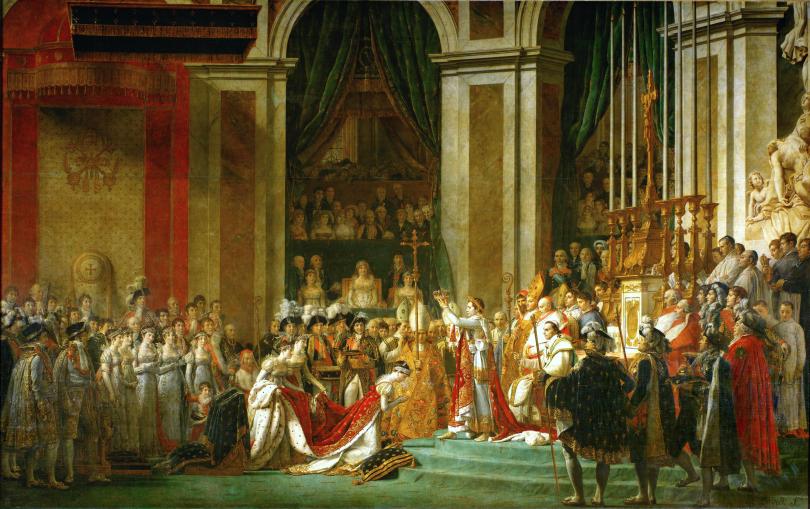
Napoleonic Christmas

It’s Christmas Week!  And what a glorious week it is.  It’s been raining persistently in South Carolina since Sunday morning, but I’m enjoying the coziness of the hygge—warm coffee and lazy reading.

PragerU had a little video up this morning from historian Andrew Roberts about Napoleon.  It’s an interesting take on the not-so-short French emperor—an apologia, really (for those that prefer reading—as I often do—to watching videos, here is a PDF transcript).

Roberts argues that Napoleon was not the necessary precursor to Hitler, et. al.; rather, Napoloen was “sui generis“—a man unto himself.  While I believe the ideas of the French Revolution did unleash the totalitarian forces of Hitlerism, Stalinism, Maoism, and all the rest—a murderous, bloody Pandora’s Box—I’ve never considered Napoleon among their ranks.

Read More »

Lazy Sunday XXXVII: Best of the Reblogs, Part II

Thanksgiving is almost here!  Regular readers will by now know of my love for Halloween, which is second only to Christmas in my heart.  But Thanksgiving is definitely up there in the Top Five, at least—sandwiched neatly between the former two, a brief taste of the Christmas togetherness and relaxation to come.

This week’s Lazy Sunday continues with some of my favorite reblogged posts.  As I wrote last week, one of the simple joys of blogging is making friends with other bloggers.  Maybe one day we can all meet up at some kind of blogging convention.

This week’s reblogs feature two from Practically Historical, a blog dedicated to historical topics, mostly American History.  The other is from Quintus Curtius, a classicist and world traveler (not to mention a former Marine) who writes beautifully about forgotten chunks of the distant past.  He revives the old tradition of the great antiquarians, much to our benefit.

  • Reblog: Lincoln and Civil Liberties” – This post is an examination of Lincoln’s decision to arrest pro-secessionist legislators in Maryland, in order to prevent the State from seceding from the Union.  He examines John Merryman, for whom the case Ex Parte Merryman is named, and notes Merryman was actively engaged in leading an armed militia in Maryland against federal authority.  Yikes!
  • Reblog: Quintus Curtius, ‘On Living Near the Ocean’” – This essay on the ocean really struck a chord with me.  Quintus Curtius is a strong writer, and his examination of the ways that people respond to living near the water are fascinating.  On the one hand, people enjoy the vigorous health of the salt air and good seafood, but maritime towns tend to be breeding grounds for shabbiness and dingy criminality (see also:  Myrtle Beach).  A worthy read.
  • Reblog: Practically Historical on the Electoral College” – Gordon Sheaffer of Practically Historical delivers again with an excellent examination and defense of the Electoral College.  He has a great takedown for the anti-EC crowd, who argue that individual votes are all that matter:  he argues that we should think of the EC like a series of baseball games.  Yes, the highest score wins individual games, but the wins are what matter.  A team can win ten games by one run each, while another team can win nine games by ten runs each; what matters are the wins, not the overall scoring.

That’s it for this week. Enjoy the fleeting glory of your weekend, and enjoy the short workweek!

Happy Sunday!

—TPP

Other Lazy Sunday Installments:

TBT: The Influence of Christianity on America’s Founding

My high school American history classes are getting into the American Civil War—or the War of Northern Aggression, or the War for Southern Independence, or whatever you’d like to call it—this week, so we’ve been talking about beginnings a good bit.  The Civil War had deep roots that go back not just to the 1840s or 1850s, and not even to the Constitutional Convention in 1787.

Indeed, the fundamental division dates back to the English Civil War in the 1648, when the Puritan Roundheads under Oliver Cromwell ousted and beheaded Charles I, and established the English Republic (which—the English having little taste for radicalism or dictatorships, fortunately collapses in 1660 with the restoration of the Stuart monarchs).  Loyalists to the king and the monarchical order were the aristocratic Cavaliers.  Those same Puritans of East Anglia settled heavily in Massachusetts following the Pilgrims’ famous landing at Plymouth Rock, and the Cavaliers—in body and spirit—dominated the tidewater plantations of the South.

Read More »

Corporate Grind II: The Return of Corporate History International

It’s been a golden week for reblogging, as some of my blogosphere buddies continue to generate some amazing content.  It looks like I may have to do another Dissident Write feature soon (here are I and II).  Armistice Day always brings out the best material, too.

As we head into the weekend—mercifully free of professional obligations—I’m pleased to note the revival of my buddy fridrix’s blog, Corporate History International.

Read More »

Memorable Monday: Veterans’ Day 2018, Commemoration of the Great War, and Poppies

Today is Veterans’ Day in the United States.  Veterans’ Day began as Armistice Day, which ended the First World War in 1918.

The past century was not great for Western civilization.  Most of the horror of the long twentieth century stemmed from the Great War and its mostly senseless destruction.  The sense of nihilism that engulfed the West—a civilization that was bestrode the world with confidence and panache—metastasized into the identity crisis of its nations today.

The piece below is adapted from a talk I gave to the Florence County, South Carolina GOP last year at its November 2018 monthly meeting.  I still think it’s one of the best Historical Moment talks I ever gave, but that’s mostly due to John McCrae’s powerful poem “In Flanders Fields“; the poem is reproduced in full below.

Thank you to all of our veterans for their service.

—TPP

Yesterday Americans, Europeans, and the world commemorated the 100th anniversary of the end of the Great War, what we call the First World War.  The Armistice that silenced the guns of one of the most brutal conflicts in human history was signed in the wee hours of 11 November 1918, but did not take effect until 11 AM—the eleventh hour of the eleventh day of the eleventh month.  That bit of numerical symmetry, while memorable, cost an additional 2738 lives, with 10,944 casualties—a pointless denouement to a destructive war.

Peace would ultimately come to Europe—after three prolongations of the Armistice—in 1920 with the ratification of the Treaty of Versailles (the United States, refusing to join the League of Nations, negotiated a separate treaty with Germany, the Treaty of Berlin, in 1921).  That treaty, which the Germans called the Diktat because of its severity, and because it pinned the war solely on the German Empire, was a reflection of the Armistice signed three years earlier.

In preparing tonight’s remarks, I came across an article that describes the first meeting between Marshall Foch, the commander-in-chief of the Allied forces, and Matthias Erzberger, a middle-aged German politician who had come to sue for peace.  The Frenchman looked stonily at the German peace delegation, and said, “Tell these gentlemen I have no proposals to make.”  Rather, Marshal Foch had a number of demands to issue, thirty-four in total, including Germany’s agreement to pay heavy reparations.

In hindsight, we know the folly of trying to squeeze blood and treasure from the turnip that was a starving, reduced Germany—and the radicalism it, in part, inspired.  But we have to understand, as best we can, the bitterness and weariness the Great War wrought.  Millions of men in Europe had lost their lives, or were maimed for life, fighting in the war.  The republican governments of France and Britain were not willing to accept peace without something to show for it; their people (and voters) would not have accepted it.  Indeed, Marshall Foch told his staff he intended “to pursue the Feldgrauen [field grays, or German soldiers] with a sword at their backs” until the moment the Armistice went into effect.  One cannot help but wonder that the fighting in this final hours was motivated, in part, by a mutual bloodlust, and an opportunity to settle scores one last time before the clock struck eleven.

From the grime and death of the Great War, however, grew new hope—a hope for peace, yes, but also a hope that humanity could avoid such a devastating conflict again.  That hope—and the enduring hope for a world built on peace and understanding—is poignantly symbolized in the flowering of the churned up “No Man’s Land,” the pock-marked area between Allied and German trenches.  Immortalized in Canadian Lieutenant-Colonel John McCrae’s “In Flanders Fields,” poppies were first flowers to bloom in that graveyard of Western civilization.  To this day, the crimson of the poppies serves as a reminder of the men who made the ultimate sacrifice for their countries, and that even in death, life endures.

I will close this somewhat grim Historical Moment with a brief reading of that poem; it can commemorate the men there far better than I:

In Flanders fields the poppies blow
Between the crosses, row on row,
That mark our place; and in the sky
The larks, still bravely singing, fly
Scarce heard amid the guns below.

We are the Dead. Short days ago
We lived, felt dawn, saw sunset glow,
Loved and were loved, and now we lie
In Flanders fields.

Take up our quarrel with the foe:
To you from failing hands we throw
The torch; be yours to hold it high.
If ye break faith with us who die
We shall not sleep, though poppies grow
In Flanders fields.