Lazy Sunday LXXVII: Rural America

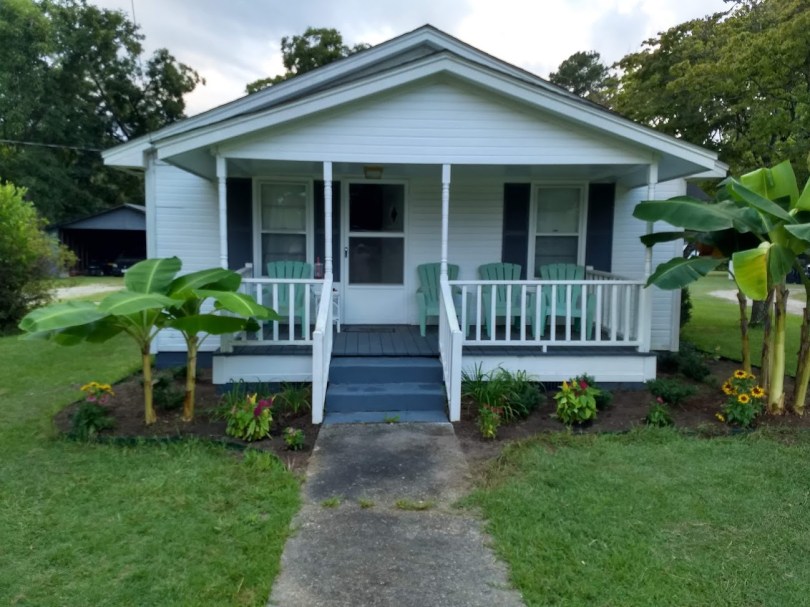
After a week of incredibly hot weather here in South Carolina, Saturday brought a blessed drop in both the temperature and humidity—a foretaste of autumn.  My girlfriend and I spent Saturday weeding my disgracefully overgrown flower beds, which were mostly weeds strangling the life out of everything but the hardiest of perennials (and my robust banana trees).  We then did some new plantings (with a few more to put in, as well as some mulch).  The results were pretty good:
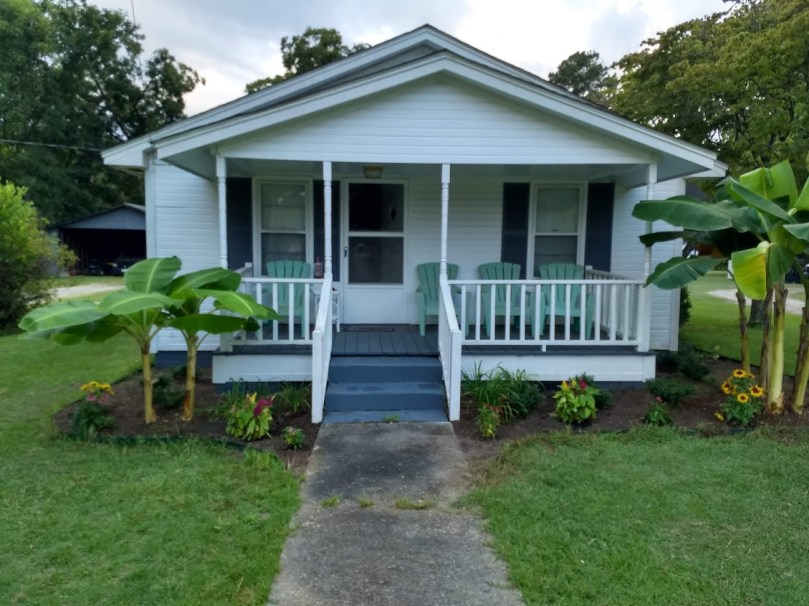
Lamar House - After Planting, 5 September 2020

It felt good to get our hands (and clothes, and faces) dirty, digging through the dirt and nurturing plant life.  My mother is an expert gardener, so I’ve picked up a few simple techniques from her; otherwise, we just bought flowers we liked and plopped ’em in with some in-ground bedding soil and a some water.  Fingers crossed that everything survives.

My mind has been on the soil lately, and our connection to it.  I have a fondness—perhaps a tad romantic—for country life.  With current trends in the cities—rising home prices, rising property taxes, and rising urban violence—country life seems like an attractive, even inevitable, alternative.

As such, I thought I’d dedicate this week’s Lazy Sunday to some pieces about rural America:

  • TBT: Rustics Have Opinions, Too” – This piece dates way back 2009, when the blog was in its first iteration on Blogger, and I was still enthralled with “Randian-libertarian economic” philosophy.  Such are the follies of youth.  However, I did notice even then the deep disdain of limousine liberals for the rest of us here in “flyover country,” a disdain that, at least in part, accounts for the TEA Party movement and the Trumpian revolt of 2016.
  • High-Tech Agrarianism” – When The Virus hit, people were in a tizzy about having enough toilet paper and food.  People gained a renewed interest in gardening as a source of sustenance, not just beauty.  In this post, I mused about a possible return to small-scale homesteading, coupled with our advanced information technology.  Essentially, I posited a world in which people still work, albeit increasingly from home and on more flexible hours, and can use their time to tend to small crops to supplement their diets.
  • SubscribeStar Saturday: The Future is Rural” – One of two recent posts on the lure of rural America and small town life, I argue here that life in the country offers many attractive incentives for working families.  Not only are cities pushing people away with high prices and crime; the country is ready to take in telecommuters who earn good money but want a low cost of living in a safe, healthy environment.
  • SubscribeStar Saturday: Small Town Natalism” – The second post in my Saturday series about small town and rural living, this post is a preliminary sketch of a policy proposal:  applying nationalistic, pro-birth natalist policies to the small town context.  Instead of wasting money on seldom-used public facilities, local governments could offer a stipend to married families with children to encourage increased birth rates.  That would grow towns organically and attract new residents, thereby broadening the tax bases in often distressed rural areas.

That’s it for this week.  The garden is calling to me.  Time to put down some mulch!

—TPP

Other Lazy Sunday Installments:

Support The Portly Politico

As I’ve written elsewhere, it’s been a tough year for musicians.  Fortunately, things are looking up on that end, at least for yours portly.  With school starting back this week, I’m hoping some of my old students will be comfortable with resuming one-on-one lessons, especially after sitting in class all day with other students (and with our new sanitation and safety protocols).  Still, 2020 will be a down year for lessons revenue, and especially for gigs.

In brighter news, The Portly Politico has more followers and subscribers than ever.  Currently, my SubscribeStar page has seven subscribers, three of whom are subscribed at the $5 tier.  Thanks to their support, the blog is bringing in $15.38 a month after SubscribeStar takes its cut.  That may seem like small potatoes, but that support means more than the dollar figure suggests.

If you haven’t already, I’d encourage you to subscribe$1 a month is an easy lift, and considering the back catalog of posts is growing every week, the value of that investment continues to grow.  If you’re already a $1 a month sub, you may want to consider upgrading to a $5 a month subscription.

I’m also introducing more perks for $5 a month subs.  So far, the $5 tier has been the same as the $1 tier, just with Sunday Doodles tossed in.  Last week, I included some bonus doodles.  I’ll be doing that more frequently—not necessarily weekly, but often enough to make it a fun surprise.  I’m also going to be uploading more music, especially material that can’t currently be found on my Bandcamp page.

During distance learning, I amassed a treasure trove of history and government lectures.  I’ll be uploading some of those for $5 subs, probably starting with the Second World War lectures.

Finally, select Fridays this fall will be “Five Dollar Fridays,” posts that will be largely dedicated to 2020 election coverage and analysis.  As the name suggests, those posts will be exclusive to $5 and up subscribers.

Naturally, I’ll continue to offer free weekly content Sunday through Thursday, and some Fridays.  We’re closing in on 600 days of posts, and two years is about 134 posts away.  Of course, if you’re not subscribed, you’re missing out on 116 posts (as of this writing)!  That’s a ton of content (and doodles).

If you’re interested in a subscription, sign up here or here.  If you know of someone who might be interested in paying a small fee for quality content, please forward this blog post them, or send them here.

One final pot-sweetenerif we hit 10 subscribers—at any level—by the end of August 2020, I’ll upload some special, surprise content for all subscribers.

Thanks again for your support—and your patience with yet another sales pitch.  It is truly appreciated.

God Bless,

TPP

TBT: Painting

This summer was the first in probably seven years that I took off from maintenance work at school.  However, last Friday I received a call from the head of our Buildings & Grounds Department, calling me out of semi-retirement for one final score:  painting classrooms.

It was nice to get back to painting, an activity I’ve always enjoyed.  It’s a bit tedious, but I appreciate the almost immediate gratification:  I can see my progress as I go.  And today’s paints often allow for finishing a job in one coat, maybe with some minor touch-ups.

I put in seventeen hours of painting in three days, and now I’m back to funcling for one more day, this time with my niece and nephews’ other uncle pitching in (a trip to Chuck E. Cheese is in the works) before teachers report back for the new academic year.

Well, back to the kiddos.  Here’s 24 April 2019’s “Painting“:

Tonight’s post is one of those self-indulgent entries that has little bearing on what’s happening in the world today, but it’s germane to why this post is so late to arrive.

I spent the day painting in my brother’s finished basement.  He and his wife have this great living area/playroom for their kids down there, but there was a great deal of trim work that needed painting, as well as baseboards.

I spend many of my summers working maintenance at school, which usually involves painting classrooms.  There’s something about slapping a fresh coat of paint on a room that makes it look like there have been major upgrades or improvements, when really you’ve just changed the color.

Of course, everyone loves that fresh paint smell, and new paint does look good.  A change in color can dramatically change the atmosphere of a room—it’s “feel,” if you will.

This post, however, is more about the process of painting.  While I am thankful I do not have to paint for a living, it is an activity that I enjoy on occasion, usually because I’m getting paid to do it (as was the case today—thanks, bro).  Beyond the financial benefits, the act of painting is akin to driving long distances on the Interstate:  it’s a bit tedious, but it clears the mind wonderfully.  I’ve done some of my deepest thinking done while painting walls.

There’s also a tangible pay-off to painting:  the finished product is very satisfying.  What’s more, the process itself is rewarding, as you watch your progress unfold in real time.  There is little in the way of “busy work” in painting a room.

So many jobs today, especially of the clerical sort, seem to be about spinning wheels in an attempt to appear productive.  I’m convinced that huge sectors of our economy consist of such paper-pushing.  Just look at the excessive credentialing that underpins so many fields, like education, without tangibly improving the quality of the professions.

In painting—as in my blue-collar trades—there is little room for such wheel-spinning.  The job either gets done, or it doesn’t.  Unreliable contractors baffle me for this reason (and they are common in the rural South, as I suspect demand drastically outstrips supply), although the problem there is usually getting the project started.

Regardless, the job must be done.  If it’s not done, it’s noticeable, especially when painting.  A missed spot on the wall is like starting at the pirates’ black spot in your hand.

Of course, painting takes its toll.  My entire body is sore from bending and stretching all day (I was switching between trim on the ceiling and baseboards on the floor, as well as some window trim and door frames).  Anecdotally, I’m told that many professional painters are drunks.  I don’t know if that’s true, but I’ve heard it from enough different people that there must be some kernel of truth to it.  What’s the connection?  (Apparently, paint fumes, but that’s not a huge problem, I’ve found, with latex paint in well-ventilated areas.)

That said, I will sleep soundly tonight, and enjoy a sense of serene accomplishment.  Painting today was a wonderful way to refocus my mind and to help me calm down after a busy, extended Easter Weekend.

Happy Wednesday!

–TPP

Trump’s One-Two Punch

Trump won in 2016 running on a strong “America First” platform.  A major component of America First-ism is prioritizing the interests and the well-being of American citizens first—before the interests and well-being of foreign-born workers and immigrants, legal or otherwise.  The appeal and the concept aren’t difficult to understand:  a government should, chiefly, operate in the interest of its citizens before anyone else.  We can discuss the best immigration policies as a nation, but those policies should always place American citizens at the forefront.

It’s such a simple and pure political philosophy, it’s a wonder it comes under such fire.  But such is the world of globalists—who want cheap labor and sacrificial offerings to Efficiency—and progressives—who think anyone who is white and cares about having a job is a racist.  Take out the mercenaries (the former group) and the insane (the latter group) and you have reasonable people, those folks that might quibble around the edges of America First doctrine, but can’t disagree with its fundamental premises.

Trump has been better than most of his predecessors on immigration, though his waffling and equivocating—likely the product of Jared Kushner’s influence—have soured his some of his earliest supporters.  His turn on Jeff Sessions and the former Attorney General’s ultimate defeat in the Alabama Republican primary this summer seemed to many Trumpists to be a betrayal of immigration patriotism.  Sessions was, indeed, the leading voice in the United States government, pre-Trump, in denouncing open borders and unlimited immigration.  With Sessions leaving the national scene, immigration patriots and restrictionists have reason to worry.

That said, it bears remembering that Trump won the presidency campaigning on building a wall, prioritizing Americans over foreign workers, and keeping American industries at home.  No one in meaningful national politics (other than Jeff Sessions and Pat Buchanan) was beating that drum prior to Trump.  Trump tapped into a deep well of resentment over the Obama administration’s decade of putting middle-class Americans last, and several decades of neglect and open scorn from national politicians.

I also don’t expect Trump to reverse the postwar consensus overnight, or to get the whole loaf all at once.  I think Trump’s basic instincts are to put Americans first, while weighing the complexities of various interest groups and economic factors.

But Trump is at his best when he cuts the Gordian Knot and drives to the heart of the issues.  If Americans are losing jobs to foreign visa holders, well, make those visas less valuable.  He’s done that with an executive order barring H1B visa holders from working in federal government jobs, and barring the government from using contractors who use H1B visa holders.

Read More »

TBT: Hustlin’: Minecraft Camp 2019

It’s been a week to talk about video games (I even found a downloadable version of SimEarth that runs in DOSBox, which is one of the nerdier sentences ever written), and my annual Minecraft Camp is less than two weeks away, The Virus permitting.  As such, I thought I’d look back to last summer’s post about camp for this week’s TBT.

The post mostly goes into some of my side gigs, and talks about the weather (we had a blessedly pleasant spring this year, unlike 2019).  My private lessons have died down a bit due to The Virus, but I’m hoping to get those going again soon.

That’s about it by way of preamble.  I’m still recovering from the after effects of this little stomach bug.  The plumbing is fine, but I’m still a bit weak.  Hopefully I’ll be 100% by the time you read this post, and posts will get back to their usual quality soon enough.

With that, here is 2019’s “Hustlin’: Minecraft Camp 2019“:

The June slump has hit, as people are less interested in news and politics and going outside.  It’s been a gorgeous few days here in South Carolina.  I left the house Wednesday morning and it was cold.

For non-Southerners, allow me to explain:  here in the Deep South, our only true season is summer, which runs from late March through Thanksgiving.  I’ve seen people mow their lawns a week before Christmas.  If we’re lucky we get a mild summer.  After an oppressively muggy May, a morning in the low 60s is a blessed reprieve here in the Palmetto State.

But talking about the weather is probably why my numbers are down, so I’ll move on to another non-politics-related topic:  my penchant for hustlin’.  Readers know that I have a few gigs running at any time, including private music lessons, adjunct teaching, my History of Conservative Thought summer course, and playing shows.  I also paint classrooms and do sweaty manly maintenance work at my little school when I’m not molding minds.  And while it doesn’t pay anything yet, I’m hoping to get a few bucks for my writing.

But perhaps my favorite side gig is an annual tradition:  my school’s annual Minecraft Camp.  A former school administrator started the camp, and I’ve carried it on for some years now.

For the uninitiated, Minecraft is basically LEGOs in video game form.  The genius creation of programmer Markus Persson, the game places players in a massive sandbox world, with the objective being… anything!  There are no timers (other than a day and night cycle), no goals, and no ending.  Players generate a theoretically endless world from scratch, and proceed to build—craft—their way to civilization (or endless PVP battles).

Players can activate Creative Mode, which allows for endless flights of fancy, with access to every block and resource in the game, or they can play in Survival, which is exactly what it sounds like:  players hide from (or fight) monsters at night, hunt for or grow food, and have to keep their health up.

Minecraft has enjoyed ubiquity since its release in 2011—it’s the best-selling video game of all time—and when we started Minecraft Camp back in the day (I think it was summer 2013 or 2014, but I’m not sure), it was HUGE.  The game has inspired probably tens of thousands of mods, from simple additions like extra monsters or types of blocks, to total conversions that completely rebuild the game’s mechanics.

With the rise of Fortnite a year ago, the game seemed to wane in popularity, but it’s apparently enjoying a resurgence:  our camp was up to twelve Crafters from a low of about four or five last year.  It gets absolutely chaotic at times—like during our final camp PVP battle, and a hectic boss fight against a gigantic, camper-created Creeper named “Creeperzilla,” that saw kids shouting nearly at the top of their lungs with unabashed glee—but it’s also beautiful to see the creativity of young children.  I am constantly amazed to see what they create.

And, let’s face it, there are worse ways to make an extra buck than playing video games with a group of creative eight-to-thirteen-year olds.  It definitely beats raking up old pine straw and spraying Roundup on cracks in the parking lot.

You can check out our camp’s blog here:  https://tbcsminecraft.wordpress.com/

Nintendo Labo Piano

Apologies for the late post today.  I spent the day with my niece and nephews (all under five) playing—and working on this piano:

My family was and is a Nintendo Family.  Kids today don’t appreciate the Console Wars, but in the late 80s/early 90s, you pretty much had to pick a side—Nintendo or Sega.  You had to make the choice because, outside of some rare exceptions, your family couldn’t afford both.  Even if you could, it wasn’t cost-effective:  a Nintendo cartridge alone would run maybe $40 or $50 in 1990.

So we fell on the Nintendo side (our cool next door neighbors, from Wisconsin, were Team Nintendo, too).  Our nerdier-but-still-cool-to-us neighbors across the street were a Sega family.  Crossing Ridgemont Drive was like visiting another country that was sort of like your own, but different enough to be noticeable, and to stir up fond feelings for your own tribe—like visiting Canada.

Read More »

Lazy Sunday LXII: The South

Poet Archibald MacLeish wrote that the American “West is a country in the mind, and so eternal.”  The American South may be the same, but it’s more—it’s a country in the soul.  It’s the culture, the faith, the land, the people—these elements truly make the South “the South.”

The South has been changing for a long time, but those old virtues are still present here, even if they are fading.  The wickedness of modernity probes its tentacles into every crevice of every society, and the South is no different.  We’ve managed to capitalize on the material benefits of modernity without sacrificing our souls entirely—yet—but the unrealized dream of the Reconstruction Era Radical Republicans to remake Southern society into the image of the North is rapidly becoming reality.

That said, the South and its more adventurous cousin, the West, have managed to hold onto the important things in life, namely faith, family, and work.  In the United States, the vast belt from my native South Carolina in the east, driving westward to Texas, and up through at least Nebraska (that’s for you, NEO), still maintain sanity in a nation that is increasingly unhinged with an addiction to postmodern progressivism.

Not to say that Northerners don’t love their families or God, but the governing ethos of Yankeedom is materialist efficiency über alles.  Even the terse attitudes and abrupt styles of conversation suggest little room for even the most cursory pleasantries.  The propensity with which Northerners sling around f-bombs is one of the more dramatic reminders of what cultural differences exist between America’s two great regions even to this day (although, alas, I hear more and more Southerners engaging in sloppy manners and foul language).

But I digress.  I’ve made enough sweeping generalizations for one Lazy Sunday.  You can read more of my sweeping generalizations about vast swaths of the country in these essays, all about fair Dixie:

  • Southern Conservatism: John Randolph of Roanoke” – I somehow had never learned about John Randolph of Roanoke (outside of a reference in Richard Weaver’s Southern Essays) until teaching History of Conservative Thought during Summer 2019.  This post was all about the feisty—some might say ornery—Virginia statesmen who constantly strove to keep Virginia strong and the federal government weak.
  • Reblog: Conan the Southern?” – This post looked at better post from The Abbeville Institute about Texan Robert E. Howard, the creator of Conan the Barbarian.  Howard’s tough Texas upbringing and Jacksonian derring-do inspired the ferocious barbarian hero, a self-made man in a world of evil wizards and sinister forces.
  • The Hispanicization of Rural America” – After driving through some parts of western South Carolina and noticing there were only Hispanics, I wrote this post, lamenting the replacement of white and black Southerners.  Here’s the key paragraph:

    I don’t like seeing my people—the people of South Carolina—being displaced in their communities by foreign invaders who speak a different language, who don’t care about our Constitution, and who don’t want to adopt our hard-won culture of liberty.  It took from 1215 to 1776 to get from the Magna Carta to the Declaration of Independence; do we really want to throw away 561 years of Anglo-Saxon common law and careful cultural-political development in the name of multiculturalism?

  • The Invasion and Alienation of the South” – The Abbeville Institute is the gift that keeps on giving.  This post discussed an essay called “A Stranger in a Strange Land,” about a young Louisiana woman’s sense of total alienation in an ostensibly Southern city, Dallas.  She also details the leftward shift, politically, of Southern cities, which I have observed in nearby Charlotte, North Carolina—increasingly a colony of Ohio.
  • The Cultural Consequences of the American Civil War” – An instant-classic in the TPP archives, this post originated as a LONG comment on “What Do You Think?,” a post on NEO’s Anglophilic blog Nebraska Energy Observer.  I make some bold claims about the good that was lost following the Civil War—like liberty.

Bless your heart,

TPP

Other Lazy Sunday Installments:

SubscribeStar Saturday: Making Music

Today’s post is a SubscribeStar Saturday exclusive.  To read the full post, subscribe to my SubscribeStar page for $1 a month or more.  For a full rundown of everything your subscription gets, click here.  NEW TIER: $3 a month gets one edition of Sunday Doodles every month!

The past few days I’ve really been pushing my music (see here and here), mainly because Bandcamp waived the commission it takes on sales of musicians’ work yesterday (1 May 2020).  They’re foregoing their cut again the first Friday of June 2020, so I’ll likely be pimping out my electronic ditties again in a month (although, of course, feel free to pick up tunes any time).

I’ve maintained that Bandcamp site the better part of a decade, and until this week, I hadn’t made a single sale.  Perhaps the poor-mouthing about the impact of The Virus on musicians opened hearts and wallets.  To those of you that did purchase my work—I sold seven copies of my full discography (seven releases available now for $15.75), with many buyers paying more than the minimum—I offer a big and hearty THANK YOU.  Seriously, you have no idea what a morale boost it is to have your support.

As for the poor-mouthing, one of the lessons I’ve learned about music is that fans aren’t buying the music, per se, although that does have to be good; rather, they’re buying you and your story.  It’s a frustration for many artistic types that they labor over their art, putting all of their heart, soul, sweat, and blood into it, only to see people more interested in their personal lives than their music.

To read the rest of this post, subscribe to my SubscribeStar page for $1 a month or more.

Counting Blessings

After writing yesterday’s blog post about our diminished prosperity, I was quite upset.  I am an emotional sort, given my brooding artistic temperament, and I should know by now that complaining about money and the state of the world will only work me up—or, perhaps, down—into a blue funk (or, occasionally, a purple rage).

So today’s post is meant to be a yellow counterpoint.  It’s easy for me to fixate on negatives.  That’s pretty much the nature of blogging and commentating about politics and culture.  And while I am optimistic for the future, I am a declinist:  I can’t help but notice that much of culture is, at best, a stagnant swamp (hiding away the occasional orchid); at worst, it’s a swamp draining into a desert.

But enough that.  Today’s post is about counting blessings.

Read More »

TBT: End the Income Tax

Last week I went through the annual ritual of paying my income taxes.  For the second year in a row, it’s been a painful experience.  I’m finally at the point in my life where I end up owing money to the federal government, which has only made me more conservative, if that was possible.

Part of the problem is that I slam so much money into my retirement (the legal annual maximum each year into my HSA, my 403(b), and my traditional IRA) that even with increases to my federal withholding, I still fall short.  It’s because a good chunk of my income in 2019 came from private music lessons, gig guarantees, tips, and merch sales at gigs.  I brought in around $9099 from those combined (with the lion’s share of that revenue coming from private music lessons).  My brother tells me I’m probably going to have to start filing quarterly, although The Virus has pretty much killed that side business for the time being.

My taxes took hours to complete, too, as I painstakingly recreated all the mileage I drove for lessons and gigs (now chastened, I am going to maintain a mileage log in my vehicle).  Combined, I drove around 6011.4 miles last year just for lessons and gigs.  WHOA!

Of course, the IRS is now privy to all of that information.  I keep a very detailed budget, and carefully track every transaction, cash or otherwise.  And, naturally, no good deed goes unpunished.

Wouldn’t a national sales tax be easier, and less invasive?  Or maybe a restoration of the old-school tariff regimes of the nineteenth century?  Sure, the congressional battles over tariffs nearly brought South Carolina’s secession in 1832-33, but I’d rather importers pay more (yes, yes—I know the costs will passed on to me, the consumer) than have to divulge my every move to the feds.  Plus, I’d gladly pay another couple of hundred bucks for my washing machine if it means an American worker gets a job and can have some pride in working.

Anyway, the tax man has gotten his share, and I’ve received a decent refund from the great State of South Carolina, so that eases the pain.  Of course, I’m still patiently awaiting my inflationary TrumpBux.  I suppose beggars can’t be choosy about their government’s preferred form of institutional shakedown.

With that, here is 15 April 2019’s “End the Income Tax“:

Today is tax day.  Despite President Trump’s signature tax reform, I ended up owing money to the feds for the first time in my adult life (although I’ll be getting a bit back from the State of South Carolina).

The income tax used to be unconstitutional in our Republic.  Indeed, the primary way that federal government gained revenue was from tariffs on imported goods and excise taxes on certain products, like whiskey.  Alexander Hamilton advocated for high protective tariffs to protect young domestic industries from British manufacturers, who were “dumping” cheap British goods into the infant nation (a practice China has taken up today).  Only during times of war, such as the American Civil War, did Americans have to endure a tax on incomes.

Like most odious, liberty-killing measures, the income tax was a Progressive Era project, ratified in the 16th Amendment (followed shortly thereafter by the 17th Amendment, which made US Senators directed elected, and the 18th Amendment, which prohibited the manufacture, sale, and distribution of alcohol).  Progressive reformers assured Americans that only a very small proportion of Americans would ever pay the income tax, which was graduated from the beginning.

That claim was true… for the first year.  Immediately, Congress began ratcheting up tax rates and requiring more Americans to pay it.  Governments are hard-pressed not to exploit a newfangled method of raising revenue.

The income tax is not all bad:  it’s a more stable source of revenue that tariffs, which depend upon foreign imports.  No imports, no taxation.  Advocates for the graduated income tax, like Tennessee Congressman and future Secretary of State Cordell Hull, argued that, in the event of a major war in Europe (which broke out a year after the 16th Amendment was ratified), international trade would fall, bringing collected duties down with it.  That was a prescient observation, and a strong argument in favor of some kind of domestic tax.

That said, the income tax is incredibly invasive.  Every year, I lament that the federal government has to collect so much information about me:  where I worked during the fiscal year, how I saved my money, etc.

According to Scott Rasmussen, 52% of Americans favor repealing the 16th Amendment.  Count me among them.  The income tax gives the government far too much influence over our lives, and the federal tax code is so byzantine and full of carve-outs and exemptions, it’s become the purview of the well-connected.  It’s become a corporatist monstrosity.

What would replace the income tax?  Given that it’s likely never to be repealed—governments don’t typically diminish their power (or access to other people’s money)—the question is largely academic.  Still, it’s worth considering.

While I think tariffs can serve a useful purpose (see also: bringing China to heel), and that there’s an argument for some mild protectionism, high protective tariffs like Republicans championed after the Civil War would be ruinous to trade.  The deadweight loss (destroyed economic activity) associated with tariffs—especially from the inevitable retaliatory tariffs other nations would pass in response—would do more harm than good, and could result in a Smoot-Hawley Tariff of 1930 situation (i.e., the Great Depression).

The only realistic alternative that I see currently (from my admittedly myopic position) is a national sales tax.  There are some serious drawbacks to this approach, to be sure, but it would be the cleanest, most efficient way to generate revenue.

A national sales tax would encourage saving and work, both of which are currently disincentivized under our current tax regime.  Instead, purchases would be disincentivized, which would hurt sales, but encourage people to hold onto more of their money.  Further, it would not require the government to keep elaborate tabs on every worker; the Internal Revenue Service could be greatly reduced, or even eliminated.

Of course, any tax is a necessary evil, and a national sales tax would make it more difficult for high sales tax States to raise revenue (as it would limit those States’ ability to increase their taxes if necessary).  It would also slow purchasing, and necessarily raise prices (by definition, especially if you’re tacking 15-25% on top of a good).  There’s also the question of whether a sales tax should just apply to consumer goods, or if it should be an uber-expensive value-added tax, with each economic transaction along the chain of production getting taxed.

Those are sticky questions for wonkier types than I to sort out.  But wouldn’t it be nice to build an economy on the production of real value—of stuff—rather than one built on ever-expanding sales, purchasing on credit, and debt financing?

Regardless, the federal income tax is a major imposition, an invasive intruder that enters our lives every April, borrowing from us (without interest!) throughout the year, and intimidating us with the looming threat of disruptive audits.  It seems everyone would be happier—even, in a way, the feds!—if it were eliminated.