Saturday Reading: SOTU and the Shutdown

A quick post today, as I have a jam-packed Saturday (after a jam-packed week, with another busy week on the horizon—it’s the Year of the Panther, baby!):  the President has reached an agreement to reopen the government for three weeks, it seems in order to get paychecks out to Homeland Security and federal law enforcement more than anything else, with the promise (threat?) to leverage another government shutdown in February to obtain border wall funding.

This compromise feels like a loss; I can only hope President Trump has some clever scheme up his sleeve.  From what I’ve been hearing (most recently on today’s episode of Radio Derb), the polls have shown Americans steadily blaming Trump for the shutdown.  Of course, this prompts me to ask, “do they see the shutdown as positive or negative?”

Certainly there are good federal employees who need paychecks, especially border patrol agents and federal law enforcement, but how many of you actually felt the effects of the shutdown?  At the very least, let’s hope the President took Ben Boychuck’s advice, as well as the advice of his anonymous senior official, to layoff permanently some of the dead weight in the federal bureaucracy.

As Boychuck writes in the Sacramento Bee:

Everyone knows the president cannot fire career government employees willy-nilly. Our civil service laws are ironclad. But a fairly obscure rule would allow the administration to lay off certain workers if they’ve been furloughed for at least 30 days. It’s called a “reduction in force” and it’s perfectly legal as long as the White House adheres to certain criteria, accounting for an employee’s tenure, total federal and military service, and work performance.

According to Boychuck, some 350,000 federal employees are eligible for “reduction in force” according to this obscure rule.  I don’t think anyone is advocating laying off all of those people—surely some 5-10% of them perform useful functions and/or aren’t totally subvervise to the President’s agenda—but I imagine we could do without at least some of them.  Surely even a token culling of the herd would send a powerful warning to feds:  you work for the American people, not your second home.

A part of me worries that our peacocking POTUS might be reopening the government simply to give the State of the Union Address in the House chambers.  That would be a bad move.  The Constitution doesn’t specify the form or venue for the SOTU address.  In fact, it doesn’t even have to be a verbal “address” at all!

Thomas Jefferson—timid about public speaking, and fearful of the kingly connotations—stopped giving a verbal address upon taking office in 1801.  Instead, his annual message was sent to Congress and read aloud by the Speaker or another member, then published throughout the States in newspapers.  Everyone could easily read it, and this approach made perfect sense in a pre-mass-communications age.

The Jefferson approach endured until the presidency of Democrat and progressive Woodrow Wilson.  Remember, Wilson hated our Constitution (PDF), and believed it was an archaic document that did not work adequately in the dynamic, industrial world of the early twentieth century.  He idolized the British Parliament, and sought to make the presidency more akin to the position of Prime Minister—the first among equal voting members in the legislature.  He believed that approach, called fusion of powers, was more efficient and democratic (“democratic” in those days being the Left’s preferred way to advance progressive ideology and policy, though in practice that meant electing representatives who would farm out their law-making powers to unelected technocrats in the federal bureaucracy).

Regardless, the die was cast, and with the advent of television, the State of the Union Address has become a ponderous, grandiose political event that doesn’t really tell us anything useful about the state of the nation, but just how awesome whoever the current president is.  This time, those boastful claims would be mostly true, but was it worth reopening the government to do it on time?

Boychuck, among others on the Right, were calling for the President to end the modern, monarchical spectacle of the State of the Union, returning it to Jeffersonian simplicity.  As much as I don’t want to deny the president his moment in the sun, that approach seems prudent, and more in accord with the republican nature of our Constitution.

TBT: Rustics Have Opinions, Too

I first launched The Portly Politico on Blogger back in 2009.  It was a different world back then, and I was a different conservative.  I was probably still deep in my Randian-libertarian economic conservative phase:  I sincerely believed neoliberal economics and mostly unbridled capitalism could solve almost all of the world’s problems, which meant I was fundamentally progressive in my outlook, “progressive” in the sense of taking a Whiggish view of human history—yes, some things are bad now, but they’ll inexorably get better as we expand free trade and free movement of peoples across borders.  Heck, I even thought that, as a Christian nation, America should take in illegal immigrants!

Such are the follies of youth.  Intervening years of lived experience—not to mention the increasingly overt radicalism of the Left—have convinced me that, as wonderful as free markets are, we’ve tended to sacrifice real lives and communities in exchange for cheap plastic junk.  I’ve also considerably altered my views on immigration; at this point, I think America needs 150 milligrams of Deportemal (and a healthy dose of limiting legal immigration, too).

One thing that hasn’t changed:  I still identify with the struggles and values of rural America.  In this 2009 post, I pointed out the growing contempt for rural Americans that the Democratic Party now openly embraces.  I think I was overly-generous to the author of the piece discussed herein, however; upon re-reading Kevin Baker’s essay “Barack Hoover Obama,” I’m chilled by how openly he argues for the usurpation of usual constitutional order and division of powers in order to push for “change.”  I apparently missed it completely ten years ago, much to my current chagrin.

Back then, I remember conservatives having some mild optimism that President Obama would govern as a pragmatic moderate—left-of-center, to be sure, but reasonable.  Then he forced through the Affordable Care Act on a purely partisan basis, alienating Republicans and contributing to the deep ideological divide in America today.  His administration doubled down on identity politics, reopening mostly-healed racial wounds.  Much of the cultural chaos we suffer today is the result of the twin evils of Senator Teddy Kennedy’s 1965 immigration bill and President Obama’s politics of racial grievance.

So, that’s my apology for my naivety as a young, portly man.  That said, here is 2009’s “Rustics Have Opinions, Too“:

I’ve noticed something about the American Left, specifically those members who claim to be “cultured”: they share a distrust and even hatred for rural Americans. They constantly mock the values, feelings, and politics of this oft-derided constituency, framing them as stereotypical “rednecks” or “good ol’ boys” who spend most of their time polishing their guns drunk while watching NASCAR.

Let’s face it: stereotypes exist for a reason. Think of any offensive stereotype and there’s a kernel of truth to it. But that doesn’t mean we should go around judging people based on those stereotypes. Liberals are making that point all the time, and in this case they’re actually right. As usual, though, they fall back into their old, hypocritical ways when it comes to rural Americans. It’s “hate speech” if someone insinuates that an Asian is good at math, but it’s perfectly acceptable to laugh at someone who’s only skin pigmentation is on the back of his neck.

I’m not saying that having a sense of humor is wrong. Maybe white guys really aren’t as cool as black dudes when they drive. Dave Chappelle had tons of great material and Boondocks deals with race relations in the United States today better than any other show out there. I want to make it clear that I have nothing against humor. By laughing at stereotypes, we rob them of their power, rather than adding to it.

The same holds true for “rednecks” or “white trash” or whatever label one uses. If it weren’t, Jeff Foxworthy would be out of a job. The problem arises, however, when we start to marginalize those Americans because of the stereotypes that exist. Such marginalization of African Americans, for example, would be roundly denounced by the left, and rightfully so. Unfortunately, liberals often celebrate when such marginalization is applied to the rural white American.

In an otherwise excellent article in Harper’s Magazine entitled “Barak Hoover Obama: The Best and the Brightest Blow it Again,” Kevin Baker indulges in this marginalization to a sickening extent [Note–at the time of this writing, the full text of the article is only available to Harper’s subscribers]. The bulk of the article draws historical parallels between Presidents Herbert Hoover and Barack Obama. Baker’s research is impeccable and his understanding of an oft-maligned (and extremely intelligent) former president is refreshing. He implicitly challenges the more common “Obama-is-to-Roosevelt-as-Bush-is-to-Hoover” analogy and draws some pessimistic conclusions about Obama’s approach to passing many of his long-promised, radically liberal reforms.

A large part of Baker’s argument is that President Obama is proceeding with excessive caution and is relying too heavily on Congress to enact the changes he seeks for the nation (naturally, many conservatives would argue that the opposite is true, but suffice it to say that Baker is approaching Obama’s proposed reforms from the point of view of a liberal supporter–he actually thinks that cap-and-trade is a good thing). Baker maintains that congressional Democrats from states with small populations like Montana are stepping up after years of quiet service to challenge many of Obama’s efforts.

The language Baker uses to describe these representatives and senators is thick with disrespect. He talks about their states as filled with tumbleweeds and ignorance. He implicitly challenges the notion that these congressmen–and by extension their constituents–have no place in contemporary American politics and that they should be brushed aside and ignored, all because they’re impeding Ossiah’s democratic-socialist vision. This viewpoint is shared implicitly and explicitly by most liberals and leftists. The thinking is that because these states have small populations–and don’t have a good place to get sushi or gourmet coffee–they don’t deserve to have a place in the American political system (not to mention the fact that Baker is encouraging Obama to squelch dissent and open discussion, supposed bedrocks of modern liberalism).

What’s most disturbing about this reasoning is that it is anathema to the very structural philosophy of the United States Constitution. The Constitution clearly sets out to create a structure that gives states with large populations more power in the House of Representatives, while allowing states with small populations to maintain an equal footing in the Senate. The same theory exists behind the Electoral College. If our system was not balanced in this way, New York and California would always pick the next president and would exert a dangerous amount of control over national politics (with only conservative Texas able to balance things out a bit). Regional interests do not necessarily coincide with national interests, and what’s good for New York may not be good, and may even be bad, for Iowa.

Yet liberals consistently ignore this inconvenient truth and view it as a stumbling block to their pet projects, whatever they might be. At the risk of sounding like a blowhard conservative talk show host, leftists in America today have no respect for the Constitution except when it is politically advantageous or convenient. Now, I am willing to admit that there are plenty of conservatives who probably treat the Constitution in the same way, but they are much, much harder to find. This disrespect cannot endure for long, regardless of the side.

Therefore, I applaud what these rural Democrats are doing. Maybe they are dusty old relics of the party, but that’s for the Democrats to sort out themselves, and that should not invalidate what these men have to say. Maybe most of them are blowhards and are simply seizing their moment to be in the spotlight or to play to their base, but some of them have useful objections and suggestions. I don’t want to give liberals any additional aid, but it seems to me that they could use all the help they can get in the more rural parts of the country. Taking the interests of rural Democrats more seriously would be a great start.

Kevin Baker and his ilk live in a world of trendy green advertising and mocha lattes. They have no respect for hard working rural Americans–oh, heck, we’ll call them “rednecks”–who help make this country into the wonderful tapestry of ideas and cultures it is today.

Besides, who wants to watch Jeff Gordon race in a Prius?

Championship Beef

One of my favorite writers, Roger Kimball, offers up a beefy analysis of President Trump’s fast food feast for the National Championship Clemson Tigers (the hardest words I’ve ever had to write); you can read it here:  https://spectator.us/trump-burger-masterpiece/

Naturally, the Left is up in arms because, well, it’s Trump.  If President Barack Obama had served fast food burgers, we’d be reading think-pieces on The Root about the historical significance of fast food in the African-American community, and how the meal demonstrates Obama’s “cool, hip” side and authentic blackness.  Of course, because Trump does it, it’s probably racist.

I’ve seen all kinds of criticisms of this fun feast from Leftists.  One of the shots of the spread showed food in plastic containers, and—I kid you not—a Facebook Lefty with whom I’m acquainted complained about all the plastic, presumably because it’s bad for the environment (classist subtext:  food in plastic containers is for backwards rubes).

The president is also catching flak because he joked that if the First Lady had been in charge, the players would be eating salad.  Apparently, that’s a sexist remark.  Gimme a break.

You know these players loved eating Junior Bacon Cheeseburgers, Whoppers, and Big Macs in the White House.

I sure would.  There are few things I enjoy more than a classic cheeseburger from McDonald’s.  It’s got everything you need (those onions are perfect), and it’s a no-fuss, quick, cost-effective meal.  Indeed, the McDonald’s McDouble cheeseburger is probably the most calories-per-dollar meal in human history.

Of course, progressives not-so-secretly find poverty distasteful—thus the abundance of the soy latte set among limousine liberals—and shudder at the food of us common folks.

Kudos to the president for this clever, whimsical gesture.

Fire Furloughed Feds?

In a remarkable op-ed for The Daily Caller, an anonymous “senior Trump administration official” blows the lid off the Deep State in the most sensible of ways: he talks about the good the government shutdown can do for the federal government’s efficiency, and how President Trump can use a prolonged shutdown to drain the swamp effectively.

The explosive piece argues that roughly 15% of workers in Washington, D.C.’s sprawling bureaucracy are committed patriots who want to fulfill the president’s agenda (after all, that is their job). 80% are unmotivated to do anything, because it’s virtually impossible to fire them.

The remaining 5% are Marxian change agents (my description) that are actively involved in the Resistance and are seeking to undermine Trump’s agenda with bureaucratic rigmarole. These are the folks that believe it is they, not the American people, who know best how to manage and direct our lives. Trump represents an existential threat to these sleeper agents for Cultural Marxism and technocratic elitism.

Apparently, an extended government shutdown empowers agency heads and the president to remove non-essential personnel far more easily—they can simply be fired like anyone else, instead of having recourse to a lengthy appeals process that can take years.

Perhaps the most absurd and chilling part of this op-ed is when the writer discusses the mindless fealty to “process,” which fuels agency growth—the bureaucracy exists to expand the bureaucracy:

They do nothing that warrants punishment and nothing of external value. That is their workday: errands for the sake of errands — administering, refining, following and collaborating on process. “Process is your friend” is what delusional civil servants tell themselves. Even senior officials must gain approval from every rank across their department, other agencies and work units for basic administrative chores.

Process is what we serve, process keeps us safe, process is our core value. It takes a lot of people to maintain the process. Process provides jobs. In fact, there are process experts and certified process managers who protect the process. Then there are the 5 percent with moxie (career managers). At any given time they can change, clarify or add to the process — even to distort or block policy counsel for the president.

I can’t help but think that many of these federal gigs are just overpriced ways to give excessively-credentialed but essentially useless workers something to do to keep them busy for forty years. No doubt there are plenty of good, hardworking civil servants in the federal government, but they would seem to constitute the minority. The incentives clearly favor inertia and lack of initiative over real drive and pluck. Indeed, there seem to be strong disincentives against making any changes.

As I wrote recently about education, one of the biggest problems any institution can face is excessive bureaucratization. Yes, as an organization grows, administrative oversight and the establishment of procedures—the dreaded “process”—must grow alongside it.

I’ve experienced this necessity first-hand working in a small private school that ballooned from just shy of 100 students eight years ago to about 285 now. That’s still a small school compared to large public high schools and middle schools, and we still get a lot done through what we might call “informal” procedures and custom, but we’ve increasingly had to adopt more standardized procedures to complete certain duties more efficiently.

But there’s streamlining, and then there’s needless obfuscation. Of course, the byzantine structure of the administrative state is designed to protect its beneficiaries and to expand its size and scope. The more arcane and confusing its procedures, the more folks must be hired to tend to the holy cow of process.

Let’s hope President Trump is listening to whoever this official is, and takes an ax to the loafers and traitors that make up 85% of our federal workforce, then let the Freedom Fifteen Make America Great Again!

National Review Carries Water for The Rock

The cuckier writers at National Review are apparently obsessed with Dwayne “The Rock” Johnson as a potential Republican presidential candidate.  It’s almost as if they acknowledge that a charismatic celebrity with massive name recognition is a political boon, they just don’t like the guy that had the guts to pull it off.

The publication ran a cover story about The Rock—by noodle-wristed particularist and moral scold David French—back in 2017, and Jim Geraghty wrote glowingly about him in 11 January 2019’s “Morning Jolt” newsletter.  The occasion for Geraghty’s blurb was an interview in which The Rock gave a “full-throated defense of freedom of speech”; however, Johnson now says the entire interview was fabricated.

I don’t have anything against The Rock.  He makes movies that people enjoy and is personable.  That said, I know precious little about his politics (everyone’s favorite source, Wikipedia, isn’t much help).  The NR guys seem to think he’s a “natural conservative” (not a direct quotation), and we all know how that works out.

This plumping for The Rock may very well be part of Conservatism, Inc.’s tendency to declare progressive ideas actually conservative, something The Z-Man discusses in his various podcasts (unfortunately, I can’t find a specific example quickly on his blog, though I’ve heard him make this point in numerous podcasts).  As conservatives, I don’t think we can really trust anyone who isn’t explicitly conservative.

Granted, Trump isn’t so much conservative as he is anti-Leftist, but his instincts are fundamentally conservative; his Supreme Court and federal judge nominees are constitutionalists; and he’s surrounded himself with solid conservatives.  Trump possesses a gut-level conservatism, the kind that is more practical than philosophical.

Maybe The Rock has that, too—Trump certainly surprised us—but I don’t get the fascination with him here in 2019.  Of course, I was dead-wrong about Trump back in 2015, so what do I know?  If he runs as a Republican in 2024, I’ll hear him out.  Despite my purist ravings, I’ll take a flawed, uncertain Republican over a Democrat 9999 out of 10,000 times.

Fictitious Frogs and Bureaucratic Despotism

Thanks to blogger photog at Orion’s Cold Fire for sharing this piece about federal overreach and Chevron deference, “The Celebrated Fake Frog that is Taking Down the Deep State” by Karin McQuillan:  https://amgreatness.com/2019/01/14/the-celebrated-fake-frog-that-is-taking-down-the-deep-state/

One of the key problems conservatives face today is the unelected, unaccountable “fourth branch” of the government, the massive federal bureaucracy.  This bureaucracy is so vast, even presidents can’t seem to rein it in (although President Trump is making an effort to drain the swamp).

The size and scope of it wouldn’t be so terrible if it weren’t so powerful.  Thanks to bad Supreme Court rulings and Congress’s willingness to give the hard task of legislating to federal agencies, bureaucrats have the power to write regulatory rules that have the force of law.  As McQuillan details in her piece, Congress passes vague, broad laws that leave politically-costly questions for the agencies to answer.  In turn, those agencies—shielded as they are from accountability to the voters—write whatever rules they wish, and the American people bear the brunt of these technocratic fiats.

That’s one source of President Trump’s woes from within the government:  there is surely an insulated, upper-crust of old Beltway hands that fully expect that they will call the shots.  McQuillan’s piece describes the absolutely wicked absurdity of this overreach, as exemplified by that most heinous of federal agencies, the Environmental Protection Agency.

Seasoned conservatives are familiar with the EPA’s history of insane, downright anti-human rulings, like preventing farmers in drought-stricken California from receiving much-needed water because they sought to protect the tiny delta smelt (fun fact:  the EPA killed more delta smelt when taking samples of their population sizes than would have died had irrigation systems been activated).

McQuillan’s piece details an example of a Louisiana farmer who was unable to use his privately-held land because it was a potential habitat for species of endangered frog—except that biologists argued the land could not support the frog even if someone put it there!  The farmer won against the EPA at the Supreme Court, setting the stage for potential dismantling of some of the Deep State, and its odious grant of power from Chevron deference.

It’s no wonder that the Deep State tried so hard to oust former EPA Administrator Scott Pruitt, and that it continues to punish President Trump with the pointless, costly, politically-motivated Mueller investigation.

As such, let’s continue to encourage President Trump—and the farmers in Louisiana, playing host to fictitious frogs on their dewy lands—to DRAIN THE SWAMP!

Proud Boys

An enduring challenge for conservatives is the constant campaign of disinformation from the Left regarding our organizations, tactics, and beliefs.  Conservatives are limited to a few bastions of barely-tolerated resistance:  the Republican Party, the Cato Institute, National Review, etc., organizations that fastidiously hold to an ever-more-narrow range of acceptable discourse.

That, of course, is a huge source of President Trump’s appeal—he smashed through the barriers the Right’s enemies imposed upon it, and it won him the presidency.  You could feel Americans breathing a nearly-audible sigh of relief that, finally, someone was saying the things we were all told we weren’t supposed to say.

It was in the heady days of 2016, then, that edgy, fun-loving dissidents like Milo Yiannopoulos and Gavin McInnes rose to prominence in the conservative movement.  McInnes tells some sordid stories about his wild, punk rock past, but largely his advice would have been deemed commonsensical just sixty years ago:  get married, have kids, work hard, love God, love Western civilization and the freedom it brings.

Now, uttering some of those same tenants gets you sent to the cultural gulags.  Take, for instance, McInnes’s fraternal organization, the cheekily-named Proud Boys.  The organization has come under fire lately as an allegedly sexist, racist, xenophobic order (it allows men, women, immigrants, and all races to join), and because it is proudly “Western chauvinist,” meaning it champions Western civilization as the best civilization.  Given Western civilization’s inherently universalist claims to human rights and liberty, it’s clearly open to all peoples of all backgrounds who accept its basic premises.

Primarily, however, it’s been criticized for engaging in self-defense.  Instead of taking beatings from radical, violent Antifa terrorists, the Proud Boys fight back.  Their whole maxim is that they don’t start fights, but they will fight back in self-defense.

Not surprisingly, noodle-wristed hand-wringers of the NR persuasion foppishly bemoan this completely reasonable response to unwarranted assaults with their usual appeals to decorum (the comments on that linked piece are instructive of how out-of-touch NR has become even with its own readers).  “Just take the beating” is apparently the primary admonishment.

While we could certainly have some discussion about Christ’s famous instruction to “turn the other cheek,” it seems completely permissible to strike back at the masked hooligan waving a piece of rebar at you.

At the risk of breaking my general injunction against telling people to watch lengthy videos twice in one month, I’d refer you to this excellent explanation from McInnes himself:

https://youtu.be/DGrPjx2V_TA

To alleviate the unnecessary legal suffering of some of the group’s members, McInnes reluctantly but decisively backs out of the organization.

For further reading, here is Milo’s piece about the libelous death of the Proud Boys:  https://www.dangerous.com/50463/i-too-must-bid-adieu-to-the-proud-boys-a-spunky-pro-western-mens-club-defamed-to-death/


Reblog: The Falling Down Revolt

Blogger photog of Orion’s Cold Fire has written a trenchant, insightful essay about the political and cultural revolution occurring in the United States now.  It’s called “The Falling Down Revolt,” taking its name from the 1993 film Falling Down, starring Michael Douglas.

In that film (as photog explains in a follow-up essay, “I’m the Bad Guy? How Did That Happen?“), Douglas plays a disgruntled private defense contractor who, despite obeying all the rules and following the script that was meant to guarantee a decent life, has lost his job, his family, and, ultimately, his sanity.  After facing numerous obstacles and inconveniences of post-modern life—gang violence, traffic jams, fast-food bureaucracy, etc.—the protagonist snaps, going on an intense, cathartic killing spree.

For photog, the film serves as a metaphor for average Americans who do everything they’re supposed to do—work, support their families, pay their taxes, obey the law—but are, in turn, rewarded with scorn, derision, and indifference (or even hatred) from political and cultural elites.  Those elites don’t see these Americans as the backbone of the country, but as “backwards” rubes who cling to outmoded, bourgeois and traditional social values.

Neither photog or myself are suggesting that working- and middle-class Americans should erupt into a bev-rage this summer; rather, the frustration many Americans (including ourselves) feel is that of being hoodwinked.  Instead of the beautiful cheeseburger in the picture, we got a squishy, shriveled mess.

In a comment on photog’s essay, I drew a parallel to the 2018 remake of Death Wish starring Bruce Willis.  To self-indulgently and arrogantly quote myself:

[T]his guy [Willis’s character] that did everything right was screwed by an elite indifferent to and incapable of addressing a rising tide of criminality and violence. He finally broke and took matters into his own hands. I’m not endorsing vigilantism, but he realized he was a chump.

I think (metaphorically) the country has woken up to the chumpitude our elites foisted on us for so long. Tucker Carlson’s monologue diagnoses this malady thoroughly, as you and I have both written about.  (Hyperlink added)

The “Falling Down Revolt” is an excellent name for this movement of normal, traditional Americans who just want a fair shake—and who are tired of being blamed for everyone else’s problems while their own are steadfastly ignored or ridiculed.  Kudos to photog for coining and applying such an apt metaphor.

TBT: Ted Cruz – Conservative Hero, or Traitor to His Party?

Given Mitt Romney’s perfidious WaPo op-edit seemed germane to look back to a seemingly forgotten moment from the 2016 Republican National Convention:  Ted Cruz’s convention speech in which he did not endorse (or, as I noted, not not-endorsed) nominee Donald Trump.  While Senator Cruz has become a steadfast supporter of President Trump’s agenda, at the time it was unclear where the conservative firebrand stood on Trump’s candidacy.

Cruz’s speech in 2016, however, was different in tone, tenor, and emphasis than Senator Romney’s traitorous op-ed.  Cruz fought a grueling series of primaries and caucuses against Trump.  Trump had insulted Cruz’s wife’s looks—a point Cruz made to a group of angry Texans who questioned why the Senator had not endorsed the candidate outright.  And Cruz largely aligned, in practice, with Trump’s policies, albeit in a more conventionally Conservative, Inc. way.

Romney, on the other hand, reeks of the kind of Jeff Flake/Bob Corker Republican who will undermine Trump’s agenda given the slightest chance, in exchange for the fleeting applause of the mainstream media.

Much of the analysis below assumed a stronger, more enduring Never Trump movement within the Republican Party, as well as a less successful Trump presidency.  Trump, fortunately, has exceeded expectations.  His successes on tax cuts, foreign policy, the judiciary, and elsewhere have taken the wind out of neocon sails, and energized the populist-nationalist conservative movement.

With that, here is my lengthy analysis of Senator Cruz’s fateful, mostly forgotten, speech:

On Wednesday, 20 July 2016, Texas Senator Ted Cruz delivered a speech at the Republican National Convention in Cleveland, Ohio, in which he congratulated his primary opponent and Republican presidential nominee Donald Trump on his victory, then urged voters to “vote your conscience” in November.  Boos filled the arena.

What convention delegates were booing was not the admonition to vote their conscience–for many of them, that means voting for Donald Trump–but the lack of an explicit endorsement from Senator Cruz to endorse Trump.

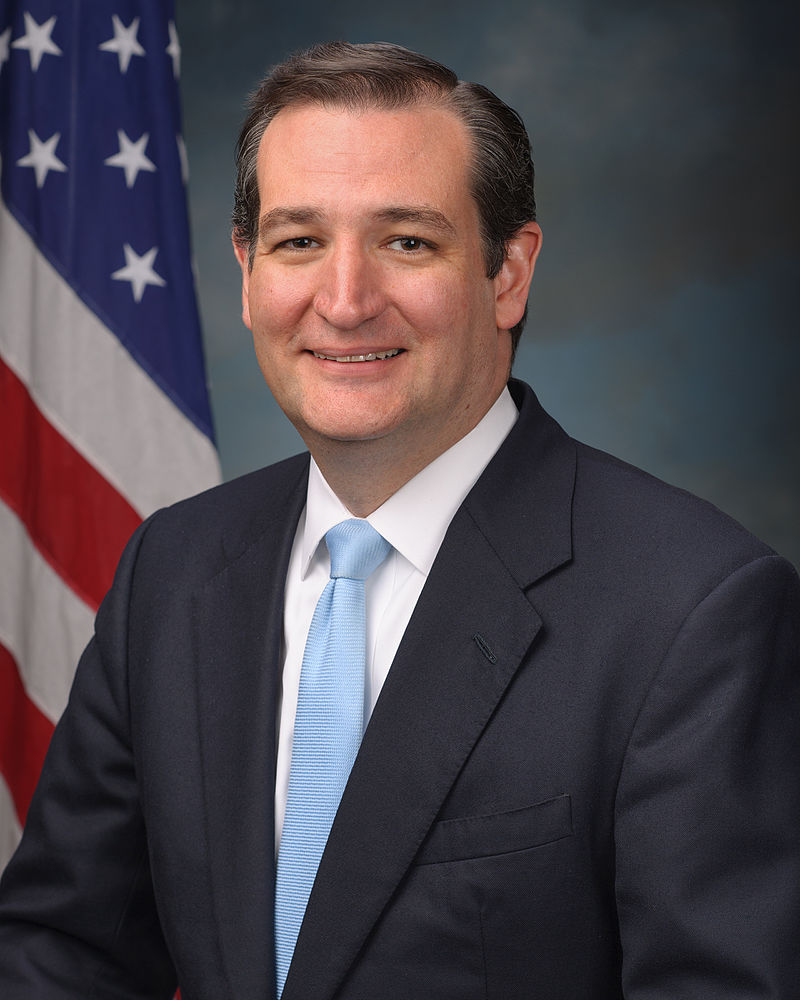
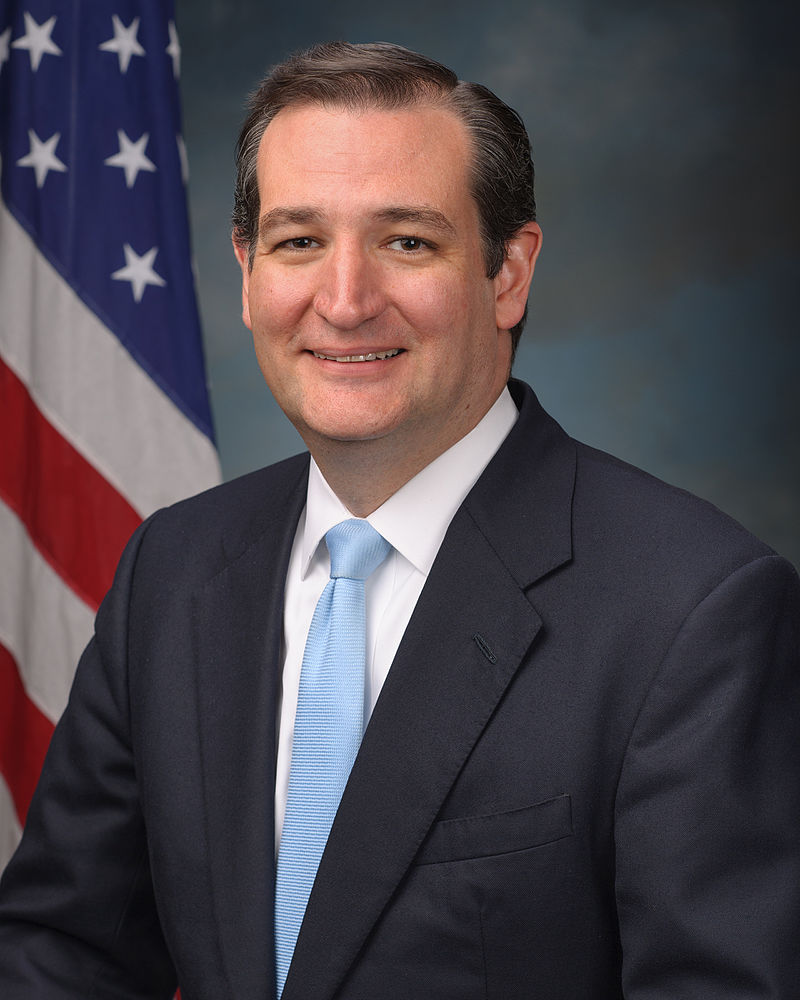
Ted Cruz – not the Zodiac Killer, but almost in as much trouble.
(Image Source:  By Frank Fey (U.S. Senate Photographic Studio) – Office of Senator Ted Cruz, Public Domain, https://commons.wikimedia.org/w/index.php?curid=25195114)

Immediately, two camps formed:  the majority pro-Trump camp, and the dwindling minority of Never Trumpers.  Within the former there are, broadly, two groups:  die-hard Trump fans, who have supported the candidate since last summer; and more tepid supporters who have given their support to Trump because they support their party’s nominee, they won’t support Hillary Clinton, they support elements of Trumpism, or some combination of the three.

The latter camp–I suspect–will continue to lose momentum now that the nomination process is complete.  Some of those voters will reluctantly vote for Trump for fear that a Clinton presidency will irrevocably shift the Supreme Court toward constitutional adaptavism and judicial activism.  Some will vote third-party, probably for Libertarian candidate Gary Johnson, or not vote at all.  A very small minority will vote for Clinton.

The kerfuffle highlights well the tensions inherent in party politics:  when does loyalty to party overcome adherence to principles, and vice-versa?

How these two groups have interpreted Cruz’s speech is predictable.  For the pro-Trump/party unity crowd, they see Cruz’s non-endorsement as a traitorous, duplicitous swipe at the nominee and his supporters, someone who went back on his word to endorse the winner of the primary process.

For the anti-Trump side, Cruz is a hero who stands on principle, even in the face of overwhelming pressure from his party to support explicitly the GOP nominee.  They argue that his pledge to support the candidate became null and void when the Trump campaign attacked Cruz’s wife, Heidi, and insinuated that his father was involved in the Kennedy assassination.

The kerfuffle highlights well the tensions inherent in party politics:  when does loyalty to party overcome adherence to principles, and vice-versa?  To what extent should a voter temper his principles for the sake of political advantage, expediency, or compromise?

These are difficult questions, and they did not start with the 2016 election cycle.  Movement conservatives were frustrated, for example, with the 2008 and 2012 GOP nominees.  They perceived Arizona Senator John McCain and Massachusetts Senator Mitt Romney, respectively, as being inconsistently conservative.  Some conservatives refused to vote for those candidates; many did.  Some voted for them enthusiastically, reasoning that their flaws were better than accepting the progressivism of President Barack Obama, or changing their thinking to align with the candidates.  Others did so more reluctantly.

***

(Full disclosure–and a disclaimer:  I voted for Senator Cruz in the 2016 South Carolina GOP primary.  The analysis to follow does not represent an endorsement or criticism of Senator Cruz’s speech or positions, but rather is an attempt–as fully as possible–at an objective analysis of the reasons for his position, and the consequences of it.  Angry advocates of both sides take note.)

So, which is it?  Is Ted Cruz a hero of the conservative movement, standing on principle at the expense of party unity?  Or is he an opportunistic traitor to the Republican Party?

It’s a tricky question, and both sides have merit.  The pro-Trump majority is broadly correct that, having committed to endorsing the ultimate nominee, Cruz should hold up that endorsement, as many other Republicans have done, if reluctantly.  Take, for example, Speaker of the House Paul Ryan, who has endorsed Trump, but also been quick to criticize the nominee when his statement’s violated Ryan’s principles.

“…while Cruz didn’t outright endorse Trump, he didn’t not endorse him, either, and in no way maimed Trump.  If anything, he mostly hurt himself.”

On the other hand, Cruz in no way denigrated Donald Trump, or even suggested that voters should not vote for him.  Given in any other context, his speech would have received uproarious applause and plaudits from conservatives.  It did not explicitly fulfill his pledge to support the nominee, but it did not seek to criticize or harm the nominee overtly.

Lost in this debate–and in media coverage of the Cruz incident–was one of the best moments of party unity and statesmanship, which came when former Speaker of the House Newt Gingrich started his speech by saying, essentially, that Senator Cruz had encouraged voters to vote their conscience for the candidate most likely to uphold the Constitution.  As Gingrich put it, the only viable candidate for president who would plausibly do so is Trump.

Some may object that Newt’s entreaty was a neat verbal trick, or point out the possibility of voting third-party (though Gary Johnson isn’t viable), but it demonstrated his ability to think on his feet and his skills at diplomacy.  He was able to restore some sense of decorum and unity to the proceedings.

In short, while Cruz didn’t outright endorse Trump, he didn’t not endorse him, either, and in no way maimed Trump.  If anything, he mostly hurt himself.

***
That gets to another question, one that I think is equally interesting:  what, if anything, did Cruz hope to gain from this speech?  Some will say it was free of any political motivation, but that seems unlikely.  Call me a cynic, but I think Cruz has his eye on the future.
I suspect–and, naturally, I could be very wrong–that Cruz is setting himself to win over the support of conservatives who either won’t vote for Trump, or will vote for him with deep misgivings.  He’s also looking for those voters who are becoming more enthusiastic about Trump, but have lingering feelings that they’ve had to talk themselves into liking the candidate a bit too much.  If anything goes majorly wrong in a Trump presidency, these voters may turn to Cruz in four or eight years.
Whether Hillary Clinton or Donald Trump wins in November, Cruz will cast himself as the principled conservative who took a stand when the overwhelming force of his party’s opinion pressured him to do otherwise.  In the event of a Clinton victory, Cruz will attempt to win the GOP nomination in 2020.  In the event of a Trump victory, Cruz is betting on Trump making enough mistakes that enthusiasm for him sours, and in their hour of need, Republicans will say, “this was the man with the wisdom to resist.”  That’s a much tougher path, as it is extremely difficult to challenge successfully an incumbent president for his party’s nomination.
In both cases, it’s assuming an awful lot, and if the reaction at the Quicken Loans Arena Wednesday night is any indication, Cruz miscalculated badly.  But politics is a fickle mistress, and the political scene could look very different in four years.
***
Will Cruz’s speech galvanize the dwindling Never Trump forces?  Or will he spur more conservatives to support the party as a rallying cry against him?  Will he be blamed for splitting the party if Clinton wins?  Or will his gambit pay off, with voters of some distant election year seeing in him a man of principle?
These are interesting questions; ultimately, they are for the voters to decide.

Tucker Carlson’s Diagnosis

A recent monologue from Tucker Carlson’s Fox News program is blowing up the right-wing blogosphere, and understandably so.  Carlson has been a vocal critic of the neoliberal deification of economic efficiency at all costs.  I used to be a member of this cult, until the candidacy of Donald Trump (and lived experience) knocked the idealistic scales from my eyes.

Normally, it bugs me when people send me video clips to watch.  If they’re cutesy videos of the variety that drive clicks—think cats playing piano, or Goth versions of Christmas songs—I usually ignore them, no matter how hyped they are.  That’s not some virtue on my part; I just don’t want to take the time to watch them, especially on a cell phone (a pet peeve:  someone making me watch a video on their cell phone; I will refuse).

That said, I’m indulging in some hypocrisy:  you must watch this video as soon as you’re able.

For those of you that don’t want to take the time, here are some highlights:

  • Elites care only about maximizing economic efficiency, regardless of the human costs to individuals, families, and communities
  • That lust for efficiency drives income inequality, particularly benefiting the technology sector/Silicon Valley
  • “We are ruled by mercenaries, who feel no long-term obligation to the people they rule”—a key idea; I’ve read a similar analysis from controversial blogger Z-Man, in which he argues that leaders in a democracy are, inherently, renters rather than owners, and therefore are heavily tempted towards asset-stripping while in office, rather than building and maintaining a nation:  http://thezman.com/wordpress/?p=15929
  • Because of the hollowing out of American manufacturing and declining wages (again, due in part to the quest for efficiency), men struggle to find employment or to improve their wages
    • Because of that, rural parts of the country are dominated increasingly by healthcare and education, female-dominated fields
    • While better wages for women is fine, Carlson claims that—whether or not they should—women are less likely to marry men who earn less than them, therefore

These are just some of the most interesting insights, but Carlson sums up in fifteen minutes what would take a legion of hack bloggers like me hours or weeks to explain.

Again, I urge you to watch this videohttps://video.foxnews.com/v/5985464569001/?playlist_id=5198073478001#sp=show-clips