Lately I’ve been heavily focused on yard work, as my lawn and flower beds were resembling an abandoned lot more than a well-maintained lawn. As such, I’ve had small-scale farming on the brain more lately, even though the only edibles I planted were one forlorn banana pepper plant and some oregano (although the celosia leaves are edible before the plants flower).
Naturally, my mind returned to this March 2020 essay, “High-Tech Agrarianism.” It’s perhaps a testament to how much we have adjusted to The Age of The Virus that I did not go out and till my half-acre, instead letting it loose to its recent weedy state.
Reading over this essay, which I wrote in the week after South Carolina schools shut down, it’s interesting how much I’ve mellowed on The Virus. I was skeptical of it beforehand, but when schools were shuttered for the last two months of the academic year, the sense that something big was wrong only grew. The most remarkable aspect of The Virus is that, even with shutdowns, the economy kept going, and there’s not the same sense of depressing listlessness that reigned during the Great Recession.
Of course, the economic fallout may very well be delayed, and I’m in a much better position financially and professionally this time around than I was in 2009. The government distributing $1200 checks and propping up businesses probably smoothed out the economic disruption a bit, too.
It’s also interesting that other than wearing masks and sanitizing ourselves and our things constantly, life seems to be marching on more normally. The True Believers in The Virus scold large gatherings, but people want to be together. We can limit crowds only so much—people are going to congregate.
The Age of The Virus aside, the idea of tilling suburban and small town acreage is a prudent, if difficult, job. I still maintain it’s a better use of land than a lawn. Instead of mowing and edging, put that effort towards watering, weeding, and fertilizing. Crops look good—and taste good, too.
That last paragraph probably highlights my ignorance about agriculture—something I’m working on as I flirt more and more with the idea of converting my yard into arable square feet. We’ll see where I am in another six months.
Here’s “High-Tech Agrarianism“:
The coronavirus situation—which I am convinced is both quite serious, but also inspiring some huge overreactions—has created a world that feels almost entirely different than it did even a few days ago. This time last week, I was convinced that the whole thing was way overblown, and that life would largely continue apace, minus some school closures here and there.
By Friday evening I was growing more concerned, as everything began to get closed or cancelled. I proctored the SAT Saturday morning and even went out of town that evening. At that point, I thought the risk of my school closing was greater than it had been even two or three days before, but I still figured it was a relatively remote possibility.
Then Governor McMaster announced the closure of all South Carolina public schools (I teach at a private school, but we always follow gubernatorial closures)—and a bunch of other stuff shut down. I picked up dinner at a Hardee’s in Florence, South Carolina Monday evening after a guitar lesson, and it was surreal—everything was gone from the front, and the cashier had to give me a lid and straw according to their new cleanliness guidelines.
(Let’s take a moment to thank all those service industry folks and long-distance truckers who are continuing to work and risking exposure; they are unsung heroes. Also, spare a thought to people in those industries that are out-of-work at the moment. They need our love and charity now more than ever.)
That’s all to say that, in a remarkably short period of time, the United States has undergone a major paradigm shift. The world of Saturday, 14 March 2020 at 2 PM—when I emerged from the cocoon of extended time SAT testing—was a different than the world of Wednesday, 18 March 2020 at 9 PM (when I’m writing this very belated blog post).
One trend—that I think will be positive if it endures—is the implicit rejection of globalism. People are suddenly awakening, dramatically, to the manifold downsides of open borders and excessive global economic integration. Suddenly, localism is back in vogue.
One of my musician friends, a bit of a Sandersnista hippie-dippie type (but attractive enough to get away with it) has been posting Left-leaning memes consistently throughout this crisis. But one meme caught my eye:
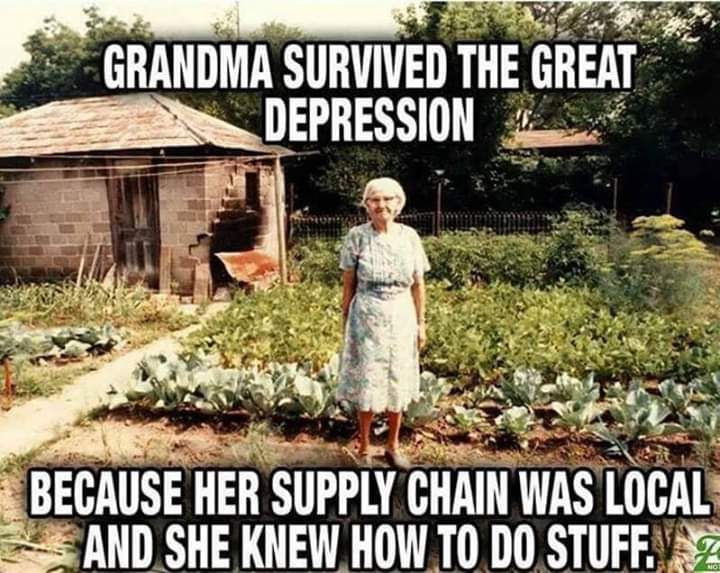
Here’s good ol’ Granny tending her garden. The meme is right: I know from family lore that my Mamaw and Papaw fed themselves, their children, and a lot of other folks in the mountains of southwestern Virginia during the Depression with chickens and crops they raised themselves.
That got me thinking: could America see the return of widespread of homesteading, or some modern-day version of Jeffersonian agrarianism?
I was pondering this question on my way to church tonight (yes, yes, social distancing, etc., but it’s a small church, and we had a very small turnout, so I’m sure it was fine to attend), driving through the fields on the outskirts of Lamar. I began pondering the notion of a society with our level of information technology, but that saw most Americans farming or gardening for at least a small bit of their sustenance.
Such a system would be “high-tech agrarianism”—it would combine modern technology, especially information technology like the Internet, with millions of freehold agriculturalists. Yes, we’d still have the huge mega-farms, we’d have people working in offices, etc. But people would be making good use of their land, too, growing crops instead of grass.
Of course, I then began to ponder if such a society could have ever developed organically. My instinct is no—it required the massive integration of local, regional, and national economies to raise production efficiency to the point that we can have widespread, niche-y specialization in tens of thousands of fields. Greater efficiency fed into greater technological advancement, which in turn led to greater efficiency—and on and on and on, in a revving upward cycle.
But now we’re staring down this virus, which is leading governments all over the world to close stores, cancel events, lay off workers, turn away elderly patients, and on and on. Those long, efficient supply chains are massively disrupted. People are hoarding toilet paper and bread in the hopes of riding out likely (and, in some places, actual) quarantines.
I’m assuming life will return to normal… eventually. But when? So far, many of my assumptions about the pandemic have been incorrect (it turns out this time, the media wasn’t just crying wolf—well, not entirely, anyway; it still seems that some of this panicked response is driven by ridiculous media spin and speculation). If we continue down this road of greater and greater decentralized isolation, people are either going to riot, or figure out how to provide for themselves.
In such a world, maybe high technology and small-scale farming could work keyboard-in-glove. I’ve long advocated for some return to a simpler, more agrarian, more localized life.
Of course, I’m romanticizing America’s Jeffersonian past. Farming is hard—and risky (of course, that hardness made our nation great). I certainly don’t know anything about it—another truth to the meme above. Also, if we’d continued as a mostly farming nation, we wouldn’t have the means to fight this virus, or to figure out how to fight it.
That said, converting your half-acre lawn into a garden full of corn, squash, peppers, lettuce, cabbage, beans, berry bushes, etc., seems like a far more productive use of your little plot of land, and one that could save your life and the lives of others in a pinch. That seems sensible.
We could also do with some can-do gumption, like Granny had.
Home Depot is operating on shortened hours, but they’re remaining open. Maybe now is the time to buy a roto-tiller.
Donate to The Portly Politico
Support quality commentary on politics, education, culture, and the arts with your one-time donation.



 The Portly Politico