Gardening

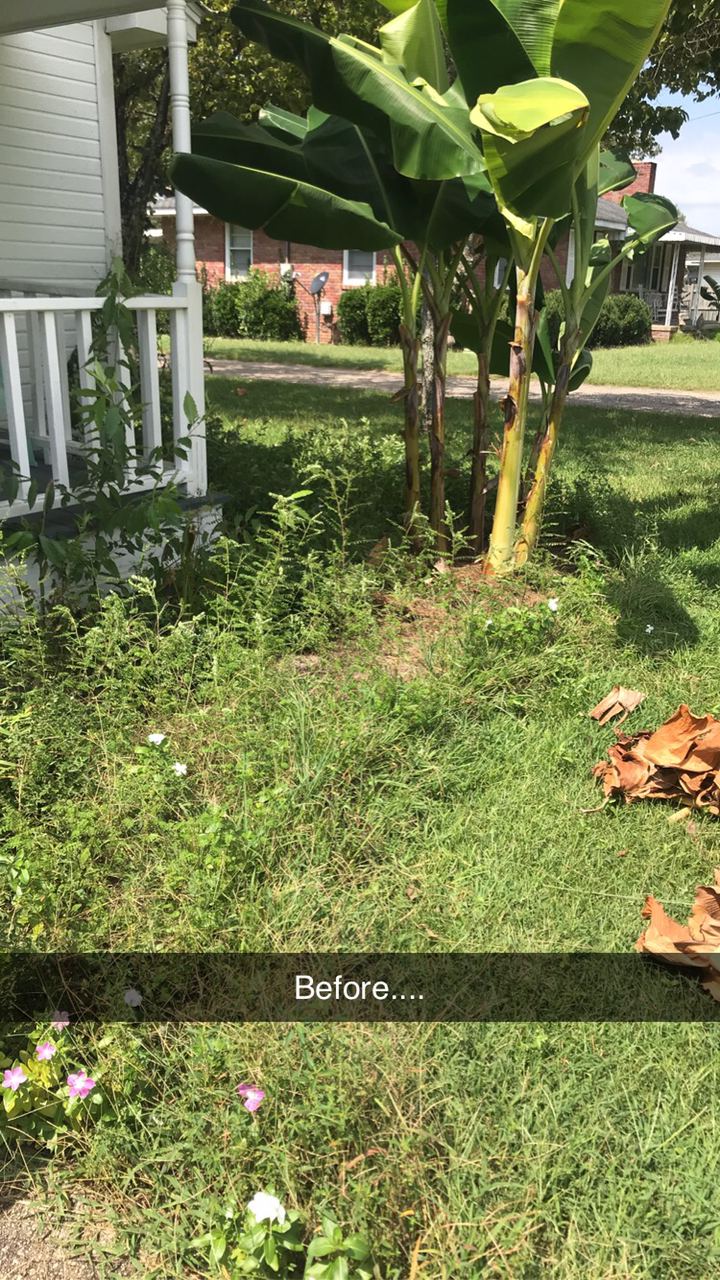
We’re back into the full swing of things after the glorious three-day weekend.  As I noted in various weekend posts, I spent much of the Labor Day holiday gardening.  My house was starting to look haunted, the weeds were growing so high:

Flower Beds - Before

My girlfriend took the weeding with gusto, while I raked out pine straw and debris.  I also pulled and cut some gargantuan weeds from my woefully neglected grapevines (which are, nevertheless, producing big, fat grapes).  After a couple of hours the beds were much improved:

Flower Beds - During

As with many home improvement projects, there’s the tedious part—in this case, weed-pulling—and then there’s the fun part.  For us, the fun part was going to Home Depot and Lowe’s to find plants to beautify the beds.  Over the course of two days, we found some beautiful options, including some colorful mums.

Read More »

Lazy Sunday LXXVII: Rural America

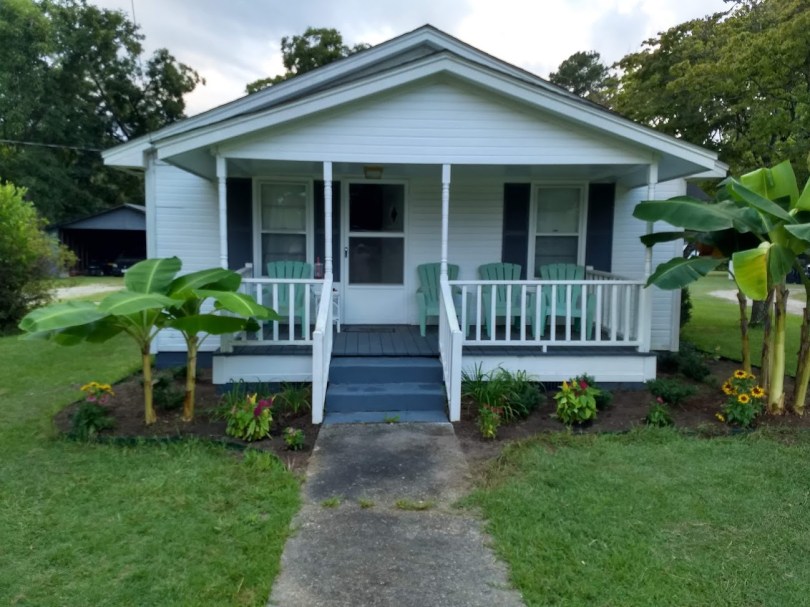
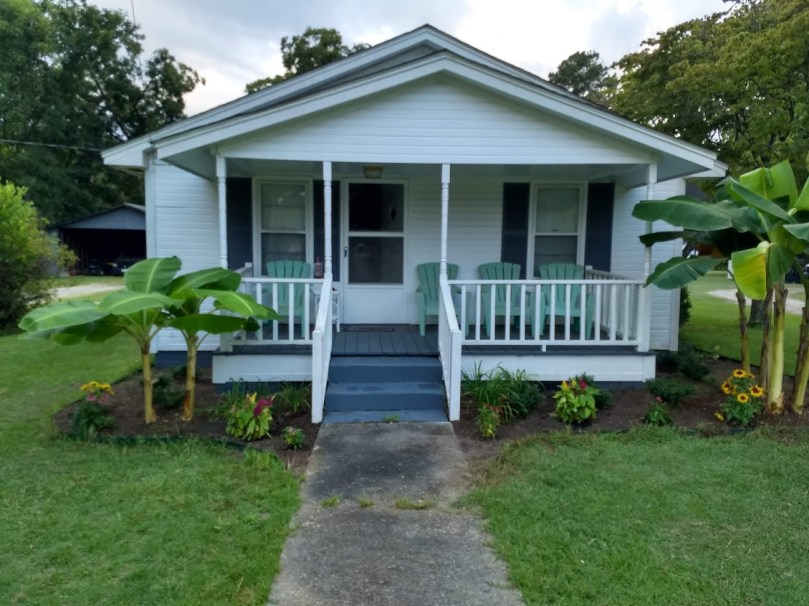
After a week of incredibly hot weather here in South Carolina, Saturday brought a blessed drop in both the temperature and humidity—a foretaste of autumn.  My girlfriend and I spent Saturday weeding my disgracefully overgrown flower beds, which were mostly weeds strangling the life out of everything but the hardiest of perennials (and my robust banana trees).  We then did some new plantings (with a few more to put in, as well as some mulch).  The results were pretty good:

Lamar House - After Planting, 5 September 2020

It felt good to get our hands (and clothes, and faces) dirty, digging through the dirt and nurturing plant life.  My mother is an expert gardener, so I’ve picked up a few simple techniques from her; otherwise, we just bought flowers we liked and plopped ’em in with some in-ground bedding soil and a some water.  Fingers crossed that everything survives.

My mind has been on the soil lately, and our connection to it.  I have a fondness—perhaps a tad romantic—for country life.  With current trends in the cities—rising home prices, rising property taxes, and rising urban violence—country life seems like an attractive, even inevitable, alternative.

As such, I thought I’d dedicate this week’s Lazy Sunday to some pieces about rural America:

  • TBT: Rustics Have Opinions, Too” – This piece dates way back 2009, when the blog was in its first iteration on Blogger, and I was still enthralled with “Randian-libertarian economic” philosophy.  Such are the follies of youth.  However, I did notice even then the deep disdain of limousine liberals for the rest of us here in “flyover country,” a disdain that, at least in part, accounts for the TEA Party movement and the Trumpian revolt of 2016.
  • High-Tech Agrarianism” – When The Virus hit, people were in a tizzy about having enough toilet paper and food.  People gained a renewed interest in gardening as a source of sustenance, not just beauty.  In this post, I mused about a possible return to small-scale homesteading, coupled with our advanced information technology.  Essentially, I posited a world in which people still work, albeit increasingly from home and on more flexible hours, and can use their time to tend to small crops to supplement their diets.
  • SubscribeStar Saturday: The Future is Rural” – One of two recent posts on the lure of rural America and small town life, I argue here that life in the country offers many attractive incentives for working families.  Not only are cities pushing people away with high prices and crime; the country is ready to take in telecommuters who earn good money but want a low cost of living in a safe, healthy environment.
  • SubscribeStar Saturday: Small Town Natalism” – The second post in my Saturday series about small town and rural living, this post is a preliminary sketch of a policy proposal:  applying nationalistic, pro-birth natalist policies to the small town context.  Instead of wasting money on seldom-used public facilities, local governments could offer a stipend to married families with children to encourage increased birth rates.  That would grow towns organically and attract new residents, thereby broadening the tax bases in often distressed rural areas.

That’s it for this week.  The garden is calling to me.  Time to put down some mulch!

—TPP

Other Lazy Sunday Installments:

Small Town Natalism

Today’s post is a SubscribeStar Saturday exclusive.  To read the full post, subscribe to my SubscribeStar page for $1 a month or more.  For a full rundown of everything your subscription gets, click here.

Last Saturday I argued that “The Future is Rural.”  With the rise in urban violence (that seems to turn up every presidential election year) and unsustainable living costs, coupled with the spread of telecommuting and improved Internet access, I predict that more and more Americans will flee to the countryside.

Even with the tide turning in favor of rural and small town life, local and county governments can take some proactive steps to attract residents.  If the goal is to attract working families consisting of committed parents, localities need to get creative.

The usual approach to building up revenue in small towns is to spend lavishly on parks and sports fields.  Large cities famously subsidize the NFL with billions in stadium construction, but small towns routinely fall into these construction boondoggles.  The premise is that new softball fields will bring in summer travel leagues, generating local tourism dollars, which is always how new ball fields are sold to the public.  Of course, the maintenance of these facilities are added into a locality’s annual budget, becoming recurring expenses, on top of the initial cost of production, which is often debt-financed.

Rather than spend public money on baseball diamonds and—even worse—soccer fields, small towns hoping to attract working families should use that money for something far more precious:  children.

To read the rest of this post, subscribe to my SubscribeStar page for $1 a month or more.

Donate to The Portly Politico

Support quality commentary on politics, education, culture, and the arts with your one-time donation.

$10.00

SubscribeStar Saturday: The Future is Rural

Today’s post is a SubscribeStar Saturday exclusive.  To read the full post, subscribe to my SubscribeStar page for $1 a month or more.  For a full rundown of everything your subscription gets, click here.

In case you missed itThe Portly Politico is now theportlypolitico.com!  Thanks to subscriber support (and a 50% off flash sale), TPP is now a premium WordPress site.  If you want to help advance strong conservative commentary on politics, culture, history, religion, and art, consider a $1 or $5 a month subscription—or more!

The roiling waves of urban riots this summer could be the death knell of urban living.  Even smaller cities are falling victim to progressive insanity and destruction.  It was one thing when Seattle and Portland were ablaze, and Americans wrote off Detroit years ago.  But now Kenosha, Wisconsin is the hotbed of disorder and chaos?

The story of “white flight” from urban centers is a Leftist favorite, and—of course—progressives blame the plight of inner city blacks on the fact that white people took their tax dollars and fled tot he suburbs.  Never mind that riots in the 1960s destroyed white- and black-owned businesses, and that the current wave of riots destroys millions of dollars in black-owned property.  The Leftist narrative also implies that blacks aren’t capable of succeeding without substantial financial and institutional support from whites, a clear example of progressivism’s bigotry of low expectations.

As is often the case with Leftist canards, there is a kernel of Truth among the popcorn ball of misleading disinformation:  people did flee urban centers in the 1960s, precisely because they were so dangerous.  As the respectable, middle-class civil rights movement gave way to the militant black nationalism of SNCC and the Nation of Islam, sane people ran for the suburban hills.

Now we’re in a similar moment, in which progressive grievance-mongering and racial malfeasance gin up BLM and Antifa criminals, eager to fight imaginary “Nazis” in the streets.  While these riots are a tragedy for our nation and for the rule of law, there is a silver lining:  it could prove to be a boon for rural America.

The rest of today’s post might be a tad delayed; I am proctoring the SAT this morning, and then am hitting the road for a family celebration.  My apologies in advance.

To read the rest of this post, subscribe to my SubscribeStar page for $1 a month or more.

Road Trip!

Your portly is hitting the road for sunny (and humid) Florida for a few days at Universal Studios (more details on that tomorrow).  I’m convoying down in my 2017 Nissan Versa Note with my girl and my younger brother and his family, with plans to rendezvous with our older brother and his girlfriend at the airport in Orlando.

I am very much a homebody by nature, which has come in handy during The Age of The Virus.  That said, I’ve tried to get out more over the past year and see more of my great State, South Carolina, as my various festival trips from last fall indicate.  I’ve also developed quite a fondness for taking the back roads, though my desire to get where I’m going usually overrides the romance of driving down barely-maintained rural routes.

Recently, I did take an extended back path from Columbia to Aiken, South Carolina.  I was willing to add twenty minutes to my drive to see some nature.  The route took me through a forgotten triangle of countryside, bounded by I-20 to the east and north and I-26 to the west (there’s no “bottom” to the triangle, so it’s more of an right angle).  That took me through Pelion and New Holland, the latter of which was largely cattle ranches and huge, open swaths of green pastures.

Read More »

Island Living

Hippies are annoying and filthy creatures, but you’ve got to hand it to them:  behind all the patchouli and Grateful Dead bootlegs, they’re a resourceful lot.

A Canadian couple in British Columbia, Catherine King and Wayne Adams, have been living for nearly three decades on a floating, man-made island off the western coast of Vancouver.  Like good hippies, they built the island—which weighs over one million pounds—from recycled materials, mostly lumber.  In a particularly Boomer hippie detail, Adams would trade artwork to fishermen for scraps of lumber and other cast-offs.

Read More »

Spring Break Short Story Recommendations, Part IV: “The Shed”

Well, all good things must come to an end.  Such is the fate of Spring Breaks everywhere.  While I still have the glorious weekend before me, today marks the formal last day of break.

With that, it’s time to finish out our Spring Break Short Story Recommendations (read Part I, Part II, Part III, and the TBT installment) with 1952’s “The Shed,” a bit of small-town terror by E. Eerett Evans.  This story is a tad obscure, as is its author, and I couldn’t find a free version online, but like “The Judge’s House” and “Thus I Refute Beelzy,” it’s from 11 Great Horror Stories.

“The Shed” takes place in a small town in Michigan in the first decade of the twentieth century, and focused primarily on the rough-and-tumble adventures of the town’s boys, all under fourteen.  The boys are scrappy, plucky, and fun, and spend their days exploring town, splashing in the local waterhole, and generally doing the kinds of things boys did before they were shut up in classes for eight hours everyday.

The boys’ favorite play place is a dilapidated shed that belongs to the local railroad company.  They use the shed as their base of operations, and as a makeshift jungle gym.  However, they strenuously avoid one dark corner of the shed, in which resides The Shadown, an iridescent, subtly shifting, amorphous mass of malevolence.  The boys know, instinctively, to stay away from it, but otherwise tolerate its malignant presence.

Read More »

TBT: Hump Day Hoax

Last year, my little town made national headlines when our mayor claimed that a mysterious, sticky yellow substance on her vehicle was evidence of a “hate crime.”  The investigation—which involved a Darlington County Sheriff’s deputy looking at the car—revealed it was pollen.

At the time, I thought that the mayor was pandering for headlines (even though what I wrote at the time was more generous).  But the likelier answer is she’s just stupid—sweet, to be sure, but stupid.

Also, it’s sad that many black Americans exist in a world so haunted by race-hustlers that they see hooded Klansmen committing acts of racially-motivated pollination around every corner.  That’s surely the vast minority of black Americans, but that such blinkered conspiratorial thinking is so prevalent is disconcerting (and that’s coming from someone with a conspiratorial cast of mind).

I decided to revive this piece for TBT because filing opens tomorrow for an open Town Council seat in Lamar.  One of our local councilmen resigned, so the town is holding an open election on 12 May 2020.  The filing fee is just $31.

Lamar Town Council Special Election

I’m still a newcomer to town, but for $31, my thinking is, “Why not run?”  I see a great deal of potential for my adoptive home town.  I also believe everyday citizens—not just well-heeled businessmen and attorneys—should run for public office.

We’ll see.  Regardless, here’s 2019’s “Hump Day Hoax“:

It’s that point in the semester where everything is coming to a head all at once, so today’s post is about 12-14 hours late to the party.  Indeed, it was only about fifteen minutes before writing this post that I stumbled upon an article with a local flavor.

It seems the mayor of my adopted hometown, Lamar, South Carolina, believes that a racial hate crime was committed against her.  Her vehicle was covered in a sticky yellow substance that resembled spray paint, she claimed.

After a brief investigation—it probably involved running a finger across the hood of the car—the Darlington County sheriff’s deputy determined the mystery substance was—GASP!—pollen.

You can read the full story here: http://www.gopusa.com/hate-crime-against-darnell-mcpherson-s-c-mayor-turns-out-to-be-pollen/

I’ve met Lamar’s mayor—my mayor—before, and Mayor McPherson is a pleasant and welcoming lady.  I met her when I went to town hall to setup garbage and sewage service at my home.

Lamar is a very small town—the population, according to the 2010 census, was slightly less than 1000—and it still functions on a timetable that is even slower than the rest of the South.  In true, old-school Southern tradition, local government offices shut down on Wednesday (as do some local businesses, if I’m not mistaken), and many folks get their mail at the Post Office, rather than a mailbox (my mail wasn’t delivered for about two weeks, until a neighbor told me I had to move the box across the street, otherwise our rural route carrier wasn’t going to stop).

Needless to say, it runs on a small staff, so Mayor McPherson was in there with the town’s two administrative assistants, processing water bills and the like.  I appreciated her dedication and friendliness, and she encouraged me to get involved in the community.

As such, it’s disappointing to see this kind of hysteria from her.  From the tone of the article, she sounds like she sincerely believes some misdeed was done against her—although I’m probably being overly generous.  The Jussie Smollett hoax was clearly too ludicrous to be true; maybe the Case of the Hooded Pollinator is the same situation.

Blog Spotlight: Salt of America

Here’s something a bit lighter for your Tuesday.  I was poking around on the Internet looking for—well, I don’t know what—and I stumbled upon this charming little blog, Salt of America.  It has an “early Internet” feel in terms of layout, with a few banner or sidebar ads, and an archaic system for logging your ZIP code so the site can get sponsors.

Other than the ads for Mobil 1 engine oil and Campbell’s Soup, the site includes all sorts of articles and documents pertaining to rural living in the American past.  The site features a series of local and regional histories that explore the development of various American cities and States.  I’m particularly interested in checking out a two-part series on America’s first State to ratify the Constitution, Delaware (Part I, Part II).

Read More »

Beethoven’s Sixth Symphony

It’s been an artistically fulfilling weekend.  First there was the play (I’m sure readers are tired of reading about it) in which I performed.  After three successful performances, my girlfriend and I took in the South Carolina Philharmonic‘s Sunday matinee performance of their popular Beethoven and Blue Jeans concert.  Classical music is even more enjoyable when you get to wear jeans.

The SC Philharmonic’s energetic conductor, Morihiko Nakahara (a show in himself), didn’t pull any punches with this year’s B&BJ program.  It was, essentially, “Beethoven’s Greatest Hits,” as I remarked to my girlfriend.  Morihiko always tosses in one piece of weird modern classical music, but after enduring young composer Jessie Montgomery‘s 2016 tone poem “Records from a Vanishing City,” it was straight into the classics:  Beethoven’s Symphony No. 6 in F Major, the so-called Pastoral, rounded out the first half of the concert.  Then it was into the thundering “DUHN DUHN DUHN DUUUUUUH, DUHN DUHN DUHN DUUUUUUUUUUUUUUH” of the Symphony No. 5 in C Minor after the break.

Everyone loves the Fifth Symphony, with its iconic opening theme (the first in symphonic music to make a rhythmic idea the theme, not a melodic one).  But for my money, the bucolic beauty of the Sixth takes the cake.

Read More »