Mueller Probe Complete, Trump Vindicated

The long national nightmare is overThe long national nightmare is over—the Mueller probe/expensive government boondoggle/politically-motivated, Deep State witch hunt is finally complete, and President Trump is in the clear:  there was no collusion between the Trump campaign and the Russian government.

Now that the world finally knows what we all suspected for the past two years, the Left is in complete meltdown mode.  The mental gymnastics to which they’re resorting is humorous, but sad.  A key lesson to remember is that what the Left can’t achieve politically or socially, it will achieve through the courts (or violence).

For two years, the Left assumed that their inside man, Robert Mueller, and the rest of the Clintonian, globalist Deep State would produce (or, if need be, fabricate) the “evidence” needed to oust a duly-elected President of the United States.

Now, they’re magic wand has turned into a limp stick, incapable of conjuring up the fabled “collusion” the Left dreamed about for two long years.

President Trump emerges victorious.  It’s a huge blow to the Deep State, and almost like Part II of the 2016 election:  an outside figure, facing enormous odds and an entire media-government-business establishment arrayed against him, has won a hard-fought battle, even with the deck stacked against him.

There are still investigations in New York involving the perfidious and mendacious Michael Cohen, but those will, most likely, similarly yield nothing but bitter fruit for the Left—and more vindication for Trump.

In the meantime, it’s a great day to be on the Trumpian Right.  MAGA MAGA MAGA!

–TPP

P.S.—Here’s a great video c/o my younger brother:

Lazy Sunday V: Progressivism, Part I

A number of my posts diagnose and analyze the impulses underpinning modern progressive Leftism.  This week’s Lazy Sunday will look back at some of those posts; stay tuned for Part II next Sunday.

One thing I’ve learned from studying Leftism is that (to paraphrase Nietzsche) if you stare into the abyss too long, the abyss stares back.  It becomes remarkably easy to adopt, without even realizing it, their tactics and hatred.  I imagine it’s like studying demonology:  what starts out as an attempt to learn the Enemy’s tactics can easily turn into something more sinister.

With that warning, it’s important to understand how the Left operates, and why it’s been able to win for so long.  Only by doing so can we begin to fight back effectively.

As such, here are some posts on progressive Leftism for Lazy Sunday V:

1.) “Progressivism and Political Violence” – this post was one of my first exploring the Left’s predilection for street-level violence (and, more wickedly, the use of official state violence) to achieve its ends.  My prediction was that, should the Left use nearly total political control (including the courts), it would not hesitate to resort more extensively to street thuggery, doxxing, and other nefarious methods to disrupt the lives of conservatives.  If you just read one essay this lazy Sunday, read “Progressivism and Political Violence.”

2.) “Progressivism and Political Violence II: Candace Owens and the Deficiency of Decorum” – a follow-up to “Progressivism and Political Violence,” this essay explores the idea of “decorum,” which the Establishment Right has used as an excuse to “fight” the Left with both hands tied behind its back.  My contention here is that these traditional restraints are breaking down, and we have to be willing to fight back, tooth and nail, if necessary.  They want us destroyed simply because we want to pursue our own way of life, and don’t unabashedly embrace theirs; we just want to be left alone.  Unfortunately, the Left won’t let us.

3.) “Secession Saturday” – speaking of the Left’s desire to destroy us, I’m increasingly reading commentators discuss the possibility of “peaceful separation.”  This post explores that idea (briefly) in the context of an essay from American Greatness by Christopher Roach.  Roach argued that, even if a peaceful separation of progressive Leftists and traditional conservatives is possible, the totalitarian Left would never allow it.  Case in point…

4.) “Totalitarian Leftism Strikes Back” – even science-fiction writing can’t catch a break.  Everything must be dominated by the Left, even—especially—culture.  The Left spent most of the twentieth century marching through the institutions of the West, taking control of the academy, the arts, entertainment, churches, etc., so that even when it lacks political power, it always dominates in the culture.

These posts are just the tip of the iceberg.  Stay tuned next Sunday for Part II.

Other Lazy Sunday Posts:

Sailer on Progressive Split

Demographer and statistician Steve Sailer has a piece up at Taki’s Magazine entitled “Bernie vs. Ta-Nehisi,” detailing the major split within modern progressivism between old-school Marxists and social justice warriors.  Naturally, there’s a great deal of overlap between those groups, but Sailer looks at the major wedge between them:  their views on race.

First, let’s define our terms here:  the “old-school Marxists” like Bernie think race is a tool of the upper classes to divide the social classes.  Part of this approach, as Sailer points out, is electoral pragmatism:  align the have-nots against the haves, regardless of race, to maximize voters.  There are more non-rich people than there are rich, so promising Medicare for all and to “soak the rich” Huey Long-style can bribe voters of all stripes.

The other side—what I’ve referred to broadly referred to as the “social justice warriors”—are the ones obsessed with race, and who see racial injustice everywhere.  For Sailer, the symbolic leader of this group is racialist mediocrity Ta-Nehisi Coates, the former blogger made good because white liberals feel good about themselves when reading his rambling essays.

(I imagine it’s a sensation of righteous self-flagellation that isn’t too dangerous or life-altering for the reader:  they get the sadistic satisfaction of acknowledging their own implicit bias, racism, and privilege, while feeling like they’re making a difference because they breathlessly show their support for an erudite-sounding black guy.  But I digress.)

The former group wants to buy off all voters with as many publicly-funded goodies as possible; the latter wants to buy off minority voters with reparations and other publicly-funded goodies, all while chastising white voters (and gleefully awaiting the approaching day that whites are a minority, too).

Sailer, who refers to Coates as “TNC,” sums this division up succinctly:

The war between Bernie and TNC pits the old Marx-influenced left, with its hardheaded obsession with class, power, and money, against the new Coatesian left, which cares more about whether Marvel’s next movie features a black, female, or nonbinary superhero.

The rest of Sailer’s essay focuses on the obsession with racial identity and representation that dominates “Coatesian left.”  It’s not enough that everyone, black or white, share in Sanders’s redistributionist schemes; rather, blacks specifically must benefit at the expense of whites as a form of payback for slavery, alleged “redlining” in during the Depression, and “institutional racism.”

Further, the Coatesian/social justice Left demands “representation,” because a black superhero will magically improve the lot of black Americans.  Another Sailer quotation:

Coates’ notion that mass entertainment culture has been devoted to stereotyping black people as undeserving is, of course, absurd. But it helps explain some of his popularity in an era in which it is considered sophisticated to argue that Will Smith shouldn’t be cast as Serena and Venus Williams’ tennis dad because he’s not as dark-skinned as Idris Elba (while others argue that Smith, unlike Elba, deserves the role because he is an ADOS: American Descendant of Slaves).

Can you imagine what Socialist Senator Sanders thinks of these energies devoted to which millionaire should get richer?

Unlike Bernie, Coates is concerned with the old-fashioned comic-book virtues that appeal to 9-year-old boys: honor, status, representation, heredity, antiquity, and vengeance.

Revenge is a dish best served cold.  Maybe that’s why so many prominent Democratic presidential hopefuls are reheating such a tired idea.

Neither Sanders-style Marxism or Coatesian racial grievance will repair the United States’s fractured culture, but it will be interesting to see which side wins the Left.  Demographics suggest the latter will prevail over time.

Regardless, at bottom, both of these movements are redistributionist, and seek to plunder accumulated wealth and productivity to unprecedented degrees.  One might be traditional Marxism and the other Cultural Marxism—but they’re both Marxism.

Totalitarian Leftism Strikes Back

Readers versed in the recent skirmishes of the Culture Wars may have heard about the Sad Puppies / Rabid Puppies campaign to win back the Hugo Awards—science-fiction’s biggest literary awards—from entrenched social justice Leftists.  photog at Orion’s Cold Fire has a brief piece up, linking to a piece on The Federalist about the recent controversy.

The quick takeaway is as follows:  having destroyed the Hugo Awards rather than let independent, apolitical authors get a fair shake, SJWs are now targeting a group called 20Booksto50K, an online community dedicated to getting independent authors published.  It’s an organization that is entirely harmless, from what I can tell on the surface, but it’s a threat to the SJW-dominated publishing industry.

The Left is all about dominating the institutions.  If they can’t control an institution, they’ll destroy it.  Independent organizations are a huge threat to the Left’s Cultural Marxism, as the existence of alternatives inevitably loosens the Left’s grip on power.  People aren’t allowed to have alternatives; they must accept and embrace Leftist ideology and goals, whatever they happen to be at the moment.

Not surprisingly, sci-fi writers don’t like that they can only win major awards if their stories don’t involve convoluted, high-tech battles over gender nonconformity or intergalactic diversity training.

The major figure in this field, from the little I know about it, is dissident writer Vox Day, who has created his own publishing house and distribution platform.  Vox Day anticipated deplatforming from Amazon, and was prescient in creating his own means to distribute his work to fans.

The Internet was a bastion of freedom for conservatives and dissidents of all stripes.  Now the tech giants are clamping down on the Right, and even the heretofore apolitical.  Remember:  merely being apolitical is, to the totalitarian Left, the same as being against the Left.

Like the Borg of Star Trek, all will be assimilated into the Left’s Marxist ideology.

Sanctimonious Leftism

We’re all familiar with the lunacy of the Progressive Left, and its tendency toward insane and downright evil positions.  Issues like abortion (now, apparently, including babies that survive attempted murder against them) highlight the fundamentally different philosophical foundations of Progressivism and traditionalism.

That said, one of the more annoying aspects of modern Leftism is its sanctimonious virtue-signalling, which is part of the appeal of Progressivism:  you get “virtue” on the cheap, without any real sacrifice.

Case in point:  a letter to The Virginia Pilot about the Ralph Northam non-troversy.  Readers will know that I don’t much care about what costume Governor Northam wore three decades ago, but I do care that he advocates for infanticide both in and out of the womb.

But the letter in question is a prime of example of Leftist sanctimony in action, full of broad, vapory statements about how Northam can work towards reconciliation.  The letter is from Rich Harwood, who runs a policy think-tank of some kind called The Harwood Institute.

I only know about the Harwood Institute because, somehow, one of my e-mail addresses for one of the schools where I teach has ended up on their mailing list.  For about a year I thought it was the “Hardwood Institute,” and they were trying to sell me lumber.

Regardless, Rich Harwood, the namesake founder of this fairly bland, center-Left organization wrote a letter entitled “A suggested path toward reconciliation,” and blasted an abbreviated version out to the Harwood Institute’s e-mail list.

The entire letter is an exercise if blathering sanctimony.  He recommends five steps for Governor Northam, and how he can become, chillingly, an “instrument for society.”  One of those steps is—no joke—to “[m]ake room for deep sorrow.”

I think I just threw up in my mouth a little bit.

Here is an extended excerpt to give you the full flavor of Harwood’s virtue-signalling:

[Governor Northam] faces a fundamental choice: Is his reconciliation tour about his own political survival, or can he become an instrument of society? 

Choosing the latter requires him to exercise a ruthless humility, where he recognizes his own role is limited. Racial reconciliation cannot be led by a single leader, nor orchestrated by an elected official. It will come through a whole host of big and small actions, emerging over time, that include overlapping conversations, popular culture and music, the writing of new books and the illumination of painful history. 

So the governor must ask: What is my contribution in this moment? What can I do? What does it mean for me to be an instrument of society? ….

There may be those who say that Northam has made it past the worst of this crisis and that he should just hunker down and ride out the last of it. Perhaps that’s possible. But, for him, is that good enough? Can he live with that? Will that help him fulfill his personal calling, and more importantly gain a sense of redemption from Virginians? 

I urge Northam to choose the path of becoming an instrument of society.

Amid all of this feel-good crap is this phrase “instrument of society.”  That’s a terrifying concept, and one that is indicative of the totalitarian Left.  No one can just be—every individual must subsume himself into the mass.

Northam may have been an idiot thirty years ago; now, he’s a useful tool for the Left, except that the Left cannot forgive what may have been acceptable under yesterday’s morality.  For the Left, there IS no yesterday.  Everything that is bad now has always been bad, which is why their positions shift so constantly (remember when Barack Obama and Hillary Clinton were opposed to gay marriage and supported border control?).

Harwood, too, is a useless tool for the Left, and he probably doesn’t even realize it.  He’s no-doubt marinated his entire life in a cloistered, East Coast liberalism that arrogantly believes it holds all the answers—if only we can get those rubes in flyover country to come to heel.

Racial issues in America are overblown and tiresome.  Civil rights have been secured for virtually every race and deviant lifestyle choice conceivable.  Instead of focusing on these silly side issues, let’s try to stop the mass slaughter of innocents.  That’s an area where we can—and should—make “room for deep sorrow.”

TBT: Federalism Denied

It’s a late post today, faithful TPP readers, as the school year is gearing up and constraints on my time increase.  Better late than never, yes?

This week’s throwback post discusses the Seventeenth Amendment, which ended the election of US Senators via their respective State legislatures, and instead moved that choice directly to the people of the several States.

One of the Progressive Era Amendments—which gave us such chestnuts as the graduated income tax (Sixteenth Amendment), Prohibition (Eighteenth Amendment), and women’s suffrage (Nineteenth Amendment)—the Seventeenth Amendment was part of a broad cultural and political shift toward, paradoxically, greater choice and enfranchisement for the electorate on the one hand, and greater government control and oversight on the other.

Americans were optimistic in the power of the government at all levels—and, increasingly, at the federal level—to solve problems like poverty and privation, naively believing that, in a democracy, the people would make wise decisions about selecting its technocratic, managerial elite.

Not surprisingly, the managerial elites gained enormous power, and the people got the shaft.

This essay explores the consequences of the direct election of US Senators, as well as why State legislatures came to support the idea.  On the one hand, States lost their representation in Congress—the Senate was designed to represent State-level interests nationally—but State legislatures were also relieved of responsibility for what was becoming an onerous duty, susceptible to corruption, or even carelessness.

Here is “Federalism Denied”:

In last Wednesday’s post, “Politics, Locally-Sourced,” I urged readers to become more interested in and educated about their local and state governments.  A keystone of modern conservative political philosophy (and of the classical liberalism of the Framers) is decentralization, the idea that power should be spread broadly, both in terms of population and geography.  Due to the massive power the federal government accrued during and after the Second World War, decentralists also argue that power should devolve from the federal government back to the States.  The federal government, of course, plays an important role in maintaining the national defense, conducting foreign affairs, and regulating interstate commerce, among a number of other constitutionally delineated areas, but a great deal of power is reserved for the States in the X Amendment.

The X Amendment reads thus:  “The powers not delegated to the United States by the Constitution, nor prohibited by it to the States, are reserved to the States respectively, or to the people.”  Clearly, then, where the Constitution is silent, the States are reserved broad powers.  They cannot become dictatorial–their constitutions must not conflict with the national supremacy of the US Constitution–but they can have broad latitude in determining statewide regulations, taxes, and the like.

In theory, at least, this federalist structure is how our nation is supposed to operate, and it manages to do so, despite significant hobbling from the federal government.  Congress has forced upon the States a number of unfunded federal mandates.  Essentially, a large portion of State budgets are consumed with fulfilling orders from Washington, D.C., without any form of assistance.  Additionally, States are often coerced into adopting certain policies or passing certain laws, lest the federal government withdraw their funding (this tactic was used to increase the drinking age from 18 to 21–not necessarily a bad thing, but the means matter almost as much as the ends; such coercion circumvents the proper amendment process).

What brought about this change, and how can we reverse it?  How can we restore the proper balance between the States and the federal government?

There are no easy answers here, and the centralization of power in the federal government occurred for a complicated host of reasons:  the acceptance of a desperate people of a greater role for the government in the economy during the Great Depression; the (temporary) success of a massively planned economy during the Second World War; the massive expansion of the welfare state during the Great Society; the (necessary) fight at the national level to protect the civil rights of black Americans; and more.

However, I would argue that a major source of this problem was the passage of the XVII Amendment.

The XVII Amendment replaced the old system of selecting senators with their direct election.  Prior to its passage, senators were selected by their state legislatures, which were themselves chosen in local elections.

There are a number of compelling arguments for why this amendment was adopted.  For one, many states had already moved to a de facto system of direct election, in which voters essentially “elected” their senator, and the state legislatures were duly pledged to vote in accord with the people’s choice.  Also, there were several scandals in which senate candidates merely bribed state legislators for their votes.  Finally, many state legislators found that voters cared more about who the legislators would elect to the Senate, not what they thought about state problems.

You can review these arguments in a (rather condescending) piece from Slate by David Schleicher entitled “States’ Wrongs.”


“[T]he States no longer have a constitutional role in the federal government.”

However, while there certainly appeared to be need for reform in senatorial elections, many of these problems still persist.  Voters are still overly-fixated on national politics, even more so than voters in the late nineteenth and early twentieth centuries.  If anything, state elections are even more focused on national issues than they were before.  Special interest groups still manage to exert influence over the Senate, and can do so even more effectively by whipping up voters.

Most importantly, though, is that the States no longer have a constitutional role in the federal government.  The Senate used to serve as the representative of the States’ interests, while the House still operates as the representative of the people’s interests.  Now the people have direct influence over both branches of Congress, and an important, necessary brake on the fickle will of the majority is gone.

States’ rights has become an ugly phrase, associated as it is with slavery and segregation.  However, just because states’ rights has been invoked to defend the indefensible doesn’t mean that it isn’t a good idea.  The States function as an important bulwark against tyranny, and federalism affords many opportunities for policy innovation and experimentation–Louis Brandeis’s “laboratories of democracy.”  Also, the geographical, ethnic, religious, and cultural diversity of the United States practically demands states’ rights, as different States have different needs, goals, and desires.

Repeal of the XVII Amendment is extremely difficult and unlikely:  people like to vote (actually, people like to know they can vote, even if they often choose not to do so).  But Congress, specifically the Senate, can do much to keep the further expansion of federal power in check.  Senator Ben Sasse of Nebraska is spearheading this effort through his speeches, delivered from the Senate floor, about the proper role of the Senate and its obligation to be an august, contemplative chamber.

We, the people, can also take steps to become more involved in state politics.  Ultimately, the drive to restore federalism starts with us.

***

For more information about the XVII Amendment and different approaches to addressing it, here are some resources:

The Campaign to Restore Federalism (pro-repeal of the XVII Amendment):  http://www.restorefederalism.org/

“Repeal the 17th:  Problems to Address” by constitutional scholar Rob Natelson:  http://tenthamendmentcenter.com/2013/08/26/repeal-the-17th-problems-to-address/

“Repeal the 17th Amendment?” by Gene Healy of the Cato Institute (great piece that is sympathetic to the idea, but recognizes the political problems involved):  http://www.cato.org/publications/commentary/repeal-17th-amendment

“States’ Wrongs” (mentioned above) by David Schleicher of Slate (anti-repeal, with some interesting historical background and a lot of elitist sneering at movement conservatives):  http://www.slate.com/articles/news_and_politics/jurisprudence/2014/02/conservatives_17th_amendment_repeal_effort_why_their_plan_will_backfire.html

Secession Saturday

Care of photog at Orion’s Cold Fire, here’s a thought-provoking piece by Christopher Roach of American Greatness, “The Left Won’t Allow a Peaceful Separation“: https://amgreatness.com/2019/01/21/the-left-wont-allow-a-peaceful-separation/

Roach touches on some of the same points I bring up in my essay “Progressivism and Political Violence,” in which I diagnose some of the well-known pathologies of the Left, including its tendency towards totalitarianism. That impulse is why the Left is never content to adopt the Right’s “live and let live” mentality. Thus, the willingness to eat their own (as in the Northam non-troversy), to demonize young conservatives, to harass conservatives at dinner, and to denounce anyone who doesn’t believe whatever the latest frontier of social justice is this week.

The idea that America is in a “cold civil war”—one that is turning increasingly hot—isn’t nothing new (sadly). Controversial Dissident Right figure John Derbyshire calls it a conflict between “goodwhites”—the limousine liberals and soccer moms who think Trump is mean and who want to virtue-signal to minorities to appear cool and progressive—and “badwhites”—the rest of us folks in “flyover country” who largely want to be left alone to enjoy our faith, family, and liberty in peace.

That the cold, cultural civil war may turn hot is a cause of concern to many folks on the Right and Left. I shudder to contemplate it. Roach, in his piece, argues that a peaceful separation may one day be the result of our current Kulturkampf, but he is pessimistic that the Left would willingly let anyone leave, due to its totalitarian nature.

He also points out that, though we often forget it, the United States is, itself, a product of secession—from merry old England. As I often point out to my students, the question of whether or not States were bound permanently to the Constitution was an open question until 1865. The Jeffersonian “compact theory” argued, essentially, that the States had formed the Union and “opted in” to the Constitution. The big, open question prior to the American Civil War, then, was thus: having opted in to this arrangement, did States have the ability to opt out? A straightforward reading of the Declaration of Independence suggests heavily that, in certain extreme circumstances, they might be able to do so.

As I’ve long told my students, the Civil War answered that question conclusively by force of arms. Now, States sue the federal government through their respective attorney generals’ offices should there be any conflicts between them and the feds.

That said, as I’ve grown older, I’ve come to realize that no political question is ever truly “settled,” and no political arrangement—even one as enduring and amazing as our federal constitutional republic—can last forever. The idea of secession could be given a renewed lease should the federal government continue to overextend its authority, and should the culture wars deepen and darken.

To be clear, I’m not advocating for secession or anything of the sort. I’m merely exploring—in a very brief way—a complex idea that is, in the balance, not entirely without merit. Regardless of the motivations for the American Civil War, the notion of States’ rights—an entirely constitutional idea, per the Tenth Amendment—and of “compact theory” are quite sound, and could enjoy renewed credibility.

There is much to chew on and mull over here. I recommend you read Roach’s piece and make up your own mind. Feel free to leave comments below.

Happy Saturday!

–TPP

Reblog: New White Shoe Review for You

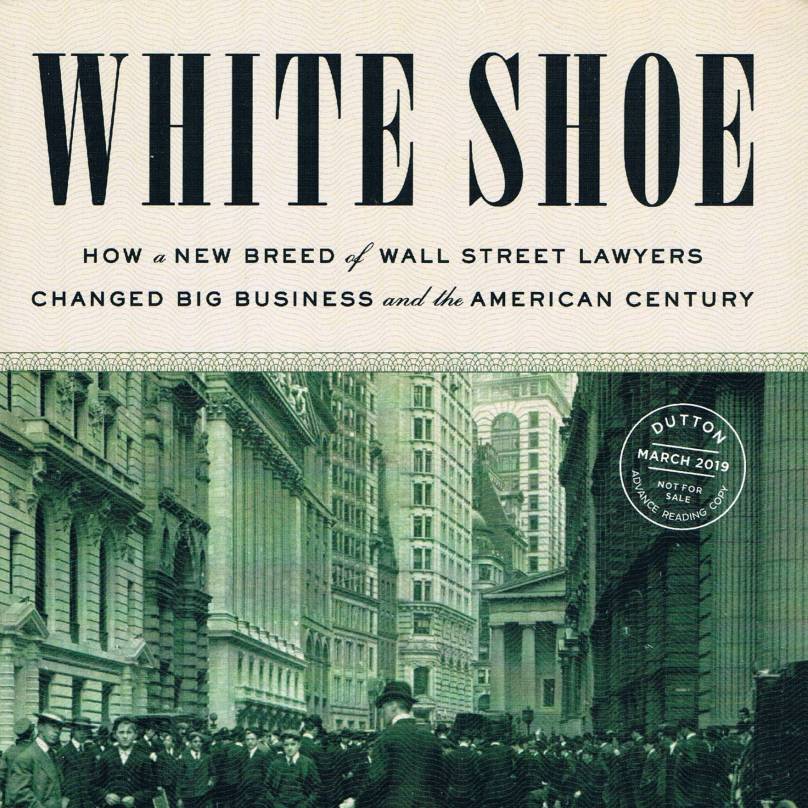
My good friend and fellow blogger Frederick Ingram of Corporate History International has written an intriguing review of what appears to be a quite intriguing book: historian John Oller’s White Shoe: How a New Bread of Wall Street Lawyers Changed Big Business and the American Century. Based on Ingram’s review alone, the book is a fascinating dive into the heady politics of early twentieth-century America, the transition from the relative laissez-faire capitalism of the so-called “Gilded Age” into the economic, political, and social reforms of the Progressive Era.

The Progressive Movement fundamentally transformed the United States, in many ways (constitutionally) for the worse. But it was an attempt to rectify some of the excesses of the Gilded Age, and to ensure that workers were not merely cogs in faceless corporate machines. In reading Ingram’s review, I heard echoes of Tucker Carlson’s recent on-air musings, particularly the idea that efficiency is not a god to be worshipped blindly, and that capitalism is great, but it should work for us, not the other way around.

The more things change, the more they stay the same: Carlson’s diagnosis of America’s current ills echoes attorney (and future Supreme Court justice) Louis Brandeis’s “curse of bigness,” the argument against efficiency-for-its-own-sake. I was struck, while reading Ingram’s review, how much our own age mirrors the period that, in many ways, begat our current crises: the Progressive Era of 100 years ago.

According to Ingram, a consensus of sorts was reached among these big Wall Street Lawyers (WSLs), which ultimately prevented radicalism and presented “capitalism with a human face”:

“The end of ‘The Last Great Epoch’ coincided with the end of World War I, flanked by the funerals of the earlier generation of great industrialists and white shoe pioneers. ‘Each year has the significance of a hundred,’ said William Nelson Cromwell in 1918, and this applied not just to armistice negotiations but vast swaths of human society. Business, law, and government in the US would be professionalized and regulated, but still relatively free by world standards. The reforms advocated by enlightened and informed WSLs formed a barrier against imported radicalism. Even rightwing attorneys backed movements such as social security, child labor prohibitions, and even minimum wage.”


Ingram, as I mentioned, is a good friend, and we’ve had some lively discussions over the years about the “big questions” of life. His thoughtfulness and reflexivity are in full display in his review here, as he links insights from this work to concurrent readings of Jordan Peterson and Christopher Andrews. He also brings in his own experiences working in “BigLaw,” as he calls it, the grueling world of billable hours and 80+-hour workweeks.

To (indulgently) block-quote Ingram once more:

“Having worked as a BigLaw accounting clerk myself, I have an issue with the Cravath System and the slavish devotion to billable hours. Is your spouse really going to leave you if you don’t make $250,000 this year? Will your children no longer look up to you? Is that worth being a cortisol-addled prick 80 hours a week, every weekday of your miserable life? Wouldn’t it be wiser to make, I don’t know, $100k or even $50k and have your peace of mind back?”


As much as I admire the energy and drive of the restless striver—and as much as I over-work myself—Ingram makes a compelling point. Money doesn’t buy happiness (although it certainly buys a great deal of freedom), and the pursuit of it can lead other, more enduring obligations—family, friends, faith—to wither.

An excellent review, from a good friend. Check it out at https://corporatehistory.international/2019/01/27/new-white-shoe-review-for-you, then pick up a copy of Oller’s book.

fridrix's avatarCorporate History International

White Shoe: How a New Breed of Wall Street Lawyers Changed Big Business and the American Century by John Oller (Dutton: 2019). Review by Frederick C. Ingram, CorporateHistory.International, January 27, 2019.

White Shoe promises to deliver an engaging and revealing tale regarding the handful of New York City attorneys who effectively created big business as we’ve known it, the “new high priests for a new century.” As an accomplished historian (The Swamp Fox: How Francis Marion Saved the American Revolution, Da Capo: 2016) and former Wall Street attorney himself (Willkie Farr & Gallagher), John Oller is well placed to fulfill this tall order.

20190127 white shoe cover squareIn a previous economy, I researched hundreds of corporations for the International Directory of Company Histories, so the prospect of peeking a little beyond the opaque public relations and investor relations curtain intrigued me. I’m also reminded of strolling along Fifth Avenue, whose equally opaque walls…

View original post 1,441 more words

TBT: Rustics Have Opinions, Too

I first launched The Portly Politico on Blogger back in 2009.  It was a different world back then, and I was a different conservative.  I was probably still deep in my Randian-libertarian economic conservative phase:  I sincerely believed neoliberal economics and mostly unbridled capitalism could solve almost all of the world’s problems, which meant I was fundamentally progressive in my outlook, “progressive” in the sense of taking a Whiggish view of human history—yes, some things are bad now, but they’ll inexorably get better as we expand free trade and free movement of peoples across borders.  Heck, I even thought that, as a Christian nation, America should take in illegal immigrants!

Such are the follies of youth.  Intervening years of lived experience—not to mention the increasingly overt radicalism of the Left—have convinced me that, as wonderful as free markets are, we’ve tended to sacrifice real lives and communities in exchange for cheap plastic junk.  I’ve also considerably altered my views on immigration; at this point, I think America needs 150 milligrams of Deportemal (and a healthy dose of limiting legal immigration, too).

One thing that hasn’t changed:  I still identify with the struggles and values of rural America.  In this 2009 post, I pointed out the growing contempt for rural Americans that the Democratic Party now openly embraces.  I think I was overly-generous to the author of the piece discussed herein, however; upon re-reading Kevin Baker’s essay “Barack Hoover Obama,” I’m chilled by how openly he argues for the usurpation of usual constitutional order and division of powers in order to push for “change.”  I apparently missed it completely ten years ago, much to my current chagrin.

Back then, I remember conservatives having some mild optimism that President Obama would govern as a pragmatic moderate—left-of-center, to be sure, but reasonable.  Then he forced through the Affordable Care Act on a purely partisan basis, alienating Republicans and contributing to the deep ideological divide in America today.  His administration doubled down on identity politics, reopening mostly-healed racial wounds.  Much of the cultural chaos we suffer today is the result of the twin evils of Senator Teddy Kennedy’s 1965 immigration bill and President Obama’s politics of racial grievance.

So, that’s my apology for my naivety as a young, portly man.  That said, here is 2009’s “Rustics Have Opinions, Too“:

I’ve noticed something about the American Left, specifically those members who claim to be “cultured”: they share a distrust and even hatred for rural Americans. They constantly mock the values, feelings, and politics of this oft-derided constituency, framing them as stereotypical “rednecks” or “good ol’ boys” who spend most of their time polishing their guns drunk while watching NASCAR.

Let’s face it: stereotypes exist for a reason. Think of any offensive stereotype and there’s a kernel of truth to it. But that doesn’t mean we should go around judging people based on those stereotypes. Liberals are making that point all the time, and in this case they’re actually right. As usual, though, they fall back into their old, hypocritical ways when it comes to rural Americans. It’s “hate speech” if someone insinuates that an Asian is good at math, but it’s perfectly acceptable to laugh at someone who’s only skin pigmentation is on the back of his neck.

I’m not saying that having a sense of humor is wrong. Maybe white guys really aren’t as cool as black dudes when they drive. Dave Chappelle had tons of great material and Boondocks deals with race relations in the United States today better than any other show out there. I want to make it clear that I have nothing against humor. By laughing at stereotypes, we rob them of their power, rather than adding to it.

The same holds true for “rednecks” or “white trash” or whatever label one uses. If it weren’t, Jeff Foxworthy would be out of a job. The problem arises, however, when we start to marginalize those Americans because of the stereotypes that exist. Such marginalization of African Americans, for example, would be roundly denounced by the left, and rightfully so. Unfortunately, liberals often celebrate when such marginalization is applied to the rural white American.

In an otherwise excellent article in Harper’s Magazine entitled “Barak Hoover Obama: The Best and the Brightest Blow it Again,” Kevin Baker indulges in this marginalization to a sickening extent [Note–at the time of this writing, the full text of the article is only available to Harper’s subscribers]. The bulk of the article draws historical parallels between Presidents Herbert Hoover and Barack Obama. Baker’s research is impeccable and his understanding of an oft-maligned (and extremely intelligent) former president is refreshing. He implicitly challenges the more common “Obama-is-to-Roosevelt-as-Bush-is-to-Hoover” analogy and draws some pessimistic conclusions about Obama’s approach to passing many of his long-promised, radically liberal reforms.

A large part of Baker’s argument is that President Obama is proceeding with excessive caution and is relying too heavily on Congress to enact the changes he seeks for the nation (naturally, many conservatives would argue that the opposite is true, but suffice it to say that Baker is approaching Obama’s proposed reforms from the point of view of a liberal supporter–he actually thinks that cap-and-trade is a good thing). Baker maintains that congressional Democrats from states with small populations like Montana are stepping up after years of quiet service to challenge many of Obama’s efforts.

The language Baker uses to describe these representatives and senators is thick with disrespect. He talks about their states as filled with tumbleweeds and ignorance. He implicitly challenges the notion that these congressmen–and by extension their constituents–have no place in contemporary American politics and that they should be brushed aside and ignored, all because they’re impeding Ossiah’s democratic-socialist vision. This viewpoint is shared implicitly and explicitly by most liberals and leftists. The thinking is that because these states have small populations–and don’t have a good place to get sushi or gourmet coffee–they don’t deserve to have a place in the American political system (not to mention the fact that Baker is encouraging Obama to squelch dissent and open discussion, supposed bedrocks of modern liberalism).

What’s most disturbing about this reasoning is that it is anathema to the very structural philosophy of the United States Constitution. The Constitution clearly sets out to create a structure that gives states with large populations more power in the House of Representatives, while allowing states with small populations to maintain an equal footing in the Senate. The same theory exists behind the Electoral College. If our system was not balanced in this way, New York and California would always pick the next president and would exert a dangerous amount of control over national politics (with only conservative Texas able to balance things out a bit). Regional interests do not necessarily coincide with national interests, and what’s good for New York may not be good, and may even be bad, for Iowa.

Yet liberals consistently ignore this inconvenient truth and view it as a stumbling block to their pet projects, whatever they might be. At the risk of sounding like a blowhard conservative talk show host, leftists in America today have no respect for the Constitution except when it is politically advantageous or convenient. Now, I am willing to admit that there are plenty of conservatives who probably treat the Constitution in the same way, but they are much, much harder to find. This disrespect cannot endure for long, regardless of the side.

Therefore, I applaud what these rural Democrats are doing. Maybe they are dusty old relics of the party, but that’s for the Democrats to sort out themselves, and that should not invalidate what these men have to say. Maybe most of them are blowhards and are simply seizing their moment to be in the spotlight or to play to their base, but some of them have useful objections and suggestions. I don’t want to give liberals any additional aid, but it seems to me that they could use all the help they can get in the more rural parts of the country. Taking the interests of rural Democrats more seriously would be a great start.

Kevin Baker and his ilk live in a world of trendy green advertising and mocha lattes. They have no respect for hard working rural Americans–oh, heck, we’ll call them “rednecks”–who help make this country into the wonderful tapestry of ideas and cultures it is today.

Besides, who wants to watch Jeff Gordon race in a Prius?

The Left’s Cluelessness on Gun Control

As a rule, I don’t write about guns, gun control, or shootings, mainly because I have nothing to add, and because there doesn’t seem to be much to discuss:  either you support gun rights, or you don’t (in other words, you either read the Constitution literally, or you simply want to reinterpret it to fit your ideology more conveniently).

My basic take on the issue is as follows:  the personal right to bear arms is constitutionally safeguarded in the Second Amendment.  That right is necessary for two reasons:  to protect personal property, yourself, and your family; and to protect against an overly oppressive government.  To be clear, I’m not advocating any kind of violent overthrow of or resistance to the government; rather, I’m arguing that the Second Amendment is our last resort against a government that becomes so hostile to our rights, we have no other recourse but to fight it (see also:  the American Revolution).  I do not think we have reached that point, as we still have ample constitutional means to correct and reform the government.

As for shootings, I believe it’s a spiritual and mental issue, not a gun issue.  Godlessness seems to be the real root issue of many of our social maladies, coupled with a nihilism whose logical conclusion is “if everything is meaningless, then I can do whatever I want,” and “if everything is meaningless, then life is worthless.”  Connect the dots, and it’s no surprise we have nihilistic suicides and mass murders.  Add in the grotesque, macabre fame such acts bring in an age of social media, and the sick motivations for violence are further heightened.

Regardless, I couldn’t help notice this piece from Pacific Standard, a far Left rag known (to the extent it is) for its radicalism and overly-earnest headlines.  I get PS‘s daily e-mail of stories, and occasionally read its pieces to see what the other side is thinking (occasionally, they’re actually interesting).

I’ve been sitting on this one for awhile, but here is the context for the piece:  it was written shortly after the shooting last November in California.  Heads collectively exploded when word got out that progressive utopia California, with its robust gun control laws, was the site of a tragic mass shooting.  Without cheapening the deaths of those unfortunate, innocent souls, the question that came to my mind was, “If gun control is so effective, then how could this happen in California?”

Of course, it’s a straw man question:  gun control isn’t effective.  Indeed, arming responsible, law-abiding people is far preferable to disarming them (and, in effect, arming the bad guys, who will break the new gun control laws).  What struck me, then, was the head-exploding of the true believers on the Left.  The subtitle of this piece says it all:  “A quick look at the regulations and numbers doesn’t necessarily suggest the state’s laws are useless.”

In short, pro-gun control Leftists scrambled to explain away this shooting.  For the Left, shootings are never about man’s fallen nature and capacity for sin (unless that man is a white police officer and the person shot is some kind of favored minority), but instead a technocratic problem to be solved with increasing government control—enforced, ironically, with guns.