With the Iowa caucuses more or less in the books (did they ever actually get a final count?), the scuttle-butt around America’s Power Bottom, “Mayor Pete” Buttigieg, is heating up like a crowd of bejeweled dudes at a Miami nightclub. He’s cast as the “moderate” alternative to Bernie Sanders, the self-avowed “democratic socialist” who honeymooned in the Soviet Union and who continues to lure gullible Millennials with the promise that this time, it’ll work—honest!
But Buttigieg’s alleged “moderation” is a lie. On the issues, he’s far to the Left on many issues. Granted, that’s the overall trend in the Democratic Party, as everyone has had to embrace increasingly Leftist positions to remain electable in the activist-heavy primaries. Indeed, there’s no such thing as “conservative” Democrat anymore; such a creature is just a Republican who hasn’t taken the leap yet, for whatever reason.
Of course, this brings up a question: what exactly is political moderation? And a sub-question: does such a thing even exist?
Trump delivered an amazing State of the Union address Tuesday night—the best I have ever heard in my own lifetime, as well as the most entertaining. That incredible, lively address—a celebration of America and her greatness—was followed Wednesday by Trump’s acquittal in the Senate on both of the flagrant, fallacious impeachment charges. President Trump and the American people are riding high.
Before Tuesday night’s address, I thought the 2019 SOTU was the “Best SOTU Ever.” Now it’s fallen to a respectable second place slot—perfect for this week’s TBT feature:
I was wrong, as were most conservative (and some progressive) commentators: President Trump was right to hold out for a real State of the Union Address, rather than reviving the Jeffersonian tradition of the written address.
It was an address that was optimistic and accurate. Unlike most SOTU addresses, which tend to be tedious attempts to inflate small bits of good news beyond all reasonable proportions, Trump’s 2019 address described, in detail, just how great America is, and how far we’ve come in two short years.
It’s little wonder Speaker of the House Nancy Pelosi wanted to cancel the speech: how do Democrats respond to that? The first part of the speech was full of positive economic news, news that can’t be ignored or denied. The president detailed explosive wage and job growth, including the lowest unemployment rates for black, Hispanic, and Asian Americans in history.
Beyond the economic good news—and the vow that the United States will never be a socialist country—it was a fun speech (well, it was a bit long, and dragged a smidge, but not much). Even Democrats started getting up and dancing around at one point! Congress sang “Happy Birthday” to a Holocaust survivor. President Trump cut some jokes, and was clearly having a blast. As any performer knows, if you’re having fun on stage, the people in the audience will have fun, too.
If you missed the speech, go to YouTube, shut the office door, and fire that baby up while you file TPS reports. You won’t regret it.
The European Union is an overweaning, elitist, supranational tyranny. It is a progressive dream, which is why the Leftists are melting down over Brexit, and attempted to thwart it for so many years. Progressives today—just like progressives in the early twentieth century—are gaga for technocratic rule and elitist dominance.
It’s not about “democracy”; if it was, they would have accepted the outcome of the 2016 referendum. Democracy only matters to progressives when it advances their ends. That’s why progressives hold elections and referendums—repeatedly, if necessary—until they get the outcomes they want—and then the matter is settled forever. If that doesn’t work, courts or the bureaucracy will effectively veto the voters’ “incorrect” choices.
This week’s TBT looks back to a piece I wrote in January 2019 that summarized a segment Tucker Carlson did on his wildly popular show. That segment really shaped my thinking on some economic and social issues (although other commentators and writers were already influencing my thinking in that direction).
Earlier this week, I wrote a piece about another Tucker segment that applied these concerns into a political platform, of sorts, one that moves beyond economic growth to real improvement for people’s lives.
This blog post was a bit shorter, so I’ll allow it to speak for itself. It’s definitely worth watching the linked video in the piece, as it is the segment the post covers.
Normally, it bugs me when people send me video clips to watch. If they’re cutesy videos of the variety that drive clicks—think cats playing piano, or Goth versions of Christmas songs—I usually ignore them, no matter how hyped they are. That’s not some virtue on my part; I just don’t want to take the time to watch them, especially on a cell phone (a pet peeve: someone making me watch a video on their cell phone; I will refuse).
That said, I’m indulging in some hypocrisy: you mustwatch this video as soon as you’re able.
For those of you that don’t want to take the time, here are some highlights:
Elites care only about maximizing economic efficiency, regardless of the human costs to individuals, families, and communities
“We are ruled by mercenaries, who feel no long-term obligation to the people they rule”—a key idea; I’ve read a similar analysis from controversial blogger Z-Man, in which he argues that leaders in a democracy are, inherently, renters rather than owners, and therefore are heavily tempted towards asset-stripping while in office, rather than building and maintaining a nation: http://thezman.com/wordpress/?p=15929
Because of the hollowing out of American manufacturing and declining wages (again, due in part to the quest for efficiency), men struggle to find employment or to improve their wages
Because of that, rural parts of the country are dominated increasingly by healthcare and education, female-dominated fields
While better wages for women is fine, Carlson claims that—whether or not they should—women are less likely to marry men who earn less than them, therefore—
These are just some of the most interesting insights, but Carlson sums up in fifteen minutes what would take a legion of hack bloggers like me hours or weeks to explain.
One of the major debates on the Right over the past year or so has been the efficacy of libertarianism. Part of that debate arises from disagreement about the role of government: should it attempt to be neutral, as libertarians argue (which, we have seen, it is not), or should it act in the “common good” (or, as the Constitution puts it, the “common welfare”)? In a world in which the Left wins victory after victory in the long culture wars, the assumptions of the “New Right” that arose following the Second World War are increasingly called into question.
Among those assumptions are libertarian economics. Increasingly, conservatives are adopting a more suspicious view of concepts like supply-side economics and free-market capitalism. That suspicion is not because capitalism is a failure, per se, but because it is almost too successful: the wealth and prosperity it brings have also brought substantial social and cultural upheaval. Because capitalism is an impersonal and amoral system, it doesn’t make value judgments about what is “good” or “bad” in the context of marketplace exchanges. The Market itself is the highest “good,” so any hindrance to its efficiency is bad.
Ergo, we see arguments in favor of legalized prostitution, legalized hard drugs, legalized abortion, etc. Again, if market efficiency is the greatest good, then why not allow these “victimless” activities?
Of course, unbridled libertarianism is doomed to fail, especially as it scales up. Legalized hard drug use might keep junkies out of prison, but we don’t want heroine addicts buying their next hit at the grocery store. Prostitution destroys families and the lives of the women (and men) involved, and spread disease. Abortion is straight-up murder.
Capitalism cannot sustain itself in a vacuum. It needs socially conservative behaviors and attitudes to sustain it. If one wanted to live in a stateless libertarian paradise, one would need a small, tight-knit community in which everyone bought into the non-aggression principle and agreed to be honest in business dealings. But as soon as one person decided not to abide by the unwritten social code, the entire experiment would unravel, like that scene in Demolition Man when the effeminate police force doesn’t know how to use force to subdue a violent criminal.
But for all of those critiques, capitalism remains the best system we’ve ever developed. I agree with Tucker Carlson that the economy is a tool, not an ends to itself, but if government interferes too much with the tool, the tool is no longer effective. If anything, the economy is a chainsaw: too much regulation and the engine stalls and the blades become dull due to misuse and neglect; too little regulation and you lose an arm (or your life), even if you cut down a ton of trees in the process.
One of the most powerful books I ever read was Milton Friedman’s Capitalism and Freedom (1962). It transformed the way I viewed the relationship between the government and economics. Friedman would have a huge impact on my life and my thought. While I don’t agree with all of his conclusions, I still largely accept his conclusions.
Friedman was a minimalist when it came to government power, but he still recognized some role for government: maintaining the national defense, combating pollution, and fighting against infectious diseases.
Here is a 1999 interview with Milton Friedman, from the excellent Uncommon Knowledge series, hosted by Peter Robinson. It highlights some common objections to libertarian economic ideas, as we as Friedman’s thoughtful, nuanced responses:
For what it’s worth, I’ll add that Peter Robinson is a fantastic interview. He possesses that perfect quality in an interviewer: he doesn’t steal the limelight. I grew so weary of Eric Metaxas‘s interviews, not because his guests were uninteresting—he has great guests!—but because he can’t help but talk over them constantly (his penchant for campiness also goes a bit overboard, and I love that kind of cheesy stuff). After listening to some of Peter Robinson’s interviews Sunday afternoon, I never found myself wishing he would shut up—always a good sign.
Regardless, these are some weighty issues. I have been hard on libertarians over the past year because I think they tend to reduce complex issues to supply and demand curves, and I can’t help but notice how we keep losing ground in the culture wars by espousing endless process and slow persuasion (which seems to be stalling in its effectiveness).
On the other hand, I’m glad that conservatives don’t wield power the way progressives do; as Gavin McInnes once put it in a video (one I would never be able to locate now) after the 2016 election, Trump and conservatives have sheathed the sword of power. Progressives, masters of psychological projection, expected Trump to come out swinging, because that’s what they would do.
I just don’t know how long we can delay them from swinging the sword again, and after Trump’s unlikely victory (and his likely reelection), I imagine progressives will no longer even engage in the pretense of even-handedness and fair play: they will crush us relentlessly if given the chance, rather than face an uprising again.
Libertarianism doesn’t have the answer to what to do to prevent that scenario. Unfortunately, I’m not sure any faction on the Right does—at least not in any way that is palatable.
It’s also been a wonderful opportunity to spend time with family and to overeat lots of delicious, rich foods. If you’ve never heard of the Appalachian delicacy “chocolate butter,” do yourself a favor and look it up. Yes, it’s even better than the name suggests.
Of course, all of that good cheer requires a solid financial foundation. And in his three years in office, President Trump has shattered records for unemployment, wage increases, and economic growth. Economics isn’t everything, but the Trump economy is something for which we should give thanks.
It’s Christmas Week! And what a glorious week it is. It’s been raining persistently in South Carolina since Sunday morning, but I’m enjoying the coziness of the hygge—warm coffee and lazy reading.
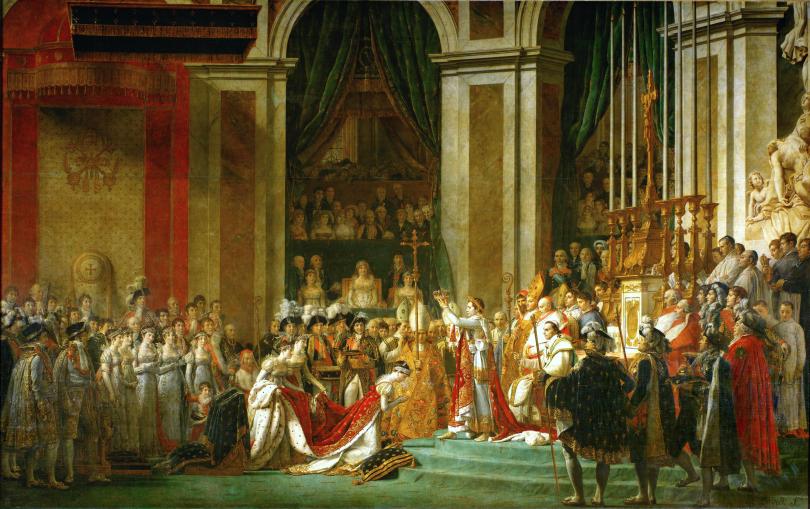
PragerUhad a little video up this morning from historian Andrew Roberts about Napoleon. It’s an interesting take on the not-so-short French emperor—an apologia, really (for those that prefer reading—as I often do—to watching videos, here is a PDF transcript).
Roberts argues that Napoleon was not the necessary precursor to Hitler, et. al.; rather, Napoloen was “sui generis“—a man unto himself. While I believe the ideas of the French Revolution did unleash the totalitarian forces of Hitlerism, Stalinism, Maoism, and all the rest—a murderous, bloody Pandora’s Box—I’ve never considered Napoleon among their ranks.
I first found out about him and his controversial essay from NR, back when I was a devout print subscriber, amid the heady days when campus protests were novel enough to be terrifying. NR ran a little blurb about Williams College cancelling a scheduled talk from Derb, and I’ve been listening to his podcast—an entertaining mix of news, science, political and cultural commentary, and updates on the president of Turkmenistan—ever since.
The big Christmas concert has come and gone. It was pretty wild week, but now we’re on the downward slope.
When I first started doing these little Christmas concerts, we had maybe 100 students at the school. There were no dance classes, and drama was kind of tacked onto English. The focus was on the music, and in such a small environment, everything was simpler: setup, planning, logistics. It was all accomplished more informally.
Now the student body has nearly tripled in size. With that growth has come added complexity. Put it all in a gymnasium during basketball season—the sport third to only baseball and hockey for numbers of games and practices—and it makes for a herculean task.
A major part of American history was, of course, slavery. As I typed that sentence, I nearly wrote “the unfortunate legacy of slavery,” though we’re still living that, just not in the way the race-baiters and social justice warriors claim.
But phrases like “the unfortunate legacy of slavery” have become incredibly cliched. It and similar phrases (“slavery is our great national sin”) act as magic talismans, incantations that, when invoked, protect the speaker (presumably) from the ultimate curse, the label of “racist.”
Of course, slavery was wrong, and slavery is immoral. It was our great national sin (paid for, as Lincoln pointed out in his Second Inaugural Address, with the blood “drawn by the sword” in the American Civil War). It continues to have an “unfortunate legacy,” in that race-baiting charlatans continue to blame it for virtually every pathology in black American culture.
Dang it… I screwed up the incantation with that last bit. I’d better kiss my job goodbye right now.









 The Portly Politico