TBT: Democrats Show Their True Colors

Even after the rapid cultural changes I’ve witnessed since the Bush II administration, I’m always amazed how quickly our national debate changes.  We’re accelerating towards something, and fast.

One bit of evidence—when I wrote “Democrats Show Their True Colors” eleven months ago, it was still somewhat rare for Democrats to openly call themselves socialists.  Now, they’re all clamoring to assume the mantle of big government spendthrifts.

Read More »

Trump Up in Polls

Yesterday’s post looked at blogger photog’s musings about the radical implosion of the Democratic Party.  photog surmised that either the Democrats will tone down their ultra-progressive rhetoric, or they will continue to double-down on—and let President Trump bait them into—their death’s embrace with socialism.  My money is on the latter.

Shortly after that post went to press, I read a National Review blurb about Trump’s record-high approval ratings.  Trump has hovered around 35-40% in most approval polls, with a solid base of support.  Democrats and Never Trumpers have been banking on Trump not gaining substantially beyond 40% approval ratings (never mind that the 2016 polling was egregiously far off).  If we figure that some poll respondents simply aren’t confessing that they like the president or will vote for him, we could probably add 3-5% to that support.

Read More »

SubscribeStar Saturday: Controlling Spending

Today’s post is a SubscribeStar Saturday exclusive.  To read the full post, subscribe to my SubscribeStar page for $1 a month or more.

It’s been a crazy week, with President Trump successfully maneuvering the ultra-progressive “Squad” of Congresswomen Ilhan Omar, Alexandria Ocasio-Cortez, Rashida Tlaib, and Ayanna Pressley as the faces of the entire Democratic Party.

Lost in the shuffle—indeed, what seems to be an afterthought for most politicians and Americans now—is excessive government spending.  Virtually all of the major Democratic candidates for president in 2020 endorse policies like Medicare for All that would balloon an already-engorged federal deficit (around $22 trillion, I believe).  President Trump, for all of his successes with deregulation and trimming bureaucratic fat, has not done much to cut the budget substantially—indeed, he didn’t even campaign on cutting entitlement spending.

To read the rest of this post, subscribe to my SubscribeStar page for $1 a month or more.

McClay & Sheaffer on American History

It’s been a history-packed week for yours portly.  Tuesday morning my History of Conservative Thought students and I continued our examination of Edmund Burke, the great Member of Parliament and godfather of Anglosphere conservatism.  Burke foresaw the radical nature of the French Revolution well before the guillotining began.

On Thursday, I had the opportunity to substitute a colleague’s summer course, Terror and Terrorism, a popular course he’s run for several summers now.  Students in that course read excerpts from John Jacques Rousseau’s Social Contract (PDF, the same one the students read, in part), a political philosophy perhaps the polar opposite of Burkean traditionalism.

Rousseau’s theory of the “general will” is, I would argue, responsible for the radicalism of the French Revolution—which wrought the Bolshevik (Russian) Revolution, the Maoist revolutions of the Great Leap Forward and the Cultural Revolution, and on and on.  There’s a reason one of my Conservative Thought students claims that “the French Revolution was the first Communist revolution,” by which he means it contained within it the collectivist ideals of Rousseau’s general will.

But I digress.  In the spirit of all that historical musing, I thought I’d recommend two pieces I’ve read recently about the historian’s craft, and the dangers of applying a progressive lens to our understand of the past.

The most recent piece is a post from Practically Historical, entitled “Expunging Our Past.”  Gordon Sheaffer‘s pithy historical posts are enlightening and engaging, and fits with an argument he makes in this post:

“History should be popular.  Our past must be understood by the citizenry- historical studies targeted only at academics cannot be how we measure the discipline.  There is a way to make history insightful and enjoyable.”

Amen!  One of my great frustrations while in graduate school was the ponderous relativism inherent in the jargon-laden, hyper-focused monographs we were forced to read.  I certainly acknowledge the usefulness and necessity of thoroughly researching a small corner of our historical experience, but what happened to the grand, sweeping histories of the eloquent generalist?

When I was a younger man, I relished reading accessible (but, nevertheless challenging) works of history, especially broad overviews of a time period or nation.  It’s fascinating to learn about the minutiae, to be sure, but a good historian should be able to give the broad strokes and the colorful details.

But the real point of Sheaffer’s piece is that the progressive revisionists are attempting to reduce American history to a Marxist (and Manichean) story of class struggle.  That trend dates back to Progressive Era historian Charles Beard, who famously argued that the Constitution was merely an economic arrangement that benefited the wealthy Framers, protecting their wealth and privilege at the expense of the common man.

Archfiend (and political scientist, not historian) Howard Zinn continued that theme in the popular-but-inaccurate A People’s History of the United States, which has sadly been adopted in many school districts across the country as an American history textbook.  Zinn presented American history as a procession of plutocrats exploiting the working people and racial minorities for personal aggrandizement, rather than the rich tapestry of hard-working yeoman and laborers who really built the country under the protective auspices of the Constitution.

Just as Burke was the antidote to Rousseau, so historian Wilfred McClay serves as a corrective to the partisan excesses of Zinn.  He’s written a new textbook, Land of Hope, which strives to be a “well-written and appealing history of the United States that, while being informed by the best scholarship, does not lose sight of the big picture about our nation’s admirable and exceptional history.”

McClay argues that without a proper foundation in our own nation’s history, we are unable to govern ourselves.  Quite true:  I would argue that a large part of our current national discontent and brutal culture war is that we have two very different visions of America.  The one is an America that is strong, liberty-loving, fair-minded, and great; the other is of an America that is exploitative, prejudiced, greedy, and callous.

That’s why I’ve long argued that simply requiring students to take an American history course to graduate from high school and/or college isn’t enough to move the needle.  It does no good if the course is a collection of progressivist pabulum or a crash-course in victim studies.  There’s no guarantee your high school history teacher—likely certified from a progressive education program—will actually teach American history fairly or accurately, much less your community college adjunct.

There are a ton of choice tidbits in this interview McClay gave to Encounter Books, the publisher of Land of Hope, but here’s a good excerpt on Zinn:

Encounter: Howard Zinn said that his goal in writing A People’s History of the United States was to create a “quiet revolution” in our understanding of American history. Did he succeed in that endeavor?

McClay: Yes and no. He succeeded in unsettling many aspects of the consensus in which American historical writing was embedded. He did this to an astonishing degree, particularly since he was not himself a historian. But he did not succeed in providing a substitute account of American history that goes beyond simplistic melodrama. Most honest historians will acknowledge that, even if they are sympathetic to Zinn’s leftist politics.

Encounter: Why was Zinn’s account so popular?

McClay: It is engagingly written, and gives a simple-minded, moralistic, account of the past as the struggle between the white hats and the black hats, the Children of Light and the Children of Darkness. For some people, including many Americans who have felt disillusioned by our national flaws, this has been irresistible.

He also rails against the AP US History exam, which used to the “gold standard,” as he puts it, but which has suffered due to constant “tinkering with the exam, and interjection of themselves into what teachers actually teach in AP courses.”  I teach APUSH, and what McClay writes is absolutely true.  It’s bad enough teaching to a test every year—you don’t have the opportunity to luxuriate in the warm waters of historical detail—and it’s worse when the College Board tries to alter the exam every five minutes.

To close, one more powerful quotation from McClay:

Students should learn that history is not merely an inert account of self-explanatory details, but is a task of reflection that calls to our deepest sense of our humanity. And learning our history, the history of our own country, is part and parcel of learning who we are, and learning about the society of which we are already a part.

Again, I say, amen!

TBT: [Four] Years of Excellence

President Trump officially kicked off his 2020 reelection campaign earlier this week, and it’s been almost exactly one year since the post below.  I’ve been quite impressed with President Trump, who has governed far more conservatively than I and many other conservatives could have ever hoped.  While there is still much to be done on immigration—border crossings have accelerated due to misguided progressive policies that encourage child trafficking—and the wall seems to be more an abstraction than a concrete reality, Trump has slashed taxes, created jobs, and strengthened national security.

Trump has also stacked the federal courts with conservative-leaning judges and justices.  And that’s in the face of progressive aggression and Deep State coup attempts.

His record speaks for itself.  President Trump has taken the reins of the Republican Party and has done much to shore up the Republic.  Here’s looking to four more years—and to Keeping America Great!

Father’s Day—16 June 2018—marked three years since President Donald Trump’s now-legendary descent down the golden escalator at Trump Tower, following by his controversial but true-to-form announcement that he would be seeking the Republican Party’s nomination for President.

I was, initially, a Trump skeptic, and I voted for Texas Senator Ted Cruz in the South Carolina primaries the following February.  When Trump first announced, I wrote him off—as so many others—as a joke.  I appreciated his boldness on immigration, but I still thought the PC Police and the campus Social Justice Warriors were firmly in control of the culture, and that no one could speak hard truths.

I also remembered his brief flirtation with running in 2012, and thought this was just another episode in what I learned was a long history of Trump considering a presidential bid.  At the South Carolina Republican Party’s state convention earlier in 2015, I asked two young men working on Trump’s pre-campaign (this was before The Announcement) if he was reallyserious this time.  The two of them—they looked like the well-coifed dreamboat vampires from the Twilight franchise—both assured me that Trump was for real, and I left with some Trump stickers more skeptical than ever (note, too, that this was before the distinctive but simple red, white, and blue “Trump” lawn signs, and definitely before the ubiquitous “Make America Great Again” hats).

I even briefly—briefly!—considered not voting for Trump, thinking that he was not a “real” conservative.  I still don’t think he’s a conservative in the way, say, that a National Review columnist is (although, the way they’ve gotten so noodle-wristed lately, that’s a good thing; I’ve just about lost all respect for David French’s hand-wringing, and Kevin Williamson went off the deep-end), but rather—as Newt Gingrich would put it—an “anti-Leftist.”  That’s more than enough for me.

But my conversion to Trump came only belatedly.  I can still find a notebook of notes from church sermons in which I wrote, “Ted Cruz won the Wyoming primary.  Thank God!” in the margins.

Then something happened—something I predicted would happen on the old TPP site—and I couldn’t get enough of the guy.  It wasn’t a “road to Damascus” epiphany.  I started listening to his speeches.  I read up on his brilliant immigration plan (why haven’t we taxed remittances yet?).  I stopped taking him literally, and began taking him seriously.

And I noticed it happening in others all around me.  Friends who had once disdained the Republican Party were coming around on Trump.  Sure, it helped that Secretary Hillary Clinton was a sleazebag suffused with the filth of grasping careerism and political chicanery.  But more than being a vote against Hillary, my vote—and the vote of millions of other Americans—became a vote for Trump—and for reform.

Trump made politics interesting again, too, not just because he said outrageous stuff on live television (I attended his rally in Florence, South Carolina before the SC primaries, and I could feel his charisma from 200 feet away; it was like attending a rock concert).  Rather, Trump busted wide open the political orthodoxy that dominated both political parties at the expense of the American people.

Take trade, for example.  Since World War II, both Democrats and Republicans have unquestioningly supported free trade.  Along comes Trump, and suddenly we’re having serious debates again about whether or not some tariffs might be beneficial—that maybe it’s worth paying a little more for a stove or plastic knick-knacks if it means employing more Americans.

That’s not even to mention Trump’s legacy on immigration—probably the most pressing issue of our time, and one about which I will write at greater length another time.

Regardless, after over 500 days in office, the record speaks for itself:  lower taxes, fewer regulations, greater economic growthgreater security abroad.  At this point, the only reasons I can see why anyone would hate Trump are either a.) he’s disrupting their sweet government job and/or bennies; b.) they don’t like his rhetorical style, and can’t get past it (the Jonah Goldbergite “Never Trumpers”—a dying breed—fall into this group); or c.) they’re radical Cultural Marxists who recognize a natural foe.  Folks in “Option B” are probably the most common, but they’re too focused on rhetoric and “decorum”—who cares if he’s mean to Justin Trudeau if he gets results?  The folks in “Option C” are willfully ignorant, evil, or blinded by indoctrination.

As the IG report from last Thursday revealed—even if it wouldn’t come out and say it—the Deep State is very, very real.  That there were elements within the FBI willing to use extralegal means to disrupt the Trump campaign—and, one has to believe, to destroy the Trump presidency—suggests that our delicate system of checks and balances has been undermined by an out-of-control, unelected federal bureaucracy.  Such a dangerous threat to our republic is why we elected Trump.

President Trump, keep draining the swamp.  We’re with you 100%.

Deportemal II: Trump Vows Mass Deportations

On Monday, President Trump announced the deportation of millions of illegal aliens beginning “next week,” vowing that ICE agents would remove such aliens “as fast as they come in.”

Here are the two pertinent tweets from the president:

Critics and supporters alike are asking for details on how Immigration and Customs Enforcement will process the millions here illegally.  As I write this post, I’ve just listened to part of Ben Shapiro’s podcast on the announcement; he argues that a surgical, case-by-case approach is preferable, as some illegal aliens possess skills we would want in the United States.

While I appreciate Shapiro’s measured response, I can’t agree.  As I wrote in “Deportemal,” the time for half-measures has passed.  A lengthy review process of the millions of illegal aliens—which could be anywhere from 11 to 33 million (PDF; that document shows an illegal population of 12 million as of 2015), and maybe higher (that no one can know for sure is a major part of the problem)—would bog down for years, if not decades.  Another visa process ladled on top of inherent law-breaking will merely exacerbate the problem.

Consider:  our current catch-and-release system—migrants show up to one court date, get a temporary visa and orders to report back to court, then disappear into the countryside, never darkening an immigration court again—already gives migrants an easy in.  Essentially, touching American soil is like tagging home base:  once you’re here, you’re in.

Now, imagine adding an individual review process to that.  First, you’d have to assume good-faith on the part of illegals in the country.  They have virtually no incentive to come to another hearing.  Yes, they have the opportunity to be absolved of their illegal status (I’m assuming that’s what Shapiro is proposing), but if they think they don’t, they’ll avoid the process.

Second, a whole cottage-industry of gaming the individual amnesty system will emerge.  Lawyers skilled in the ins-and-outs of this fresh bureaucratic hell will profit at the expense of their countrymen and poor illegals.  Appeals—and you know with the federal government there would be a lengthy appeals process—would linger on for months, even years, further adding to the administrative load of ICE and our courts.

If we were dealing with a few thousand people, we could demonstrate some mercy and approach this issue with a lighter touch.  Unfortunately, we’ve failed to enforce our border laws for so long that we’ve allowed this crisis to metastasize, to the detriment of American citizens and potential immigrants alike.

Republicans squandered a golden opportunity to make some real strides on immigration reform during the 2017-2019 congressional session.  President Trump has moved mountains since then via constitutional executive orders and international diplomacy, particularly his threat of slapping hefty, incremental tariffs on Mexico.  Increased enforcement of Mexico‘s southern border has, according to Shapiro, already eased the number of arrests on the American border.

In the wake of President Trump’s massive 2020 reelection campaign launch last night in Orlando, Florida, it is imperative for immigration patriots to run (and win!) in 2020, and for Americans to support Trump’s reelection.  It’s our best hope to resolve this crisis, to the benefit of Americans and the world.

For more of my writing on immigration, check out “Lazy Sunday XIII: Immigration.”

Consider supporting the blog at my SubscribeStar page.  $1/mo. gets you exclusive access to new posts every Saturday.

Conservative Inheritance

In 1950, literary critic Lionel Trilling wrote in The Liberal Imagination (PDF) the following about conservatism, which he viewed as being virtually extinct following the Second World War:

In the United States at this time liberalism is not only the dominant but even the sole intellectual tradition. For it is the plain fact that nowadays there are no conservative or reactionary ideas in general circulation. This does not mean, of course, that there is no impulse to conservatism or to reaction. Such impulses are certainly very strong, perhaps even stronger than most of us know. But the conservative impulse and the reactionary impulse do not, with some isolated and some ecclesiastical exceptions, express themselves in ideas, but only in action or in irritable mental gestures which seek to resemble ideas.

It’s probably the most frequently cited quotation from a liberal among conservatives, because it did, in 1950, offer a practical assessment for the state of conservatism in the United States.  The twin struggles of the Great Depression and the war led to a triumph of what Russell Kirk called “Rooseveltian liberalism,” which sought to use the power of the government to address economic problems.  With the defeat of Nazism and Japanese imperialism, and entering the long Cold War with the Soviet Union, Americans placed great faith in the ability of their government to solve basic problems.

Indeed, the experience of conservatism since the Second World War has largely been that of accepting liberalism’s underlying propositions.  “Conservatism,” then, came to be more of reaction to the excesses of liberalism—a tapping of the brakes, not a full stop or reversal—rather than a cogent philosophical and social system on its own.

While that’s a controversial statement with many exceptions—there remained many conservatives, like Arizona Senator Barry Goldwater, who continued to resist Rooseveltian liberalism—consider that the first Republican President since 1932, Dwight Eisenhower, accepted much of the New Deal, and left it virtually intact.  His signature achievement as president, other than ending the Korean War, was to champion the construction of the Interstate Highway System.  That was a worthy undertaking, to be sure, but the legacy of a major Republican president was to spend millions, rather than rolling back the interventionist state.

Since then, conservatism has gone through a number of permutations, many of which I’ll cover throughout my History of Conservative Thought course this summer.  My point here, however, is that conservatism, strictly speaking, cannot exist in the dominant framework of modern liberalism.

I’m not rejecting the tenants of classical liberalism—equality before God, the possession of God-given natural rights, the freedom of association—per se.  But conservatism is an empirical, rather than a rationalistic, endeavor.  Indeed, Russell Kirk argued that conservatism is not an ideology, as such, but the result of millennia of human experience.

Or, as Ted McAllister writes in “Toward a Conservatism of Experience” for RealClearPolicy, “Conservatism is an inheritance, not an ideology.”  He continues:

American conservatism emerged out of our experiences as a self-governing people who love their inherited liberties rather than abstract rights; whose laws have historically emerged out of our norms rather than a specious theory of justice; whose gift for creating and protecting political freedom (the freedom to govern ourselves, our communities, our associations) has served as the primary obstacle to the relentless drive toward an egalitarian administrative state.

McAllister’s essay—which is really a book review of Patrick Deneen’s book Why Liberalism Failed—makes a compelling case for a conservatism based not on metaphysical abstractions but on the “discovery, articulation, and defense of a reality we experience and of affections formed long before we needed to defend them.”  McAllister argues that conservatism had to adopt a more universal, ideological paradigm during the Cold War to face the major existential threat of international communism, but should return the localized, particularized forms of organic social arrangements America enjoyed prior to 1945.

Part and parcel to this restoration is a rejection of democracy’s excesses.  McAllister writes that “democratic culture overindulges a love of equality and abstract moral truths,” that it encourages a leveling of all people into bland masses and, paradoxically, hyper-atomistic individuals.  In such a culture, perverse individualism separates Americans from their communities and their heritage.  Instead, our churches, schools, social clubs, and other institutions have fallen prey to progressive ideologues, rather than serving as the glue that binds society together.

There’s a lot to chew on in McAllister’s review.  Permit me one more extended quotation:

American conservatism is rooted in inheritance, in the rough guidance of experience over abstract idealism, and in the protection of the pluralism found in voluntary association and in self-governing communities. This is why something profoundly American is lost when conservatives embrace abstraction and universal slogans in their struggle with either liberalism or progressivism….

Suffice it to say that today we lack a strong and traditionally conservative intellectual — and specifically academic — class. The easiest measure of this weakness is found in both the number and the intellectual range of conservative academics. Of particular importance here is the dearth of conservatives in the humanities. Indeed, the number of conservative scholars devoted to such studies as philology, literature, theology, philosophy, and history as well as themes such as imagination, beauty, and truth, has dwindled both in raw numbers and as a percentage of conservative academics. Of course, outside the academy, there are journals and institutions that engage the moral, literary, historical imagination, which offer some reason for hope. But the overall trend on the Right has been toward intellectual work geared toward contemporary and immediate concerns — more about power than about beauty.

In essence, McAllister argues that, while we often appeal to abstractions in our never-ending battle against progressivism, we adopt their rationalist framework by doing so, albeit out of necessity and expediency.  That said, our focus on the immediacy of political power has led conservatism to sacrifice culture—a key reason, I would argue, as to why progressives are so dominant there.

McAllister overstates the problem slightly—just look at New Criterion to see “conservative scholars devoted to… themes such as imagination, beauty, and truth”—but the Left certainly dominates our culture.

At this point, though, I wonder how we can get back the old conservatism.  It’s a worthy goal, but it seems unlikely in an age in which progressive and postmodern dogma reign supreme.  The extent to which the progressive frame infects conservatism—even down to our mental processes—is disheartening, and explains the capitulatory approach of once-great conservative publications like National Review, which can barely contain its eagerness to run and apologize to Leftists for challenging them.

In the long-run, though, conservatism’s foundation—its groundedness—in objective reality, as opposed to rationalist abstractions, will allow it to prevail in all its beautiful, localized, variegated permutations.  That “long-run” just might take a very long while to arrive.

TBT: Open Borders is the Real Moral Crisis

I’ve been writing quite a bit about immigration lately, as it’s the major issue facing the West today.  Our leaders’ inabilities to address the crisis of immigration suggests their ineffectiveness—and, perhaps, their callous indifference to the damage unrestricted and illegal immigration wreak.

President Trump rose to national prominence and won the presidency campaigning on fixing illegal immigration.  His efforts so far have been a mixed bag, as duplicitous, progressive judges overreach from their elitist perches and block Trump’s efforts at reform.

It seems a distant memory now, but all the faux-outrage from the Left just a year ago was about the “child separation” business at the border.  One still reads some echoes of those melodramatic headlines, but the underlying problem has gone unaddressed.

In fact, it’s gotten worse:  immigrants now realize that if they cross the border with a minor child, they can be swept into the interior of the country.  Once an illegal immigrant is in the nation, it’s incredibly difficult to get him out again.

It’s a sad testament that President Trump and Congress have been unable to accomplish more on this front.  As such, it’s shame that this week’s TBT still sounds all-too-familiar.

Here is “Open Borders is the Real Moral Crisis“:

I typically avoid wading into fashionable-for-the-moment moral crusades, but the hysteria over children being separated from their parents at the border is ludicrous, and demonstrates the typical “facts over feelings” emotionalism that mars our immigration debate.  That feel-goodism is why we’re even in this mess—if it can be characterized as such—in the first place.

Because I’ll be deemed a monster—“Won’t somebody please think of the children!“—for not unequivocally denouncing this Clinton-era policy, I’ll issue the usual, tedious disclaimers:  yes, it’s all very tragic; yes, it could be handled better; yes, I would have been terrified to be separated from my parents at such a young age; etc.

Now that the genuflecting to popular pieties is out of the way, let me get to my point:  this entire situation would be a non-issue if we had simply enforced our immigration lawsconsistently for the past thirty years.  President Trump isn’t the villain here (if anything, Congress is—they can take immediate action to change the policy or come up with some alternative—but I don’t even think they’re wrong this time); rather, the villains are all those who—in the vague name of “humanity” and “human rights”—ignored illegal immigration (or, worse, actively condoned it).

Sadly, it is an issue.  But what else are we to do?  Years of non-enforcement have sent the implicit but clear message to potential illegal immigrants that we don’t take our own borders (and, by extension, our national sovereignty and rule of law) seriously, and that if you’re sympathetic enough, you’ll get to skip the line.  Folks come up from Mexico and Central America fully expecting that, after some brief official unpleasantness, they can dissolve into the vastness of the United States and begin sending remittances back to their relatives—who may then pull up stakes and come.

Further, sneaking into the country illegally is a crime, and the United States has every right to enforce its laws, including those pertaining to immigration.  Mexico, similarly, has that right—and uses it unabashedly to police its own border (or to let Central American migrants waltz through on their way to the Estados Unidos).  Naturally, the punishment for breaking laws is often detainment, and the kiddies don’t join dad in his cell.

To give a common example:  what happens to the children of, say, an American heroin dealer when he’s arrested and sentenced to ten years in a drug bust?  His children—if they have no relatives willing or able to take them in—go into the foster care system.  It’s tragic, it’s terrible, but it’s part of the price of committing a felony.  No one wants it to happen, but it’s a consequence of one’s actions.  This reason is why crime is so detrimental to society at large, even beyond the immediate victims.

Unfortunately, a combination of winking at immigration enforcement (“eh, come on—you won’t get deported”), feel-good bullcrap (as my Mom would call it), and Emma Lazarus Syndrome(trademarked to The Portly Politico, 2018) have contributed to the current nightmare situation.  Now that an administration is in office that actually enforces the duly legislated law of the land—and at a point at which the problem has ballooned to epic proportions due to past lax enforcement—the problem is far thornier and more consumed with emotional and moral peril.

As any self-governing, self-sufficient adult understands, sometimes doing what is necessary is hard.  I do feel for these children who are stripped from their parents arms (although, it should be noted, usually for only a matter of hours), but who cares about my feelings?  We can have compassion for those who try to arrive here illegally, as well as their children, without attempting to take on all of their problems, and without sacrificing our national sovereignty and our laws in the process.

The United States is the most generous nation in the world—and the most prosperous—but we cannot take everyone in; to do so would not make everyone else better off, but would rather destroy what makes America the land of compassion, liberty, prosperity, and charity that it is.

***

For further reference, I recommend the following videos, the first from the brilliant Ben Shapiro, the second from Dilbert creator Scott Adams:


I’d also recommend this piece from National Review columnist Richard Lowry, which is quite good:  https://www.nationalreview.com/2018/05/illegal-immigration-enforcement-separating-kids-at-border/

And, finally, this piece from Conservative Review‘s Daniel Horowitz, which explains the true moral toll of illegal immigration—and misplaced compassion—very thoroughly:  https://www.conservativereview.com/news/the-immorality-of-the-open-borders-left/

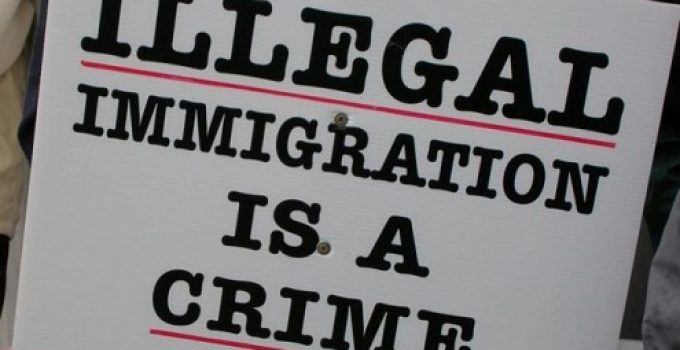
Deportemal

I have little patience for illegal immigrants.  Their illegality encourages ethnic cloistering.  Their very presence constitutes a persistent state of lawlessness, which seems to breed further criminality.

Then there’s the matter of the vast gulf between mainstream American culture and the virtually premodern peasant cultures from which most illegal migrants come.  Child rape is serious problem among men of certain Latin American cultures, as a recent piece from The Blaze demonstrates.  A twenty-year old illegal immigrant impregnated an eleven-year old.

You read the piece and you notice something:  the police already told this young man to leave the girl alone.  Why was he not shipped back to his homeland immediately?  Why was he allowed to stick around long enough to get this girl pregnant in his car near her school?

Yes, yes—why did the school let her slip away to have sex with a man nearly a decade her elder?  There’s blame to go around.  As for the parents, the girl’s father apparently wanted to beat the crap out of the illegal alien, understandably, but the police told him to cool it so he wouldn’t get himself in trouble.

That right there illustrates why average Americans are so frustrated with illegal immigration.  Law-abiding citizens are held to a stringent, inflexible standard.  Forget to claim $20 on your income taxes?  The IRS will spend thousands of dollars to get you.  Own land with “wetlands” on it?   You can’t grow anything on it, lest a non-existent frog die.  Want to camp on the beach?  Sorry, you can’t do that.

But if you’re here illegally, you get free medical care, no taxes, and an entire political party eager to grant you the franchise.  You can even sleep with minors, because, well, that’s just your rich, vibrant culture, and we wouldn’t want to burden you with our colonialist Western standards, would we?

Here’s how we rectify this situation:  deport every illegal immigrant the minute he or she runs afoul of the law, for the slightest offense.  If Pedro throws so much as a cigarette butt onto the side of the highway, send him back.

It would be shocking to you how much illegals get away with while here.  I once heard from an attorney about a client that was here illegally.  The client had received his second speeding ticket, as well as a $1000 tickets for driving without a license.  The attorney managed to get the officer to dismiss the $1000 ticket.  Good luck doing that if you’re a citizen.

My question was, “Why didn’t they deport this guy immediately?”  Look, speeding is probably one of the more benign offenses one can commit—that’s why it’s just a misdemeanor in most States—but it can result in injury or death.  That’s tragic enough when it’s a citizen behind the wheel.  But there’s an added element of injustice when the person driving shouldn’t be here in the first place.

Finally, the whole “living in the shadows” thing is rhetoric, pure and simple.  It conjures up images of old abuelas shivering in dark trailers, afraid to go outside lest an ICE agent apprehend them.  What it really means is that they can’t get a Social Security card and get sweet government bennies—they’re in the “shadow” of official existence.  I know some libertarians who would kill to be in that situation.

Rather than huddling up in the forgotten by-ways of America, illegals flaunt their status.  I’ve been to taquerias and been told that half of those present are likely illegal.  Most of them, to be sure, are harmless, and just looking for some opportunity.  But they’ve jumped the line, doing a real disservice to immigrants that go through the lengthy, expensive process the right way.  ICE could hit a couple of these joints in an afternoon and clear them out.

The solution to illegal immigration, like most answers in life, is simple but unpleasant:  deport ’em all.  Stop fooling around with detaining them in our prisons at our expense.  Ship them back—even if it takes multiple tries—and send the message to those still in Central America that their luck won’t be any better.

America needs 100ccs of prescription-strength Deportemal, stat!