Phone it in Friday LXXVIII: YouTube Roundup XXX: Assorted Foolishness

Right at the end of 2024, I churned out some truly absurd content for my YouTube channel.  I may have shared some of this content here on the blog, but I can’t quite remember—that whole festive season is now a foggy, happy blur.

Regardless, you’re in for a treat.  I’ve got a sultry, satin pillowcase; a pizza covered in Vidalia onions; and a glimpse back into the Christmases of yesteryear.

Read More »

SubscribeStar Saturday: Chicago 2024, Part III: Pizza and Ice Cream

Today’s post is a SubscribeStar Saturday exclusive.  To read the full post, subscribe to my SubscribeStar page for $1 a month or more.  For a full rundown of everything your subscription gets, click here.

After a busy day of scurrying all over northwestern Indiana and Chicago, my brother and I settled into our accommodations at the Palmer House Hotel and rested for a bit.  My older brother is one of those guys who likes to have the television on constantly, and he had it tuned—bizarrely—to CNN (I guess he wanted to go for that “waiting-at-the-doctor’s-office” or “sitting-at-an-airport-concourse” feel).  We were in Chicago right after President Biden’s disastrous glitching out during his debate with President Trump, and it was interesting seeing how desperate the CNN anchors and pundits were.  The Democratic Governors met and announced their support for Biden, and it reminded me of how much work Michigan Governor Gretchen Whitmer—the one who the FBI plotted to kidnap to pin it on Republicans—has had done.

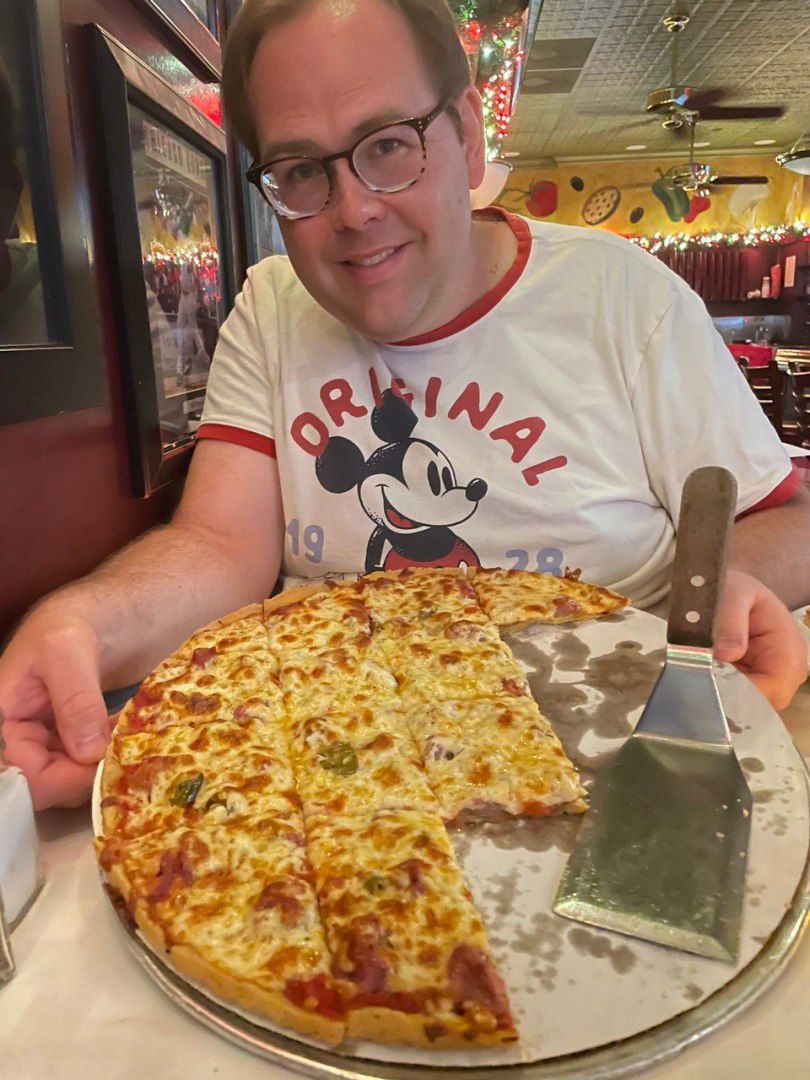
I showered the grime of Gotham and CNN from my doughy body and put on my best (and, I’ll hasten to add, only) Mickey Mouse t-shirt, and we went to Pizano’s Pizza and Pasta for dinner, a short walk from out hotel room.  Pizano’s obviously serves Chicago deep dish pizza, but they also feature “Chicago Tavern Style,” which I thought Pizza Hut made up as part of a recent advertising campaign (apparently, it’s real).

It turns out that Chicago Tavern Style is not just a clever marketing ploy by a formerly renowned national pizza franchise; it’s actually a Chicagoan innovation to pizza.  Basically, it’s the happy medium between, say, New York Style and Chicago Style slices.  The crust is a bit thicker, with a doughier quality than New York Style, but not so thick that it’s like eating a lasagna, a la Chicago Style.

Here’s a handy picture to illustrate:

My brother described the crust as “redolent of the oiliness of a Pizza Hut Personal Pan Pizza from the Nineties,” which is the perfect description.  We ordered the “Jeweler’s Special” (the Loop is the old jewelers district in Chicago), which came with sausage and giardiniera.  Giardiniera is the blend of various peppers and carrots that Chicagoans put on their hot dogs.

The pie was delicious, but too spicy.  Keen observers will note the sheen of sweat on my massive forehead.  That wasn’t just because of my excess portliness; the peppers were causing sweat to pour down my face.

To read the rest of this post, subscribe to my SubscribeStar page for $1 a month or more.

Tuesday TPP Update: Moving Weekend

Apologies to readers for some delayed posts Saturday and Monday.  I will be working to get those finished today and tomorrow, and to get back on my regular posting schedule.  Even this short update post is a bit delayed.

I spent the entire weekend helping my girlfriend move to her new apartment, and while it was one of the easier moves I’ve done in terms of furniture heft, it was also a situation of Murphy’s Law:  what could go wrong, did (well, not entirely—I suppose the U-Haul could have exploded en route).  We made an initial run Friday morning to drop off a small load and to get the keys to her new place.  It turns out there were several bits of documentation that the various utility providers had either not sent or did which my girlfriend did not realize she needed until the night before, but fortunately that all got sorted fairly quickly and headed back to South Carolina for the big load.

Unfortunately, when we arrived at the U-Haul pickup location, the place was totally dark—and this was at 3:30 PM.  There was also a massive storm system rolling in, with lightning popping in the area as we waited despondently on the off-chance the proprietor of the fly-by-night used car lot where my girlfriend had made the reservation would show up.

When it became apparent this mystery proprietor was not going to materialize miraculously, I began calling every U-Haul location in the general vicinity.  On the fourth attempt, I got through to a location.  They did not have a twenty-foot truck, but were able to place a reservation for me at a location that was a mere half-mile away from the shuttered used car lot.  As the storm began to shower its sky babies upon us, we booked it to a U-Haul Super Center and got the twenty-foot truck, which I drove gingerly through the downpour to my girlfriend’s apartment.

(An aside:  I love U-Haul trucks, with their lower storage cabins and their easy-to-drive cabins.  What I do not love is the willy-nilly fashion in which U-Haul hands out franchises to every Tom, Dick, and Skeletor out there.  Virtually every move I’ve ever made has involved going to a seedy, dilapidated, remote location, and asking the surly gas station/hardware store/dirt-floor shack attendant to give me the keys to the truck.  There’s always something unseemly about it—it’s like buying drugs, or purchasing an escort [I don’t know what those things are like, to be clear, but I’ve watched enough 70s movies to get the idea].  One time I picked up a U-Haul at a shack with a literal dirt floor and one bare light bulb burning overhead.  I’m surprised I made it out of there alive, much less with a truck!)

Read More »

Monday Morning Movie Review: Willy’s Wonderland (2021)

Back in 2014 the indie game Five Nights at Freddy’s fired the imaginations and nightmares of gamers with its twitchy, fast-paced, stressful management of a low-powered security camera system and a couple of security doors.  The premise of the game is simple:  survive the night as a security guard while the animatronics at a haunted pizzeria come to life.

The game trades on the creepiness of those old Showbiz Pizza (later Chuck E. Cheese) robot concerts and their terrifying characters.  While that ill-fated pizza franchise has struggled with bankruptcy, the interest in deadly animatronics slaying unsuspecting night watchman and would-be pie lovers has only grown.

It’s not surprising, then, that Hollywood would take note of Five Nights at Freddy’s success and attempt to capitalize on this very specific horror niche.  2019 saw the release of The Banana Splits Movie, a horror comedy ludicrously based on the late 1960s Hanna-Barbera cartoon The Banana Splits.

I haven’t seen The Banana Splits Movie (though it’s definitely on my list of “weird things to watch”), but I have seen the most recent entry into the subgenre of animatronics horror:  2021’s Willy’s Wonderland, starring Nicolas Cage in a role completely counter to the over-the-top acting style Cage usually employs:  he doesn’t speak a single word in the entire film.

Read More »

Rest in Peace, Herman Cain

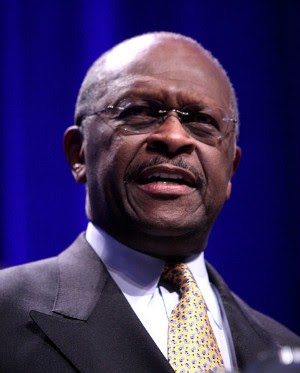
Yesterday, former Godfather’s Pizza CEO and 2012 Republican presidential primary candidate Herman Cain passed away after a long struggle against The Virus.  Cain was 74.

Breitbart calls Cain a “Conservative firebrand,” which was apparent to anyone following the crowded 2011-2012 Republican presidential primaries.  Like 2016, that was a crowded primary field, with tons of conservative darlings and Establishment types alike jumping into the field.  Back in those days, everybody thought Barack Obama was going to be the next Jimmy Carter—an ineffectual, overly-progressive one-termer.  The economy stunk, Obama seemed out of his depth, and conservatives were united and motivated to get out and vote.

Herman Cain quickly set himself apart from the rest of the crowd, though—he wasn’t a career politician, but a successful businessman (according to John Derbyshire, Cain is also somewhat a mathematical genius).  He put out his bold “9-9-9 Plan“—flat, nine percent national sales, income, and corporate tax rates.  Cain’s reasoning:  “If ten percent is good enough for God, nine percent is good enough for the federal government.”  Yes, it was a bit far-fetched, but it was catchy, and in an era of high corporate and income taxes—both of which undermined American business competitiveness domestically and abroad—it resonated with voters.  The implicit reference to the biblical tithe also let voters know Cain was a devoted Christian, which was a welcome change from the open hostility of the Obama administration to religious liberty.

Read More »

Corporate Grind II: The Return of Corporate History International

It’s been a golden week for reblogging, as some of my blogosphere buddies continue to generate some amazing content.  It looks like I may have to do another Dissident Write feature soon (here are I and II).  Armistice Day always brings out the best material, too.

As we head into the weekend—mercifully free of professional obligations—I’m pleased to note the revival of my buddy fridrix’s blog, Corporate History International.

Read More »

An Open Letter to Papa John’s Pizza

Disclaimer—sigh:  I do not endorse racist ideologies or unnecessarily racist language, but I support free speech.  People shouldn’t go around using racial slurs, and may face professional and social consequences for doing so, even though it’s protected speech.  That said, I also believe nuance and context matter greatly.  It’s for the non-nuanced- or contextually-minded reader that I include this brief disclaimer, which I hate is even something I have to consider doing in an allegedly free country.

Pizza is a big part of modern American history, one of those beautiful examples of “cultural appropriation” that took the thin-crusted Neapolitan peasant street-food, improved upon it greatly, and made it a staple for all classes and races in the United States.

While everyone and their brother has their own opinions about the best slice and where to get it, my favorite of the “chain delivery pizza joints” (not to be confused with generally-superior ma-and-pop local pizza joints—or the Aiken-Augusta-area chain Pizza Joint) is, hand’s down, Papa John’s.

Sunday afternoon, I received “An open Letter from Papa John’s CEO, Steve Ritchie” in my e-mail.  Apparently, Papa John’s founder John Schnatter said The Forbidden Word, and has been forced out of his company.

You can read the full-text of Ritchie’s letter here.  A key line (emphasis added):

Racism and insensitive language – no matter the context – will not be tolerated at any level of our company. Period.

I began looking around to see what exactly Schnatter said.  What I found is that, yes, he used The Forbidden Word—in reference to Kentucky Fried Chicken’s beloved Colonel Sanders, on a conference call with a company training him on how to handle public relations better.

In essence, Schnatter was asked in a role-playing exercise how he would handle a situation similar to his remarks about the NFL National Anthem protests.  Schnatter had spoken out publicly about the protests, arguing—correctly—that they were hurting Papa John’s sales (Papa John’s has long been the official pizza of the NFL, so poor NFL ratings meant poor pizza sales; I’ve often enjoyed the ridiculously good deals they put out during football season).  As such, he’d already put a target on his back for progressive Social Justice Warriors.

As for the use of The Forbidden Word, Schnatter responded that Colonel Sanders used it, and then related a story about racial violence he witnessed or heard about as a boy in Indiana.  He wasn’t endorsing such violence, but intended it to show that he detested it.

Apparently, some employees of the public relations firm, Laundry Service, were offended, and—wow, wouldn’t you know it!—his use of The Forbidden Word was leaked.

Now he’s no longer working for the company he founded, and 120,000 employees (not to mention Papa John’s stockholders) are going to suffer.

I’m not holding Schnatter blameless here—he should know in the twenty-first century that a.) the Leftist mob doesn’t care about nuance, they just want another scalp and b.) you’re not allowed as a white man to say a word that thickly marinates every modern rap song—but a lot of employees, many of them black, might face layoffs because a handful of people got upset and leaked the contents of a confidential, training-based conference call.

It just goes to show that no one is safe, in any forum, at any time, ever.

In response to all this non-troversy, I took a moment to write a reply to Mr. Ritchie.  Here is the text in full:

Dear Mr. Ritchie,

Thank you for your e-mail.  I was unaware of the Papa John’s non-troversy until I received this e-mail.

From what I can tell from the news reports, John Schnatter may have been a tad careless with a culturally-taboo word, but he meant no ill-intent.

I suspect, rather, that he’s been crucified—the latest victim of such—on the cross of political correctness gone mad.  Given his past statements about NFL protestors hurting NFL ratings—and, by extension, your company’s pizza sales—he put a target on his back too tempting for the Social Justice Warriors to ignore, as he dared to make a truthful observation about one of their sacred cows.

Those statements, too, may have been unwise in a business context (even leaving out the possible racial component–and I don’t think arguing that players should abide by League rules is an inherently racist idea—it’s probably not a good idea to criticize publicly a major business partner), but they don’t warrant the kind of scorched-earth response that Mr. Schnatter has endured.

I am sorry to hear that his remarks have hurt actual people—the employees and franchisees of Papa John’s.  Surely you can agree that that’s the only tangible damage that has occurred here.  Otherwise, no person, of any race, was actually harmed by Mr. Schnatter’s use of the “N” word in an in-house conference call that, as I understand it, was a training session for avoiding future public-relations imbroglios (oops!).  In that context especially, shouldn’t the one receiving the training have additional leeway to learn without fear of some SJW ruining his life?

I hope that your employees will continue to make excellent pizza, as they have done for years, and will not be overly burdened by the kabuki theatre of your diversity initiatives.  I understand that, as a major company, you have to do your token genuflecting to the gods of multiculturalism and political-correctness, even though I’d personally rather see your Board grow some cajones and say, “Sorry for the misunderstanding and if anyone was offended, but the remarks have been taken out of context.  We serve pizza for all people, and while we don’t condone racism, we do support free speech, and believe that everyone should lighten up a bit—preferably over a slice of Papa John’s pizza.”

Sincerely,

Tyler James Cook

The cost of doing business seems to be never uttering anything remotely controversial, ever.  Schnatter was doomed the moment he pointed out—again, correctly—that the NFL was losing viewership because of the politicized National Anthem protests.  Yes, he shouldn’t have said The Forbidden Word—even in the context of quoting someone else, it’s not allowed according to current social mores—but it was just a matter of time before the Twitter mobs, Social Justice Warriors, white knights, or overly-sensitive consultants (Laundry Service is designed to train people not to make public faux pas; surely they’ve had clueless clients before that needed teaching) brought him down.

Why can’t we just enjoy pizza without it becoming an exercise in political posturing?

Pizza Paving Potholes

I love pizza and politics, and writing about both runs in the family.  So while looking for South Carolina’s primary election results this morning at thestate.com, I was intrigued to find the following headline:  “Tired of potholes? Domino’s Pizza helps pay for road repair. How to nominate Columbia.”

The State‘s article links to Domino’s Pizza’s Paving for Pizza program (how’s that alliteration?).  Here’s the gist of it:  nominate your town using your zip code, and Domino’s might pitch in some dough (tee hee) to fill its potholes.  They’ve already done it in several cities around the United States, from California to Texas to Delaware.

Every South Carolinian knows that one of our major issues is the poor state of our roads.  Indeed, last year the legislature passed a gas tax hike, the first phase of which kicked in at the beginning of 2018.  That tax will raise the tax by $0.02/gallon each year for six years, ultimately topping out at $0.12/gallon by 2023.

It also introduced increased fees for registering vehicles from out-of-state, and raised registration fees for hybrid and electric vehicles (which put more miles on roads using fewer gallons of gas, meaning hybrid and electric owners pay less in gas taxes—ergo, the State wants to get their cut from those drivers, too).

(Remember, South Carolina drivers, you can save your receipts from the gas pump starting this year—2018—and deduct what you paid in gas taxes from your SC income tax when you file for FY2018.  It has to be gas purchased in South Carolina—of course—and the receipt has to show the number of gallons purchased.  Hold on to those bad boys!)

So, what does this have to do with pizza?  Domino’s—like many companies in South Carolina and throughout the nation—needs good roads to deliver its gooey pies safely and efficiently.  Bad roads, littered with potholes, negatively impact Domino’s business, incurring expensive tire replacement and vehicle repair bills (and preventing your mushroom-and-pepperoni pizza from arriving in thirty minutes or less).

As such, Domino’s has a vested interest in seeing that roads are repaired.  Rather than lobbying for more roads funding or pushing for a gas tax, though, Domino’s decided to act directly in its economic interest—that is, to have better roads—and has committed to helping communities fill their potholes.

This kind of public-private partnership is innovative (and good marketing—I’m dedicating an entire wall-o-text to Domino’s Pizza!), and it demonstrates that free-market principles can work to the benefit of all parties.  Domino’s and its drivers get safer roads; residents of a “Paving for Pizza” town also enjoy safer roads; State and local governments save on astronomically expensive road repairs (I once heard a Florence County, SC Councilman say that it costs $1 million to repave one mile of road—yikes!); and taxes on gas or property don’t have to increase, which hurts everyone.

Kudos to Domino’s for taking a proactive approach to solving a public problem.