Phone it in Friday XXVI: Unschooling with John Taylor Gatto

It’s been awhile since I’ve posted anything about John Taylor Gatto, the teacher who rejected compulsory schooling and argued forcefully in favor of a true education, one unbounded from mass school schemes.  I was on a kick back in the spring of listening to his talks, but hadn’t listened to him much lately.

That is, until the YouTube Algorithm—may it be praised—tossed this video into my feed:

I know, I know—it’s nearly an hour long.  I don’t expect you to listen to it all now (please finish reading this blog post first), but if you’re in the car or warshing (as my girl would say) the dishes, put it on in the background.  It’s a must-listen.

Read More »

TBT: The Influence of Christianity on America’s Founding

My high school American history classes are getting into the American Civil War—or the War of Northern Aggression, or the War for Southern Independence, or whatever you’d like to call it—this week, so we’ve been talking about beginnings a good bit.  The Civil War had deep roots that go back not just to the 1840s or 1850s, and not even to the Constitutional Convention in 1787.

Indeed, the fundamental division dates back to the English Civil War in the 1648, when the Puritan Roundheads under Oliver Cromwell ousted and beheaded Charles I, and established the English Republic (which—the English having little taste for radicalism or dictatorships, fortunately collapses in 1660 with the restoration of the Stuart monarchs).  Loyalists to the king and the monarchical order were the aristocratic Cavaliers.  Those same Puritans of East Anglia settled heavily in Massachusetts following the Pilgrims’ famous landing at Plymouth Rock, and the Cavaliers—in body and spirit—dominated the tidewater plantations of the South.

Read More »

The Invasion and Alienation of the South

A few weeks ago, I wrote about the changing, dying rural communities I observed on a trip through western South Carolina.  You’re not supposed to say as much, but I don’t like that the culture and the world I grew up in are changing.  I’m not sure when it became taboo to say, “This is my home and these are my kin,” but apparently that’s no longer acceptable if you’re a conservative Christian in the American South, especially if you’re a white man.

Around the time I wrote that post, I stumbled upon two excellent posts from the Abbeville Institute that express that sentiment beautifully.  One, “Stranger in a Strange Land” by Leslie Alexander, is a poetic, heartbreaking glimpse at a personal sense of alienation:  the writer, a Louisiana native with deep roots, finds herself adrift in Dallas, a land that lacks not only has “no regional culture here—one of common language, mores and manners–there is not even an American one.”

The other, from Nicole Williams, is a more technical and historical dive into the emergence of the “New South,” the story of how an economically devastated postbellum region, in a search for economic opportunity, ultimately sold its culture and identity for a mess of pottage.  The title says it all:  “What Price Prosperity?

Read More »

Lazy Sunday XXVII: Bric-a-Brac

It’s been a pretty crazy week, and the weekend has only eased up slightly.  Last week’s Lazy Sunday was all about small town living, and about how valuable social peace is to maintaining a healthy society.

I’ve been harping on this idea a great deal lately.  Politics is an abyss, and staring into it for too long and too often starts to distort and twist one’s perspective.  In some ways, avoiding the topic twists the perspective of those who are not staring into the abyss, as I wrote about yesterday.  Nevertheless, it gets tiring—indeed, soul-sucking—to focus on politics constantly.

Additionally, I am increasingly in a state of despair about the ultimate direction of our nation and culture.  President Trump has been a welcome, God-given reprieve, but even his efforts have been repeatedly stymied, even by those within the party he remolded into his own image.  Even normal ideas are increasingly considered “radical,” and we can’t even discuss problems openly anymore in a polite setting.  I am a declinist by nature, but this is just ridiculous.

So, in the midst of this deepening despair—and this sense that, in abandoning God, He’s abandoned us to our fate—I’ve been trying to write more about lighter topics.  Perhaps it’s a bit of buoyant distraction as the ship slowly descends into the murky depths of irreversible darkness, or maybe it’s the recognition that there’s more to life than petty political squabbles (although most of those squabbles are increasingly theological battles for the soul of the West), but I’ve found that writing about Saturn is more enjoyable.

With that in mind, here’s a grab-bag of portly bric-a-brac:

  • The Bull on the Roof” – I wrote this post on my phone—never an enjoyable endeavor—while watching my little niece and nephew one evening (they lived, so I guess I wasn’t too negligent).  It’s about a delightful little piece of classical music from 1920, before modern classical music turned into atonal trash and killed the genre.  I wish music composition schools were still churning out composers who could write stuff like this piece.
  • Funcling” – I love being an uncle.  My little niece and two nephews are fun (and exhausting) to watch and to play with, and their imaginations are amazing.  This piece was about their obsession with pretending to be various Nintendo characters, mostly Kirby and sundry Pokemon.
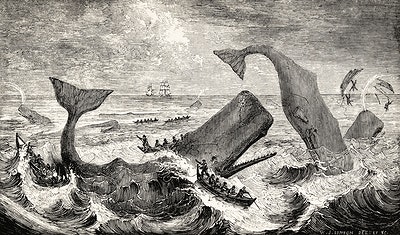
  • Summer Reading: The Story of Yankee Whaling” – I read this little book over the summer, and loved it.  Written for children in the late 1950s, the book is an historical overview of the defunct whaling industry, an industry that built and fueled New England and America.  They don’t write history like this anymore; now, the book would be full of hand-wringing about whales being endangered species due to overhunting.  None of that in this book:  whales are powerful creatures, and men need to make a living.  Adventure ensues.
  • Saturn: The Creepiest Planet?” – Other than Earth, Saturn is the best planet (and, next to Earth, the creepiest, it seems).  I dream of being able to visit other planets.  In fact, I get perturbed when talking to scientists because they’re such buzzkills about space exploration.  “You would be crushed instantly, TPP, if you tried to fly into Saturn’s gaseous core” (even that sentence mocking them is probably riddled with errors to which they would object)—yeah, I know!  Let me suspend disbelief for a minute.  Better yet, come up with some solutions.  I’m sick of nerds telling me that putting plants and potting soil on the moon won’t terraform it.  Figure it out!  Aren’t we paying you to make science-fiction a reality?

That’s it for this week.  Don’t let politics suck your soul away.  Maybe God will hear our cries for help and do something; maybe not.  Regardless, spend time with family, read good books, and listen to good music—and try to enjoy yourself as the ship goes down.

—TPP

Other Lazy Sunday Installments:

Summer Reading: The Story of Yankee Whaling

I released the Portly Politico Summer Reading List 2019 on my SubscribeStar page a few weeks ago, which features a few books I highly recommend.

After dashing off yesterday’s post on Sunday night, I picked up a little book I’ve had in my private collection for some years now, The Story of Yankee Whaling.  It’s part of the now-defunct American Heritage Junior Library series of history books for young readers, and it’s a charming little volume about the grand adventures and brutal lives of whalers in colonial and nineteenth-century America.

The first edition of the book was published in 1959, but my edition is a slender paperback edition from 1965.  It is rich in primary source documentation, as well as sketches and woodcuts from the high watermark of whaling.  The author is Irwin Shapiro, who worked closely with Edouard A. Stackpole, the then-curator of the Mystic Seaport Marine Historical Association in Mystic, Connecticut.

Read More »