TBT: Tucker Carlson’s Diagnosis

This week’s TBT looks back to a piece I wrote in January 2019 that summarized a segment Tucker Carlson did on his wildly popular show.  That segment really shaped my thinking on some economic and social issues (although other commentators and writers were already influencing my thinking in that direction).

Earlier this week, I wrote a piece about another Tucker segment that applied these concerns into a political platform, of sorts, one that moves beyond economic growth to real improvement for people’s lives.

This blog post was a bit shorter, so I’ll allow it to speak for itself.  It’s definitely worth watching the linked video in the piece, as it is the segment the post covers.

Here is January 2019’s “Tucker Carlson’s Diagnosis“:

recent monologue from Tucker Carlson’s Fox News program is blowing up the right-wing blogosphere, and understandably so.  Carlson has been a vocal critic of the neoliberal deification of economic efficiency at all costs.  I used to be a member of this cult, until the candidacy of Donald Trump (and lived experience) knocked the idealistic scales from my eyes.

Normally, it bugs me when people send me video clips to watch.  If they’re cutesy videos of the variety that drive clicks—think cats playing piano, or Goth versions of Christmas songs—I usually ignore them, no matter how hyped they are.  That’s not some virtue on my part; I just don’t want to take the time to watch them, especially on a cell phone (a pet peeve:  someone making me watch a video on their cell phone; I will refuse).

That said, I’m indulging in some hypocrisy:  you must watch this video as soon as you’re able.

For those of you that don’t want to take the time, here are some highlights:

  • Elites care only about maximizing economic efficiency, regardless of the human costs to individuals, families, and communities
  • That lust for efficiency drives income inequality, particularly benefiting the technology sector/Silicon Valley
  • “We are ruled by mercenaries, who feel no long-term obligation to the people they rule”—a key idea; I’ve read a similar analysis from controversial blogger Z-Man, in which he argues that leaders in a democracy are, inherently, renters rather than owners, and therefore are heavily tempted towards asset-stripping while in office, rather than building and maintaining a nation:  http://thezman.com/wordpress/?p=15929
  • Because of the hollowing out of American manufacturing and declining wages (again, due in part to the quest for efficiency), men struggle to find employment or to improve their wages
    • Because of that, rural parts of the country are dominated increasingly by healthcare and education, female-dominated fields
    • While better wages for women is fine, Carlson claims that—whether or not they should—women are less likely to marry men who earn less than them, therefore

These are just some of the most interesting insights, but Carlson sums up in fifteen minutes what would take a legion of hack bloggers like me hours or weeks to explain.

Again, I urge you to watch this video:  https://video.foxnews.com/v/5985464569001/?playlist_id=5198073478001#sp=show-clips

God Bless Us, Every One: The Gift of the Trump Economy

Christmas Week is always full of blessings.  Thanks to the good folks at pro-MAGA news aggregator Whatfinger News (and a helpful tip from photog of Orion’s Cold Fire on how to submit links to them), The Portly Politico has seen its best week in terms of traffic all year.  Two pieces, “Napoleonic Christmas” and “Christmas and its Symbols” made the main page, leading both to surpass my previous top post for the year, “Milo on Romantic Music.”  Apparently, people still get riled up about Napoleon.

It’s also been a wonderful opportunity to spend time with family and to overeat lots of delicious, rich foods.  If you’ve never heard of the Appalachian delicacy “chocolate butter,” do yourself a favor and look it up.  Yes, it’s even better than the name suggests.

Of course, all of that good cheer requires a solid financial foundation.  And in his three years in office, President Trump has shattered records for unemployment, wage increases, and economic growth.  Economics isn’t everything, but the Trump economy is something for which we should give thanks.

Read More »

Bologna

The long national nightmare is over.  No, not the impeachment farce; it’s the end of the semester!  Grades are in the books, work is done, and teachers and students are heading out for two weeks of glorious Christmas Break.

It’s been an eventful week.  As the House was fulminating about Trump’s alleged “crimes,” I was playing a gig with our community jazz band.  I play second alto sax with the group, but I asked to sing a song on this concert.

It’s long been a dream of mine to sing with a full jazz swing band behind me, and that dream came true Wednesday evening.  I sang Andy Williams’s “It’s the Most Wonderful Time of the Year,” and was a nervous wreck (if you’ve seen the lyrics to that tune, you’ll understand why—what a mouthful!).  But I got through it admirably enough, even with a low-grade sinus infection.

The gig was during the dinner hour at a large church in town.  The first alto player indicated how hungry he was, and wondered if he could get a plate.  I told him (unhelpfully) that I’d eaten a bologna sandwich in my car before coming in (which sounds like a joke and/or the most mundane, pathetic detail in the world, but it was true).  All the old guys in the band—it’s a swing band, so there are a lot of them—expressed their enthusiasm for bologna sandwiches, and asked how it was prepared:  did I use mustard?  “Nope, Duke’s mayonnaise, with cheese.”  Murmurs of approval followed.

Read More »

Size Matters

The big Christmas concert has come and gone.  It was pretty wild week, but now we’re on the downward slope.

When I first started doing these little Christmas concerts, we had maybe 100 students at the school.  There were no dance classes, and drama was kind of tacked onto English.  The focus was on the music, and in such a small environment, everything was simpler:  setup, planning, logistics.  It was all accomplished more informally.

Now the student body has nearly tripled in size.  With that growth has come added complexity.  Put it all in a gymnasium during basketball season—the sport third to only baseball and hockey for numbers of games and practices—and it makes for a herculean task.

Read More »

Milo on Romantic Music

The Christmas season always gets me excited for music, because there are so many wonderful carols and hymns about the birth of Jesus.  I will write more on the topic of Christmas carols later on in the month, but today I wanted to touch on a really niche topic:  Milo Yiannopoulos‘s love of Romantic-era music.

What got me on this topic is not just my musical mood; it was an epic Telegram thread Milo had going about… classical music.

Read More »

TBT: Deportemal

The unintended theme this week has been back on immigration, particularly the kind that swamps small communities and results from one-sided tolerance.  Since I’ve already uncorked that bottle, I figured I’d like the wine flow with this week’s TBT feature.

This piece, dating back to late May of this year, was a full-throated screed against the manifold injustices of illegal immigration.  Few topics make my blood boil more:  the flagrant violation of the rule of law, the entitled attitude (“we have it tough, so we have a right to be here”), the two-tier system of justice—all are make my stomach turn.

So, here’s my prescription to cure our ills:  a healthy dose of “Deportemal“:

I have little patience for illegal immigrants.  Their illegality encourages ethnic cloistering.  Their very presence constitutes a persistent state of lawlessness, which seems to breed further criminality.

Then there’s the matter of the vast gulf between mainstream American culture and the virtually premodern peasant cultures from which most illegal migrants come.  Child rape is serious problem among men of certain Latin American cultures, as a recent piece from The Blaze demonstrates.  A twenty-year old illegal immigrant impregnated an eleven-year old.

Read More »

One-Way Cosmopolitanism

A major theme—perhaps clumsily conveyed—of yesterday’s post was that Americans should be able to keep their culture and local identity without shame.  As I noted, struggling rural communities are particularly susceptible to being swept away by large-scale immigration, legal or otherwise.  Thus, we see small South Carolina towns gradually hispanicize, turning into little replicas of various Latin American cultures, rather than the old Southern culture that predominated.

One often hears that Americans should be tolerant and open-minded to other cultures, and to extend maximum understanding and patience.  That is a generous and worthy view:  I don’t expect the Chinese foreign exchange students at our school to speak accent-less English and understand liberty their first day off the plane.  In that instance, we go out of our way to attempt to understand the cultural background from which those students came.

It’s another matter, though, when it involves the permanent or long-term relocation of foreign aliens to our land.  Remember the expression, “When in Rome, do as the Romans do?”  That rule always seems to apply to Americans—who are routinely criticized for being uncouth abroad—but never to any other ethnic group, and especially not to cultures outside of the West.

It’s an enduring frustration of mine:  one-way cosmopolitanism.

Read More »

The Hispanization of Rural America

This weekend I drove through some very rural parts of western South Carolina to check out some small-town festivals (Subscribe Star subscribers will get the full story this Saturday, and read my ode to candy apples, which this same trip also inspired).  My route took me north from Aiken through Ridge Spring, South Carolina, then up through Chappells and Saluda to Clinton, located on the cusp of the Upstate.  Then it was a 90-minute drive back south through Saluda, Chappells, and Johnston on the way back to Aiken.

Most of this section of South Carolina is farmland, dotted with small towns or unincorporated communities.  Some of these towns were once thriving little railroad junctions, or the communities of prosperous farmers or textile mills.

Now, they often feature quaint but dilapidated downtowns (often full of barber shops and wig stores, but plenty of boarded-up windows), a few stately old homes, and a great deal of poverty.

What I noticed on this most recent trip, however, was the clear uptick in Hispanic residents and businesses.

Read More »

Lazy Sunday XXXI: Trump, Part II

This week’s Lazy Sunday picks up from last week’s edition, “Lazy Sunday XXX: Trump, Part I.”  Our perpetually embattled POTUS/GEOTUS continues to fight back against the screeching Leftists:

  • Trump Up in Polls” – This piece from July looks at Trump’s rising approval ratings.  It also analyzes those numbers, and looks at MSNBC gasbag Joe Scarborough’s prediction that “bigotry and racism” would cost Trump reelection in 2020.  At the time, I wrote that “bigotry and racism” would not be much of a factor:  the epithet of “racism” has been hurled so much lately, it’s become like “The Boy Who Cried Wolf”—it’s meaningless.
  • Happy Monday: President Trump’s Approval Rating at 52” – Remember the government shutdown?  That seems like an eternity ago (I wish it were still going on).  Even in the midst of that, Trump’s approval ratings crested to their highest since Inauguration 2017.  President Trump has returned to the 52% (and 53%, I believe) mark since the impeachment witch hunt has begun.
  • Babes for Trump” – This little post always seems to do well, and was seeing a steady trickle of traffic recently (consistently enough that I made it a TBT feature).  Whenever I post it to The Portly Politico‘s Facebook page, one of my Trumpian former students always likes it.  Easy, big fella!  Regardless, the post is about President Trump’s support among Republican women.  My only real fear for 2020 is that, should Fauxcahontas get the nomination, box wine aunties and suburban moms will vote for her because she’s a woman, and because Trump is a “meanie.”  Get over yourselves!
  • Breaking:  Trump Nominated for Nobel Peace Prize” – Remember when we were supposed to be embroiled in nuclear war with North Korea?  Notice how that hasn’t happened?  A Scandinavian politician called for President Trump’s nomination to the Nobel Peace Prize.  That might have been a tad rich, but it would have been far more deserved than President Barack Obama’s receipt of the award—simply because he was a black guy who got elected President!  He won the award before he even had a chance to wreck our foreign policy.

Well, that’s it for this Sunday.  Enjoy your Columbus Day tomorrow!

–TPP

Other Lazy Sunday Installments:

TBT: Nehemiah and National Renewal

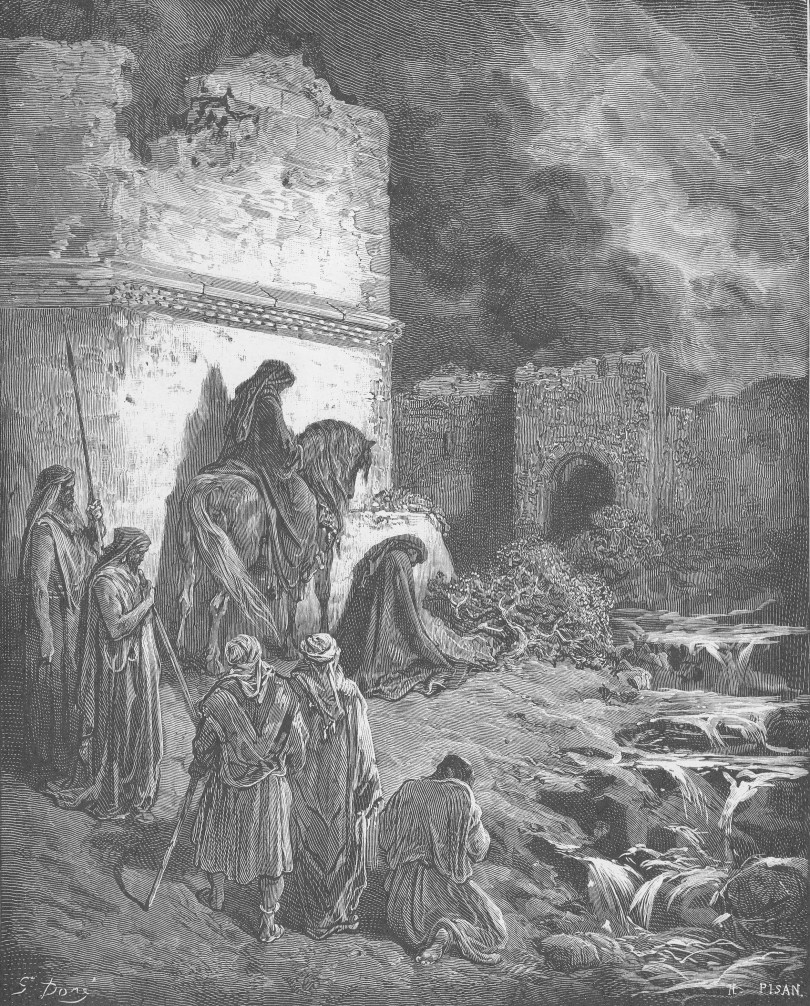
In keeping with the unofficially churchy theme of two of this week’s posts (here and here), it seemed like a good opportunity to look back at a post from February about Nehemiah.  In “Nehemiah and National Renewal,” I explored the impact of Nehemiah’s faithful reconstruction of Jerusalem’s collapsed wall in terms of the national renewal it brought (and the spiritual renewal that came with it in a follow-up post):

This past Wednesday, I was asked to fill in for the pastor at the small church I attend.  Being such a small church—our average Sunday morning attendance is about forty—the pastor works another job, and he had a rare business trip.  I suppose he figured he could do worse than asking a high school history teacher to fill in for him.

Fortunately, the lesson was fairly straightforward:  he sent me a handout on Nehemiah 1:1-11, and the focus of the lesson was on the idea of spiritual renewal.

For the biblically illiterate—a shocking number of Americans today, I’m finding (I once had a class full of philosophy students who had never heard the story of the Tower of Babel, which is pretty much Sunday School 101)—the story of Nehemiah is simple:  after an extended period of exile in Babylon, the Israelites were sent back, under the auspices of the Persian Emperor Cyrus the Great, to Jerusalem.  Cyrus sponsored the rebuilding of the Temple in Jerusalem, but the city itself, as well as its walls, remained in a state of disrepair.

There were two waves of Israelite resettlement over the span of a century, but many Israelites remained in Babylon or other parts of the Persian Empire, such as the imperial capital.  Nehemiah was one of those, and would be part of a third wave of resettlement.  He served as cup-bearer to Artaxerxes, the Persian emperor at the time.  The position of cup-bearer was an important and trusted one:  he handled the emperor’s food and drink, ensuring it was not poisoned.

Beyond serving as the royal taste tester, the office carried with it important administrative duties, and gave incredible access to the emperor.  In short, it was a position of great influence, power, and prestige, which positioned Nehemiah nicely for what was to come.

Nehemiah spoke to a fellow Israelite who was visiting the imperial capital, and was distraught to hear of the poor condition of the city and its walls.  He fell to his knees, weeping and crying out to the Lord.  Nehemiah 1 details his prayer to God, calling out in adoration; confessing his and his people’s sins; thanking God for His mercy and gifts; and supplicating God for His Will to be accomplished through Nehemiah.

Specifically, Nehemiah asked God to be used to rebuild the wall around Jerusalem.  As cup-bearer, Nehemiah was able to present his petition to the emperor, who agreed to send Nehemiah to oversee the construction project.  In addition, Artaxerxes provided lumber from the royal forest, as well as funds to bankroll the endeavor.  He also sent letters with Nehemiah detailing his endorsement of the project.

Nehemiah’s work was not finished there, and it was anything but easy.  Initially, surrounding tribes criticized and mocked Nehemiah, questioning his loyalty to Artaxerxes, and saying that rebuilding the walls was a silly waste of time and effort.

However, once the wall reached half its height, his critics began plotting violence.  The plot to attack the workers reached Nehemiah, so he divided the work crews into those building the wall, and those defending their fellow workers from attack.

Having failed to stage an attack on the workers, Nehemiah’s enemies realized that the man himself was the target—cut off the head, kill the snake.  Again, God revealed this plot against Nehemiah, and he was able to avoid assassination.

Finally, the wall was rebuilt in an astonishing fifty-two days, an incredible feat of organization, ingenuity, and faithfulness.  The naysayers were humiliated, and Nehemiah instituted a period of national and spiritual renewal among the Israelites.  His reforms purified the nation spiritually and even ethnically, as old debts were forgiven and marriages to pagan women were dissolved.

It’s a powerful story—indeed, a powerful bit of history—about trusting in God in the face of extremely difficult odds.  But Nehemiah is also a story about national renewal, and the spiritual revival that came with it.

The wall around Jerusalem served a practical purpose—defending the city and its inhabitants from attack (even though the city was under the protection of the Persian Empire, the ancient Near East was, then as now, notoriously tribal, and the collapse of an empire would lead to dozens of ethnic conflicts)—but it was also a symbol of the Israelite nation.

Indeed, the author of the handout I used Wednesday evening writes that the “enemies of Israel could say, ‘What kind of God do you serve?  Look at the mess of your Holy City?’ It was a terrible witness and was cause for reproach from non-believers.”  The poor condition of the Jerusalem and its fortifications reflected the spiritual decay and corruption of the Israelites—they had intermarried with pagan women, adopting their false gods; they were living in rubble; and their reduced condition suggested that their God—the One True God—was not Who He made Himself out to Be.

It’s a bit on the nose, but I can’t help but recognize the parallels between the United States today and Jerusalem then—and between President Trump and Nehemiah (although I think Trump is closer to Cyrus the Great in terms of his spirituality and outlook).

I’m not suggesting Nehemiah was clubbing with Eastern European supermodels.  But like Trump, he faced overwhelming resistance from other nations to his wall project.  The rest of the ancient Near East feared a strong, renewed Israel.  Nehemiah’s return to Jerusalem, and the reconstruction of the wall, led to a period of national revival, as the people regained their identity, expelled the corrosive foreign influence in their midst, and renewed their commitment to God.

America is, spiritually and culturally, in similarly dire straits today.  President Trump has presented himself as a modern-day Nehemiah, come to control our borders, enforce our immigration laws, and restore America’s greatness on the world stage.  While he has made great strides in these areas, he meets resistance, duplicity, and mockery at every turn.

The story of Nehemiah tells us, however, that the struggle is worth the slings and arrows our enemies, both foreign and domestic, will lob at us.  To President Trump, I would urge the following:  stay the course, ignore the haters, take it to God, and BUILD THE WALL!