O Little Town of Bethlehem and the Pressures of Songwriting

Somewhere—I think it was in one of the Civilization games, but I can’t seem to find the exact quotation—I heard a pithy saying, something along the lines of “Genius is a combination of pressure and time.”  It’s one of those expressions that instantly rings true.

Years ago, a coffee shop in a nearby town (it’s now become a hip, upscale dining spot—and it axed the live music) used to host a quirky songwriting competition.  The premise was simple—every month, participants would pay $5 entry fee into a pot, and a “secret judge” would pick a winner, who would win that evening’s pot.  Sometimes there would be a small “second round” of the top three contenders for that evening (I won once, back in January 2014, when I believe I debuted “Greek Fair“; I was surprised, but also thankful that I wouldn’t spend $5 a month for the rest of the year).

Read More »

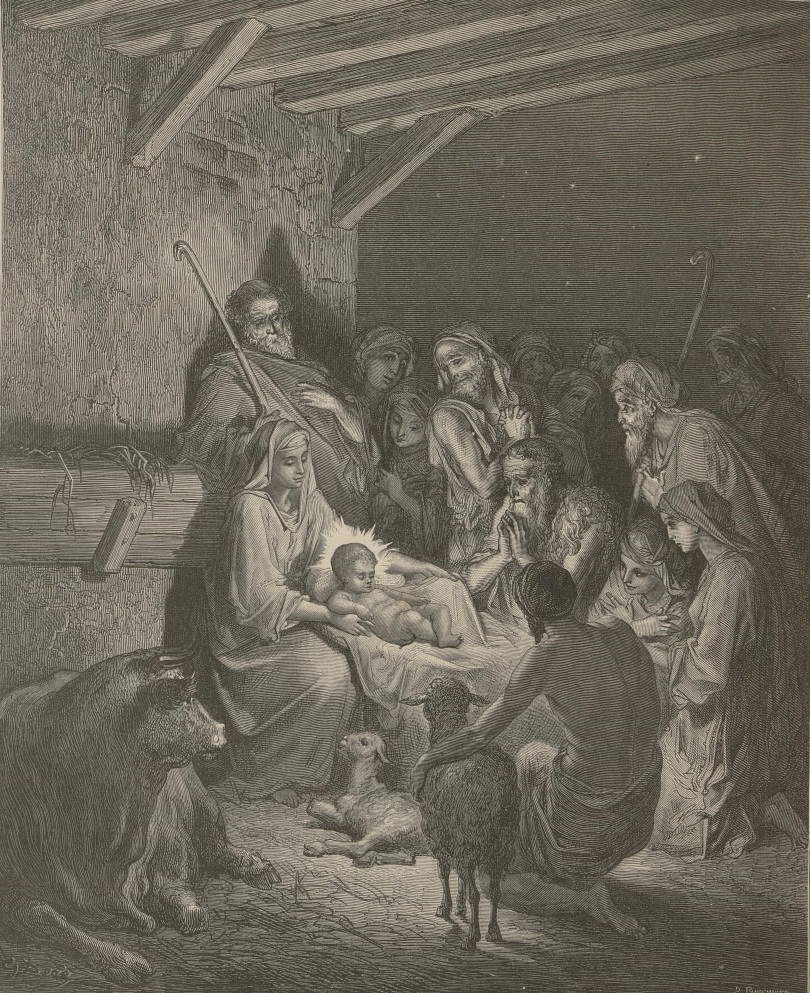
Away in a Manger

The political scene still strikes me as incredibly boring—a sad testament to how jaded our politics have become, that we don’t get more riled up about impeachment proceedings.  It’s also a testament to the perfidy and disingenuous of congressional Democrats:  everyone knows the articles of impeachment are a politically-motivated farce and, to use GEOTUS’s preferred name, a “witch hunt.”

It’s sad that President Trump will be impeached, and I’m nervous that squishy neocons and RINOs in the Senate will betray him.  That would be the ultimate kick in the teeth—the elites backhanding their own citizens for daring to challenge their aloof rule.  I shudder to contemplate the fall out should conviction and removal in the Senate occur.

Until then, it’s all a distracting media circus, with the Democrats and press engaged in a frenzied dance around the cannibal’s pot.  Even then, it manages to be incredibly dull.  At least actual cannibals have some conviction.

All that said, let’s look at more Christmas carols!  Next up:  “Away in a Manger.”

Read More »

A Little Derb’ll Do Ya: Haydn’s “Derbyshire Marches”

My Saturday morning ritual involves “sleeping in” until about 8:30 AM, brewing some coffee, and listening to Radio Derb, John Derbyshire’s weekly podcast for VDare.com.  Derb goes back for years—he used to write for National Review, before they kicked him out for writing “The Talk: Nonblack Version” for Taki’s Magazine.

I first found out about him and his controversial essay from NR, back when I was a devout print subscriber, amid the heady days when campus protests were novel enough to be terrifying.  NR ran a little blurb about Williams College cancelling a scheduled talk from Derb, and I’ve been listening to his podcast—an entertaining mix of news, science, political and cultural commentary, and updates on the president of Turkmenistan—ever since.

Read More »

Lazy Sunday XL: Christmas Carols

No, it’s not an “extra large” edition of Lazy Sunday, dear reader:  it’s the fortieth edition of this hallowed tradition.  That’s forty Sundays of thematic reflections, gazing back at the output of fifty weeks of consecutive daily posts.  Yep—today marks the 350th consecutive day of posts here at The Portly Politico.  We’re just fifteen days away from reaching the one-year mark.

Just as yesterday’s SubscribeStar Saturday post on “O Holy Night” (subscribe today for just $1 a month to read it and dozens of other pieces) should have come as no surprise to readers, this Lazy Sunday continues with that theme.  Indeed, we’re looking back at the posts this week (and from last December) about Christmas music:

  • ‘Silent Night’ turns 200” (and “TBT: ‘Silent Night’ turns 200“) – I wrote this post on Christmas 2018.  At the time, the world was celebrating the 200th anniversary of a sweet, simple Christmas carol, and one of my all-time favorites.
  • The Joy of Christmas Carols” – This piece is a reflection on the sheer joy of playing and singing Christmas carols.  Like traditional hymns, carols possess wonderful staying power, and they stick with you powerfully.  I’ve often caught myself singing “Joy to the World” (more below) in the middle of July.  They also beautifully and simply tell the story of Christ.
  • Joy to the World” – “Joy to the World” is somewhere in my Top 5 Favorite Christmas Carols (if such a list actually existed).  The Number One slot goes to our next entry, but “Joy” is up there, for sure.  In this post I analyze the simple but effective use of a descending D major scale to kick off the melody of a song that leaps and bounds across those eight notes, much like the soaring tones of the angels that appeared over Bethlehem that night some 2000 years ago.
  • SubscribeStar Saturday: O Holy Night” – I believe that, objectively, “O Holy Night” is the greatest Christmas song ever.  I used to say the “objectively” part as a joke—how can an opinion be objective reality?—but now I’ve come to believe it.  It’s powerful.  It’s operatic.  And for $1 a month, you can find out why.

That’s it!  We’re closing in on Christmas, rapidly.  Enjoy your Sunday, and Merry Christmas!

—TPP

Other Lazy Sunday Installments:

SubscribeStar Saturday: O Holy Night

Today’s post is a SubscribeStar Saturday exclusive.  To read the full post, subscribe to my SubscribeStar page for $1 a month or more.  For a full rundown of everything your subscription gets, click here.

The unofficial theme of the blog this week has been Christmas music.  What better way to cap off the week than with a post about the best Christmas song ever written, Adolphe Adam’s “O Holy Night“?

Like its cousin “Silent Night,” the story of “O Holy Night” involves a village’s church organ.  In 1843, the church organ of the French village of Roquemaure had recently been renovated, so the parish priest asked a local wine merchant and poet, Placide Cappeau, to write a poem to commemorate the occasion.  That poem, “Cantique de Noël,” would be set to music a short time later by composer and music critic Adolphe Adam—and Christmas history would be made.

To read the rest of this post, subscribe to my SubscribeStar page for $1 a month or more.

TBT: “Silent Night” turns 200

The Christmas season—and a pending Christmas concert—has seen me waxing melodic on the holiday’s wonderful music.  As such, today’s TBT is predictable (if anyone were interested in predicting such a thing):  it’s a look back at a short post about the 200th anniversary of the classic carolSilent Night.”

Like “Joy to the World,” “Silent Night” is one of my favorite carols.  It’s sweet and simple, but can also be rocked up (the 6/8 time signature and three-chord structure lend the tune to bluesy interpretations, and I’ll occasionally slide in some blue notes when playing the song instrumentally).

It looks like it won’t make it into our Christmas program this year—a rarity—but I’ll be sure to make room for it next year.  Its more operatic cousin, “O Holy Night,” will be our finale, though.  I’ve always linked the two tunes mentally because of their similar names and themes (and they’re both in 6/8).  “O Holy Night” really lends itself to a hard rock interpretation, as my annual “O Holy (To)Night” cover version attests.

Without further adieu, here is Christmas 2019’s “‘Silent Night’ turns 200” (now closing in on 201):

One of my favorite Christmas carols, “Silent Night,” turns 200 this Christmas season.

The carol was originally written as a poem in the aftermath of the Napoleonic Wars by a village priest, Joseph Mohr, in the village of Oberndorf, Austria, in 1816. Two years later, Mohr approached the town’s choirmaster and organist, Franz Xaver Gruber, to set the poem to music. Gruber agreed, and the carol enjoyed its first performance to a small congregation, which universally enjoyed its simple sweetness.

Since then, the humble hymn has spread far and wide, and is probably the most recognizable Christmas carol globally today. It’s been covered (likely) thousands of times; it’s certainly become a staple of my various Christmas performances.

This simple, sweet, powerful carol beautifully tells the story of Christ’s birth, as well as the import of that transformative moment in history, that point at which God became Flesh, and sent His Son to live among us.

As much as I enjoy classic hard rock and heavy metal, nothing can beat the tenderness of “Silent Night”—except the operatic majesty of “O, Holy Night,” objectively the best Christmas song ever written.

Merry Christmas, and thank God for sending us His Son, Jesus Christ.

Joy to the World

The musical mood continues here at The Portly Politico—as does the joy (check out my “Joy of” posts here, here, and here).  The Christmas season always lifts my spirits, and the boost from my piece on Milo and Romantic music has further buoyed them (if you’d like to elevate my mood to transcendent heights, consider purchasing some of my music).

With yesterday’s post on Christmas carols, I thought it might be interesting to look deeper into the most joyous of them all:  Isaac Watts‘s “Joy to the World.”

Read More »

The Joy of Christmas Carols

Christmas puts me in a musical mood. For one, I’m somewhat contractually-obligated to put on a Christmas concert, which will consume most of my free time this week, so I’d better embrace the Christmas spirit—or else. But it’s not hard to get excited about the iconic music of the season.

(Also, Milo Yiannopoulos—the actual Milo—shared my post about his views on Romantic music, which helped make it the most trafficked post of the year so far. That was incredibly gracious of him to do, and it’s further boosted my excitement for playing and writing about music.)

As I wrote in an earlier blog post on hymnals, I’ve gradually taken over piano playing at my little Free Will Baptist church. We sing many of the traditional hymns that were written and popularized in the nineteenth and twentieth centuries, as well as some earlier selections. Shape-note hymns are often hard to play, with big intervalic leaps in the melodies and surprisingly complex harmonies.

Take that melodic variety and harmonic complexity and multiply it by a factor of ten, and you’ve got Christmas carols.

Read More »

Cyber Monday Musings

Today’s post is a glorified sales pitch.  ‘Tis the season, after all.  If you want to get to the punchline, head over to my SubscribeStar page and subscribe for $1/month to unlock all of my SubscribeStar Saturday posts.  For $5/month, you get fresh doodles every Sunday, as well as other random bonuses.  The most recent $5 post included an MP3 of an original composition from Electrock Retrospective, Volume I: Dance Party.  More goodies to come!

Well, the glorious Thanksgiving Week is over.  The blog Didact’s Reach opened today’s post with the observation that this Monday is “doubly terrible”—after four or five days of heavy eating, sleeping, and shopping, nobody wants to be back at the grind.

This morning officially kicks off the busiest two weeks of the school year for yours portly:  a middle school drama production gets into tech rehearsals (and opens) this week, and our big, over-the-top Christmas concert is ten school days away—yikes!  That’s why I call Thanksgiving “the eye of the storm”—the brief calm before the craziness of December hits.  As the tech guy and music teacher at my little school, it’s an unusually busy season.  My online course hits their exam this week, too, so those grades are coming due.

But that’s all tedium that will get done one way or the other.  As for today, it’s Cyber Monday!

Read More »

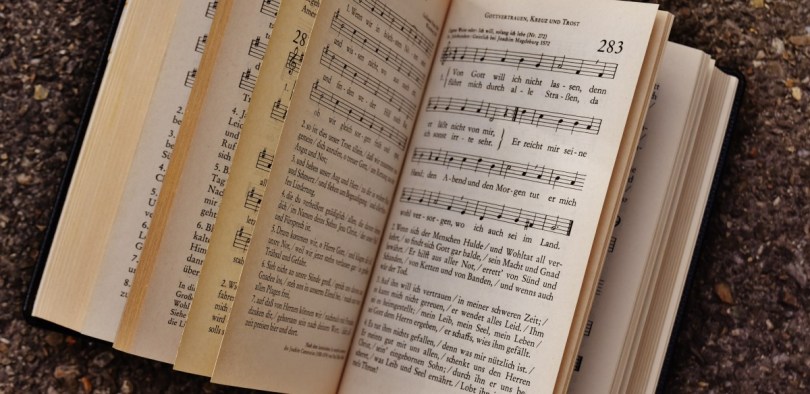
The Joy of Hymnals

I recently started playing piano for Wednesday night and some Sunday services at my little Free Will Baptist Church.  My church has about thirty or forty attendees on a good Sunday morning, so it’s slim pickings for pianists.

The little old lady who had been playing is very feeble, and she managed to miss more accidentals than a seventh-grade clarinet player due to her failing hearing and eyesight.  As such, she was eager to pass off the monkey’s paw of church piano playing to someone else.

As such, I’ve gradually improved my sightreading.  More importantly, I’ve enjoyed the opportunity to reacquaint myself with some wonderful old hymns—and to learn some for the first time.

Read More »