SubscribeStar Saturday: Washington, D.C. Trip Part II: Showdown at the Lincoln Memorial

Today’s post is a SubscribeStar Saturday exclusive.  To read the full post, subscribe to my SubscribeStar page for $1 a month or more.  For a full rundown of everything your subscription gets, click here.

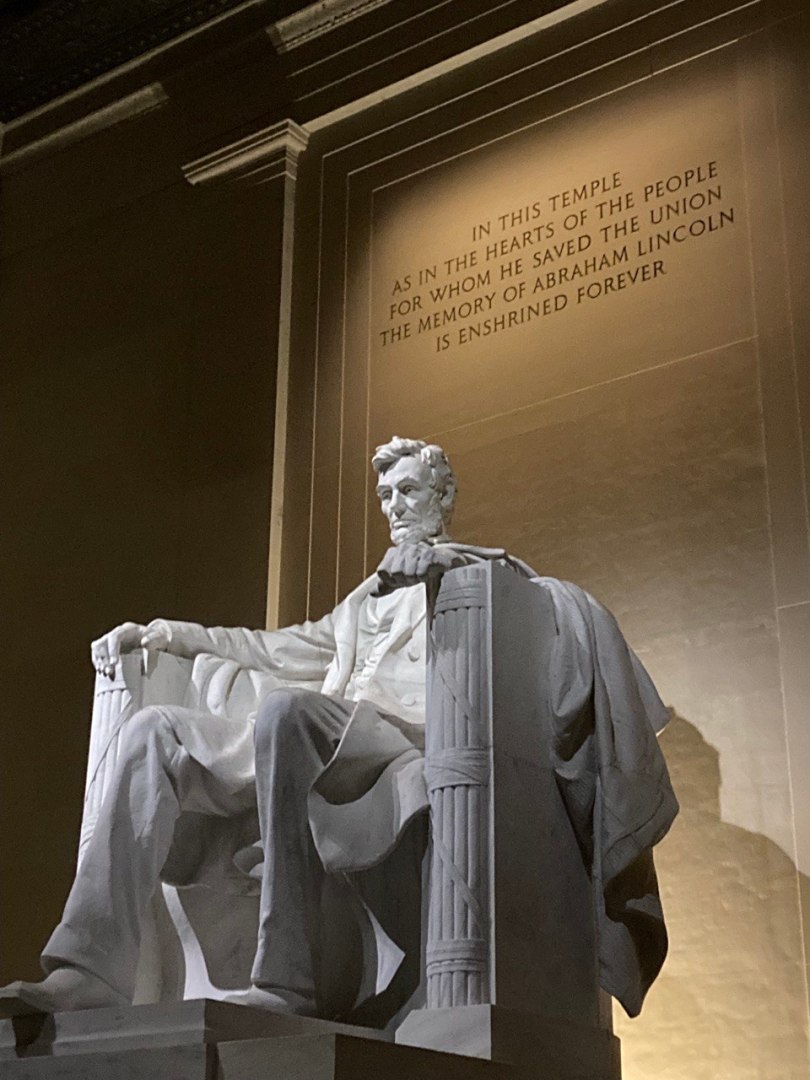
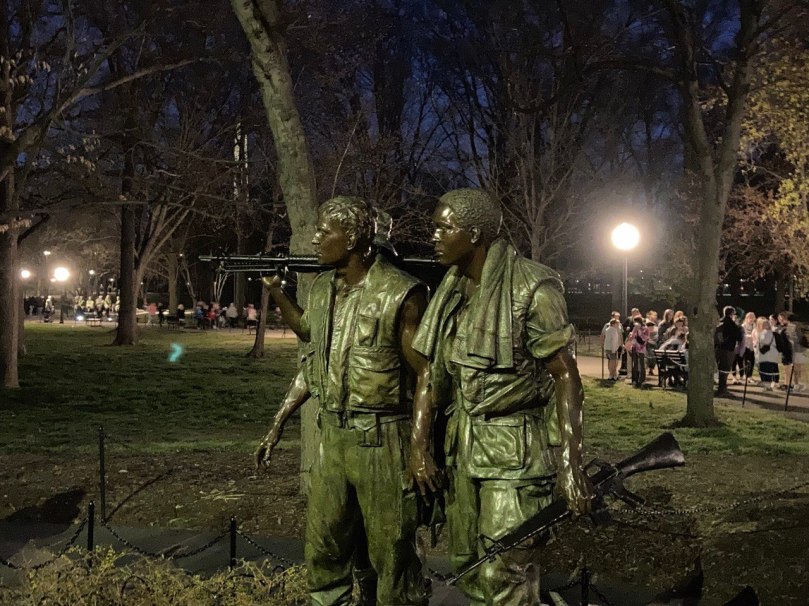
After a long bus ride and a whirlwind tour of two Smithsonians and the Spy Museum—and a hearty feast at Buca di Beppo—our merry band of wastrels and wine moms headed out on an evening tour of three memorials:  the Korean War Memorial, the Vietnam War Memorial, and the Lincoln Memorial.

I first visited the Korean War Memorial on a high school band trip, and found it to be particularly arresting.  The fuzzy images of soldiers crossing a battlefield have stuck with me ever since.  It’s a testament to the power of a good memorial not only to honor the dead, but to highlight the hardships and tribulations they endured.  The Korean War is the “forgotten war” of twentieth-century America, sandwiched as it was between the glory of the Second World War and the ignominy of the Vietnam War.

Korean War Memorial 1

Apparently, I failed to capture any pictures of the Korean War Memorial (the image above is an addition to the Vietnam War Memorial), likely because I was a.) in quite, reverent awe while passing through the memorial and b.) calling down knuckleheads who ought to know to treat these memorials as quasi-sacred places, memorials worthy of silent dignity and respect.

That apparent lack of understanding of and respect for those who gave their lives was a recurring theme of the evening, and one that would result in some frustration and consternation on the part of yours portly.

To read the rest of this post, subscribe to my SubscribeStar page for $1 a month or more.

TBT: Lincoln on Education

This week’s TBT feature was also in last Sunday’s “Lazy Sunday XXIV – Education.”  With the school year in full swing, it’s always enjoyable to look back at the benefits of education—a reminder of why getting education right is so important.

Abraham Lincoln was largely self-educated, and he was motivated, it seems, by both a desire to improve his condition in life, and by a genuine love of learning.  As an avid reader myself, I can related to the anecdote (relayed below) of young Abe walking around with “a book in his hand or in his pocket.”

This little piece was an “Historical Moment,” a monthly feature for the Florence County (SC) GOP’s public events.  If I recall correctly, the FCGOP Chairman skipped over my segment in the program (presumably by mistake, but perhaps to save time), so while I wrote this brief talk for the September 2018 meeting, I did not deliver it publicly until the October meeting (it was published on this blog in September).

I hope you’ll find this adaptation of my talk enjoyable.  Here is “Lincoln on Education“:

We’re gathered here tonight to hear from members of and candidates for School Board; in that spirit, I’d like to speak briefly about education, particularly the education of the first Republican President, Abraham Lincoln.

From what I’ve read, Lincoln’s entire formal education consisted of around a year of schooling.  He would have a week or two here and there throughout his childhood in Kentucky and Indiana, and then return to working on the family’s farm.

Despite little formal education, Lincoln taught himself throughout his life.  He loved to read, and would read deeply on a variety of subjects, obtaining books whenever and wherever he could.  One of his contemporaries commented that “I never saw Abe after he was twelve that he didn’t have a book in his hand or in his pocket. It didn’t seem natural to see a feller read like that.”  When he sat for the bar exam, he’d read law books on his own time to prepare.

Lincoln also believed in education as a source of patriotism, morality, and self-improvement—what we might call “upward mobility.”  He was not a man who wanted to stay on the farm, and his self-education was a means to escape poverty.

If you’ll indulge me, I’d like to quote Lincoln at length from his 1832 speech “To the People of Sangamo County”:

“Upon the subject of education, not presuming to dictate any plan or system respecting it, I can only say that I view it as the most important subject which we as a people can be engaged in. That every man may receive at least, a moderate education, and thereby be enabled to read the histories of his own and other countries, by which he may duly appreciate the value of our free institutions, appears to be an object of vital importance, even on this account alone, to say nothing of the advantages and satisfaction to be derived from all being able to read the scriptures and other works, both of a religious and moral nature, for themselves. For my part, I desire to see the time when education, and by its means, morality, sobriety, enterprise and industry, shall become much more general than at present, and should be gratified to have it in my power to contribute something to the advancement of any measure which might have a tendency to accelerate the happy period.”

Here we can see Lincoln’s belief that education lays the foundation for patriotism—we understand our freedoms better when we understood what they cost, and that others lack them.  We see, too, the power of education to teach us the virtuous and the good.  From that morality flows, as Lincoln said, “sobriety, enterprise, and industry,” the tripartite tools to improve our material conditions.

Patriotism, morality, and industry—these were the three benefits of education Lincoln espoused.  Coming from the man who wrote the Gettysburg Address, I think we should take Lincoln’s views on education seriously.

#MAGAWeek2019: President Trump’s Independence Day Speech

It’s #MAGAWeek2019 here at The Portly Politico.  Each day’s post will be a SubscribeStar exclusive.  For a subscription of $1/month, you gain exclusive to each day’s posts, as well as exclusive content every Saturday throughout the rest of the year.  Visit my SubscribeStar page for more details.

I was not planning on writing about President Trump’s incredible Independence Day speech as part of , mainly because I try to keep these posts historical.  The speech was so powerful, though, and so educational in a historical sense, it and President Trump have earned a spot (alongside the president’s favorite food) as part of my annual celebration of American greatness.

Read More »

Lazy Sunday II: Lincoln Posts

I’ve been out of town all weekend—thus yesterday’s very belated post—and it’s getting to the point in the academic year where all the craziness hits at once.  That being the case, I’m posting another one of these “compilation” reference posts to give you, my insatiable readers, the illusion of new content.  It’s like when a classic television show does a clip show episode:  you relive your favorite moments from the series (or, in this case, the arbitrary theming I foist upon you).

Today’s “Lazy Sunday” readings look back at my posts that pertain to President Abraham Lincoln, the Great Emancipator (read the first “Lazy Sunday” compilation).  I noticed that I’ve been writing more about Lincoln over the past week (perhaps my quiet homage to the recently-completed Black History Month?), so I decided to compile, in one place, all of my Abraham Lincoln posts (at least, the ones I could find on this blog).

Without further ado, here are The Portly Politico‘s Lincoln Posts (in chronological order):

  • TBT: Happy Birthday, America!” – a reblog from the old TPP site, this post largely lets Lincoln speak for himself, as it features a full transcript of the Gettysburg Address.  Always good for patriotic goosebumps.
  • Historical Moment – The Formation of the Republican Party” – this short post was adapted from a brief talk I gave to the Florence County Republican Party.  The purpose of the meeting, I recall, was to focus Republicans on who we are as a Party and what we believe, so I thought it would be useful to give a brief introduction to the formation of the GOP.  As the first Republican President (although not the first Republican presidential candidate—that honor goes to John Charles Fremont of California, who ran in 1856), Lincoln obviously exercised huge influence on the young party.
  • Lincoln on Education” – another “Historical Moment” adaptation (I’m all about recycling material), I was supposed to deliver this moment before a forum of candidates for the Florence School District 1 race in autumn 2018.  I was all set to deliver it, but the FCGOP Chairman (accidentally?) skipped over me in the agenda, so I saved it until the following month’s meeting (again, why let good copy go to waste?).
  • Lincoln’s Favorability” – here’s one of TWO posts from last week about Abraham Lincoln.  I’m going to give Lincoln a rest after tonight—he worked hard enough during the Civil War—but this piece looked at an interesting Rasmussen poll, that shows Lincoln is massively beloved by the American people.
  • Reblog: Lincoln and Civil Liberties” – this post is a reblog from Practically Historical, the blog of SheafferHistorianAZ.  Sheaffer—a fellow high school history teacher—wrote a post detailing how Lincoln’s suspension of the writ of habeus corpus was, indeed, constitutional.

Happy Sunday!

–TPP