#MAGAWeek2018 – Thomas Jefferson & The Declaration of Independence

Happy Independence Day, America!  242 years ago, the Second Continental Congress declared independence from Great Britain, changing the course of history and spawning independence movements all over the globe.

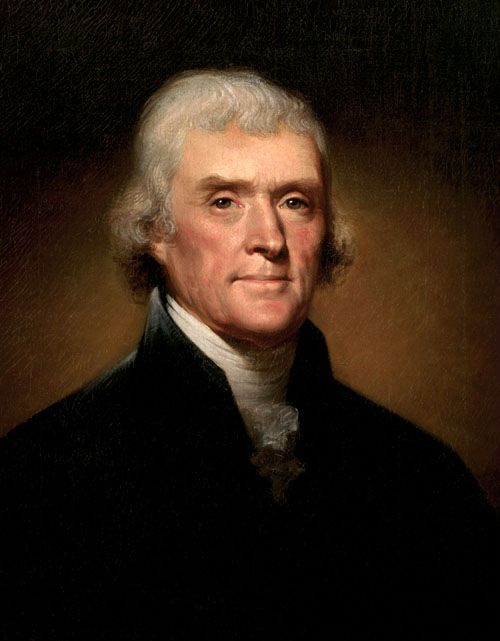
As such, it’s only fitting that today we look at the author of the Declaration of Independence, Thomas Jefferson.

Few figures in the period of the Early Republic have inspired as much debate as Jefferson, who clashed frequently with President Washington’s Secretary of Treasury, Alexander Hamilton, while serving as Secretary of State.  His friendship with John Adams turned into a bitter, acrimonious rivalry, as the two parted ways on the proper response to the French Revolution, then squared off against one another in the 1796 and 1800 presidential elections.  The two would make amends later in life, exchanging some of the liveliest, most insightful correspondence of the period.

After the publication of Thomas Paine’s revolutionary pamphlet “Common Sense” electrified pro-independence sentiment throughout the colonies, the Second Continental Congress put aside any hopes of reconciliation with Britain, and instead decided to declare independence.  To draft the document that would take the colonies across the Rubicon, the Congress selected Jefferson.

Jefferson wrote the Declaration with his fellow countrymen and other European nations in mind, although it was addressed to Parliament and King George III.  The Declaration is one of the most brilliant documents ever written, and its opening paragraphs are almost more important than the specific list of grievances against the English government.

Jefferson’s claim—radical at the time—that “all men are created equal”—shook the world, and its reverberations through history are well-documented.  There are, however, some other key phrases.  The phrase “When in the Course of human events” seems innocuous on the face, but carries an important meaning:  the “unalienable” rights are not unique to any one people, nation, or time in history, but are universal.  All peoples enjoy natural rights that are woven into the fabric of the universe—and which were “endowed by [our] Creator.”

Jefferson was likely a Deist, believing that a God created the universe, but afterward left it to work and unfold according to physical laws of nature.  Nevertheless, Jefferson believed—as did many of the Founders, who were often products of the Scottish Enlightenment (and, fortunately, not the more destructive French Enlightenment)—that the Creator imbued the physical universe with natural rights, just as He created gravity.

Regardless, after some revisions—the congressional committee that commissioned Jefferson had him change “Life, Liberty, and Property” to “Life, Liberty, and the pursuit of Happiness”—the Declaration was adopted as both a specific list of grievances detailing America’s case to “a candid world,” and as a timeless expression of America’s belief in natural rights.  The usual disclaimers apply—women and free blacks, not to mention slaves, were left out of this consideration at the time, despite objections from Abigail Adams, wife of our second president (and mother of yesterday’s subject)—but the Declaration paved the way for all Americans to enjoy greater liberty.

When time permits, I will dive into a deeper, lengthier discussion of Jefferson’s legacy; as it is, it’s taken me several hours just to write this much, as I’m fulfilling my avuncular duties of watching my niece and nephew.  For now, I will end on one final anecdote:

On 4 July 1826, Thomas Jefferson passed away—the fiftieth anniversary of the signing of the Declaration of Independence.  A few shorts hours, in what is likely the most serendipitous event in American history, an aged John Adams slipped away, too.  Moments before his passing, Adams said, “Thomas Jefferson still survives,” although Jefferson had passed just hours before.  An attendant by Adams’s side said that, at the moment of the great man’s death, a sudden thunderstorm whipped up, as if the artillery of Heaven were welcoming him home.

***

To read a full transcript of the Declaration of Independence, I recommend this version at Archives.gov:  https://www.archives.gov/founding-docs/declaration-transcript

Why the Hate for Space Force?

Ever since President Trump ordered the creation of Space Force earlier this week, I’ve read a lot of snarky Facebook posts and the like mocking the idea.

Some of these posts consist of the usual arm-chair analysis:  “Trump did it to distract from the child separation crisis!” and the like (if you look at the timing of the child separation crisis issue, though, it seems like something Democrats ginned up to distract from the IG report released last week).

Much of what I’m reading, though, consists essentially of, “Wow, what a stupid idea.  Like we need to have a military in space,” or the more bleeding-heart, “Why do we want to dominate space.  LOVE TRUMPS HATE!”  That latter one is usually followed up with a link to the Wikipedia entry for the Outer Space Treaty of 1967, as if some Gene Rodenberry-style, early Star Trek-esque treaty is going to keep the ChiComs from building a death laser on the moon (don’t laugh—the Chinese are just wily enough to do it).  I’m tired of people using the name of a meaningless treaty in lieu of an actual argument.

When did we stop dreaming?  What happened to that Gene Rodenberry-style, early Star Trek-esque drive for space exploration?  I realize much of this animosity toward the idea is knee-jerk partisanship:  bearded hipsters who probably still sleep in Star Wars pajamas hate Trump so much that they can’t get behind this amazing idea.  If Obama had ordered it, they’d be throwing craft beer tasting parties sponsored by Blue Moon.

But I also suspect that Americans aren’t dreaming big anymore.  I read a little bit by National Review‘s Charles C. W. Cooke some years ago in which he talked about how great his WiFi-enabled gadgets were, and he essentially argued that we needed to appreciate the future we have instead of the sci-fi rock opera vision of the future we want (R2-D2 playing the bass guitar, taking summer vacation on the moon, using lightsabers, etc.).

While I am incredibly thankful that I can find clips like the one above in mere seconds (even if it is in another language)—and to have vast storehouses of human knowledge mere keystrokes away—does that really mean that’s all there is?  Is it ungrateful to say, “Hey, this is incredible—how about even more cool innovations?”

Space is the final—and endless—frontier.  As such, it will be the next battleground of human conflict.  Instead of laughing at the idea of Space Force, let’s figure out how to make it an efficient, effective fighting force to ensure that liberty endures beyond the 21st century—and our pale, blue dot.

TBT: Created by Philosophy

On 10 June 2016, I posted this short piece on the idea—taken from the famous Margaret Thatcher quotation—that “America was created by philosophy.”  This post was part of an ongoing examination of American nationalism, which I believe is distinct from other forms of nationalism.  Over the past two years, I have grown more convinced that culture plays a key role in defining a national identity, but I still believe in the ideational notion of America, that one can adopt the ideas of America to become part of the national fabric.

In a future post, I will likely explore further the fracturing of that national fabric, as it seems there are increasingly two—and, perhaps, three—cultures competing with one another, making even everyday communication strained.  Conservatism and Progressivism represent two opposing worldviews that share almost entirely different philosophical and cosmological foundations.  Unchecked immigration, especially from the Third World, represents another potential cultural bloc.  Without time to assimilate—to be “baked into” America’s national culture and to absorb American ideals—that third group presents its own threat to national unity, and to the very concept of liberty itself.

***

Near the end of my last post, I included a quotation from the late British Prime Minister Margaret Thatcher.  To recap, it was her famous dictum that “Europe was created by history.  America was created by philosophy.”  What exactly does that mean, and why is it important?

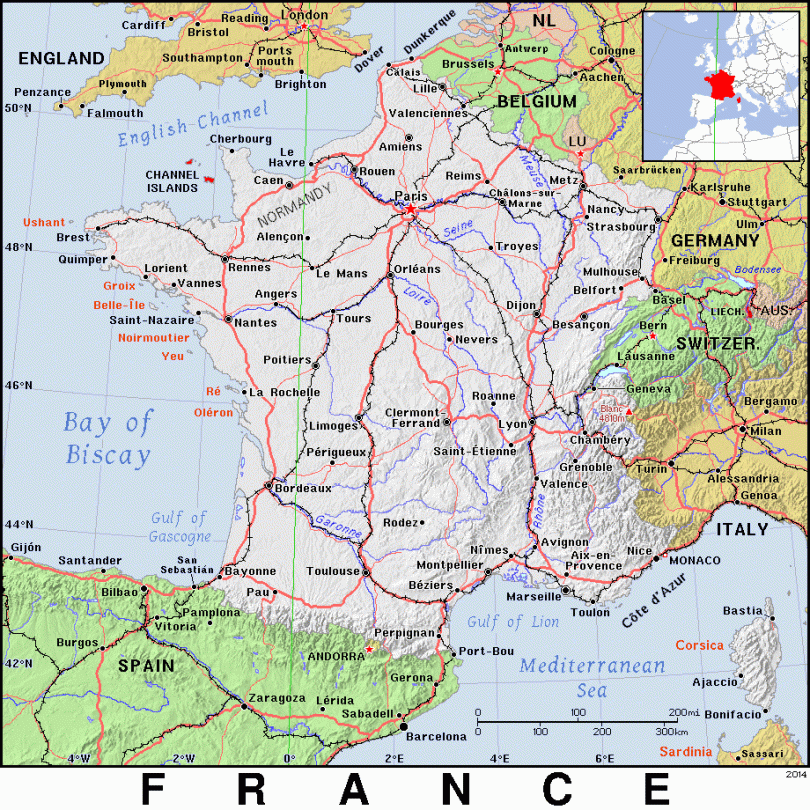
As I also pointed out in my last post, European nationality (and, by extension, the European nation-state) is built on notions of blood and soil.  In other words, being French means you are descended from a group of people broadly defined as “French” and you reside within the French “hexagon” (or at least claim that as your home).  Obviously, not every European nation-state still pursues this model–in some cases to their detriment–but some, like Italy, strenuously do.

 Now that is one sophisticated hexagon.

(Post-colonialism, being “French” includes many people outside of this geographic region, and now the French would more broadly define their nationality through shared language and culture–a model that moves closer to what I perceive to be the American model of nationalism).

In the United States–or, more specifically, in colonial British North America–Americans had a unique opportunity to define their national identity far more broadly.  Indeed, one could argue Americans did so out of necessity:  colonial British North America was a tapestry of cultures, languages, and ethnic groups.  Most hailed from the British Isles and Northern Europe, but the 18th century saw large influxes of Germanic and Scotch-Irish immigrants, not to mention the unfortunate forced immigration of the trans-Atlantic African slave trade.  Most were Protestant of various stripes–the German settlers in particular brought a rich and baffling array of spiritualism and religiosity to a young America–but Catholics and even a small number of Jews also made the trek to the colonies.

The massive Irish and German immigration brought by the Irish Potato Famine and the failed democratic revolutions of 1848, respectively, brought even more diversity to the land at that point known as the United States, and so-called “New Immigration” after the Civil War saw immigrants from Italy, Lithuania, Poland, Russia, Greece, and beyond.

By the time those “New Immigrants” began arriving in the 1870s until the tide was stemmed in the 1920s, the United States had already developed a model for nationality born of its colonial experience.  Indeed, the young United States proclaimed its nationality at the very moment it proclaimed its independence from Great Britain.

In writing the Declaration of Independence, Thomas Jefferson laid down the framework for what it means to be an American.  Jefferson, like all of the Founding Fathers, believed in the universal rights of men, rights derived not from any worldly, temporal authority, but from God Himself.  Every civics student is familiar with the ringing declaration that “We hold these truths to be self-evident, that all men are created equal, that they are endowed by their Creator with certain unalienable Rights, that among these are Life, Liberty and the pursuit of Happiness.”  Herein we see the roots of American values, birthed through the centuries by the tenacity of independent-minded Englishmen and bolstered by the more admirable claims of the Enlightenment.

However, many modern readers miss the first paragraph of the Declaration, which opens with the phrase “When in the Course of human events….”  This seemingly innocuous phrase holds within it deep wells of significance.  Jefferson here is saying that these ideals and rights are not specific to one place or one time.  The “human” here refers, rather, to all of humanity.  The phrase “in the Course of human events” refers to the timeless quality of these values–the self-evident truths of the Declaration apply yesterday, tomorrow, and forever–ad infinitum.

Thomas Jefferson, Babe Magnet

This simple phrase, then, goes a long way in explaining why the young United States was able to hold together in spite of its broad diversity of ethnic groups and religions, while the similarly diverse Austro-Hungarian Empire, which attempted to balance the interests of different ethnic groups by favoring some and oppressing others, ultimately collapsed.  The universal truths of the Declaration, espousing universal rights bestowed by the very Creator of the universe, give all men the opportunity to live their lives as they wish, confident in their liberty and free to pursue happiness and fulfillment as they please.

No doubt this philosophy of God-given liberty has bolstered the United States economically, allowing it become the richest, most prosperous nation on Earth–surely a carrot for future and continued immigration.  Ultimately, however, the most successful and fulfilled Americans, both native-born and immigrant, are those that come to embrace the core philosophy of the American experience.

A sad note in parting:  the increasing ignorance of these God-given rights, and the increasing balkanization of the American nationhood into favored classes and victim groups as a result of said ignorance, is undermining the universal vision of the Founders.  America today looks more and more like the Austro-Hungarian Empire of the early 20th-century:  decadent and splendid on the surface, but torn by internal turmoil and ethnic strife within.

To avoid a similar state, the United States must make a concerted effort to revive the Founders’ understanding of the American philosophy enshrined in the Declaration of Independence.

A Discourse on Disclaimers

Yesterday, I wrote about the current child separation policy—and the issue of illegal immigration more broadly.  I initially thought about approaching the topic with delicacy and tact, scaffolding my argument with ample disclaimers about sympathy for the situation of the children, etc. (and, in a flippant way, I did).

But the whole delicate, walking-on-eggshells, tightrope-walk performance of disclaimers is wearying, and I decided to go off half-Coultered instead.  We live in an age in which voicing any controversial (usually conservative) opinion requires pages of tedious disclaimers along the lines of “while I agree that [controversial topic here] is bad, I would argue [very narrow, logically-consistent exception to the badness of the controversial topic].”

This practice gets old fast.  To be an open conservative these days means enduring more litmus tests and grilling than a Supreme Court nominee—and that’s just to be able to function socially in mainstream society.

robert-bork
Robert Bork—one of my intellectual heroes

What does one get for one’s trouble?  Only a very few people take the time to appreciate subtlety of argument.  The Cultural Marxist, social justice warrior approach to any disagreement is to attack every position relentlessly on axiomatic grounds, rather than hearing out the opposing viewpoint in full and digesting it completely.

The effect is that to even make a controversial argument—no matter how balanced, well-researched, or logical—is to invite wholesale scorn and derision, up to and including expulsion from polite circles.  The true goal of this monolithic dismissal of anything outside of the fashionable-for-the-moment social justice “mainstream” is to silence critics and opposing viewpoints, hoping that the tedium and weariness will simply shut up dissent.

Sometimes, it works, and it worked for a very long time (until Donald Trump hit the scene).  Indeed, immediately after the 2016 presidential election, the tension of full-blown Trump Derangement Syndrome made it impossible to even engage in good-natured ribbing with Clinton supporters.  After eight years of spiking the football in cultural victory after cultural victory, the Left couldn’t take the shock of defeat in stride.

Post-Trump, however, some things have improved.  As Charles Norman wrote in an essay at Taki’s Magazine (“Trapped in the Closet,” 15 June 2018), “Courage is contagious.”  Once candidate Trump exposed the cracks in the Cult. Marx. framework, free speech began to get off life support.

In that essay, Norman quotes Paul Johnson; I’ll replicate that quotation here (emphasis Norman’s):

“…it’s good news that Donald Trump is doing so well in the American political primaries. He is vulgar, abusive, nasty, rude, boorish and outrageous. He is also saying what he thinks and, more important, teaching Americans how to think for themselves again.”

Trump was not the first to lead the way.  Polemicist Ann Coulter, philosopher Richard Weaver, commentator Ben Shapiro, Supreme Court nominee Robert Bork, National Review founder William F. Buckley, Jr., President Ronald Reagan—the list goes on and on.  Each laid a stone in the forgotten byway of liberty that brought us to where we are today.  Our Founding Father’s cut the path, especially with the First Amendment and its free-speech safeguards, which are virtually unique in the world.

***

To close, I’ll share a brief personal anecdote:  I remember being at some soiree not long ago, and was talking with a parent of some former students.  Somehow, the discussion turned to politics.  There’s always a brief moment in such situations that feels like you’re about to jump off a diving board, and you’re either going to land in water, or a lava-filled shark tank (don’t ask me how the sharks survive; that they do makes them all the more sinister).

I reluctantly-but-hopefully discussed the positive legacy of President Trump; I landed in a pool of soft marshmallow fluff.  He, too, was quietly enthusiastic, and we spent the next half-hour relishing having found a fellow traveler.  That’s what being a pro-Trump conservative—even in the rural South!—is like sometimes.  When you meet another one, it’s like encountering another human being on what you thought was a deserted island.

So, enough disclaimers.  Enough of this endless qualifying.  Let’s have real, gutsy conversations again.  Let’s say controversial things loudly, especially if they’re true.

In short, everybody lighten up!

European Disunion

Back in 2016, I wrote a series of essays on the then-approaching Brexit vote.  Just like the American presidential election that autumn, there was a great deal of misinformation and obfuscation about the “Leave” side—the Leavers were racist and xenophobic; voting “Leave” would cause the world to collapse and the Universe to fold in upon itself; boorish working-class Brits would rebel once they realized they’d lost their sweet European Union bennies.

Even I—a profoundly pro-Brexit advocate—predicted there’d be a long-term economic downturn as a result of voting “Leave” (but I believe liberty is worth far more than material security).

Of course, the Brexit vote was a major blow against supranational tyranny, and a major victory for liberty and national self-interest.  The European Union does not function like the United States and its federal system of semi-sovereign entities; rather, it’s largely ruled and governed by a small cadre of unelected, hyper-progressive, cosmopolitan bureaucrats with little regard for national differences or interests.

It was this philosophical and foundational tack that I sought to take with Brexit.  Brexit was not a policy matter that presented two sets of pros-and-cons, although that was part of the discussion.  Rather, Brexit posed a fundamental question:  does a nation have the right to determine its own national destiny—to act in its own self-interest, as it and its people see fit?  Further, did the European Union provide a framework in which nations could maintain sovereignty while enjoying the benefits of union?

I believe the Brexit vote—and the ongoing discussions about what Brexit will look like—reflected these timeless questions, and though the vote has long-since passed, the topic maintains a perennial quality for those interested in political philosophy.

To that end, I’ll be compiling, re-editing, and otherwise modifying my 2016 Brexit essays into a new eBook, Tyranny Denied:  Reflections on Brexit.  I’ll also be adding some chapters and historical notes.

That book, along with my long-planned eBook on social conservatism, Values Have Consequences, should appear later this summer or autumn—just in time for Christmas.