SubscribeStar Saturday: Prehistoric Exploration: Catan: Dawn of Humankind

Today’s post is a SubscribeStar Saturday exclusive.  To read the full post, subscribe to my SubscribeStar page for $1 a month or more.  For a full rundown of everything your subscription gets, click here.

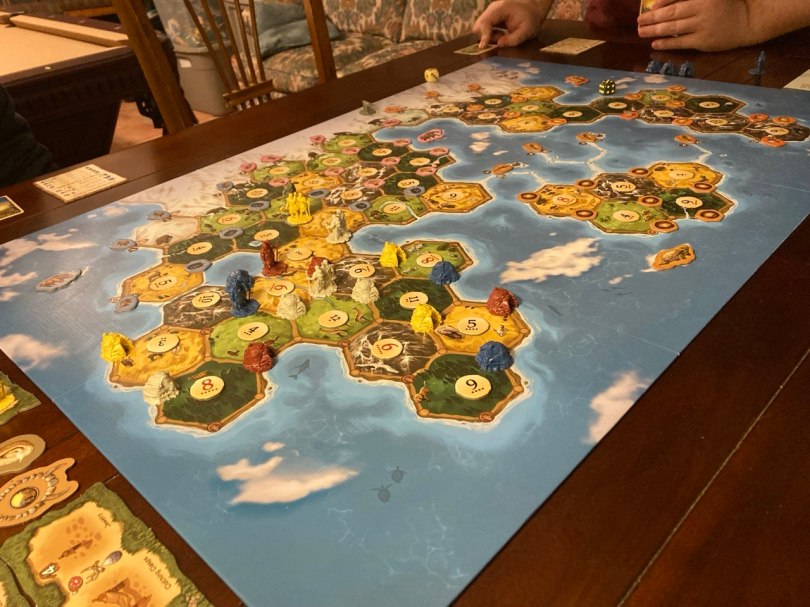
Last night yours portly had his raucous bachelor party, which consisted of eating pizza and play board games with my friends at my younger brother’s house.  The board gaming highlight of the evening was playing Catan: Dawn of Humankind (that’s an Amazon Affiliate link; I receive a portion of any purchases made through that link, at no additional cost to you), which my best man purchased as an early wedding gift.

The game can best be described as a blend of the early turns of any Civilization game and Settlers of Catan (more affiliate links), the classic Klaus Teuber game.  The map takes place on Earth, with all players starting with camps and explorers (imagine a blend of the scout and settler in Civ) in Africa.  Players are encouraged via various game mechanics to migrate out of Africa and to explore and populate the rest of the world.

Like classic Catan, the goal is to reach ten victory points.  These points achieved through various means—cultural and scientific development; exploration; and settlement outside of Africa.  Like Catan, players gather four different resources, re-themed to fit the prehistoric setting, by rolling two six-sided dice.  Players may trade these resources or cash triplicates into the bank in exchange for a single resource of another type.

There are some key differences, however:  while Dawn of Humankind is built on the Catan system, it is geared towards exploration and research.  Settlement is a key component of the game, but it’s done by sending out explorers.  Some areas of the map are blocked off by certain research requirements; for example, reaching Australia requires substantial investments into construction (for boats, presumably) and clothing.  Going towards the Arctic requires high clothing investments.  Investing in exploration lets explorers move more quickly, and investing in hunting allows players to move the Neanderthal in Eurasia and the Smilodon (saber-toothed tiger) in the Americas and Australia (these tokens act as the equivalent to the thief in classic Catan.

To read the rest of this post, subscribe to my SubscribeStar page for $1 a month or more.

TBT^16: SimEarth

The big news in the gaming world right now is the incredible The Elder Scrolls IV: Oblivion Remastered.  It came as a total shock to the gaming world (yeah, there were rumors swirling that it was in the works, but no one knew it was coming so soon), and managed to update the game’s graphics and fix some bugs while also maintaining the legendary “jank” for which the game is so fondly remembered.

Yours portly has not yet taken the dive back into Cyrodiil (although, goodness, I am desperate to do so), but I am looking forward to the rapidly-approaching summer for a chance to dig into some classic games.  It’s been so long since I’ve really been able to sit down and lose myself for hours into a good game.  I haven’t even been able to touch Civilization VII in almost two months!

Gaming always comes to my mind during the hot, lazy days of summer, when it’s so unbearable outside, I l basically live like my home is a life support pod on Venus, only venturing out when absolutely necessary.  So it was that I booted up old SimEarth some years ago, and took a rose-tinted, nostalgia-fueled walk back to my past, when I first played a copy of the game my Indian friend copied onto a 3.5″ floppy disk for me.  Those were the days!

With that, join me on this extended walk through the past; here is 16 May 2024’s “TBT^4: SimEarth“:

Read More »

TBT^4: SimEarth

May.  It’s the superfluous final month of school.  There’s not enough time to cover any new content, but too much time to launch right into exam review.  The result:  an odd limbo in which neither students or teachers wish to dwell.  It’s the time of year when everyone is in on the game of modern education—we’d all be better off doing and being somewhere else, but we’re still going through the rituals of an industrial-era factory.

Naturally, with summer looming, I’m getting the itch to do some gaming again.  Since finishing Disco Elysium a few weeks ago, I have not played any game deeply.  I did purchase Planescape: Torment, the spiritual ancestor of DE, but only managed to get in about an hour of playtime.  One of my students asked me earlier this week about Stardew Valley, which I played religiously for about two weeks in probably 2013.  That’s a modern classic I want to dust off soon.

As for the ostensible subject of this post, my forays into SimEarth have been nonexistent since those halcyon days of May 2020, when America’s love affair with The Virus was in full swing.  Being cooped up in the house got me nostalgic for the classics, but I need to revisit the planet simulator soon.

Big plans for the summer.  If I play all these games as planned, my eyeballs might fall out.

With that, here is 11 May 2023’s “TBT^2: SimEarth“:

Read More »

Ponty Praises: Ghost of Tsushima (2020)

Yours portly has been giving Ponty a bit of ribbing about writing his rebuttal to my Caldecott Award-winning review of Donnie Darko (1999).  Please know, dear readers (and dear Ponty) that it’s all a spot of fun; I know Ponty is a busy man.

Indeed, he’s been busy replaying 2020’s Ghost of Tsushima, a samurai action-adventure epic.  Just reading through his review, I was blown away by two things:  how realistic the trees in the game look (you’ll see what I mean below) and the love and dedication with which Ponty approaches his reviews.  Game journalism might be rigged in the mainstream publications, but not here at The Portly Politico.  With Ponty’s in-depth analysis, you’re getting the best video game reviewing and analysis of our time.

That might sound like hyperbole, but TPP is blessed to host some great writers.  Ponty’s video game and film reviews always deliver.  In this case, I’m eager to pick up and try Ghost of Tsushima myself… but I don’t have a PS4 or PS5!  Here’s hoping for a port to the Nintendo Switch or the PC.

In the meantime, I can live vicariously through Ponty’s thirteenth-century samurai escapades—and so can you!

With that, here is Ponty’s review of 2020’s Ghost of Tsushima:

Read More »

Zelda Game & Watch

A few weeks ago I ordered a treat for myself:  the Nintendo Game & Watch: Legend of Zelda.  It’s a nifty little device, based on the old Nintendo Game & Watch LCD handheld games.  Nintendo revived the concept with handhelds themed around Super Mario Bros. and The Legend of Zelda.

The units usually retail for $50, but Amazon had this unit on sale for $42.50 (now it’s around $45, I believe).  Amazon was also offering $10 off any order to try their location pickup and locker service, and I used some credit card rewards to whittle the final price down to $25 out-of-pocket for yours portly.

I then promptly forgot about it until nearly a week after it had shipped to the store for pickup.  I realized that I was too late, but hoped the pharmacy pickup location had not returned it.  I managed to rush over there between lessons one afternoon, and was thrilled to find my purchase still in their storage:

Zelda Game and Watch Packaging

This little unit is packed with goodies:  The Legend of ZeldaZelda II: The Adventure of Link; and The Legend of Zelda: Link’s Awakening.  There’s also an old-school Game & Watch-style game featuring Link, and a full-color clock that emits a quiet electronic “tick” every second, and features Link scurrying around Hyrule, slaying monsters.

Those three Zelda games are my favorites.  I still remember getting Zelda II: The Adventure of Link one year for my birthday, and my mom telling me to go ahead and play it before my younger brother woke up, because he would demand the controller (some things never change). The Legend of Zelda: Link’s Awakening was one of my favorite Game Boy titles.

I’m also a huge Zelda fan, and always have been.  The series and its focus on exploration, action, and puzzle-solving have always drawn me in, and I used to design my own maps and monsters as a kid.  The music has also always been inspiring, and I even arranged the iconic theme song for my old group, Brass to the Future:

I finally cracked the unit open last week, and pretty much lost all of my free time to playing The Legend of Zelda.  I realized I had never beaten the game before, so after nearly thirty-five years (the game reached the United States in 1987, and I think we got our Nintendo Entertainment System Christmas of 1988), I decided to sit down and finally defeat Ganon.

Read More »

TBT: SimEarth

I’ve been on a video game kick lately, diving back into the Civilization games and listening to a lot of the Gaming Historian on YouTube.  As such, it seemed like a good time to look back at another video game post, one about the planet simulator SimEarth.

SimEarth was one of those games that I found instantly appealing—a massive simulator of an entire planet, going through all its geological, biological, and civilizational phases.  Even growing up in a household that rejected the theory of Darwinian evolution (a theory I still don’t accept, although I acknowledge that adaptation and mutation are both possible and happen frequently), the prevailing scientific understanding of our world made for a fun video game.

The possibilities were endless.  Want to be a Deistic god and let the world run on its own?  Go for it.  Want to interfere frequently in your planet’s development?  Do it!  Want to make starfish or Venus fly traps sentient beings capable of forging an advanced civilization?  Why not!

I used to be able to make pretty compelling planets in this game, with rich histories and multiple species in succession rising to sentience, before heading off an intergalactic journey of the stars.  Apparently, I lost any skills I had, as my last game a couple of years ago (detailed below) ended in nuclear winter.  Oops.

With that, here is 27 May 2020’s “SimEarth“:

Read More »

Game Review: Sid Meier’s Civilization Revolution

Last week I took some time to play a few games, notably The Elder Scrolls III: Morrowind.  Once my niece and nephews arrived, though, I didn’t have time for much else (although we built some cool planes and helicopters with a big bin of LEGOs).  They love Uncle Portly’s “devices”—my Nintendo Switch Lite (the “big device”), Nintendo 3DS XL (the “medium-sized device”), and Nintendo DS Lite (the “small device”).  My older nephew will spend hours building levels in Mario Maker 2 if left to his own devices.  My niece usually ends up with the “medium-sized device,” leaving my littlest nephew to play whatever I happen to have that will run on the DS Lite.

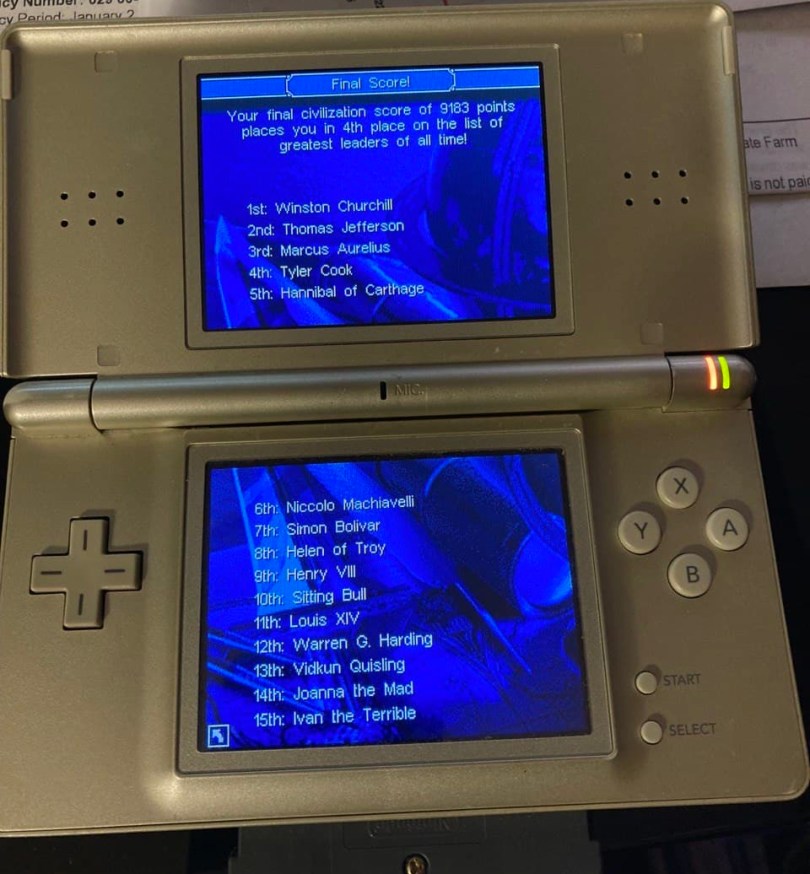
In digging around for games a two-year old could grasp, I found my old copy of 2008’s Sid Meier’s Civilization Revolution.  It’s an interesting, almost “abridged” version of the full Civilization experience—what would now be a cellphone app.  The game contains the major elements of a Civilization game from the Civilization IV era, and the game bears the stamp of many of that iteration’s innovations (as well as one of the major contributions from Civilization III, culture borders).

Naturally, my nephew wasn’t going to be playing that, but I popped it in one evening after the kids went to bed and found the game highly entertaining.

Read More »

Dorfromantik

Now that I’m enjoying the unending freedom of summer vacation, I’ve finally taken some time to play video games.  I splurged a bit last week and picked up a casual little indie game called Dorfromantik, from the four-man German development team Toukana Interactive.  I caught the game on a 20% off sale, but full freight is $10, so it’s an easy lift.  The game is still in early access, meaning that it’s technically not finished, but from my time playing it, it seems very solid, stable, and complete.

It’s also incredibly fun.

Read More »

SimEarth

Yesterday I wrote about SimRefinery, the oil refinery software lost to time (I’m praying it’s sitting on a long-forgotten floppy disk somewhere).  What I didn’t tell you was that I had succumbed to a mild but annoying stomach virus, so I was essentially useless for the rest of the day.

Of course, what better way to spend one’s time when sick than with video games?  After writing about SimEarth and doing some nostalgic reading about the world-building simulator, I tracked down a playable DOS version.  A helpful commenter also linked to the game’s 200-plus-page manual, which is necessary for accessing the game.  Anyone familiar with 1990s-era computer technology will recall that, in order to prevent piracy, games would often ask users to look up some piece of information buried in the manual, the theory being that if you owned the game legally, you’d have the manual.

During this sickly walk down memory lane, I realized how much I had forgotten about SimEarth.  The game is more complicated than I remember.  It’s not that deep, but what makes it difficult is balancing all the different inputs to your planet—the amount of sunlight, how much of that sunlight is reflected by the clouds and the surface, how much cloud cover to have, how quickly animals mutate and reproduce, how frequently meteors strike the surface, etc., etc.

Read More »

SimEverything

Summer Break is approaching, which means unstructured time, our most precious resource.  I plan on using that time to work on some long-delayed eBooks—including one on Christmas carols—and to teach my History of Conservative Thought course.  I’m also hoping to rebuild my music lesson empire after The Virus sacked the imperial capital.  There will also be lot of family time built in.

In addition to all of those wholesome and productive activities, there is also the siren song of video games.  Video games can become a major time sink (I’m learning that with Stellaris), but they’re a good way to unwind, and require a bit more focus and decision-making than passively consuming television.

One of the major video games meta-series of my youth were the various Sim games from Maxis—SimCitySimEarthSimAnt, etc. (I had a particular fondness for the scope and breadth of SimEarth, which I obtained on a bootlegged 3.5″ floppy disk from my buddy Arun in high school, back before I knew about or respected intellectual property rights).  The sandbox style in play, which encouraged experimentation and open-ended decision-making, really made those Maxis games fun (not unlike Minecraft, which also encourages exploration and free play).

So it was with great interest—and a heavy dose of nostalgia—that I read “When SimCity got serious:  the story of Maxis Business Simulations and SimRefinery” on The Obscuritory, a website dedicated to exploring games lost, forgotten, and never played.

Read More »